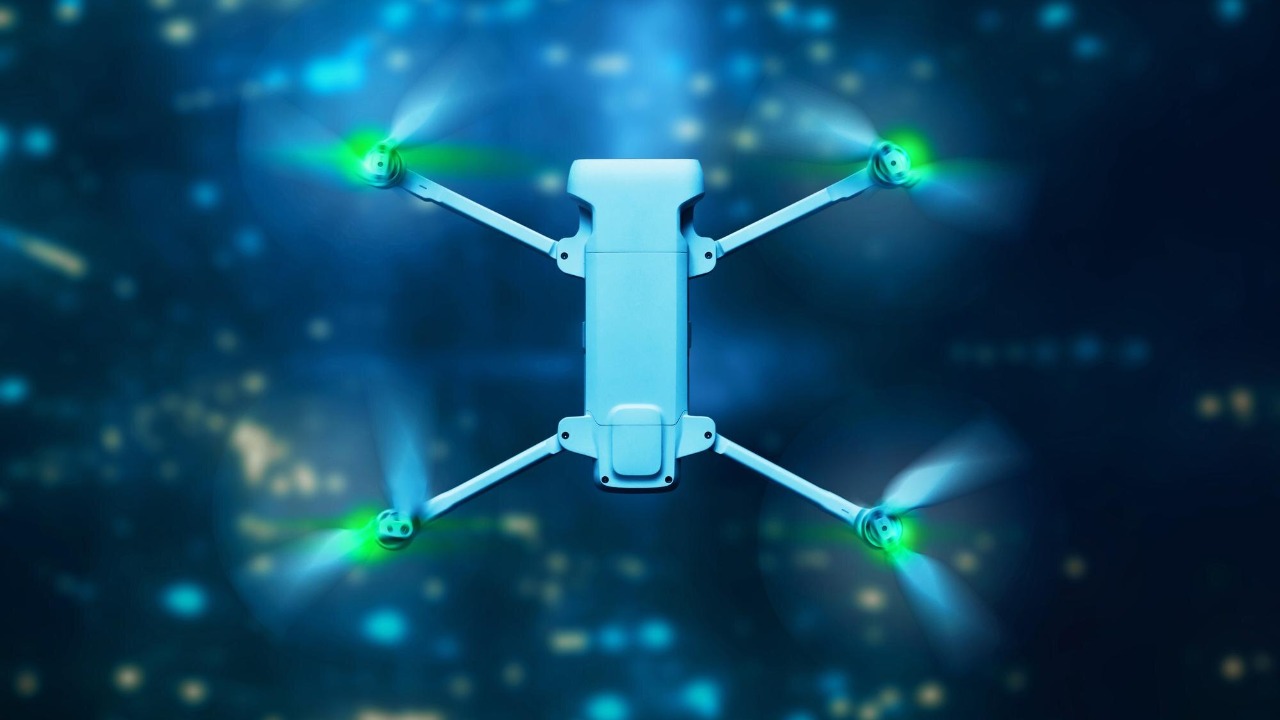

Engineers are closing in on a communications breakthrough that lets drones and robots keep talking even when conventional radio links fail. Instead of blasting stronger signals through rubble, mountains, or jamming, researchers are turning to quantum entanglement to share information in places that usually show “signal lost” on a controller screen. The result is a new kind of link that treats connectivity as a physics problem rather than a networking one, with potentially sweeping consequences for disaster zones and battlefields alike.
How a “signal lost” problem became a quantum opportunity
Modern drones are only as useful as the connections that steer them, and those links are fragile in exactly the places where autonomous systems are most needed. Thick concrete, underground tunnels, dense forests, and electronic interference can all sever radio and GPS, leaving quadcopters and ground robots blind at the worst possible moment. That vulnerability has pushed researchers to look beyond classical radio, not just for stronger signals, but for a fundamentally different way to coordinate machines when the usual channels go dark.
In that search, quantum entanglement has shifted from a theoretical curiosity into a practical tool for resilient communication. A recent experiment described a new quantum method that lets drones and robots coordinate even in areas that would normally register as “signal lost,” by using entangled particles to correlate their actions instead of exchanging conventional messages. The work, involving teams identified as Dec, New, and Quantum, frames entanglement not just as a way to secure data, but as a way to sidestep the need for a continuous radio channel altogether.
What quantum entanglement actually changes for communication
Quantum entanglement links particles so that measurements on one are correlated with measurements on another, no matter how far apart they are. In practice, that means two devices can share a set of outcomes that are perfectly synchronized, even if they cannot send a normal signal between them at that moment. The key is not faster-than-light messaging, which remains impossible, but pre-sharing entangled states that later act as a shared reference for encryption, coordination, or decision making when classical links are unreliable.
Researchers working under the banner of Dec and Quantum have argued that this property opens the door to secure communication channels that do not depend on the same infrastructure as classical networks. In their view, quantum entanglement offers a range of potential applications, from tamper-proof encryption to coordination schemes that classical computing cannot match. For drones, that means a mission can be seeded with entangled resources before takeoff, then draw on those correlations to authenticate commands or share keys even when radio conditions deteriorate.
From lab setups to hovering drones named Alice and Bob
The leap from blackboard physics to flying hardware has already begun, with early demonstrations showing that entanglement can survive the vibrations and instability of real drones. One experiment used two ground stations, nicknamed alice and bob, with two hovering drones acting as airborne relays between them. The setup showed that entangled photons could be distributed through moving platforms, hinting at a future in which fleets of quadcopters form part of a quantum internet that overlays the classical one.
In a related test, an entangled photon pair was generated on the ground, then one photon was sent to a second drone while the other remained at a ground station known as Alice. The second drone acted as a flying node, helping to share secure messages between the airborne platform and the ground by exploiting the correlations in the entangled pair. The experiment, detailed in a report on quantum-entangled drones, showed that even relatively small aircraft can carry the optics needed to handle entangled states without destroying their delicate quantum properties.
Another group used two hovering drones between the ground stations named alice and bob to demonstrate how mobile platforms can help build a quantum network in the sky. In that trial, one drone created a quantum link with alice while the other connected to bob, and together they formed a bridge that could, in principle, be extended into a larger web of entangled nodes. The project, described as two hovering drones that demonstrate the quantum internet, underscored how aerial vehicles can help researchers test and refine the protocols that will eventually underpin quantum links in more demanding environments.
China’s quantum encryption flights and the Micius precedent
While small-scale tests have validated the basic physics on drones, larger national programs have pushed quantum communication into more ambitious territory. China has been particularly aggressive, using both satellites and unmanned aircraft to explore how entanglement and quantum key distribution behave over long distances and in motion. These efforts are not just scientific milestones, they are also strategic experiments in how to secure communications in an era of pervasive cyber threats and electronic warfare.
One Chinese team reported what it described as the world’s first quantum encryption experiment using drones as mobile platforms. The project showed that unmanned aircraft could carry out practical quantum tasks that require precise alignment and timing, and that they could be integrated into a broader network rather than operating as isolated nodes. According to the researchers, the trial demonstrated that mobile platforms like drones are capable of supporting quantum encryption as part of a network, a result that strengthens the case for using unmanned systems as flexible quantum relays.
China has also leveraged space assets to stretch quantum links across continents. Its Micius satellite, launched in 2016, enabled quantum key distribution between China and South Africa, proving that entangled photons can be shared over thousands of kilometers through space and atmosphere. A recent report on quantum satellite communication noted that Micius helped establish secure links between ground stations separated by vast distances, a feat once considered impossible. That Earth-to-space success provides a template for how future drone fleets might plug into orbital quantum infrastructure, turning individual aircraft into nodes in a global entangled network.
Disaster relief: when quantum links become life support
The most compelling use cases for quantum-enabled drones may not be in routine logistics or photography, but in the chaotic hours after a disaster. Earthquakes, hurricanes, and urban explosions often shred the very networks that responders rely on, leaving search teams to work with patchy radios and improvised relays. In those conditions, any technology that can restore secure, reliable coordination without depending on intact cell towers or fiber lines becomes more than a convenience, it becomes a form of life support.
Researchers associated with Dec and Quantum have argued that entanglement could underpin exactly that kind of resilient backbone. Their work on disaster relief applications highlights how quantum links can provide secure communication without relying on the same infrastructure that classical networks need, and how quantum computing techniques can help optimize resource allocation in chaotic environments. In a scenario where drones and ground robots are searching collapsed buildings, pre-distributed entangled keys could let them authenticate commands and share sensitive data even if adversaries are trying to jam or spoof their radios.
From Geneva investors to battlefield ISR: SEALSQ’s bet
Quantum communication is not just a research topic, it is also becoming a commercial and strategic priority for companies that build secure hardware. In Geneva, Switzerland, SEALSQ Corp has positioned itself as a bridge between quantum research and real-world drone deployments. The company, listed on NASDAQ under the ticker LAES, focuses on semiconductors, post-quantum technology, and cybersecurity, and has explicitly targeted unmanned aerial vehicles as a growth market.
SEALSQ has announced plans to bring quantum technology to drone and UAV markets, with an emphasis on Intelligence, Surveillance and Reconnaissance missions that demand both security and resilience. In its description of that strategy, the company highlighted how its secure elements and cryptographic modules could be adapted to support quantum-safe protocols and, eventually, direct quantum links. The initiative, detailed in a release from SEALSQ Corp in Geneva, Switzerland, underscores how defense and security markets are likely to be early adopters of quantum-enabled drones, both to protect their own communications and to stay ahead of adversaries who might deploy similar tools.
How the new quantum link actually keeps drones talking
At the heart of the latest experiments is a shift in how communication is defined. Instead of treating a message as a stream of bits that must be pushed through a noisy channel in real time, the new quantum link treats coordination as a combination of pre-shared quantum states and minimal classical updates. Before a mission, drones and ground stations share entangled particles and establish a library of correlated outcomes that can later be used as one-time pads or decision tables. When radio conditions deteriorate, the system can fall back on those pre-arranged correlations, reducing the amount of live data that needs to traverse a compromised channel.
The Dec, New, and Quantum teams behind the recent “signal lost” breakthrough describe a method in which entanglement effectively replaces some of the messages that would otherwise have to be transmitted. In their setup, drones and robots can maintain synchronized behavior and secure key updates even when classical signals are intermittent, because the heavy lifting was done when the entangled states were first distributed. The approach, outlined in the report on a new quantum method for drones and robots, reframes connectivity as a resource that can be front-loaded and stored, rather than something that must be constantly maintained through vulnerable radio links.
Limits, myths, and what still needs to be solved
For all the excitement around entangled drones, it is important to be clear about what quantum links do not provide. They do not allow faster-than-light messaging, and they do not magically create communication where no classical channel exists at all. Every practical quantum protocol still needs some classical signaling, whether to coordinate measurements, confirm receipt of keys, or handle control commands that cannot be pre-encoded. The advantage is that those classical messages can be shorter, more robust, and protected by quantum-derived keys that reveal any attempt at eavesdropping.
There are also hard engineering problems that stand between today’s demonstrations and tomorrow’s operational fleets. Maintaining entanglement on vibrating, battery-limited drones requires rugged optics and precise alignment, and scaling from a pair of aircraft to dozens or hundreds will demand new routing and error correction schemes. The experiments with alice and bob, the Chinese quantum encryption flights, and the Micius satellite link between China and South Africa all show that the physics works, but they also highlight how much infrastructure is needed to support it. Until compact, affordable quantum hardware becomes standard on commercial drones, the most advanced quantum links are likely to remain in the hands of research labs, militaries, and specialized companies like SEALSQ Corp that can justify the cost for high-stakes missions.
More from MorningOverview