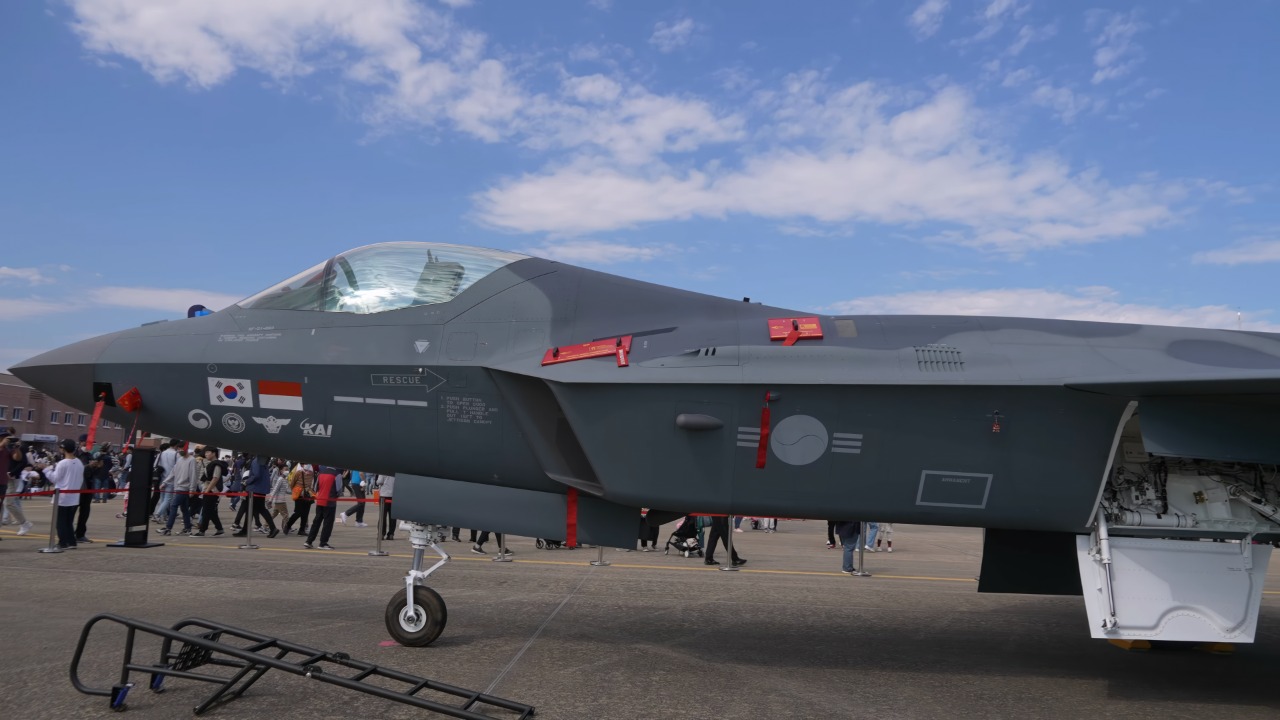

The KF-21 Boramae is South Korea’s bid to field a homegrown stealthy fighter that can undercut the F-35 on price while still threatening its dominance in export markets. It blends 4.5-generation design choices with a phased path toward deeper stealth, aiming to give air forces a modern combat jet without the full cost and complexity of a fifth-generation program. The result is a “budget stealth” platform that is already entering mass production and forcing buyers to rethink what capability they really need.
From national project to mass-production reality
South Korea framed the KF-21 as a strategic leap, a way to move from licensed production to a front-line fighter designed largely at home. The aircraft, known as Boramae, is being built by KAI (Korea Aerospace Indu) as an indigenous 4.5-generation platform that deliberately trades some extreme stealth features for affordability and easier maintenance, a balance that has led some analysts to describe it as a “budget stealth” jet that still aspires to compete with the F-35 on capability. That positioning is central to arguments that, dollar for dollar, the KF-21 may offer one of the most attractive performance packages on the market, a claim often tied to its characterization as a 4.5-generation design.
The program has now moved beyond prototypes into serial production, which is where the budget-versus-capability equation becomes real for export customers. Earlier this year, reporting on an Exclusive look at the line described how South Korea KF-21 Boramae Fighter Jet Enters Mass Production to Rival International Fifth Gen Competitors, underscoring that Seoul is not just chasing self-sufficiency but also a larger share of the global fighter market. That shift toward defense export competitiveness is what turns the KF-21 from a national prestige project into a direct commercial and strategic challenger to the F-35.
Design choices: stealthy enough, but not a pure fifth-gen clone
At the heart of the KF-21 story is a deliberate design compromise. The jet borrows the broad layout and radar-reducing shaping associated with fifth-generation aircraft, yet it stops short of the full internal weapons carriage and extreme low-observable treatments that define the F-35. Analysts describe it as a twin-engine aircraft whose configuration gives it solid performance and survivability but still leaves it short of a “true fifth-generation jet,” a judgment that appears in assessments that label the KF-21 Boramae Fighter Is an Inferior Version of the F-35 in pure stealth terms.
That critique is central to understanding how the aircraft is positioned. The KF-21 is meant to be stealthy enough for contested environments but not so optimized that it becomes unaffordable or overly complex to maintain. Its radar cross-section is reduced compared with legacy fighters, yet the decision to rely initially on external weapons carriage reflects a conscious trade between signature management and payload flexibility. This approach is echoed in commentary that calls the jet a Cheap Stealth Fighter Breaking All the Rules, suggesting that South Korean engineers have tried to sidestep the cost spiral that has dogged more ambitious fifth-generation programs defined by the F-35.
Performance and avionics: modern, if not revolutionary
On raw performance, the KF-21 is no slouch. Reporting on its flight envelope notes that it reaches speeds of Mach 1.6 and operates at a service ceiling of roughly 50,000 feet, figures that place it comfortably in the high-performance bracket for modern fighters. The KF-21 is slightly longer and heavier than some peers, which can translate into more internal fuel and range, an important factor for countries with large territories or maritime approaches to patrol. These metrics, cited in analyses that refer to Nov, Mach and The KF, reinforce the idea that the aircraft is not a budget platform in the sense of being underpowered.
Where the KF-21 tries to close the gap with the F-35 is in its sensors and electronics. Both jets are equipped with advanced onboard systems like an active electronically scanned array, with one report noting that Both aircraft carry AESA radar technology that is now considered essential for modern air combat. That same analysis highlights how AESA and other avionics are being pitched to potential customers that operate in harsh environments, such as the arctic conditions of northern Canada, underscoring that the KF-21’s electronics suite is meant to be competitive with the F-35 Fighter even if its airframe is less stealthy.
Cost, “distant cousin” lineage, and the F-35 comparison
The real disruptive potential of the KF-21 lies in its price point relative to the F-35. Commentators who frame the aircraft as a direct competitor emphasize that, with fly-away costs around a significantly lower band than the American jet, the South Korean design could offer one of the best “dollar for dollar” propositions in the fighter market. That argument is captured in analysis that describes the program as a Threat to the F-35, with Boramae Might Be the Best, Dollar for Dollar, Fighter on Earth for air forces that cannot afford large fleets of the U.S. jet but still want a modern, networked platform.
Technically, the KF-21 is not a clean-sheet break from Western design heritage. One assessment calls it a Distant Cousin of the F-35, noting that, Unlike the FA 50, which was developed in conjunction with Lockheed Martin, the KF-21 is more independent yet still uses design cues and propulsion concepts that echo the U.S. aircraft’s F135 lineage. That heritage helps explain why some in the defense community are “Curious on why LM helped develop a director competitor,” as one Curious Reddit user, daddicus_thiccman, put it in a Nov thread that was later Edited, arguing There are not many markets where the KF-21 would be seen as US direct competitor but acknowledging the overlap in some regions.
Industrial base, assembly lines, and early production milestones
For South Korea, the KF-21 is as much an industrial policy instrument as it is a military asset. The aircraft is being built by KAI, and the first production model has already reached final assembly at the company’s headquarters in Sacheon, a milestone described in coverage of the KAI facility in Sacheon. That report notes that the announcement came after a ceremony marking the First KF-21 Production Model entering final assembly, a symbolic moment that also signals the beginning of a long production run intended to replace older F-5 Tiger II fighters in the Republic of Korea Air Force.
Serial production is ramping up quickly. One account of the manufacturing line notes that Twelve aircraft are already being assembled and that a second production contract covering an additional twenty jets is expected, a sign of confidence in the program’s engineering maturity and export prospects. That detail appears in reporting that describes how, According to Twelve KAI, the engineering work on the first KF-21 Boramae serially produced jet nears completion, underscoring that the program is moving from prototype risk to production discipline. Another snapshot from the factory floor notes that, Since the launch of mass production in July 2024, the aircraft has advanced through various manufacturing stages, including structural assembly and systems integration, with South Korea’s first serial KF-21 jet entering final assembly for the Korea Air Force (ROKAF), as detailed in a report that opens with Since the start of that phase.
Roadmap to deeper stealth and fifth-generation features
South Korea is not stopping at a 4.5-generation baseline. Officials have outlined a phased plan to upgrade Indigenous KF variants Into Stealth Fighter configurations, gradually adding internal weapons bays, enhanced coatings, and more advanced sensor fusion. That trajectory is described in detail in coverage of how South Korea aims to Upgrade Indigenous KF Into Stealth Fighter status while maintaining a Balance Between Stealth and Payload, a reminder that the program’s architects are trying to avoid the payload penalties that can come with extreme low observability.
Parallel reporting notes that South Korea is in the active phase of modernizing the KF-21 fighter jet to fifth-generation level, a process that involves both hardware and software evolution. One account, which also mentions that a Prototype of Polish Heavy Infantry Fighting Vehicle Ratel is expected to Be Ready by the End of 2026, explains that South Korea is pursuing a similar incremental approach with its air program, using iterative blocks to add capabilities rather than waiting for a single, fully mature configuration. In that context, the KF-21’s current limitations look less like permanent flaws and more like stepping stones toward a more capable future variant.
Capabilities, tradeoffs, and the “cheap stealth” gamble
Even in its initial form, the KF-21 brings a sophisticated mix of capabilities. Analysts highlight its sensor-fusion potential, networked operations, and the ability to carry a wide range of air-to-air and air-to-ground munitions, albeit initially on external hardpoints. One detailed assessment notes that, While it was developed quickly, the KF-21 has many strengths. But there are also tradeoffs. Let us start with the positives, including the fact that its reduced radar cross-section is achieved while storing weapons externally, a design choice that keeps payload high at the cost of some stealth. That nuanced view appears in a report that opens with Nov, While it was developed quickly, But there are also tradeoffs, Let us consider how its sensor-fusion capability and software-driven architecture represent a big gamble for early customers who must trust that promised upgrades will arrive on schedule.
That gamble is not purely technical. The KF-21 is being marketed as a Cheap Stealth Fighter Breaking All the Rules, Aimed Right at the F-35, a phrase that captures both its ambition and the skepticism it faces. One analysis of the Boramae program, which uses the phrasing Boramae, Cheap Stealth Fighter Breaking All the Rules, Aimed, Right, and references an Image Credit, argues that the jet was officially unveiled as a deliberate challenge to the paradigm defined by the F-35. The core question is whether air forces will accept a slightly less stealthy, but more affordable and upgradeable, platform as a better fit for their budgets and threat environments.
Weapons integration and evolving strike roles
As the airframe matures, South Korea is also expanding the KF-21’s mission set. The aircraft is being configured not only for air superiority but also for precision strike, with a growing portfolio of guided munitions and stand-off weapons. A recent contract award notes that Korea Aerospace Industries has been tasked with developing ground attack capabilities for the developmental KF-21 fighter aircraft, a move that will significantly enhance the strike potential of the twin-engined fighter. That development is detailed in reporting that explains how Korea Aerospace Industries is integrating new weapons and targeting systems to give the jet a credible ground-attack role.
These upgrades dovetail with the broader block development plan. The Block I program is focused on air-to-air missions for the Republic of Korea Air Force, with later blocks adding more advanced strike and electronic warfare capabilities. According to program summaries, KAI expects that Boramae will initially serve with the Republic of Korea Air Force before later blocks, including Block II and beyond, also be available for export with expanded mission sets. That phased approach allows South Korea to field the jet quickly in air defense roles while steadily layering in the more complex systems that will make it a true multirole workhorse.
Export ambitions and the global fighter market
The KF-21 is not being built solely for domestic consumption. South Korea’s leadership has been explicit about using the program to shift the country toward defense export competitiveness, targeting air forces that want advanced fighters but cannot afford or politically justify large F-35 purchases. One detailed analysis of the production ramp-up notes that the South Korea KF-21 Boramae Fighter Jet Enters Mass Production to Rival International Fifth Gen Competitors, framing the aircraft as a challenger not only to the F-35 but also to other high-end platforms in the same weight class. That framing appears in the Rival International Fifth Gen Competitors description, which underscores that Seoul is thinking beyond its own air force.
Potential customers range from Southeast Asian states looking to replace aging fleets to NATO members that want a mix of high-end and mid-tier fighters. One widely discussed scenario involves Canada, where analysts have argued that the KF-21, marketed as the “cheap” F-35, might be hard to resist for roles that do not require the full stealth and integration of the U.S. jet. That argument is laid out in commentary that compares the two aircraft’s suitability for northern operations and notes that One of the key selling points is the KF-21’s ability to operate in the harsh arctic conditions of northern Canada, supported by its AESA radar and modern avionics, as detailed in the assessment that highlights AESA and how One company executive for North America has pitched the jet’s resilience and maintainability, as captured in an Image Credit: Media Handout.
How far can a “budget stealth” jet really go?
In the end, the KF-21’s challenge to the F-35 is less about matching every feature and more about redefining what “good enough” looks like in modern air combat. The program’s advocates argue that a 4.5-generation aircraft with strong sensors, solid performance, and a clear upgrade path can deliver most of the operational value of a fifth-generation jet at a fraction of the cost. That logic underpins claims that the KF-21 might be the best “dollar for dollar” fighter on Earth, a phrase that appears in analysis of how the The KF Boramae program is structured and how Dec assessments see it as a credible alternative to the F-35 for many missions.
Critics, however, stress that the F-35’s deeper stealth, more mature software ecosystem, and integration into U.S.-led networks still give it a decisive edge in the most demanding scenarios. They point to analyses that label the KF-21 Boramae Fighter Is an Inferior Version of the F-35, and to commentary that highlights how the F-35’s role as a sensor and command node is hard to replicate. Yet as more KF-21s roll off the line and enter service with the Republic of Korea Air Force and potential export customers, the real test will be operational performance and sustainment costs over decades, not just brochure comparisons. If Boramae can deliver on its promise of affordable, upgradeable stealth, it will not replace the F-35, but it may reshape the market around it, offering a new template for countries that want advanced airpower without paying fifth-generation prices.
More from MorningOverview