
When NASA’s free-flying helpers on the International Space Station drifted into trouble, the solution did not come from a new thruster or a last-minute software patch. It came from a virtual copy of their world, a detailed digital stand-in that could be tested, stressed, and rewired without risking the real hardware. Those “digital twins” turned a navigation crisis into a proving ground for a new way of running robots in orbit.
By recreating the station’s labyrinth of modules and equipment in software, engineers could teach the robots to find their way again and keep working alongside astronauts instead of becoming expensive space clutter. The same approach is now rippling through mission design, satellite servicing, and even future efforts to clean up orbital junk, turning what started as a rescue story into a template for how space operations might work from now on.
How NASA’s free-flying robots got lost in the first place
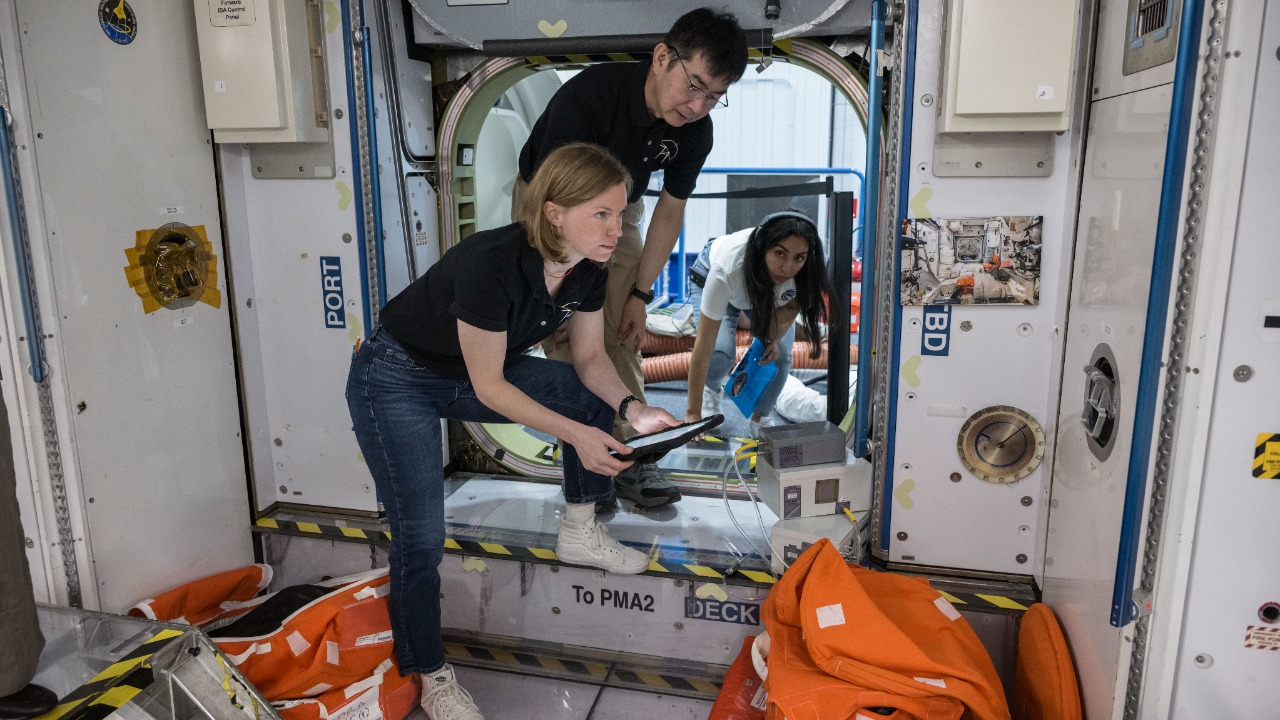
The International Space Station is not a tidy corridor with a single forward and aft. It is a sprawling, three-dimensional maze of pressurized modules, racks, cables, and handrails that confuses even human newcomers. The autonomous free-flying robots that NASA deployed inside this environment were designed to glide through microgravity and handle routine chores, but as the interior changed over time, their internal maps fell out of sync with reality. The result was a subtle but growing navigation problem that left the robots struggling to localize themselves and occasionally drifting off course instead of gliding confidently from task to task.
Those robots were meant to be more than floating cameras. They were supposed to be tireless assistants that could take over mundane inspections and logistics so astronauts could focus on experiments and repairs that only humans can do. When the navigation errors mounted, the risk was not just a few bumped panels, it was the possibility that the robots would have to be sidelined entirely, undercutting the promise of autonomous helpers aboard the International Space Station and forcing crews to reclaim time that had been carefully offloaded to machines.
The breakthrough: a digital twin of the station’s interior
The turning point came when engineers stopped trying to patch the robots’ outdated maps and instead built a full digital replica of their operating environment. Using NASA’s detailed blueprints of the station’s modules and equipment, they created a three-dimensional model that matched the real interior down to the placement of racks and structural elements. This virtual construct was not just a pretty visualization. It was a functional “digital twin” that could be used to simulate how the robots would see, move, and react as they floated through the actual station.
Once that twin existed, the team could generate synthetic sensor data, test new navigation algorithms, and refine the robots’ path planning without touching the hardware in orbit. The digital environment became a safe sandbox where failures were informative instead of dangerous, and where each iteration improved the robots’ ability to interpret what their cameras and sensors were seeing. The breakthrough was that the navigation error, which had been growing as the station evolved, could now be driven back down using corrections generated from the digital twin rather than ad hoc fixes.
From “living models” to modern digital twins
Digital twins may sound like a fresh buzzword, but the underlying idea has deep roots at NASA. In the 1960s, engineers developed what they called “living models,” ground-based replicas of spacecraft that could be used to diagnose problems and rehearse fixes when something went wrong in flight. Those early systems were crude by today’s standards, but the philosophy was the same: keep a synchronized representation of the vehicle on Earth so teams can experiment safely in the event of an anomaly. Over time, that concept evolved into the more formal digital twin frameworks that now blend physics-based models, telemetry, and software into a continuously updated mirror of the real system.
In current programs, those twins are not static diagrams. They are dynamic constructs that ingest data from sensors, adjust parameters as hardware ages, and support predictive analysis about how a spacecraft or structure will behave under new conditions. NASA’s own documentation on Digital Twins and Living Models traces that lineage explicitly, describing how the original living models were designed to support crews in the event of an anomaly and how modern twins extend that role into continuous operations, design optimization, and risk management across a mission’s life.
Inside the rescue: how virtual navigation fixed real robots
Once the station’s interior had a digital counterpart, engineers could replay the robots’ past movements and see exactly where their internal understanding diverged from the real layout. By injecting simulated camera views and sensor readings into the twin, they could test how different navigation algorithms interpreted the same scene and identify which features of the environment were most reliable for localization. This process turned a messy, real-world failure into a controlled experiment, where each tweak to the software could be evaluated against a consistent virtual backdrop before being uplinked to the robots in orbit.
The payoff was a new navigation pipeline that treated the digital twin as a reference frame instead of relying solely on static maps or on-board heuristics. The robots could now match what they were seeing to the virtual model, correct their position estimates, and plan paths that respected the true geometry of the station, even as equipment shifted or new modules were added. Reporting on how using NASA blueprints enabled this approach underscores that the key was not just better code, but the decision to anchor that code in a high-fidelity virtual environment that could be kept in lockstep with the real station.
Space Teams and the rise of twin-driven mission control
The success with free-flying robots fits into a broader shift in how space missions are designed and operated. A recent concept known as Space Teams proposes a digital twin paradigm that treats every mission as a coordinated interaction between physical assets in space and their virtual counterparts on the ground. Instead of building a spacecraft, launching it, and then bolting on tools to monitor it, the idea is to develop the physical and digital systems together so that the twin can support real-time decision making from the earliest design stages through end-of-life operations.
In this framework, the twin is not just a diagnostic tool, it is a full partner in mission planning, anomaly response, and even autonomous behavior. The Abstract describing Space Teams outlines how such twins can be used for space mission design and real-time operations, emphasizing that they enable a new kind of collaboration between human operators, software agents, and hardware in orbit. By embedding the twin into the mission architecture from the start, teams can simulate complex scenarios, validate procedures, and adjust strategies on the fly, all while keeping the risks to the physical spacecraft tightly controlled.
Cleaning up space junk with virtual testbeds
The same logic that saved robots inside the station is now being applied to one of the most pressing problems in orbit: debris. Capturing, repairing, or deorbiting defunct satellites is technically demanding and risky, especially when the target is tumbling or structurally fragile. Running full-scale experiments in orbit is expensive and slow, which is why researchers are turning to digital twins as a way to rehearse these operations virtually. By building detailed models of both the servicing spacecraft and the target debris, they can explore different capture strategies, control laws, and failure modes before committing to a single maneuver in space.
One project framed this advantage bluntly, noting that, rather than performing those experiments which take a lot of time in the real world, with a digital twin you can do controlled tests on the virtual system, the physical system, or both of the systems together. That perspective, captured in a description of a Rather ambitious debris-removal effort, highlights how twins can compress the trial-and-error cycle and reduce the risk of creating more junk through botched interventions. In practice, this means teams can iterate on grappling mechanisms, approach trajectories, and contingency plans in software until they are confident enough to execute a single, well-rehearsed sequence in orbit.
Ricardo Sanfelice and the push toward autonomous servicing
Digital twins are not just a NASA story. Academic and commercial partners are increasingly central to turning the concept into operational systems, especially for satellite servicing and end-of-life management. A new project led by Ricardo Sanfelice, a UC Santa Cruz Professor and Department Chair of Electrical and Computer Engine, is a case in point. His team is working with industry partners to develop twin-based control frameworks that can guide spacecraft as they rendezvous with, repair, or decommission other satellites, a task that demands precise modeling of both vehicles and their interactions.
By embedding autonomy into the twin itself, the project aims to let servicing spacecraft adapt to unexpected behavior from their targets, such as unmodeled tumbling or structural flexing, without waiting for step-by-step instructions from Earth. The description of this work notes that it is a new project led by Ricardo Sanfelice, who holds the role of Santa Cruz Professor and Department Chair of Electrical and Computer Engine, and that it is explicitly focused on cleaning space junk, repairing spacecraft, and managing decommissioning. That combination of academic rigor and operational urgency is pushing twin technology from the lab into the heart of how future orbital infrastructure will be maintained.
Why digital twins matter for astronauts and future missions
For astronauts living and working in orbit, the payoff from all this virtual modeling is straightforward: more reliable robotic helpers and fewer surprises. When free-flying robots can trust their navigation and handle routine inspections or inventory checks, crews can devote their limited time to complex experiments, repairs, and exploration tasks that cannot be automated. The digital twin that rescued the station’s robots is, in that sense, a quiet force multiplier, turning a potential liability into a dependable member of the on-orbit team.
Looking ahead, the same pattern is likely to shape missions beyond low Earth orbit. As habitats, logistics depots, and surface vehicles proliferate around the Moon and, eventually, Mars, the complexity of those environments will rival and then surpass the station’s interior. Digital twins that can keep pace with evolving layouts, aging hardware, and shifting mission goals will be essential to keeping robots useful and crews safe. The story of how Dec, Robots, Autonomous, and Interna were woven into a virtual rescue is less a one-off anecdote than an early glimpse of how space operations will increasingly depend on software stand-ins that are every bit as critical as the metal they mirror.
More from MorningOverview