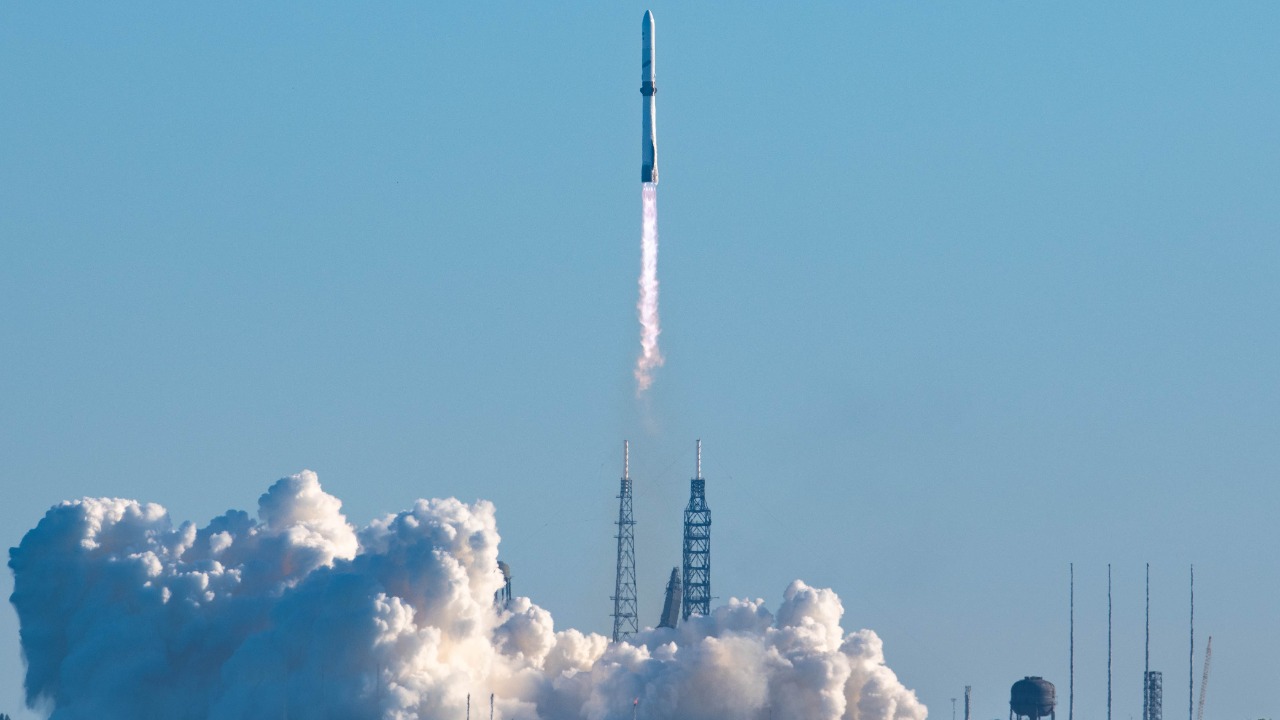

Blue Origin has carried a wheelchair user into space for the first time, sending German engineer Michaela “Michi” Benthaus on a suborbital flight and returning her safely to the West Texas desert. The mission, part of the company’s New Shepard program, turned a long‑standing barrier in human spaceflight into a test case for how commercial rockets can adapt to a wider range of bodies and abilities.
The flight was brief, measured in minutes of weightlessness rather than days in orbit, but its symbolism was outsized: a paraplegic engineer who uses a wheelchair, riding a reusable rocket alongside five other passengers, and proving that disability does not disqualify someone from the edge of space.
The historic passenger who redefined who belongs in space
I see the heart of this story in the person at its center, a German engineer who has spent years working in the space sector while being told, implicitly and explicitly, that the spacecraft she helped design were not built for someone like her. Michaela “Michi” Benthaus, described as a German engineer and wheelchair user, became the first person who relies on a wheelchair to travel beyond the Kármán line, turning a lifetime of rehabilitation and advocacy into a few minutes of microgravity that carried global resonance. Reports describe German Michaela Benthaus as paraplegic, underscoring how far the industry has shifted from an era when only perfectly able‑bodied test pilots were considered fit for flight.
Her path to the launchpad was not a marketing stunt but the culmination of a professional life spent inside the ecosystem that once excluded her. Benthaus works at the European Space Agency, and she has used a wheelchair since a mountain‑biking accident, a detail that makes her presence in a crew capsule feel less like a token gesture and more like overdue recognition of expertise. In interviews she has been identified as Ms Benthaus and has spoken about how she first connected with a veteran engineer, recalling, “I met Hans the first time online,” and explaining that she simply asked Hans the question that many disabled professionals quietly carry: after working so long for spaceflight, could there ever be a place for her on board.
A New Shepard mission that doubled as a test of inclusion
From a technical standpoint, the flight slotted neatly into Blue Origin’s growing cadence of suborbital tourism missions, yet it also served as a live experiment in accessible design. The company flew Benthaus on a New Shepard rocket, part of a program that has now completed its 37th mission, a figure that signals a maturing system rather than a one‑off demonstration. The latest launch was identified as NS‑37, and coverage of the mission notes that it marked the 37th flight of New Shepard, a milestone that gave engineers confidence to focus on human‑factors questions instead of basic reliability.
The crewed capsule carried Benthaus and five other passengers on a suborbital arc that delivered a few minutes of weightlessness before parachuting back to the desert floor. Accounts of the mission describe how Blue Origin launched wheelchair‑user and 5 others on the same trip, reinforcing that she was integrated into a standard commercial manifest rather than segregated into a bespoke “special” flight. That detail matters, because it shows that accessibility can be woven into routine operations instead of treated as a separate, charitable sideline.
Inside the capsule: how a wheelchair user actually flies
For all the symbolism, the mission’s credibility hinged on practicalities: how does a person who uses a wheelchair board a compact capsule, strap in for a high‑G ascent, and then move in microgravity. Blue Origin’s engineers concluded that the New Shepard crew cabin already had most of what was needed, and that only modest procedural tweaks were required. Reporting on the mission notes that Blue Origin did not need significant modifications to the capsule, relying instead on assistance from others to help Benthaus move across the cabin and in and out of her seat.
That approach highlights both the promise and the limits of current commercial spacecraft. On one hand, the fact that a vehicle designed years ago could accommodate a paraplegic passenger with only minor adjustments suggests that many barriers are cultural rather than structural. On the other, the reliance on human support rather than built‑in hardware shows how far the industry still has to go before accessibility is as seamless as, say, boarding a modern airliner with a jet bridge and aisle chair. The mission has already been framed as a proof of concept that future capsules, whether from Blue Origin or competitors, can be designed from the outset with wheelchair tie‑downs, transfer aids, and more intuitive handholds instead of retrofitted workarounds.
The quiet architect: Koenigsmann’s role in getting Benthaus on board
Behind the scenes, the flight was also a story about who uses their influence to open doors. A fellow German engineer, Hans Koenigsmann, emerged as a key figure in turning Benthaus’s dream into a booked seat, drawing on his long experience in commercial rocketry to navigate the practical and political hurdles. Coverage of the mission explains that a fellow German, Koenigsmann, helped arrange Benthaus flight after meeting her, using his credibility to reassure both company officials and mission planners that the risks were manageable and the benefits substantial.
Koenigsmann’s involvement also underscores how personal networks still shape access to space, even in an era of online ticket sales and glossy tourism brochures. Benthaus herself has said, “I met Hans the first time online,” describing how she approached him with a straightforward question about whether his decades of work on rockets could translate into a path for her to fly. That recollection, preserved in accounts that quote Ms Benthaus describing Hans the first contact, is a reminder that representation is not only about who sits in the capsule but also about who advocates in the conference rooms where passenger lists are drawn up.
From accident to astronaut: the long road from rehab to microgravity
What makes Benthaus’s journey resonate beyond the space community is the arc from sudden injury to a seat on a rocket. Years ago, a mountain‑biking accident left her paraplegic and dependent on a wheelchair, a turning point that could easily have ended any realistic hope of personal spaceflight. Instead, she doubled down on her technical career, building a reputation at the European Space Agency while quietly tracking the rise of commercial rockets that might one day carry private passengers. Reports on the mission note that Benthaus, who works at the European Space Agency, has used a wheelchair since that accident, a detail that grounds the flight in years of rehabilitation, adaptation, and persistence rather than overnight inspiration.
Her story also complicates the simplistic narrative that disability and high‑performance environments are inherently incompatible. By the time she strapped into New Shepard, Benthaus was not a charity case but a seasoned engineer who understood the vehicle’s systems, the risk envelope, and the operational choreography of a suborbital mission. That expertise, combined with her lived experience of paraplegia, made her an ideal test subject for how a commercial spacecraft can accommodate different bodies. It is no coincidence that coverage of the flight has framed her as the first wheelchair‑using astronaut, with images showing Michaela Benthaus in Texas after landing, celebrating a milestone that was as much about the years before launch as the minutes in microgravity.
Blue Origin’s accessibility experiment and what it signals for the industry
From the company’s perspective, flying Benthaus was both a human story and a strategic statement about the future of its business. Blue Origin has long pitched New Shepard as a reusable system that can democratize access to space, and this mission gave that rhetoric a concrete, visible example. The company has emphasized that the flight highlights ongoing efforts to expand participation in commercial spacecraft, a message amplified in social clips that show the crew floating and cheering in microgravity. One widely shared video described how Blue Origin says the mission highlights its push to broaden who can fly, framing accessibility not as a regulatory obligation but as a market opportunity.
At the same time, the mission’s success will likely ripple across the broader commercial space sector, where competitors are watching closely to see how far they must go to keep pace. If New Shepard can carry a paraplegic passenger with only procedural adjustments, then rival operators will face pressure to explain why their own vehicles remain effectively closed to similar customers. The fact that Blue Origin did not need to redesign its capsule from scratch, as noted in technical coverage that explains how New Shepard required no significant modifications, suggests that many of the remaining barriers are policy choices rather than engineering constraints.
Media, metrics, and the narrative of a “first”
The story of Benthaus’s flight has unfolded not only on the launchpad but also in the way it has been framed by journalists and commentators, who have wrestled with how to describe a milestone that is both technical and social. Coverage has consistently identified her as the first wheelchair user to travel to space, a phrasing that carries both celebration and scrutiny. One detailed account by Jackie Wattles highlighted that she just became the first wheelchair user to travel to space and noted that the mission involved 57 and Jackie Wattles, Updated Dec, Published Dec, weaving together the human narrative with the cadence of a maturing launch program.
Specialist space reporters have added further context, situating the mission within Blue Origin’s broader flight history and the competitive landscape. One analysis by Jeff Foust December described how Michaela “Michi” Benthaus celebrated after going to space on Blue Origin’s NS‑37, emphasizing that the mission was part of a series of flights rather than a one‑off spectacle. That reporting underscored that Jeff Foust December wrote about Michaela “Michi” Benthaus on NS‑37, reinforcing the idea that accessibility is now a topic for serious industry coverage, not just human‑interest sidebars.
Public reaction and the power of seeing a wheelchair in zero‑G
Beyond the technical and industry circles, the image of a wheelchair user floating in microgravity has resonated with audiences who may never memorize the name New Shepard or track the count of NS‑37. Social media clips and news segments have focused on the emotional beats: Benthaus grinning as she experiences weightlessness, crewmates helping her move through the cabin, and the jubilant celebration after touchdown in Texas. One widely shared reel captured the moment as Blue Origin makes history with a mission that put disability representation at the center of a commercial flight, turning a technical demonstration into a cultural touchstone.
Traditional broadcasters have echoed that framing, presenting the launch as both a scientific achievement and a civil‑rights milestone. A segment introduced by Seher Asaf invited viewers to “Watch” the “Moment German” engineer Benthaus became the world’s first wheelchair user to go into space, underscoring how the story bridges national pride, technological prowess, and disability advocacy. That coverage, which highlighted Seher Asaf urging viewers to Watch the Moment German engineer flew, has helped cement the flight in public memory as a turning point rather than a niche curiosity.
What comes after the first wheelchair user in space
The question now is whether Benthaus’s flight will remain a singular headline or become the first entry in a longer list of disabled spacefarers. Blue Origin has signaled that it views the mission as a starting point, not an endpoint, for accessibility, and the company’s emphasis on reusable hardware suggests that lessons from this flight can be folded into future operations. The fact that the mission was part of the established New Shepard program, which has already logged 37 flights, indicates that the infrastructure exists to make such passengers a recurring feature rather than a rare exception. Coverage that notes how Blue Origin’s New Shepard has reached this 37‑flight milestone reinforces the sense that the platform is stable enough to support more ambitious inclusion goals.
For Benthaus herself, the flight is likely to reshape her role within the space community, turning her from a behind‑the‑scenes engineer into a visible advocate for accessible design. As more details emerge about how she trained, how the crew rehearsed emergency procedures, and how the capsule layout supported her movement, those insights will feed into debates about everything from astronaut selection criteria to the design of future commercial stations. The mission has already been described as a crewed flight for the firm that carried a first‑of‑its‑kind passenger, and images of Michaela Benthaus photographed after landing in Texas will likely become reference points in presentations and policy papers arguing that space, like sidewalks and subway cars, must be built for everyone.
More from MorningOverview