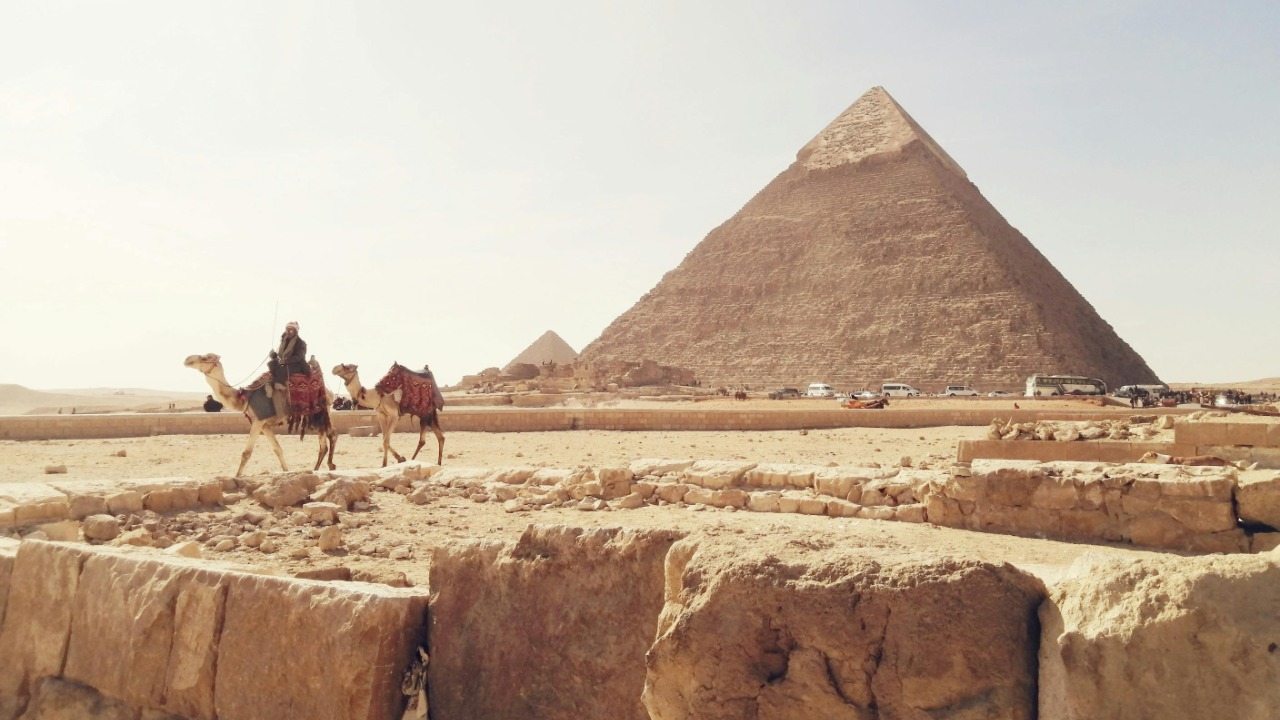

Fresh radar scans on the Giza Plateau have revealed a buried “anomaly” that is forcing Egyptologists to rethink how people once entered the pyramids. The subsurface structure, detected near the tombs of ancient elites, appears to form a deliberate architectural feature rather than a random pocket in the rock, raising the possibility that it functioned as a monumental gateway into a lost part of the necropolis. If confirmed, the discovery would not only redraw the map of Giza, it could expose how the builders choreographed the journey between the world of the living and the realm of the dead.
The find sits at the intersection of hard science and enduring myth, where ground‑penetrating radar images meet stories of hidden portals and secret chambers. I see it as a test case for how modern archaeology handles spectacular claims: the data hint at a large, organized space beneath the sand, but only careful excavation will show whether this is a practical entrance, a symbolic threshold, or something else entirely.
The anomaly that set Giza buzzing
The current wave of excitement began when an interdisciplinary team used ground‑penetrating radar to scan a quiet patch of the Giza Plateau that had long been treated as empty fill. Their instruments picked up a distinct, L‑shaped subsurface feature, with clear edges and a geometry that did not match natural fractures in the bedrock. The team described it as an “anomaly” because it stood out sharply from the surrounding geology, suggesting a constructed space that had somehow escaped earlier surveys.
Follow‑up analysis indicated that this L‑shaped structure sits beneath an area of the cemetery that had previously “avoided exploration,” even though nearby zones are crowded with tombs for high‑status officials. That pattern, where a conspicuously vacant rectangle interrupts a dense graveyard, is exactly what drew researchers to deploy radar in the first place, and the resulting images now point to a large subsurface archaeological structure that could be linked to a broader complex of unmarked underground structures.
From “anomaly” to possible ancient gateway
What transforms this buried feature from a curiosity into a potential “gateway” is its position and shape relative to known monuments. The L‑shaped outline appears to frame a path that could once have guided processions from the plateau’s open spaces down toward deeper, hidden zones. In Egyptian architecture, right‑angled corridors and dog‑leg passages often signal controlled transitions, forcing visitors to turn, slow down, and symbolically cross from one realm to another.
Researchers studying the radar data have suggested that the anomaly may mark the entrance to a larger complex, perhaps a ceremonial route or a cluster of chambers aligned with the tombs of powerful figures. Reporting on the find has already framed it as an “Ancient Portal,” a phrase that captures both the literal idea of a doorway and the more poetic sense of a threshold between worlds, and the scans themselves, produced with ground‑penetrating radar, show a coherent void that is hard to dismiss as random noise in the data, as detailed in coverage of Anomaly Near the Pyramids That May Reveal Ancient Portal.
How radar peeled back the Giza Plateau
The technology behind this discovery is as important as the anomaly itself. Ground‑penetrating radar works by sending pulses of radio waves into the ground and measuring how they bounce back from different materials, creating a kind of X‑ray of the subsurface. At Giza, the method has been refined to distinguish between compact limestone, looser fill, and empty space, allowing teams to map voids and walls without moving a single stone. The L‑shaped feature emerged as a strong, consistent signal across multiple passes, which is why archaeologists are treating it as a real structure rather than an artifact of the equipment.Earlier this year, a project described as Below The Giza Pyramid Plateau, New Radar Discoveries Will Shock The World outlined how an interdisciplinary team in March used similar techniques to trace networks of cavities deep below the Great Pyramids. Those scans revealed not just isolated pockets but layered systems of tunnels and chambers, reinforcing the idea that the plateau is riddled with planned underground spaces. The new anomaly fits neatly into that emerging picture of Giza as a multi‑level landscape, where what we see on the surface is only part of the story.
Menkaure’s hidden voids and the hunt for new entrances
The L‑shaped anomaly near the tombs is not the only recent hint that Giza still hides major access points. Separate scans of the third‑largest pyramid at Giza, the Menkaure pyramid, have identified two distinct voids on its eastern face. These pockets of “nothing” show up as clear anomalies in the data and may correspond to an unknown entrance or corridor that has never been opened in modern times. The fact that there are two such voids, rather than one, suggests a deliberate architectural feature rather than a random collapse.
Archaeologists involved in that work have proposed that the voids could be part of a hidden passage system, perhaps linked to a corridor near the pyramid’s northern entrance that has already been documented. The idea is that Menkaure’s builders may have created multiple routes into the monument, some for practical use and others for ritual purposes, and that at least one of these remains sealed. Reports on how Scans of the Giza Menkaure pyramid detected these voids underline how non‑invasive imaging is now central to the search for new entrances.
Two voids, one hypothesis: an unknown entrance
The discovery of two voids on Menkaure’s eastern face has sharpened debate about how the pyramid was meant to be approached. Traditional reconstructions focus on the visible northern entrance and its descending corridor, but the new data hint at a more complex circulation pattern. If the voids connect to a hidden passage, they could represent a secondary doorway used only in specific ceremonies, or a symbolic “false door” that existed purely for the benefit of the king’s spirit.
Specialists who reviewed the scans have noted that the anomalies sit in positions that make sense for an entrance, roughly aligned with architectural features on the exterior. A detailed account of these findings, credited By Owen Jarus, emphasizes that the voids are large enough to be meaningful spaces, not hairline cracks. Taken together with the L‑shaped anomaly near the tombs, they support a broader hypothesis: that Giza still conceals multiple, carefully planned entrances that have yet to be physically opened.
“Hidden portal” headlines and the Pharaoh’s tombs
As soon as the radar images were made public, more sensational language began to circulate, with some coverage describing a “hidden portal” buried for millennia just beneath the Pharaoh’s tombs. That framing leans heavily into the idea of a secret doorway to another realm, echoing popular fascination with curses and lost chambers. It also reflects the anomaly’s location in a zone where members of ancient Egyptian society were buried close to royal monuments, a proximity that naturally invites speculation about special access routes reserved for the elite.
In one widely shared account, the anomaly is presented as a mysterious feature that could reveal a “hidden portal” beneath the burial grounds of the Pharaoh, a phrase that captures both the excitement and the risk of overstatement. The report stresses that the structure lies just under the surface, near tombs that have already yielded rich information about how the court organized itself around the king, and it frames the find as a potential key to understanding how the living moved through this sacred landscape, as described in coverage of the Mysterious anomaly near the Pharaoh tombs.
Sorting science from speculation at Giza
For every careful radar map, there is an even louder claim about secret cities and otherworldly gateways, and Giza is no exception. Earlier this year, a team led by Professor Corrado Malanga promoted a sensational narrative about an “underground city” beneath the pyramids, complete with vast halls and advanced technology. A subsequent technical review of those assertions concluded that the evidence did not support such sweeping conclusions, and that the data had been overinterpreted to fit a dramatic story rather than a measured archaeological model.
The critique, laid out in a detailed Introduction to the claimed underground city, is a useful reminder that not every anomaly equals a lost metropolis. I see the current “gateway” hypothesis as more grounded, because it is tied to specific, repeatable radar signatures and to architectural patterns already known from other Egyptian sites. The challenge for researchers is to communicate that nuance: the subsurface structures are real and potentially transformative for our understanding of Giza, but they do not justify every imaginative leap that appears in headlines.
How Egyptologists read “portals” in stone
When archaeologists talk about portals in an Egyptian context, they are usually referring to carefully framed thresholds that manage the movement of people, offerings, and spirits. False doors carved into tomb walls allowed the deceased to symbolically pass between the burial chamber and the world of the living, while monumental gateways in temple pylons marked stages in a ritual journey. A buried L‑shaped corridor or a concealed entrance in a pyramid face would fit neatly into this tradition of controlled access, even if it never functioned as a public doorway.
Experts like Egyptolog Peter Der Manuelian have long emphasized that the layout of cemeteries and temples at Giza reflects a sophisticated choreography of space, where even seemingly empty patches of ground can carry meaning. In earlier work on the plateau, he noted that a vacant area in a graveyard, unmarked by tombs, had “avoided exploration” despite lying amid high‑status burials, a pattern that now looks strikingly similar to the zone where the new anomaly has been detected, as discussed in reports quoting Peter Der Manuelian, Egyptolog. That context makes it plausible that the buried structure served as a controlled threshold, even if its exact function remains unknown.
Why Giza keeps yielding “anomalies”
The clustering of new discoveries at Giza is not a coincidence. The plateau is both one of the most intensively studied archaeological sites on Earth and a place where large areas remain effectively untouched beneath modern debris and older excavation spoil. As survey methods improve, researchers are returning to zones that were once written off as exhausted, only to find that earlier digs barely scratched the surface. The result is a steady stream of “anomalies” that challenge the assumption that Giza’s big secrets were all uncovered in the nineteenth and twentieth centuries.
Some of the most intriguing recent work has focused on the pyramid of Menkaure, where Two voids on the eastern face of Menkaure have been interpreted as signs of an unknown entrance. Combined with the L‑shaped radar feature near the tombs and the deeper cavities mapped under the plateau, these findings suggest that the builders invested heavily in hidden or semi‑hidden routes. I read that pattern as a deliberate design choice: the pyramids were not just static monuments, they were hubs in a three‑dimensional ritual landscape that extended above and below ground.
Tourism, politics, and the race to reveal a new entrance
Any hint of a new gateway at Giza carries immediate implications for tourism and national prestige. Egyptian authorities have long balanced the need to protect fragile structures with the desire to showcase fresh discoveries that keep visitors coming. A confirmed entrance leading into previously unknown chambers would be a powerful draw, but opening it too quickly could damage both the architecture and the scientific record. That tension is likely to shape how and when the anomaly is excavated, and how much of it, if any, is eventually made accessible to the public.
The stakes are heightened by the global fascination with the pyramids, which are among the most visited landmarks in the world. Places like the Giza pyramid complex and the nearby Great Sphinx of Giza are already central to Egypt’s cultural diplomacy and its economy. A newly exposed ancient gateway, especially one tied to the tombs of the Pharaoh and to the Menkaure pyramid, would instantly become part of that narrative, a symbol of how modern science continues to unlock layers of a landscape that has dominated the world’s imagination for centuries.
What happens next beneath the sand
For now, the anomaly remains a pattern in radar data rather than an excavated doorway, and the next steps will be slow and methodical. Archaeologists will likely begin with targeted drilling or small test trenches to confirm the presence of walls and voids, followed by careful clearing if the structure proves stable. Throughout that process, they will be watching for clues that link the buried feature to known elements of the necropolis, such as alignment with causeways, tomb entrances, or the axes of the pyramids themselves. Public interest will stay high, fueled by reports that Archaeologists Found Anomaly Near the Pyramids That May Reveal Ancient Portal and by follow‑up pieces explaining what readers will learn when they dive into the details. Additional coverage has echoed that framing, with one article noting that Archaeologists Found an Anomaly Near the Pyramids That May Reveal an Ancient Portal and another stressing that Below this L‑shaped structure lies a large subsurface archaeological structure. As the first trenches are opened and the anomaly begins to resolve into stone and space, the world will find out whether Giza has indeed been hiding a lost ancient gateway in plain sight, just beneath the sand.
More from MorningOverview