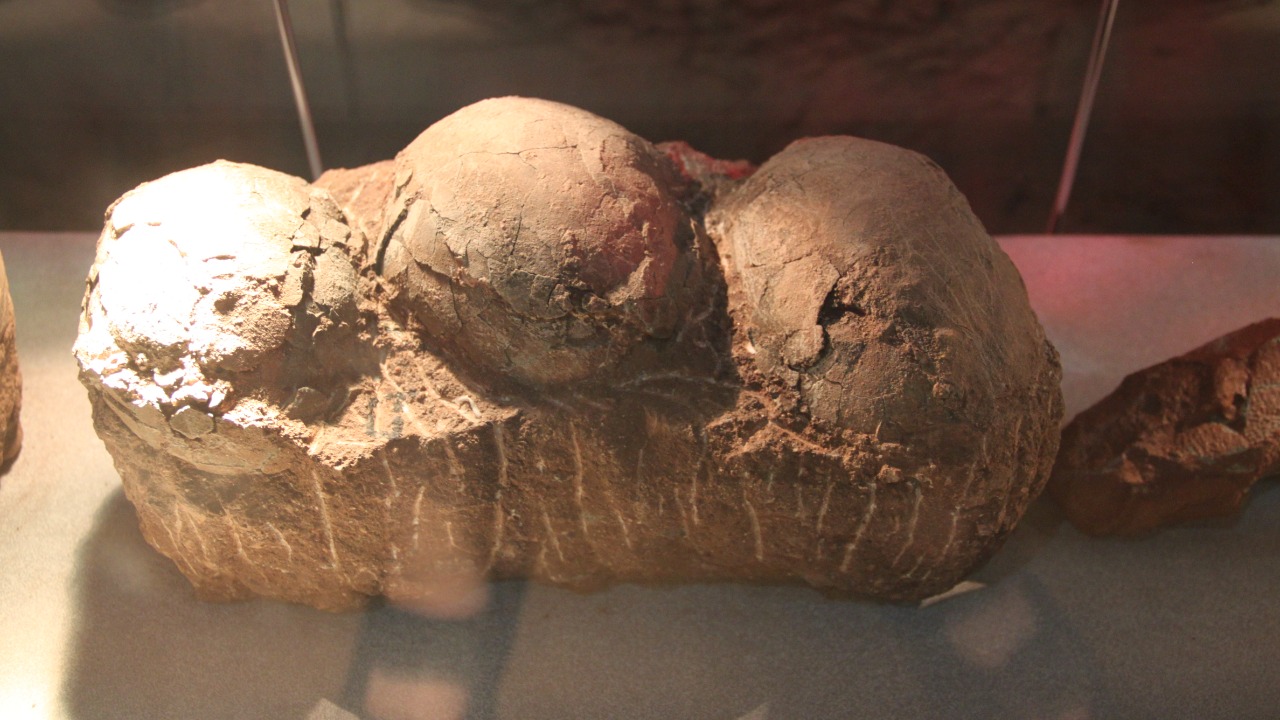

When paleontologists in China cracked open a set of cannonball sized dinosaur eggs, they did not find bones or embryos. Instead, they uncovered glittering mineral structures, crystal chambers that had quietly grown inside the shells for tens of millions of years. Those crystal dinosaur eggs, as strange as they sound, are now offering a rare and surprisingly precise look at how dinosaurs lived, nested, and died in a rapidly changing world.
The shock is not only that the eggs are filled with crystals, but that those minerals have locked in a detailed record of climate and chemistry from the Late Cretaceous. By treating each egg as both a fossil and a geological time capsule, scientists are reconstructing temperatures, rainfall patterns, and even the timeline of dinosaur evolution with a clarity that was impossible only a few years ago.
Unearthing cannonball sized eggs in China
The story begins in China, where field teams working sedimentary outcrops stumbled on nearly spherical dinosaur eggs roughly the size of small cannonballs. The fossils were so symmetrical and robust that they immediately stood out from the surrounding rock, each egg about five inches across and preserved in three dimensions rather than flattened. Researchers quickly realized they were dealing with an unusually intact clutch, the kind of find that can redefine what we know about dinosaur reproduction and nesting behavior.
Closer inspection showed that these cannonball sized eggs were not hollow and did not contain recognizable bones, but instead were packed with dense mineral growths. Reports describe them as filled with clusters of calcite, with some eggs cataloged under specimen numbers such as QL01 and QS 02, a level of documentation that underscores how carefully the fossils have been studied at the Qinglongshan site in China. The very fact that these eggs survived intact, still spherical and internally sealed, is what allowed the crystals to form and preserve a chemical record of the ancient environment, as detailed in accounts of the cannonball sized dinosaur eggs.
From eggshell to crystal chamber
What turned a fragile dinosaur egg into a glittering geologic specimen is a slow, almost alchemical process. After the original organic contents decayed, groundwater rich in dissolved carbonate seeped through microscopic pores in the eggshell. Over immense spans of time, those carbonates precipitated out as calcite crystals, gradually filling the interior. Instead of destroying the fossil, the mineralization effectively armored it, preserving the shell and creating a new crystalline interior that scientists can now probe for clues.
Researchers examining these crystallized interiors have found that the carbonate minerals did more than simply occupy empty space. The crystals captured isotopic signatures of the water and atmosphere that surrounded the eggs as they fossilized, turning each egg into a compact archive of Late Cretaceous conditions. Analyses of these crystals hidden inside dinosaur eggs have already yielded estimates of mid Cretaceous temperatures and environmental shifts that would have shaped dinosaur life.
A new species hiding in plain sight
The crystals were not the only surprise. The eggs themselves turned out to belong to a dinosaur that had never been formally described before. By comparing shell thickness, surface ornamentation, and overall geometry with known egg types, paleontologists concluded that these fossils represented a distinct lineage, one that could be identified even in the absence of skeletal remains. It is rare in vertebrate paleontology to name a species from eggs alone, yet the combination of unique shell features and consistent morphology across multiple specimens made the case compelling.
Reports describe how Chinese paleontologists dug up three nearly spherical eggs, each about the size of a cannonball, and found that all three contained clusters of calcite crystals rather than embryos. Those same studies note that the eggs were assigned to a huge crystal filled dinosaur egg type that justified naming a New Species based on the distinctive shell alone. The decision underscores how far egg science has come, with microstructure and mineral content now treated as taxonomic evidence rather than mere curiosities.
Directly dating dinosaur eggs for the first time
For decades, paleontologists had to infer the age of dinosaur eggs from the rock layers around them, a method that always carried some uncertainty. That changed when teams working with these Chinese eggs applied uranium lead techniques directly to the carbonate minerals in the shells. By measuring how uranium isotopes decay into lead within the eggshell, researchers could calculate an absolute age for the eggs themselves, rather than relying solely on the surrounding strata.
The results were striking. One set of eggs was dated to roughly 85 M years old, placing them firmly within the Cretaceous World and aligning them with a period of significant climatic and ecological change. The work, described under the banner of Paleontologists Directly Date Dinosaur Eggs for the First Time, used (U Pb) dating on carbonate minerals to tie the eggs to a specific slice of the Cretaceous World, a methodological leap that turns eggs into precise chronological markers.
The “atomic clock” inside an eggshell
The same principle that allows geologists to date zircon crystals in volcanic rocks is now being applied to dinosaur eggs. Uranium atoms locked into the carbonate lattice of the shell act like tiny timers, decaying into lead at a known rate. By comparing the ratio of uranium to lead, scientists can read that atomic clock and determine how long it has been ticking since the minerals formed. In the case of the Chinese eggs, that clock points to a time when dinosaurs were still thriving but the planet was already on a path toward dramatic change.
Analyses of eggs from China using this approach have yielded ages around 86 m years, a figure that aligns with other independent estimates of the Late Cretaceous timeline. One report explains how Dinosaur eggs from China were found to be around 86 m years old by tracking how uranium, over time, decays into lead within the shell. The precision of that atomic clock method is what turns these crystal filled eggs into anchors for reconstructing dinosaur evolution and extinction patterns.
Reading Cretaceous climate in carbonate crystals
Beyond age, the carbonate crystals inside the eggs are packed with climatic information. Ratios of oxygen isotopes in the calcite can reveal the temperature of the water from which the minerals precipitated, which in turn reflects local climate conditions. By sampling different layers of crystal growth, scientists can reconstruct how temperatures shifted over the lifespan of the egg’s burial and fossilization, effectively turning each specimen into a miniature climate archive.
Researchers working with crystallized eggs from the Qinglongshan site have used these isotopic signatures to estimate the temperatures of the mid Cretaceous and to track a notable drop in temperature that may have affected dinosaur habitats in the final days of their reign. One analysis of Crystallized dino eggs describes how a cooling trend is recorded in the carbonate crystals, while a companion study of 85 million year old dino eggs explains how scientists fired a micro laser at eggshell samples, vaporizing carbonate minerals to read both age and climate signals from fossils at the Qinglongshan site.
How the discovery unfolded in the field
The path from dusty hillside to climate archive began with routine fieldwork. Teams surveying sedimentary layers in China were already familiar with the region’s rich fossil record, which includes everything from fish to feathered dinosaurs. When they encountered nearly spherical objects embedded in the rock, they recognized the telltale texture of eggshell and carefully excavated around each specimen, preserving the surrounding matrix for later lab analysis. The initial goal was to document egg morphology and nesting patterns, not to hunt for crystals.
Only after the eggs were cut open in the lab did the full extent of the mineralization become clear. Accounts of the New discovery in China describe how Scientists found crystals inside 85-million-year dinosaur eggs, noting that the eggs were so thoroughly filled with calcite that no embryonic bones remained. The same reports emphasize that the fossils were cataloged within a Science and Technology context, highlighting how a seemingly routine paleontological dig turned into a multidisciplinary project spanning geology, geochemistry, and climate science.
Crystal filled eggs and the broader Chinese fossil record
The crystal eggs do not exist in isolation. China has become one of the world’s most important sources of dinosaur eggs and embryos, offering a spectrum of preservation that ranges from mineral filled shells to nearly complete skeletons curled inside intact eggs. Earlier discoveries include Baby Yingliang, an extraordinarily well preserved dinosaur embryo that captures a hatchling in a bird like pose, its spine curved and limbs tucked in a posture strikingly similar to modern chicks. That specimen, estimated to be a stunning 66 to 72 million year old embryo, shows what happens when soft tissues and bones are preserved instead of replaced by minerals.
Baby Yingliang, documented by Scientists in China, provides a biological counterpoint to the crystal filled eggs, which preserve chemistry rather than anatomy. Together, they illustrate the range of fossilization pathways in China, from Esti mated soft tissue preservation in Baby Yingliang to complete mineral replacement in the cannonball sized eggs. That diversity is what allows researchers to cross check developmental timelines, nesting behaviors, and environmental conditions across different sites and species.
From Jurassic Park fantasy to laboratory reality
For many readers, the phrase “dinosaur eggs” still evokes images from Jurassic Park, with scientists extracting DNA from ancient remains to resurrect long extinct species. The reality in Chinese labs is more grounded but no less remarkable. Instead of chasing genetic material, researchers are using high precision instruments to read isotopic ratios, trace element concentrations, and crystal growth patterns. The goal is not to bring dinosaurs back, but to understand how they lived and how their world changed around them.
One short explainer on how scientists work out how to directly date fossilized dinosaur eggs notes that fossilized dinosaur eggs sound like something out of Jurassic Park, but scientists in China have just worked out how to turn them into precise geological clocks. In that Sep video, researchers describe how they sample eggshell carbonate and apply uranium lead techniques, translating what once seemed like science fiction into a routine part of paleontological analysis.
Why crystal eggs matter for dinosaur evolution
The implications of these crystal filled eggs extend far beyond a single species or site. By tying eggs to specific ages and climates, scientists can map where and when different dinosaur lineages nested, how their reproductive strategies shifted, and how they responded to environmental stress. If certain egg types cluster around cooler intervals, for example, that might suggest migrations to higher latitudes or changes in nesting season. Conversely, eggs that appear only in warmer phases could indicate species that were more sensitive to temperature swings.
Reports on Dinosaur eggs the size of cannon balls explain that Two dinosaur eggs, each about five inches in diameter, were so distinctive that a species was named from eggs alone, a rare move that underscores how informative egg morphology has become. Another account of how Scientists discover two giant crystal filled dinosaur eggs notes that S. qianshanensis also provides new paleontological evidence for the identification, division and correlation of the Upper Cretaceous strata, linking individual nests to regional evolutionary patterns.
A sharper picture of an 85-million-year world
What emerges from all of this work is a sharper, more textured picture of life roughly 85-million-year in the past. Instead of treating the Cretaceous as a static backdrop for dinosaurs, scientists can now see it as a dynamic world of shifting temperatures, evolving species, and changing landscapes. The crystal filled eggs from China sit at the center of that reconstruction, serving as both biological artifacts and geochemical instruments that record the conditions of their time.
Accounts of the tumultuous Late Cretaceous describe how Crystallized eggs provide a peek into a world marked by climatic swings and ecological upheaval, while summaries of Scientists find crystals inside 85-million-year dinosaur eggs emphasize how New discoveries in China are turning once static fossils into active data sources. As I look across this body of work, the shocking surprise inside those crystal dinosaur eggs is not just the glittering calcite, but the realization that the most fragile relics of dinosaur life have become some of the most powerful tools for understanding their world.
More from MorningOverview