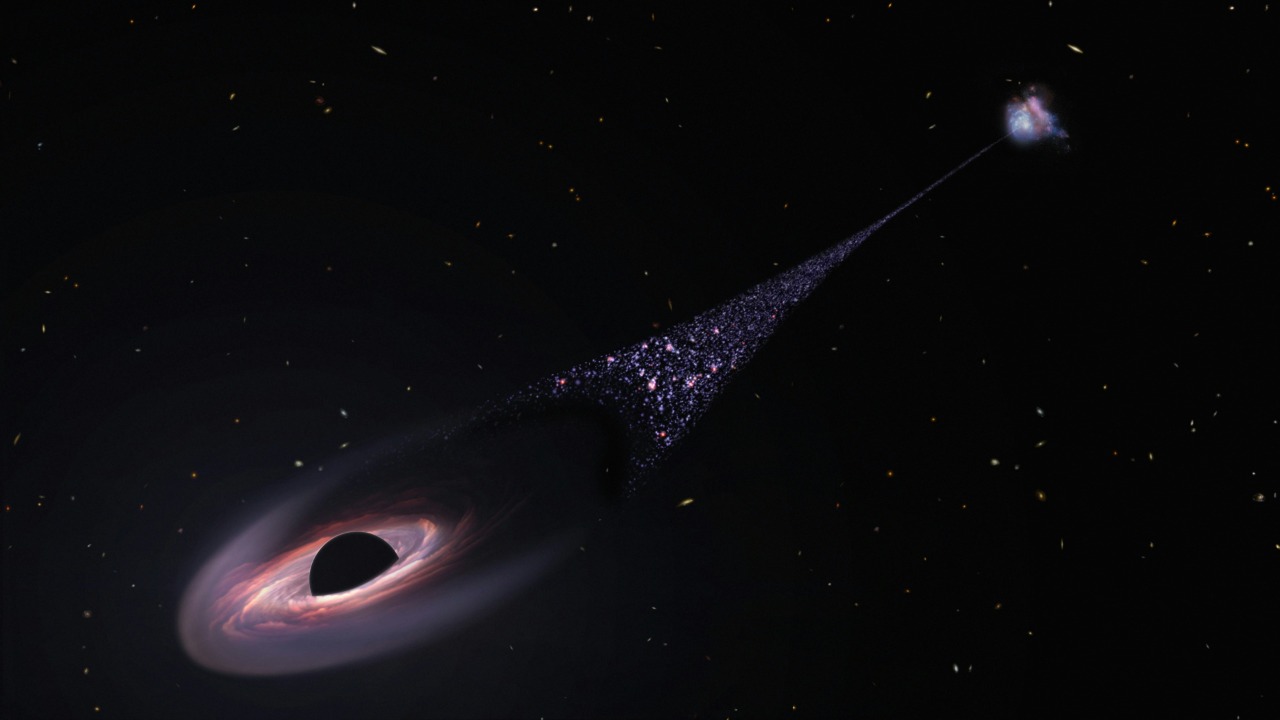

For nearly a decade, some of the most dramatic explosions in the universe have been hiding in plain sight as brief, bright flashes of blue light. New observations now suggest these outbursts are not ordinary stellar deaths but the signatures of stars being torn apart by black holes in violent, compact systems. The emerging picture is that these bright blue cosmic blasts are powered by extreme tidal destruction, where gravity rips a star to shreds and flings its remains into a swirling, light‑spewing maelstrom.
At the center of this shift is a single, unusually well observed event that has given astronomers their clearest look yet at what drives these eruptions. By tracking its light across multiple wavelengths and over many weeks, researchers have pieced together a story in which a black hole and a massive star spiral toward catastrophe, ending in a rapid, blue‑white flare that can be seen across billions of light‑years.
From freak flashes to a new class of cosmic event
When astronomers first spotted these brief blue eruptions, they did not fit neatly into any known category of stellar explosion. The events were too bright and too fast to be standard supernovae, yet they also did not match the behavior of gamma‑ray bursts or other familiar transients. Over time, the community began to group them under a new label, calling them a type of Luminous Fast Blue Optical Transient, or LFBOT, a name that captures their intense brightness, rapid evolution, and characteristically blue color.
These Luminous Fast Blue Optical Transient events quickly became some of the most puzzling signals in time‑domain astronomy. They appeared rarely, flared to extraordinary luminosities, and then faded in a matter of days, leaving little time to gather detailed data. Because they did not behave like ordinary exploding stars, some teams proposed exotic explanations involving magnetars or unusual jets, while others suspected that the answer might lie in interactions with compact objects that had not yet been fully mapped out.
AT 2024wpp, the brightest LFBOT yet
The mystery sharpened when astronomers detected an especially intense outburst designated AT 2024wpp, which quickly stood out as the brightest LFBOT ever recorded. Its light curve rose and fell with remarkable speed, yet its peak luminosity rivaled or exceeded that of many supernovae, signaling that an enormous amount of energy was being released in a very compact region of space. Because the event was caught early and followed closely, it offered a rare opportunity to probe the underlying engine in unprecedented detail.
As teams coordinated observations across multiple observatories, they were able to track how the color and spectrum of AT 2024wpp evolved over time. Those measurements showed that the outburst was not just bright but also unusually hot, consistent with a powerful central source heating surrounding material. The combination of extreme luminosity, rapid evolution, and blue‑white emission made AT 2024wpp a touchstone for understanding what sets LFBOTs apart from more familiar stellar explosions.
Pinning the power source on black holes
With AT 2024wpp under the microscope, researchers began to test whether a compact object could plausibly account for the observed energy and timescales. Detailed modeling of the light curve and spectra pointed toward a scenario in which a black hole was actively accreting stellar debris, converting gravitational energy into radiation with high efficiency. In this picture, the bright blue flash is the visible signature of matter being funneled into a deep gravitational well and heated to extreme temperatures as it spirals inward.
Support for this interpretation came from observations of AT 2024wpp that revealed features consistent with a compact, central engine rather than a simple expanding shell of supernova ejecta. The data suggested that the outburst was powered by ongoing energy injection from material falling onto a black hole, rather than a single explosive release. That conclusion marked a turning point, shifting LFBOTs from the realm of exotic supernova variants into a category more closely tied to accretion physics and tidal disruption.
How a tidal shredding produces a blue flash
Once black holes entered the frame, the next step was to understand how they could generate such rapid, luminous optical flares. The leading explanation centers on extreme Tidal Disruption Events, or TDEs, in which a star ventures too close to a black hole and is torn apart by gravitational forces that overwhelm its own self‑gravity. In this scenario, the star is stretched into a long stream of gas, with some of the material flung outward and the rest captured into an accretion disk that radiates intensely as it feeds the black hole.
Evidence that LFBOTs are linked to such extreme Tidal Disruption Events comes from a signal analysis showing that the light from these blasts is consistent with a compact, rapidly evolving accretion flow. In that reconstruction, the black hole’s gravity pulls the disrupted star’s gas into a tight orbit, where friction and magnetic fields heat it to high temperatures and drive powerful outflows. The resulting emission peaks in the blue and ultraviolet, matching the observed color and intensity of the LFBOTs.
A deadly partnership: black hole and massive star
The story becomes even more dramatic when the environment of AT 2024wpp is taken into account. Rather than a chance encounter between a wandering star and a central supermassive black hole, the data point to a close binary system in which a stellar‑mass black hole and a massive star had been orbiting each other for an extended period. Over that time, the black hole gradually siphoned material from its companion, stripping away its outer layers and altering its structure long before the final catastrophe.
As researchers reconstructed this history, they concluded that the black hole had been sucking material from its companion for so long that the star was left largely without hydrogen in its outer envelope. That picture is supported by modeling that shows how a compact object can steadily peel away a massive star’s outer layers, leaving a stripped core that is primed for a violent end. The final act comes when the orbit tightens enough that the star is effectively engulfed, triggering a rapid disruption and a luminous flare that unfolds over just a few days.
Reconstructing the last days of AT 2024wpp
To understand how such a system produces a specific event like AT 2024wpp, astronomers have pieced together a timeline of the final interactions between the black hole and its companion. In this reconstruction, the black hole’s long‑term feeding eventually destabilizes the orbit, bringing the massive star so close that tidal forces begin to tear it apart. Within days, the star’s core is shredded, and a large fraction of its mass is funneled into a compact accretion disk that powers the observed outburst.
Clues to this sequence come from signatures of hydrogen and other elements in the light from the event. As they reconstruct this history, researchers find that the black hole’s prolonged stripping of the star explains the limited hydrogen emission seen in AT 2024wpp, while the rapid rise and fall of the light curve match the expected timescale of a compact TDE in a binary system. The result is a coherent narrative in which a long‑lived, quiet interaction suddenly tips into a brief, spectacular display visible across cosmic distances.
Why these blasts look so different from supernovae
One of the reasons LFBOTs remained enigmatic for so long is that they superficially resemble certain types of supernovae, yet their detailed behavior diverges in crucial ways. Traditional core‑collapse supernovae involve the catastrophic death of a massive star, with energy released as a shock wave that blows off the outer layers and produces a relatively smooth, weeks‑long light curve. In contrast, the blue flashes associated with LFBOTs rise and fade much more quickly, and their spectra show signs of ongoing energy injection rather than a single explosive event.
At the heart of the new interpretation is a signal from a so‑called Luminous Fast Blue Optical Transient that shows the hallmarks of a compact accretion engine rather than a simple explosion. That finding undercuts models in which LFBOTs are just unusually energetic supernovae and instead supports the idea that they are powered by black holes actively devouring stellar material. In other words, the light curves and spectra are not just the fading embers of a blast, but the glow of matter in the act of being consumed.
Chasing the briefest, brightest signals in the sky
Even with a compelling physical model in hand, catching these events in the act remains a major observational challenge. LFBOTs evolve so quickly that astronomers must rely on wide‑field surveys and rapid follow‑up to capture their early phases, when the most diagnostic information is available. Once a candidate is flagged, teams scramble to bring a full suite of instruments to bear, from optical and infrared telescopes to X‑ray and radio observatories, in order to map the outburst across the spectrum.
That urgency is reflected in the way researchers responded when AT 2024wpp first appeared. As soon as it was recognized as an unusually bright and fast transient, investigations began almost instantaneously, with coordinated campaigns designed to track every twist in its evolution. Reports describe how, once AT 2024wpp was identified, teams moved quickly to secure spectra and high‑cadence photometry, building the dense dataset that now underpins the black hole shredding scenario.
What these events reveal about stellar evolution
Beyond their immediate drama, these bright blue blasts are beginning to reshape how I think about the life cycles of massive stars in binary systems. The emerging picture suggests that a significant fraction of stellar evolution may be governed not just by internal processes, but by interactions with compact companions that strip, distort, and ultimately destroy their partners. In that sense, LFBOTs are not isolated curiosities, but the visible endpoints of long, complex relationships between stars and black holes.
By tying LFBOTs to black hole accretion and extreme TDEs, astronomers are also gaining a new handle on how mass is exchanged and redistributed in dense stellar environments. The detailed look at what powers these events shows that something in the distant universe is firing off brief, electric‑blue flashes so powerful they can be seen from billions of light‑years away. Each one encodes information about how black holes grow, how massive stars lose their envelopes, and how extreme gravity shapes the fate of ordinary matter.
From cosmic enigmas to a new astrophysical tool
For years, LFBOTs were treated as cosmic oddities, intriguing but too rare and poorly understood to play a central role in astrophysical models. That perception is changing as the black hole shredding scenario gains traction and more events are identified and followed in detail. I now see these blasts as a powerful new probe of environments that are otherwise difficult to study, especially compact binaries where a black hole and a massive star interact on short timescales.
Recent work has emphasized that these bright cosmic phenomena have been a mystery for nearly a decade, but are now being linked directly to black holes devouring stars. A series of bizarre, bright blue flashes from deep space is now seen as evidence that space may finally have an explanation for these enigmatic bursts. As surveys improve and more of these events are caught early, I expect LFBOTs to move from the margins of transient astronomy to the center of efforts to map how black holes and massive stars coevolve across cosmic time.
More from MorningOverview