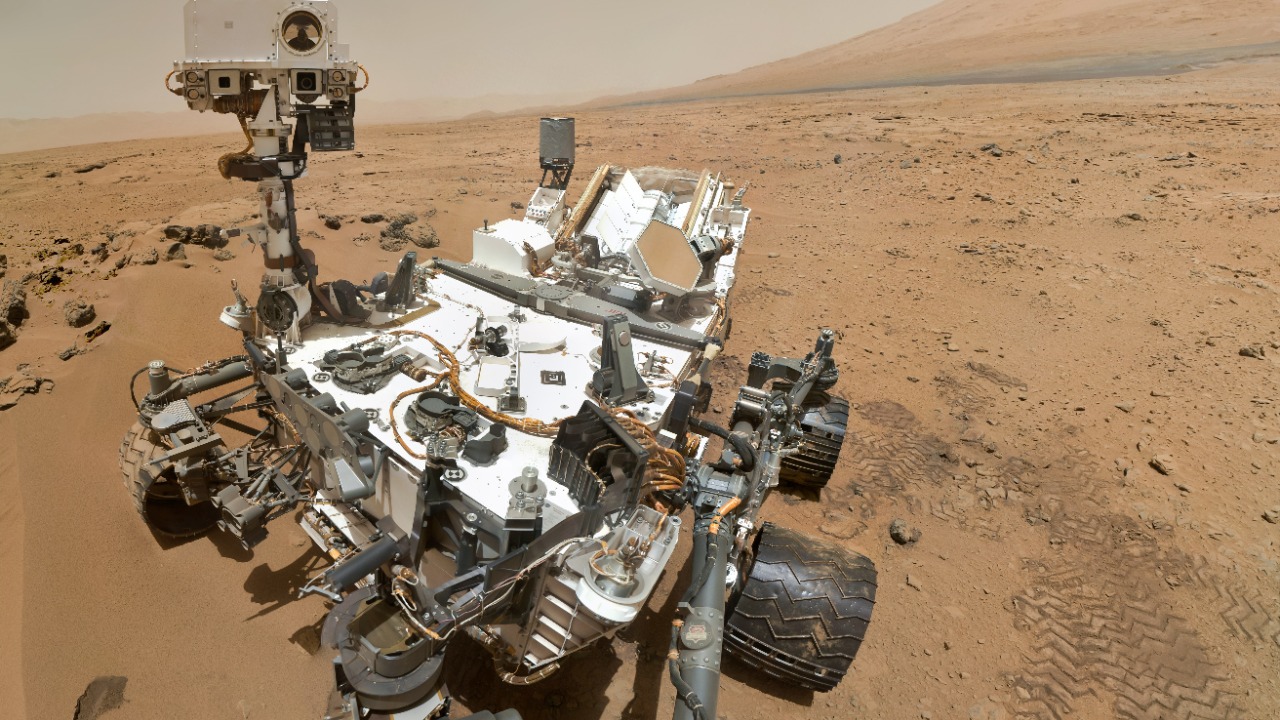

NASA has quietly crossed a threshold on Mars: its flagship rover is no longer just following orders, it is choosing its own path across the planet. The Perseverance rover now uses advanced onboard navigation to steer around hazards, stretch its daily range and free human controllers to focus on science instead of micromanaging every wheel turn. In practical terms, that means a robot explorer is making real-time driving decisions on another world while its human team watches from millions of kilometers away.
From teleoperation to true autonomy on Mars
For most of the history of Mars exploration, rovers behaved more like remote-controlled vehicles than independent robots, creeping forward only after engineers on Earth had checked and double checked every move. The light speed delay between Earth and Mars, which can stretch to more than twenty minutes one way, forced a cautious rhythm in which each short drive was planned, uplinked and then patiently reviewed before the next step. That model kept earlier missions safe, but it also meant that a large share of each Martian day was lost to waiting for instructions instead of covering ground.
Perseverance was built to break that bottleneck by carrying a far more capable auto-navigation system that lets it analyze the terrain and keep rolling while it thinks. NASA describes this enhanced capability as a leap beyond previous rovers, with the machine able to process stereo images, identify rocks and sand traps and then continue driving as it updates its route in real time. Reporting on the rover’s performance notes that NASA’s Perseverance rover can drive itself around Mars using this enhanced auto-navigation system while its wheels are turning, a crucial detail that turns autonomy from a lab demo into a practical way to cover more Martian terrain every day.
How the rover actually “sees” the Martian terrain
Autonomous driving on Mars starts with vision, and Perseverance’s view of the world is built from pairs of cameras that generate detailed 3D maps of the ground ahead. As the rover rolls forward, it continuously stitches these images into a local terrain model, marking out slopes, boulders and ripples of dust that could snag a wheel. Instead of waiting for Earth to interpret those images, the onboard computer evaluates which patches of ground are safe, which are risky and which are outright forbidden, then adjusts its path accordingly.
NASA has shared that this process is not a one-off calculation but a loop that runs as the rover moves, so the map it uses is literally created on the fly. In a technical walkthrough of the system, engineers show how as the rover drives a planned path it builds an onboard map from its left and right cameras, then refines that map with each new frame. The result is a kind of rolling situational awareness that lets Perseverance respond to unexpected dips or rocks that were too small to see in orbital images, a capability that is essential when the nearest human driver is a radio signal away.
Planning routes from orbit to wheel tracks
Even with a self-driving rover, the path across Mars starts on Earth, where engineers pore over satellite imagery to sketch out long distance routes. High resolution maps from orbit reveal broad hazards such as craters, cliffs and fields of dunes, and mission planners use that view to draw corridors that balance safety with scientific payoff. Those corridors are then translated into waypoints that Perseverance can aim for, leaving the rover to handle the fine scale steering around individual rocks and ruts once it is on the ground.
The interplay between human planning and robotic improvisation was on display when the team sent Perseverance racing toward an ancient river deposit known as a delta. Mission updates describe how engineers first traced a path using orbital data, then marked out potential sand traps and other obstacles as “keep out” zones while highlighting promising science targets as “keep in” areas. As the rover closed in on this Martian delta, it used its own cameras and auto-navigation to respect those human drawn boundaries while still finding efficient lines through the landscape, a process captured in detail when then they mark obstacles such as potential sand traps and draw “keep out” and “keep in” zones around areas they want to return to Earth.
Inside the upgraded AutoNav brain
What makes Perseverance different from its predecessors is not just better cameras but a more powerful brain dedicated to navigation. Earlier rovers had to stop frequently while their main computer crunched through images to decide where to go next, a stop and go pattern that limited how far they could travel in a single Martian day. Perseverance carries specialized hardware that can process visual data much faster, which means it can keep its wheels turning while it thinks, a subtle change that adds up to dramatically longer drives over time.
Engineers describe this system as an enhanced AutoNav package that blends stereo vision, hazard detection and path planning into a single continuous loop. Reports on the rover’s performance emphasize that this loop is robust enough for the machine to chart its own course across the barren Martian surface, reacting to unexpected obstacles without waiting for new commands from Earth. One account notes that the lonely machine must chart its own course across the Martian terrain and can respond to unexpected obstacles in the terrain, a concise summary of how far the onboard autonomy has come.
Driving to the Jezero River Delta and beyond
The real test of any navigation system is not in simulations but in the messy details of a long journey, and Perseverance has already logged a demanding road trip across Jezero crater. The rover’s science campaign required it to travel several miles from its landing site to the edge of an ancient river deposit, a trek that crossed fields of jagged rocks and patches of deceptively soft soil. Instead of inching forward under constant supervision, the rover used its self-driving tools to cover significant distances in a single Martian day, turning what could have been a multi year crawl into a manageable commute.
NASA has highlighted this journey in outreach materials that walk through how the rover navigated to the Jezro River Delta, a name that appears in mission videos and transcripts. In one explainer, a guide named Tyler Delesto describes how the Perseverance rover is currently driving a three mile journey to get to the Jezro River Delta, underscoring that the route is long enough to demand efficient, semi independent driving. That trek, and others like it, show that autonomy is not a novelty feature but a core tool for reaching scientifically rich terrain that would be impractical to access with purely manual control.
Record breaking drives and more time for science
As Perseverance’s software matured, the rover began to set new benchmarks for how far a Martian vehicle can travel in a single day. With AutoNav handling obstacle avoidance on the fly, the rover has logged drives that would have been unthinkable for earlier missions that had to stop repeatedly for ground teams to analyze every hazard. Those longer traverses translate directly into more time parked at interesting rocks and sediment layers, where the rover can drill, sample and scan instead of burning daylight on cautious repositioning.
Mission updates describe how the self-driving capability has helped the rover break distance records while still operating safely in rugged terrain. A video overview notes that NASA’s Self Driving Perseverance Mars Rover Is Breaking Records, highlighting that the Perseverance Mars rover is using its self-driving tools to cover more ground and do more science. The same reports emphasize that this is not just about bragging rights, it is about maximizing the mission’s return by shifting human attention from routine driving to complex scientific decisions.
Autonomy as a force multiplier for Mars science
Behind the headlines about self-driving robots is a quieter but more consequential shift in how Mars missions are run. Every hour that engineers once spent plotting safe paths around rocks can now be redirected to choosing which outcrops to sample, which layers to image and how to coordinate with orbiters overhead. Autonomy effectively multiplies the team’s capacity, letting a relatively small group of controllers manage a rover that is constantly on the move instead of waiting for instructions.
NASA has quantified this effect by noting that a large majority of the rover’s drives now rely on its onboard systems rather than step by step commands from Earth. In a mission status report, the team explains that more than 90 percent of Perseverance’s driving is now handled by its autonomous systems, a figure that underscores how central the technology has become. The same update stresses that this level of independence will be critical to exploring other worlds in the future, a point captured in the statement that more than 90% of Perseverance’s driving uses these autonomous tools and that such capabilities will be critical to exploring these worlds.
What “Autonomous Systems Help NASA’s Perseverance Do More Science” really means
When mission managers talk about autonomous systems helping Perseverance do more science, they are referring to a suite of tools that extend beyond driving. The same onboard intelligence that lets the rover pick a safe path can also flag interesting textures in rocks, optimize the sequence of instrument operations and even adjust plans when conditions change unexpectedly. In effect, the rover is becoming a more active partner in its own mission, handling routine decisions locally so that human scientists can focus on interpreting the data it sends back.
A detailed mission update explains how data recorded by the rover’s cameras is used to generate maps that not only show safe paths but also indicate areas with potential hazards and scientific interest. The report describes how autonomous systems help NASA Perseverance Do More Science on Mars by using maps made with data recorded by the rover to indicate paths with potential hazards, and by serving as a perfect testbed for engineers who plan rover outings. That framing makes clear that autonomy is not about replacing human judgment but about giving the team a smarter, more capable tool to carry out their plans on a distant planet.
Why this matters for the next generation of explorers
The success of Perseverance’s self-driving system is already shaping how engineers think about future missions to Mars and beyond. Any attempt to send robots into more extreme environments, from the icy crust of Europa to the rugged highlands of the Moon, will face the same communication delays and limited human oversight that challenge today’s rovers. The lessons learned from letting a machine choose its own path across Jezero crater are therefore a kind of dress rehearsal for a solar system in which autonomous explorers scout ahead for human crews or operate in places people may never visit.
NASA’s own messaging reflects this long view, positioning Perseverance as both a science mission and a technology demonstrator for autonomy. Reports on the rover’s capabilities emphasize that its enhanced auto-navigation system is not just a convenience but a necessity for covering the distances required to collect samples and study features like Cheyava Falls, a rock target whose potential findings have been flagged as especially intriguing. Coverage of the mission notes that NASA’s Perseverance rover is driving itself around Mars using an enhanced auto-navigation system, and that this capability is central to reaching and studying targets like Cheyava Falls that could hold clues to the planet’s past. As I see it, that combination of scientific ambition and robotic independence is what truly marks this moment as a turning point in how we explore other worlds.
More from MorningOverview