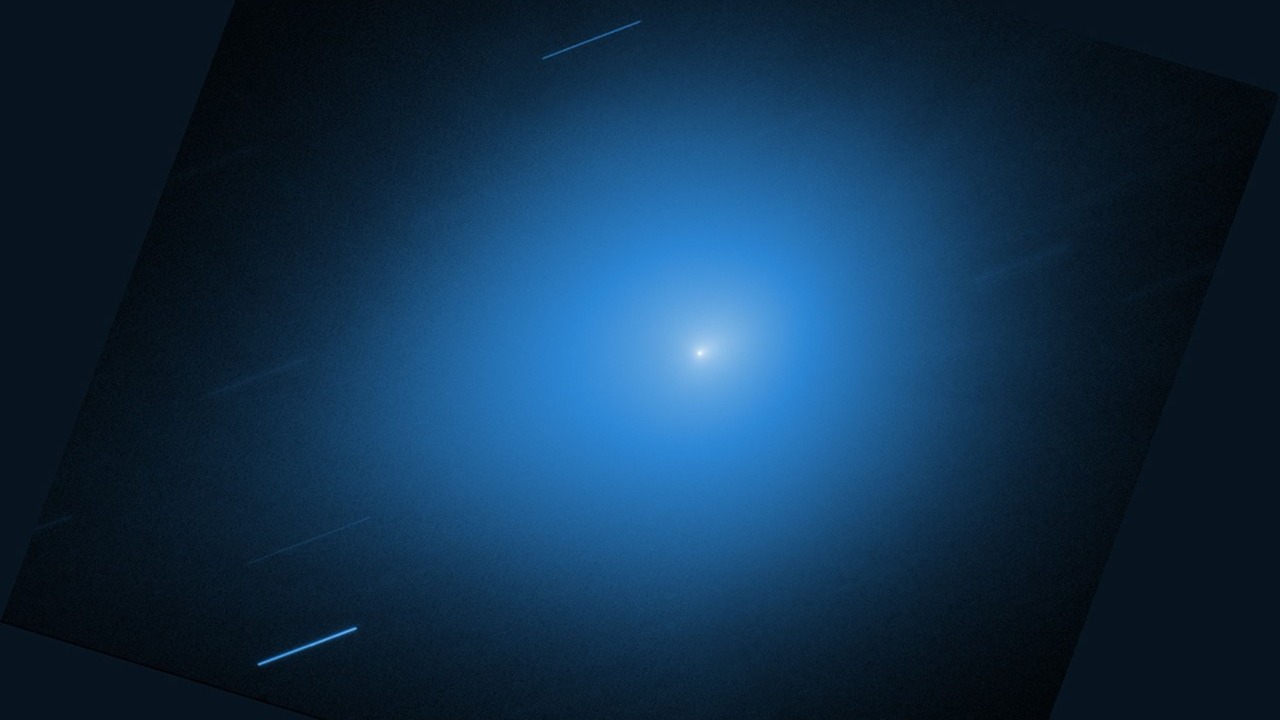

Interstellar comet 3I/ATLAS has just swept past our planet, a brief encounter with an object that was born around another star and will never return. Its flyby offered astronomers a rare chance to watch an untouched relic from deep space race through the inner solar system before it vanishes into the dark again. Now the focus shifts to what its outbound journey can still reveal about our own neighborhood and the wider galaxy.
What makes 3I/ATLAS an interstellar visitor
I see 3I/ATLAS as part of a tiny, elite class of objects that have crossed the Sun’s realm from far beyond its gravitational reach. Astronomers recognized that this comet did not originate here because its path through space is hyperbolic, meaning it is moving too fast to be bound to the Sun and will escape, never looping back like a typical long period comet. Observations of the trajectory showed that 3I/ATLAS is on a one way trip, never to be seen again once it leaves the planetary region behind.
The comet’s name encodes that outsider status. The “3I” tag marks it as only the third confirmed interstellar object, while “ATLAS” points to the Asteroid Terrestrial impact Last Alert System that first spotted it. In the official catalog it is also listed as C/2025 N1, and that embedded “202” sequence in the designation is part of the formal record of how it was logged and tracked. The survey that discovered it has already lent its name to several other icy bodies, but 3I/ATLAS stands apart from earlier Comet ATLAS finds because its inbound speed and direction clearly identify it as an interstellar traveler rather than a native of the distant Oort cloud, as summarized in the technical overview of 3I/ATLAS.
How ATLAS found a comet from another star
When I look at how 3I/ATLAS was discovered, the story starts with a system built to guard Earth from far more familiar threats. The Asteroid Terrestrial impact Last Alert System was designed to scan the sky for potentially hazardous near Earth objects, but its wide field cameras are equally good at catching anything that moves against the background stars. In this case, the automated pipeline flagged a faint, fast moving point that did not match known asteroids, and follow up work revealed the fuzzy coma that marked it as a comet, quickly tying the find to the ATLAS survey in its official name.
Once the initial orbit was calculated, the object’s interstellar nature became clear, and the designation 3I/ATLAS was assigned to reflect that it followed 1I/ʻOumuamua and 2I/Borisov as the third recognized interstellar visitor. The catalog entry that lists it as C/2025 N1, with the embedded “202” in that string, captures the timing and sequence of its discovery in the broader comet database. That same record, compiled under the heading of Comet ATLAS, ties the find back to the survey’s hardware and software, underscoring how a system built to watch for impact risks can also open a window onto the wider galaxy.
The close pass by Earth and what we actually saw
For observers on the ground, the most dramatic chapter in the story unfolded as 3I/ATLAS made its closest approach to Earth. The comet “zoomed past” our planet at a safe distance, racing through the inner solar system while astronomers and dedicated amateurs tracked its motion night by night. Coverage of the flyby captured the excitement with live updates that greeted readers with lines like “Did you see it?” and “Good morning space fans!” as the interstellar visitor swept by Earth and observers prepared to say farewell to our icy guest, a mood reflected in the running commentary on the closest to Earth coverage.
Despite the drama of an interstellar comet in our cosmic backyard, 3I/ATLAS never became a naked eye spectacle. Reports ahead of the encounter stressed that, although it would pass relatively near by astronomical standards, it would remain too faint for unaided viewing from Earth. Instead, those with access to small telescopes or sensitive cameras were told they could still pick it up as a dim smudge against the stars as it moved through our solar system. That guidance, framed around questions like “Will you be able to see 3I/ATLAS from Earth?” and “Where is it now?”, anchored expectations for skywatchers following the comet’s path past Earth.
Where 3I/ATLAS is now in the sky
With the closest approach behind it, 3I/ATLAS is already receding into the outer reaches of the planetary system, but it has not yet vanished from view for those with the right equipment. Current tracking data place the comet in the constellation of Leo, a region of the sky that rises prominently in the late night and early morning hours. At this stage of its journey, Comet 3I/ATLAS is roughly 269,237,011.4 kilometers from Earth, a distance that grows each day as it climbs away from the Sun along its outbound trajectory, according to the live ephemeris for Comet 3I/ATLAS.
For astronomers, the precise coordinates matter as much as the distance. The same tracking tools list the comet’s current Right Ascension and Declination, the celestial equivalents of longitude and latitude, which allow professional observatories and advanced amateurs to point their instruments exactly where 3I/ATLAS will be at a given time. Even as it fades, that positional information is crucial for gathering the last possible spectra and images before the comet becomes too dim to study. The fact that such detailed live data are available for an object that originated around another star highlights how quickly the global observing network can pivot to follow an unexpected visitor once it enters our skies.
How to keep watching a fading interstellar comet
For anyone hoping to catch a final glimpse, the window is narrowing but not yet closed. Although 3I/ATLAS never brightened enough to be seen without optical aid, it remains within reach of modest backyard telescopes and high sensitivity cameras for now. Guides aimed at the public have emphasized that, since its discovery, space agencies and observatories around the world have trained their instruments on 3I/ATLAS to study it during this brief passage, and that while it is already fading as time progresses, determined observers can still track it with careful planning and dark skies, as explained in practical viewing advice on how to see ATLAS.
From my perspective, the key is to treat 3I/ATLAS less like a showpiece comet and more like a subtle, technical target. That means relying on up to date charts that incorporate its changing Right Ascension and Declination, using long exposure imaging to pull its faint glow out of the background, and tempering expectations about what the eye alone can see. The payoff is the knowledge that any successful observation is a direct encounter with material that condensed around a distant star, survived ejection into interstellar space, and is now briefly accessible from Earth before it disappears forever into the dark between the stars.
Next stop: Jupiter’s neighborhood and the outer solar system
Looking ahead, the most important milestone on 3I/ATLAS’s outbound path is its passage by Jupiter. Orbital calculations show that the comet will head toward the giant planet next, where it is expected to make its closest approach in the coming phase of its journey. That encounter will not turn 3I/ATLAS into a captured moon or long term resident, but the immense gravity of Jupiter can still tweak its trajectory, slightly altering the exact direction in which it will leave the solar system, a prospect highlighted in forward looking analyses of what comes after its closest pass of Earth and where it is heading next toward Jupiter.
Beyond that rendezvous, 3I/ATLAS is on a one way route toward the outer solar system and then interstellar space. Reports on its post encounter trajectory describe it as heading for the outer solar system after its closest approach to Earth, a phrasing that captures both the scale of its remaining journey and the finality of its departure. As it crosses the orbits of the giant planets and moves into the realm of the Kuiper belt and beyond, the comet will grow steadily fainter until it is effectively lost to all but the most powerful instruments, a farewell already anticipated in coverage that bids “Farewell, comet 3I/ATLAS!” as the interstellar visitor heads away from Earth.
Why scientists are racing to collect data before it vanishes
Every hour that 3I/ATLAS spends within reach of our telescopes is scientifically precious, which is why observatories have been racing to gather as much data as possible before it fades. Interstellar comets offer a direct sample of material that formed around other stars, preserving chemical fingerprints that can be compared with those of native solar system comets. By measuring the gases and dust streaming from 3I/ATLAS as it warms near the Sun, researchers can test whether its ices contain the same mix of water, carbon compounds, and more exotic molecules that we see in long period comets, or whether its composition points to a very different kind of planetary nursery.
The fact that 3I/ATLAS is on a hyperbolic, never to return path adds urgency to that work. Once it recedes beyond the reach of current instruments, there will be no second chance to refine measurements or revisit unanswered questions. That is why the initial recognition that it did not originate in our solar system, based on the way its trajectory diverged from bound orbits, triggered such a rapid response from the global astronomy community. The same orbital analysis that showed it would be “never to be seen again” also set the clock ticking on a narrow observing window, a reality spelled out in the official ATLAS facts and FAQs.
What 3I/ATLAS tells us about our place in the galaxy
For me, the deeper significance of 3I/ATLAS lies in what it implies about the Milky Way as a whole. The very existence of an object like this, passing through our solar system on a hyperbolic path, suggests that planetary systems routinely eject comets and small bodies into interstellar space. Each interstellar comet we detect is likely just one of countless similar fragments drifting between the stars, the debris of planet formation processes that may resemble, or differ from, those that shaped our own system. By comparing the behavior and composition of 3I/ATLAS with earlier interstellar visitors, astronomers can start to build a statistical picture of how common certain materials and structures are across different stellar nurseries.
At the same time, the fleeting nature of the encounter is a reminder of how small our observational window still is. We only recognized 3I/ATLAS as an interstellar object because surveys like the Asteroid Terrestrial impact Last Alert System now scan large swaths of the sky with enough sensitivity to catch fast moving, faint targets. As those systems improve, I expect the trickle of interstellar detections to grow into a steady stream, turning rare events into a new branch of comparative planetology. For now, though, 3I/ATLAS remains a singular messenger, a piece of another star’s history that briefly brushed past Earth before setting course for the outer solar system and the long, cold journey beyond.
More from MorningOverview