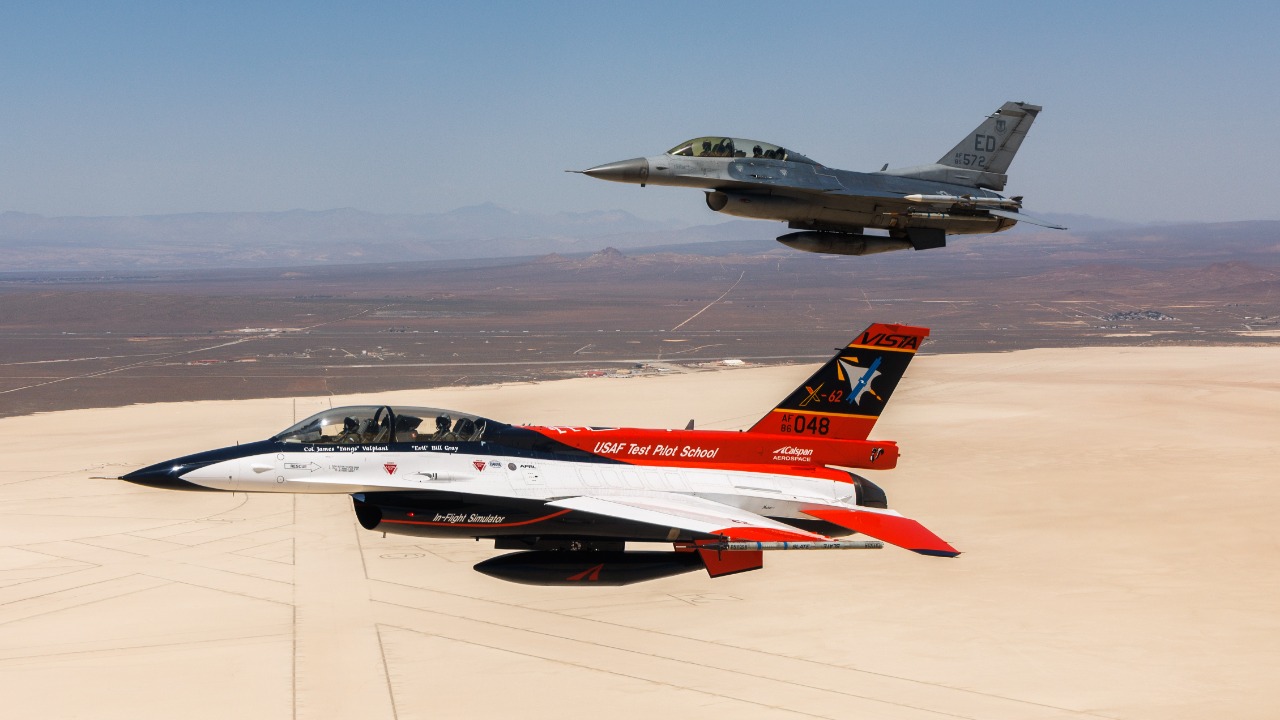

The X-62 VISTA test jet is moving into a new phase, with a fresh round of upgrades designed to push autonomous flight from controlled experiments toward operationally realistic combat scenarios. By expanding its mission systems, sensors, and software, the aircraft is being positioned as a central proving ground for how artificial intelligence can safely fly, fight, and team with human pilots at high speed.
That shift matters well beyond a single modified fighter. The way the Air Force configures and uses X-62 VISTA in the next few years will shape how quickly autonomy moves from lab code to trusted capability, and how confidently commanders can ask algorithms to make decisions in real time under threat.
The X-62 VISTA’s new chapter as an autonomy workhorse
The X-62 VISTA has already earned a reputation as a landmark artificial intelligence and autonomy testbed, and the latest upgrade program is intended to deepen that role rather than replace it. Officials describe a suite of mission system improvements that will let the aircraft explore more complex behaviors, from advanced human‑machine teaming to higher risk envelope expansion, while still retaining its core identity as a variable stability platform that can mimic other aircraft. The fact that the Air Force is investing in a new round of enhancements instead of retiring the jet underscores how central it has become to autonomy experimentation.
Program leaders frame the work as a way to expand the boundaries of flight testing, not just add gadgets. The X-62 designation itself is treated as a marker of experimental importance, and the aircraft’s status as a dedicated autonomy and artificial intelligence asset is highlighted in official descriptions of the landmark X-62 VISTA. By tying the upgrades directly to more ambitious AI flight trials, the Air Force is signaling that this single airframe will remain a primary gateway between cutting‑edge autonomy research and the realities of combat aviation.
From training oddity to centerpiece of AI experimentation
Long before it became a headline autonomy demonstrator, VISTA was a niche training asset built to behave like other jets. The aircraft is a modified F-16 that was turned into a Variable Stability In‑flight Simulator Test Air platform, allowing engineers and test pilots to dial in different handling qualities and simulate future designs. That heritage is crucial, because it means the jet was always meant to be a chameleon, able to adopt new flight control laws and mission system configurations without starting from a clean sheet.
Industry material describes how this flexibility has been repurposed for autonomy, with the same variable stability backbone now hosting advanced algorithms and sensor fusion software. In corporate language, VISTA X-62 Advancing Autonomy and Changing the Face of Air Power is presented as a one‑of‑a‑kind training airplane that has evolved into a testbed for new concepts of air combat and situational awareness across domains. That evolution from simulator to autonomy lab explains why the Air Force sees so much value in keeping the jet current with the latest mission systems.
Inside the upgrade package: mission systems and software
The current modernization push is less about raw speed or maneuverability and more about what the aircraft can sense, process, and decide. Officials describe a variety of mission system upgrades that will give the X-62 more powerful computing, improved data links, and a richer set of interfaces for both onboard and offboard autonomy. The goal is to let AI agents run more sophisticated decision‑making logic in real time, while still giving safety pilots and test engineers precise control over when and how those agents take charge.
Reporting on the program notes that the artificial intelligence and autonomy testbed is receiving these mission system enhancements specifically to support expanded experimentation with autonomous flight capabilities, including more demanding combat‑like scenarios. Coverage of the radar and other upgrades planned for the experimental jet, attributed By Stephen Losey, emphasizes that the X-62 VISTA will be used to test how AI handles complex engagements, not just basic navigation. That focus on mission systems and software, rather than airframe changes, reflects a broader shift in airpower where code and sensors increasingly define combat value.
PhantomStrike radar and the sensor-driven autonomy push
The headline hardware addition in this upgrade cycle is a new radar that will feed the aircraft’s autonomy stack with a far richer picture of the battlespace. The Air Force plans to equip the fighter with Raytheon’s PhantomStrike, a compact active electronically scanned array that can track multiple targets, support electronic warfare, and operate on smaller platforms than traditional fighter radars. For an AI testbed, that means algorithms can be trained and evaluated against realistic sensor data instead of simplified simulations.
Detailed reporting explains that the service intends to install the PhantomStrike on the X-62 fighter specifically for AI combat testing, highlighting how the radar’s active electronically scanned array design will support advanced autonomy trials in air‑to‑air and potentially air‑to‑surface roles. One account notes that the Air Force will use the PhantomStrike radar for AI combat testing, while another describes how RTX’s sensor will help validate how data feeds into autonomy algorithms on systems like VISTA. In that second account, the radar is framed as part of a broader research method in which a sensor‑rich testbed allows program teams to see how autonomy performs in roles such as electronic support or distributed strike, a point underscored in coverage of the RTX radar selected to support autonomous X-62A fighter testing.
Why the Air Force is betting on VISTA for AI combat trials
For the Air Force, the X-62 VISTA is not just another test jet, it is a way to compress years of autonomy development into a manageable flight program. Officials have stressed that as autonomy matures, they need platforms that can safely and repeatedly expose AI agents to realistic edge cases, from dense threat environments to complex formations, without risking frontline aircraft. VISTA’s combination of variable stability controls, safety pilot oversight, and now upgraded mission systems makes it uniquely suited to that role.
Earlier coverage of the program highlighted how, with AI still a nascent technology, VISTA’s ability to churn through flight tests could be critical for the Air Force as it looks to field collaborative combat aircraft and other autonomous systems. One detailed look inside the special F-16 the service is using to test out AI described how With AI still a nascent technology, VISTA provides a bridge between software labs and operational squadrons. The new upgrades effectively double down on that bet, giving the service a more capable sandbox in which to refine tactics, techniques, and procedures for AI‑piloted jets.
How the upgrade expands the scope of autonomy testing
The stated aim of the current work is to expand the role of X-62 VISTA in flight testing of autonomy and artificial intelligence, not just keep it flying. That means moving beyond basic demonstrations of AI control to more demanding missions where the algorithm must prioritize targets, manage fuel and weapons, and coordinate with human wingmen. The aircraft’s variable stability design lets engineers stress these behaviors under different handling qualities, while the new mission systems and radar provide the data and connectivity needed for realistic scenarios.
Specialist coverage of the program spells out that the US Air Force Test Center wants the upgraded jet to support autonomy that can make decisions in real time, including in contested environments. One detailed account of how the US Air Force Test Center expects autonomy to make decisions in real time on the X-62 emphasizes that the goal is to test AI that can react dynamically rather than follow rigid scripts. Another report on the same upgrade effort notes that the X-62 VISTA will be used to expand its role in flight testing of autonomy and artificial intelligence as a Variable Stability In‑flight Simulator Test Aircraft, a point reinforced in coverage of how X-62 VISTA is to be upgraded to expand its role.
Institutional backing and test ecosystem integration
The scale of the upgrade effort reflects not just technical ambition but institutional commitment. Air Force Materiel Command and the test wings at Edwards and Eglin are treating the X-62 as a shared asset in a broader advanced test ecosystem, where data from one platform feeds models and simulations across the enterprise. Leaders have spoken about the need to expand test capacity and resilience across these ecosystems, with VISTA serving as a key node that can host emerging autonomy packages before they migrate to other aircraft.
Official descriptions of the program emphasize that as the Air Force expands its use of autonomy, it must also expand its test infrastructure, and that is where VISTA’s flexibility is particularly valuable. One account from Eglin notes that as the Air Force expands autonomy it must grow resilience across advanced test ecosystems, explicitly linking the X-62 VISTA upgrade to that broader strategy. A parallel account from Edwards reinforces that the X-62 VISTA begins an upgrade program that is meant to expand boundaries in flight testing, not operate in isolation.
Industry partners and the wider autonomy portfolio
The X-62 effort also sits within a larger web of industry partnerships around autonomy and sensors. Raytheon, now part of RTX, is supplying the PhantomStrike radar and has publicly discussed how that system could be integrated into uncrewed aerial vehicles, light attack aircraft, rotary‑wing platforms, and in this case the X-62. The company has its own autonomous aircraft portfolio, including the V-Bat UAS that has seen combat service in Ukraine, and lessons from those programs are likely informing how it supports AI testing on crewed fighters.
Reporting on the radar deal notes that Raytheon said PhantomStrike could be integrated into a range of platforms, underscoring how the X-62 installation doubles as a pathfinder for other aircraft. At the same time, official program summaries aimed at the rotorcraft and broader aviation community describe how X-62 VISTA Begins Upgrade Program to Expand Autonomy Testing, using phrases like “Begins Upgrade Program” and “Expand Autonomy Testing” to signal that this is part of a sustained push rather than a one‑off modification. That alignment between government and industry narratives suggests a shared expectation that what is proven on VISTA will ripple across the Air Force’s future fleet.
What success looks like for the X-62 upgrade
For all the technical detail, the measure of success for the X-62 VISTA upgrade will be relatively simple: can it safely and repeatedly demonstrate autonomous behaviors that commanders are willing to trust in combat. That includes AI agents that can fly the jet across its envelope, manage complex engagements, and coordinate with human pilots without creating unacceptable workload or risk. It also includes the less glamorous but equally critical task of generating high‑quality data to train, validate, and refine those agents.
Program descriptions consistently return to the idea that the X-62 is a testbed, not an operational weapon, but the stakes are clearly operational. Official Air Force material describes the landmark X-62 VISTA as central to expanding boundaries in flight testing of autonomy and artificial intelligence, while industry framing of VISTA X-62 Advancing Autonomy and Changing the Face of Air Power makes clear that the ultimate goal is to influence how future air forces fight. If the upgraded jet can deliver reliable, repeatable evidence that AI can handle those demands, it will have justified its place at the center of the autonomy test ecosystem.
More from MorningOverview