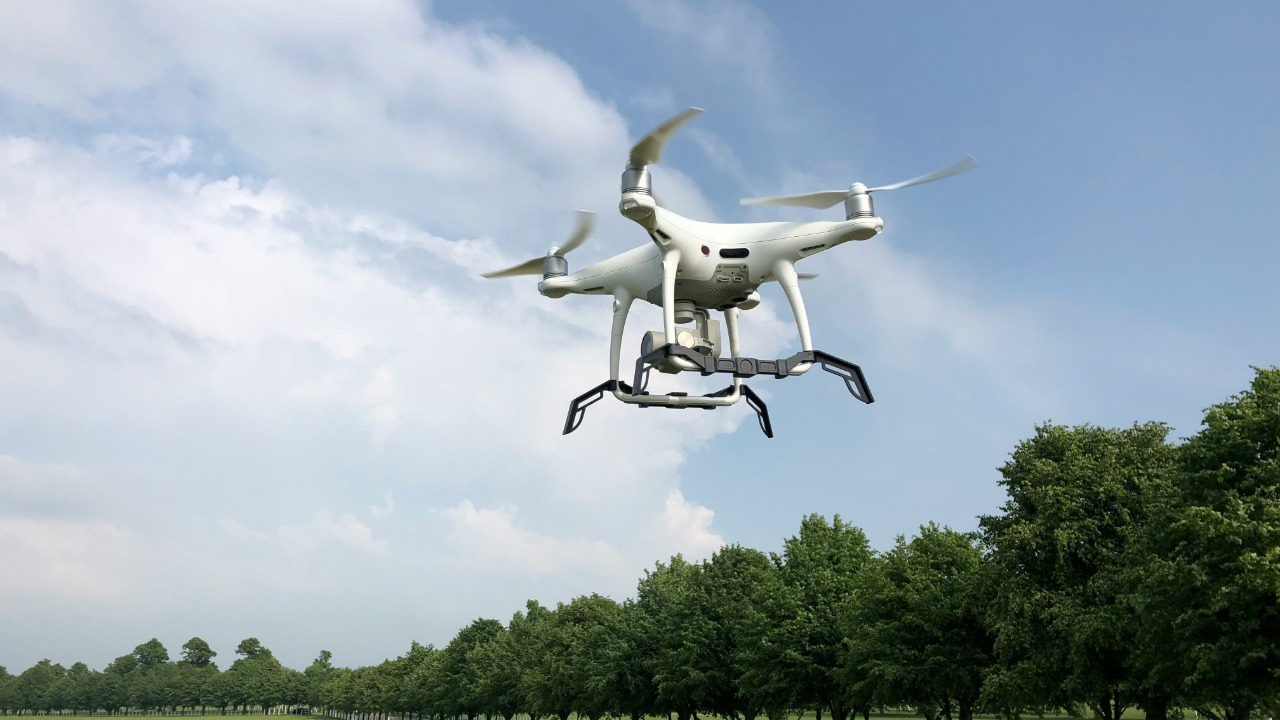

Military researchers are now proving that drones do not always need to carry their own fuel or batteries. In recent tests, aircraft have stayed aloft while being fed energy from the ground through tightly focused laser beams, reaching altitudes around 5,000 feet and hinting at a future of virtually continuous flight. The concept sounds like science fiction, but the underlying technology is advancing fast enough that defense planners are already treating it as a serious tool rather than a lab curiosity.
At the center of this shift is a new generation of high power optical systems that can track a moving aircraft and convert light back into usable electricity with surprising efficiency. I see this as part of a broader trend in which energy is treated less like something you store on a vehicle and more like a service delivered on demand, with lasers acting as invisible power lines in the sky.
How laser power-beaming keeps drones flying
The basic idea behind laser power-beaming is simple: instead of loading a drone with heavy fuel or oversized batteries, a ground station points a high power beam of light at a receiver on the aircraft, which converts that light into electrical energy. In the most recent demonstrations, that beam has successfully reached aircraft flying up to 5,000 feet (1,524 meters), a practical ceiling for many small and medium unmanned systems. By keeping the power source on the ground, engineers can scale up generation capacity without worrying about weight or volume on the drone itself.
In practice, the system relies on a precise dance between optics and tracking software. A ground based transmitter locks onto the drone and continuously adjusts the beam to compensate for motion, wind and atmospheric distortion, while the airborne receiver keeps its photovoltaic or specialized conversion surface pointed back at the source. I see the appeal for militaries that want persistent surveillance or communications relays without the cost and complexity of large satellites, because a drone that can sip power from a laser for hours or days at a time becomes a far more flexible asset than one that must land every few hours to refuel.
The new laser system built for American aircraft
One of the most concrete implementations so far is a new laser system designed specifically to transmit energy in mid air to American aircraft. Reporting on the project describes a new laser that can send power to American aircraft at an altitude of 1.500 meters, with the developers framing the concept as having effectively unlimited range as long as line of sight can be maintained. That figure, 1.500 meters, aligns closely with the 5,000 foot envelope seen in other tests, suggesting that the technology is maturing around a realistic operational band rather than a one off stunt.
What stands out to me is how this system is being pitched not just as a lab demonstration but as a building block for real missions. The same reporting notes that PowerLight’s laser technology enables in flight energy transfer that could keep aircraft in the air far longer than their onboard batteries would normally allow, especially for roles like border monitoring or communications relay where the aircraft can loiter within a defined corridor. By focusing on American aircraft and explicitly citing 1.500 meters as a design point, the developers are signaling that they are working within the constraints of existing unmanned platforms and airspace rules rather than designing for an abstract future fleet.
Inside the high-power transmitter and airborne receiver
Under the hood, the architecture is built around an autonomous, high power laser transmitter on the ground paired with a lightweight receiver on the aircraft. At the center of the system is an autonomous, high-power laser transmitter that can track and illuminate a moving target without constant human steering, which is essential if the drone is to maneuver or operate in less than perfect weather. The airborne component is deliberately kept light so it can be bolted onto existing drones without gutting their payload capacity, essentially acting as a specialized solar panel tuned for the laser’s wavelength.
Together, these components are intended to create what the company behind the project describes as a kind of wireless power line in the air. Reporting on the design notes that together, the components form a continuous energy link that can feed power to the drone while also supporting optical data links, which opens the door to combined power and communications channels. I see this integration as crucial, because it means the same optical train that keeps the drone alive can also carry encrypted control signals or sensor data, reducing the need for separate radios that might be easier to jam or intercept.
From lab demo to PTROL-UAS field testing
The shift from concept to field testing is happening under a program known as PTROL-UAS, which is focused on creating persistent, tether like power links to unmanned aircraft without the physical cable. A key objective of PTROL-UAS is to establish power beaming as a reliable method for both communications and remote power delivery, effectively merging what used to be separate infrastructure into a single optical channel. The program’s test flights at around 5,000 feet are not just about proving that the physics works, they are about validating tracking, safety interlocks and integration with existing air traffic control procedures.
According to detailed accounts of the trials, PowerLight Technologies has completed development and testing of a new system under this program that can beam energy to aircraft so they can remain in the air for far longer than their internal batteries would allow. One report notes that PowerLight Technologies has completed development and testing of a new laser that can beam power mid air to US aircraft at 5,000 feet for what the company describes as infinite range, with the testing conducted under the Power Transmitted Over Laser for Unmanned Aerial Systems effort. I read that as a sign that the technology is moving into a pre operational phase where the next step is not another lab upgrade but actual flight demonstrations in more realistic conditions.
Technical milestones and what they mean for endurance
Behind the headlines about infinite range and 5,000 foot ceilings are some very specific engineering milestones. Technical summaries of the project explain that the core of the system involves a high power ground based transmitter and a carefully engineered airborne receiver that together have cleared a series of performance gates, from stable beam propagation to safe automatic shutdown if the link is interrupted. One detailed briefing on the work highlights technical details and testing milestones that include sustained power transfer at operationally relevant distances and the successful handoff of control between different ground stations, which is essential if drones are to roam over wide areas.
For endurance, these milestones translate into a simple but powerful shift: instead of designing drones around the energy they can carry, planners can start designing around the energy they can receive. If a surveillance drone can climb to 5,000 feet, lock onto a laser and then circle for hours while its batteries stay near full charge, its effective time on station is limited more by airframe fatigue or weather than by fuel. I see this as particularly significant for missions like maritime patrol or disaster response, where a small unmanned aircraft could hover over a search area for an entire day while a truck mounted laser quietly feeds it power from the shore.
Industrial partnerships and the race to operationalize
Turning laser power-beaming into a deployable system requires more than clever optics, it demands industrial partnerships that can integrate the technology into real platforms and networks. PowerLight is already working with Kraus Hamdani Aerospace to marry its ground based lasers with long endurance unmanned aircraft, a collaboration that aims to prove that the concept can scale beyond small quadcopters. Reporting on the partnership notes that PowerLight is working with Kraus Hamdani Aerospace on systems that combine power beaming, communications and remote power delivery, which hints at a future where a single drone might act as both a flying cell tower and a persistent sensor node.
These alliances matter because they determine how quickly the technology can move from demonstration to procurement. When a company like PowerLight teams up with an aircraft maker that already has vehicles in service, the path to fielding a laser powered variant is shorter than if the entire stack had to be built from scratch. I see a competitive dynamic emerging in which different defense contractors race to offer laser ready drones, ground stations and control software, each promising better efficiency, safety and integration with existing command networks, and that competition is likely to accelerate innovation in areas like beam steering, atmospheric compensation and onboard power management.
Why militaries care about 5,000 feet and “infinite” range
The specific figures that keep appearing in these reports, 5,000 feet and 1.500 meters, are not arbitrary. Operating at around 5,000 feet keeps drones below the cruising altitudes of commercial airliners while still high enough to cover large areas with sensors or communications payloads, which makes regulatory approval and deconfliction with other air traffic more manageable. When developers describe their systems as capable of supporting aircraft at 5,000 feet for infinite range, they are really pointing to a sweet spot where the physics of beam propagation, the needs of military missions and the realities of shared airspace all intersect.
From a strategic perspective, the promise of effectively unlimited endurance at these altitudes is attractive because it allows small, relatively inexpensive drones to take on roles that once required large, costly platforms. A network of laser fed unmanned aircraft could provide continuous coverage over a border region, a maritime chokepoint or a disaster zone without the logistical burden of constant launch and recovery cycles. I see this as part of a broader shift in defense thinking, where persistence and resilience are valued as much as raw speed or payload, and where the ability to quietly keep a sensor in the sky for days at a time can be more valuable than a short, high intensity sortie.
Risks, limitations and the path ahead
For all the promise, laser power-beaming is not a magic solution, and the current systems come with real constraints. Line of sight is non negotiable, so terrain, buildings and even heavy weather can break the link, and safety systems must ensure that the beam does not pose a hazard to people, wildlife or other aircraft that might cross its path. The need for precise tracking also means that ground stations must be carefully sited and maintained, which could limit how quickly the technology can be deployed in rough or contested environments where infrastructure is vulnerable.
There are also broader questions about how adversaries might respond, from trying to jam or spoof the tracking systems to targeting the ground based transmitters themselves. Yet the steady march of testing milestones, from the initial 1.500 meter demonstrations to the more recent flights at 5,000 feet, suggests that developers are systematically working through these challenges rather than hand waving them away. As I look at the trajectory of the work, especially the detailed reports of recent tests and the emphasis on upcoming flight demonstrations, it seems clear that laser powered drones are moving from speculative concept to a near term option that commanders and policymakers will have to factor into their plans.
More from MorningOverview