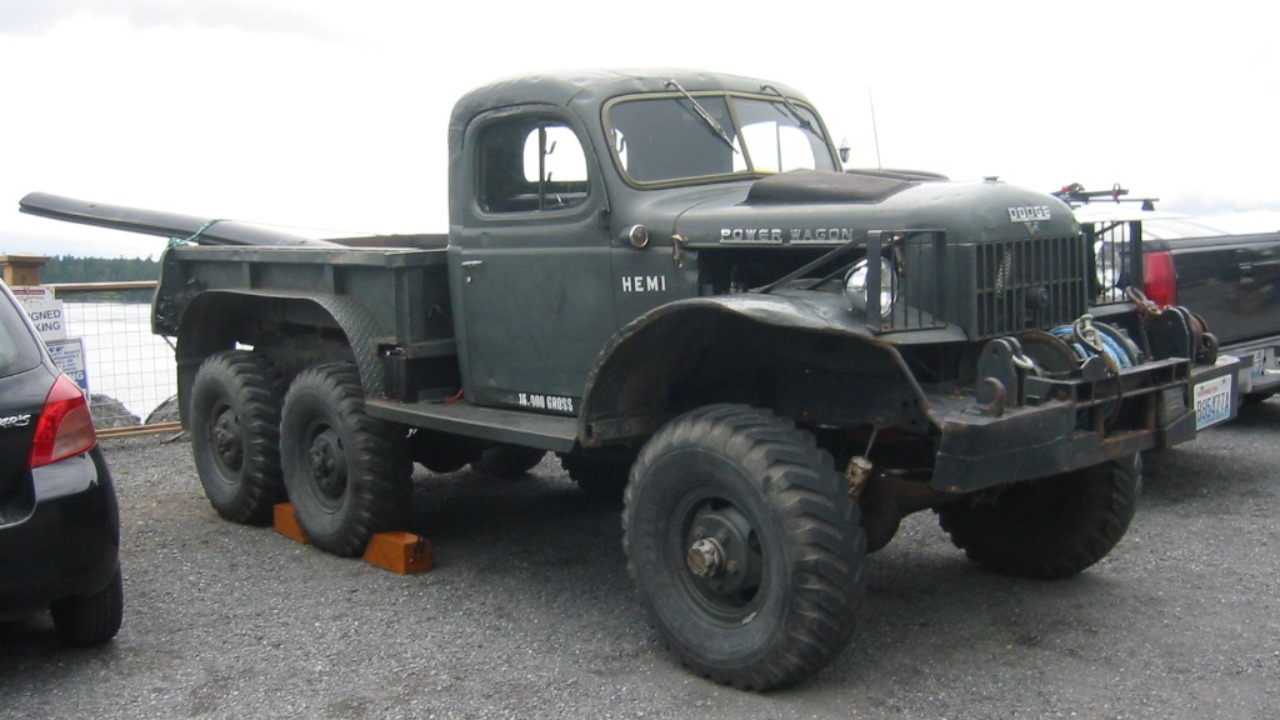

Long before four-wheel-drive badges became a marketing arms race, Dodge quietly put a purpose-built off-road pickup into American driveways. The Power Wagon arrived as a civilian workhorse with military bones, giving farmers, contractors, and explorers a factory 4×4 years before Ford or Chevrolet offered anything comparable. I see that truck not just as a rugged relic, but as the blueprint for the modern off-road pickup culture that followed.
To understand how Dodge got there first, it helps to trace the company’s truck lineage from early commercial haulers to wartime machines and finally to a civilian pickup that could claw its way through mud and rock. The Power Wagon’s story is also a reminder that innovation in trucks has often come from practical necessity rather than lifestyle branding, even if today’s restomods and trail rigs now celebrate that heritage in glossy paint and lifted suspensions.
The road to Dodge’s first serious off-road pickup
Dodge did not stumble into off-road leadership by accident, it built toward it over decades of truck development. In the period described as The Emergence of Dodge Trucks, the company expanded its lineup to serve industrial and commercial buyers who needed durability more than comfort. During the 1920s and 1930s, that meant heavier frames, stronger axles, and simple, serviceable drivetrains that could survive rough roads and overloaded beds. By the time global conflict arrived, Dodge already knew how to build trucks that could take abuse.
Those prewar lessons fed directly into the military vehicles that would later shape Dodge’s off-road identity. During the Second World War, the brand supplied 3/4-ton WC series trucks to the armed forces, machines that had to operate in mud, sand, and snow with little support. When peace returned, Dodge recognized that many rural and industrial customers faced similar terrain, even if their missions involved hay bales instead of artillery. That realization set the stage for a civilian pickup that would borrow heavily from wartime hardware while targeting farmers, ranchers, and contractors who needed a truck that could go almost anywhere.
From battlefield to back forty: how the Power Wagon was born
The Power Wagon’s origin story is as straightforward as it is significant. Mechanically, the truck was mechanically derived from Dodge’s 1942–1945 3/4-ton WC series military trucks, which meant it inherited a ladder frame, live axles, and a robust four-wheel-drive system proven in combat. Dodge essentially took that architecture, added a civilian cab and bed, and created a pickup that could tackle the same brutal conditions soldiers had faced overseas. The result was not a softened, suburbanized truck, but a civilianized piece of military hardware.
That lineage mattered because it made the Power Wagon the first civilian production 4×4 truck offered straight from a major manufacturer. Instead of relying on aftermarket conversions or specialty builders, buyers could walk into a Dodge dealer and order a pickup that was ready for logging roads, mountain passes, or unplowed fields right off the lot. In an era when most trucks were still rear-wheel drive and intended for paved or graded surfaces, Dodge’s decision to adapt its WC series into a showroom-ready four-wheel-drive pickup effectively created a new category of factory off-road work truck.
Why the Power Wagon counts as the first “proper” off-road pickup
Plenty of vehicles had driven off pavement before the Power Wagon, but this truck set a new standard for what a mass-produced off-road pickup could be. It combined a dedicated four-wheel-drive system, serious ground clearance, and a stout chassis with a usable cargo bed, giving owners both trail capability and real work capacity. As later coverage has noted, this pickup was the first mass-produced 4×4 of its kind, derived directly from Dodge’s military vehicles used in WWII. That combination of volume production and battlefield-proven hardware is what made it more than just a niche experiment.
In my view, what makes the Power Wagon a “proper” off-road pickup is not only its specification sheet but its intent. It was engineered from the outset to operate in hostile environments, not simply to survive the occasional muddy jobsite. The truck’s military roots meant its frame, axles, and transfer case were designed for sustained punishment, while its civilian body and bed made it practical for everyday hauling. That dual-purpose design, equal parts tool and terrain conqueror, is the template that modern off-road pickups still follow.
How Ford and Chevrolet lagged behind Dodge’s 4×4 leap
When Dodge put the Power Wagon into civilian hands, its Detroit rivals were still years away from offering comparable factory four-wheel-drive pickups. Ford, for example, did not bring four-wheel drive into its mainstream truck line until later in the evolution of the Ford F-Series. Early postwar F-Series trucks were primarily rear-drive workhorses, and while Ford experimented with different cab configurations, the company took longer to integrate a full-time four-wheel-drive option directly into its production system. That delay left Dodge alone in the factory 4×4 pickup space for a crucial window of time.
General Motors, through Chevrolet and GMC, also leaned on outside help before fully embracing in-house four-wheel drive. Rather than launching a clean-sheet 4×4 pickup immediately after the war, GM relied on conversion specialists and incremental upgrades. In practical terms, that meant buyers who wanted a GM truck capable of matching the Power Wagon’s off-road performance often had to turn to third-party solutions or wait for the company to catch up. Dodge’s head start gave it a reputation among ranchers, utility crews, and early recreational off-roaders as the brand that would sell them a ready-made, go-anywhere pickup without extra steps.
The NAPCO workaround and GM’s late factory 4×4 answer
One of the clearest signs that Dodge had seized the initiative is the way GM initially outsourced its four-wheel-drive capability. Before GM integrated 4×4 systems into its own assembly lines, buyers could turn to NAPCO kits that converted standard trucks into off-road machines. Eventually, GM went a step further and offered a Factory Installed Option between 1956 and 1959, allowing NAPCO four-wheel-drive hardware to be fitted on the line rather than as an aftermarket add-on. GM redesigned its truck line mid-year in 1955 and soon offered the Powr Pak configuration, which streamlined what had previously been a more cumbersome conversion process.
That Factory Installed Option was an important step for GM, but it also underscored how far ahead Dodge had been. While GM was refining the earlier add on kits into something more integrated, Dodge had already spent years selling a purpose-built 4×4 pickup that did not rely on outside suppliers. The NAPCO era shows how demand for off-road trucks was growing, yet it also highlights that Dodge had recognized and answered that demand earlier, with a fully engineered solution rather than a retrofit package.
Jeep, Willys, and the parallel 4×4 pickup experiment
Dodge was not the only company exploring four-wheel-drive trucks in the postwar period, but its approach differed from the Jeep lineage that grew out of wartime reconnaissance vehicles. Built on the CJ-2A Jeep platform, the Willys-Overland Jeep 4×4 Truck was produced from 1947 to 1965. Like the Power Wagon, it had military roots, but civilians could buy it as a rugged, go-anywhere machine. The Willys truck was narrower and lighter, more closely related to the compact Jeep ethos than to the heavy-duty military haulers Dodge had adapted.
In my assessment, that difference in scale and mission is what separates the Power Wagon from its Jeep-branded contemporaries. The Willys-Overland Jeep 4×4 Truck was an important step in bringing four-wheel drive to smaller pickups and utility vehicles, but Dodge’s truck operated in a heavier class, with payload and towing capabilities that aligned more with commercial and agricultural needs. Together, they show how the off-road pickup idea branched in two directions at once, one toward compact trail rigs and another toward full-size workhorses that could also conquer rough terrain.
How the Power Wagon reshaped pickup expectations
Once Dodge proved that a factory 4×4 pickup could sell, the expectations for what a truck should be began to shift. Buyers who had struggled through winters or remote job sites with rear-drive trucks suddenly had a more capable alternative, and word of mouth among farmers, loggers, and construction crews helped cement the Power Wagon’s reputation. Over time, that reputation fed into a broader understanding that a serious work truck could also be a serious off-road tool, not just a pavement-bound hauler with a bed.
The Power Wagon’s influence can be seen in the way later trucks blended utility with off-road hardware. Locking hubs, low-range transfer cases, and heavy-duty suspensions became selling points rather than obscure spec sheet details. I see a direct line from Dodge’s early 4×4 experiment to the modern expectation that a pickup should be able to tow, haul, and still claw its way up a muddy trail. By getting there first, Dodge helped normalize the idea that four-wheel drive was not a luxury or a niche option, but a core part of what a serious pickup could offer.
From workhorse to icon: the Power Wagon’s modern afterlife
Today, the Power Wagon’s legacy lives on in both factory models and high-end custom builds that celebrate its off-road heritage. Modern interpretations often pair vintage sheetmetal with updated drivetrains, suspension systems, and interiors, turning the original work truck into a collectible trail rig. Enthusiasts now talk about how The Dodge Power Wagon Is a platform for restomods like the black restomod Desert Power Wagon, which blends classic looks with modern performance. That transformation from utilitarian tool to aspirational off-roader shows how far the truck’s image has evolved.
Yet even in its most polished modern form, the Power Wagon’s appeal still rests on the same qualities that defined the original: durability, traction, and a sense that the truck was built to handle more than a paved commute. I find it telling that current off-road packages from multiple brands still borrow the Power Wagon name or styling cues, using them as shorthand for toughness and trail credibility. The truck that once served as a farmhand and field mechanic has become a symbol of off-road authenticity in a market crowded with lifestyle pickups.
How 4×4 pickups fit into the broader all-wheel-drive story
The Power Wagon’s pioneering role in off-road pickups also fits into a longer history of four-wheel and all-wheel-drive experimentation. Long before Detroit embraced 4×4 trucks, engineers were already exploring ways to send power to all four wheels. Learn how Ferdinand Porsche patented an early 4×4 layout, and how concepts like an AWD Porsche EV show that the idea of distributing traction across all four corners has always had both performance and utility applications. Technically, those early experiments were not pickups, but they laid the groundwork for the driveline technologies that trucks would later adopt.
By the time Dodge adapted its military WC series into the Power Wagon, the mechanical principles of four-wheel drive were well understood, but their application to a mass-produced pickup was still novel. I see the Power Wagon as the moment when those ideas jumped from specialized vehicles into the mainstream work truck world. From there, the concept spread outward, influencing everything from compact off-roaders like the Suzuki Jimny to modern AWD crossovers. The Power Wagon’s success proved that four driven wheels were not just for exotic prototypes or battlefield machines, but for everyday drivers who needed to get the job done regardless of terrain.
Why Dodge’s early gamble still matters in today’s truck wars
In the current era of off-road packages, desert racing specials, and rock-crawling trims, it is easy to forget that one company had to take the first real risk on a factory 4×4 pickup. Dodge did that when it turned its wartime WC series into a civilian Power Wagon, effectively betting that enough buyers would pay for capability that went far beyond paved roads. Later coverage has framed this moment with headlines like Dodge Built An Off Road Pickup Before Ford Or Chevy Dared To Try, and the historical record supports that claim.
That early move still shapes how I look at today’s truck market. When I see modern off-road pickups battling for dominance with locking differentials, terrain modes, and lifted suspensions, I see echoes of the moment Dodge decided to sell a military-derived 4×4 to civilians. The Power Wagon proved that there was a market for serious off-road capability in a pickup long before it became a status symbol, and that proof pushed Ford, Chevrolet, and others to follow. In a sense, every factory off-road package on sale today owes a quiet debt to the truck that first brought battlefield toughness to the back forty.
More from MorningOverview