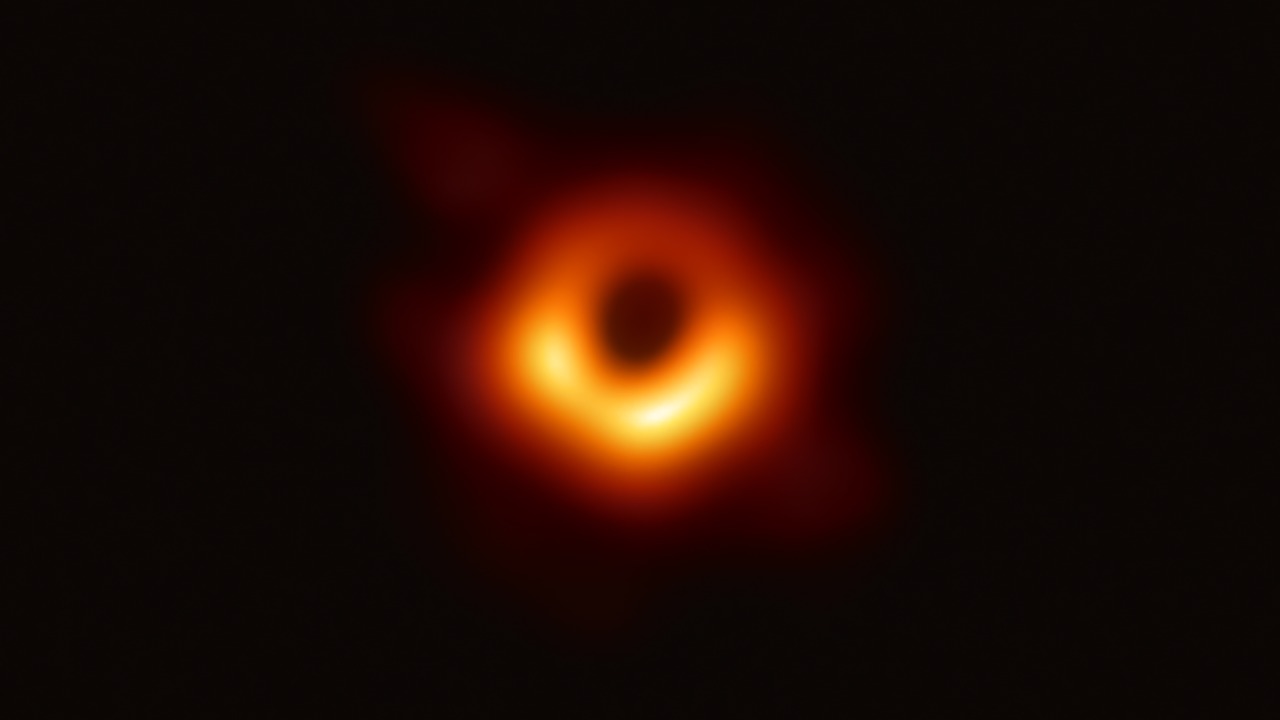

A supermassive black hole has been caught in the act of fleeing its home galaxy, racing through intergalactic space at breakneck speed and reshaping everything in its path. Using the James Webb Space Telescope, astronomers have now confirmed that this cosmic heavyweight is not only on the run but also leaving behind a spectacular trail of newborn stars that stretches across tens of thousands of light years. The discovery turns a long standing theoretical prediction into a vivid, observable reality and forces me to rethink how stable galaxies really are.
Webb’s first runaway supermassive black hole
For decades, theorists have argued that supermassive black holes should sometimes be kicked out of their galaxies, but until now the evidence has been circumstantial at best. The James Webb Space Telescope has finally delivered what researchers describe as the first clear case of such a runaway, confirming a supermassive black hole that is physically separated from its host and plowing through space at extraordinary speed, a result highlighted in detailed analyses of JWST confirms data. The object’s mass is estimated at the equivalent of at least ten million suns, placing it firmly in the heavyweight class of galactic black holes rather than the smaller stellar mass variety that pepper the Milky Way.
What makes this case so striking is the combination of motion, mass, and environment that all point to a genuine escape rather than a quirky internal feature of a galaxy. Astronomers describe the black hole as racing away from its original galactic center at roughly 2.2 million miles per hour, a speed that translates to nearly 1,000 kilometers per second and is far above what ordinary orbital motion would allow for such a massive object, as emphasized in early reports that frame it as the James Webb Space Telescope runaway. At that velocity, the black hole is not just wandering, it is on a one way trajectory out of its galaxy’s gravitational grip.
A monster moving at 2.2 million miles per hour
The raw numbers behind this object are almost absurd. A black hole with the mass of at least ten million suns is already difficult to imagine, but coupling that with a speed of about 2.2 million miles per hour, or 7.5 million kilometers per hour, turns it into a projectile on a galactic scale. Researchers discussing the runaway supermassive black hole stress that this velocity is consistent with a powerful gravitational kick, not with the more sedate motions expected for a central object in a stable galaxy, a point underscored when they describe it as ejected and racing through space. At nearly 1,000 kilometers per second, the black hole would cross the distance between Earth and the Moon in less than five minutes.
That speed has profound consequences for the surrounding gas and stars. As the black hole barrels ahead, it compresses intergalactic material in front of it and drags a turbulent wake behind, creating a dynamic environment that is nothing like the relatively calm outskirts of a typical galaxy. Observations show that this motion is not a brief outburst but a sustained flight, with the black hole already far from the galactic center and continuing to move outward, a scenario that matches theoretical expectations for a high velocity recoil produced during a complex galaxy merger, as highlighted in descriptions of a runaway supermassive object. In practical terms, the galaxy has lost its central anchor, and the black hole is not coming back.
The Cosmic Owl and a bow shock the size of a galaxy
The runaway black hole sits in a system nicknamed the Cosmic Owl galaxies, a pair of interacting galaxies whose distorted shapes and tidal features already mark them as products of a recent merger. Within this chaotic environment, the black hole has carved out a spectacular structure in front of it, a bow shaped shock of gas and dust that spans a scale comparable to an entire galaxy. Astronomers describe this feature as a literal galaxy sized bow shock of matter that is being pushed ahead of the black hole as it plows through the intergalactic medium, a detail that emerges clearly in analyses of Cosmic Owl galaxies imagery. The bow shock glows because the gas is being heated and compressed to extreme conditions as the black hole rams into it.
Behind the bow shock, the black hole leaves a narrow, luminous trail that stretches for tens of thousands of light years, like a contrail behind a jet. This trail is not just a passive smear of gas, it is a region where new stars are forming in large numbers, triggered by the intense compression and turbulence in the wake of the black hole’s passage. The geometry of the bow shock and the trailing line of star formation both point back toward the disturbed core of the Cosmic Owl system, reinforcing the interpretation that the black hole was once at the center and has since been flung outward, a scenario that aligns with the broader picture of James Webb confirms a runaway object racing through the Cosmic Owl galaxies.
Baby stars in the wake of a rogue
One of the most surprising aspects of this discovery is that the black hole is not simply destructive. As it races away, it appears to be seeding the cosmos with new stars, turning its wake into a nursery rather than a graveyard. Observations show a long, thin trail of bright knots that correspond to regions of active star formation, effectively a chain of baby stars that have formed where the gas has been compressed by the black hole’s passage, a phenomenon described as a runaway black hole escaping its galaxy and leaving baby stars in its wake. Instead of a simple void, the path behind the black hole is lit up by these newly minted stellar clusters.
This star forming trail is not a minor side effect, it is central to how astronomers identified the runaway in the first place. The line of newborn stars points directly back toward the disturbed galactic center, like a dotted arrow tracing the black hole’s trajectory over millions of years. Models suggest that the intense gravitational pull and motion of the black hole compress the gas to the point where it collapses into stars, turning a violent ejection into a creative process that builds new stellar populations, a pattern that matches descriptions of a rogue black hole that flees its galaxy while birthing stars along its path. In effect, the black hole is drawing a luminous line across intergalactic space, one cluster of stars at a time.
How do you kick out a ten million solar mass black hole?
Getting a black hole this massive up to 2.2 million miles per hour requires an extraordinary event, and theorists have long pointed to galaxy mergers as the most likely culprit. When two galaxies collide, their central black holes sink toward the middle of the merged system and eventually form a tight binary, orbiting each other at high speed. If a third galaxy, and thus a third black hole, enters the mix, the gravitational interactions can become chaotic, with one of the black holes flung outward at high speed while the remaining pair settles into a new configuration, a scenario that has been discussed by astronomers as a natural outcome of complex mergers. In that picture, the runaway is the loser of a gravitational three body brawl.
Another mechanism involves gravitational waves, the ripples in spacetime produced when two supermassive black holes merge. If the waves are emitted more strongly in one direction than another, conservation of momentum demands that the newly merged black hole recoil in the opposite direction, like a rocket experiencing thrust. The velocities predicted by such gravitational wave kicks can reach thousands of kilometers per second, enough to eject a black hole from even a massive galaxy, and the observed speed of nearly 1,000 kilometers per second for this runaway fits comfortably within that range, as highlighted in discussions of a long predicted massive escape that finally appears to have been observed when RBH 1 changed that. In either case, the runaway black hole is the visible aftermath of a violent, multi black hole interaction at the heart of the Cosmic Owl system.
Why this confirms a long standing prediction
Astrophysicists have been predicting runaway supermassive black holes for years, but until now the evidence has been limited to ambiguous candidates and indirect hints. Some galaxies appear to have off center active nuclei, and others show signs of missing central black holes, but none of these cases provided the full package of a clearly detached black hole, a visible trail of star formation, and a plausible dynamical history. The new observations change that by delivering a system where all the pieces line up, from the disturbed morphology of the Cosmic Owl galaxies to the high velocity object and its luminous wake, a combination that has been framed as the first runaway supermassive black hole tearing through space in detailed Dec JWST analyses. The result is less a surprise than a long awaited confirmation of what theory has been insisting on for decades.
That confirmation matters because it validates the broader picture of how galaxies and their central black holes co evolve. If mergers are common, and if those mergers sometimes eject the central black hole, then galaxies can temporarily or permanently lose the very objects that are thought to regulate their growth through energetic feedback. The runaway in the Cosmic Owl system shows that such ejections do happen in nature, not just in simulations, and that they can leave behind distinctive signatures like star forming trails and galaxy sized bow shocks, a pattern that has been emphasized in reports that describe a first of its kind confirmation. In that sense, the runaway black hole is both a spectacular object in its own right and a crucial test of the physics that underpins modern galaxy formation models.
What a galaxy without its central black hole looks like
Galaxies are often described as growing around their central black holes, with the mass of the black hole tightly correlated with the mass of the surrounding stellar bulge. If a galaxy loses that central anchor, the relationship is broken, at least temporarily, and the galaxy’s future evolution can diverge from the standard path. In the case of the Cosmic Owl system, the ejection of the central black hole means that the remaining galaxy is now effectively without a supermassive core, a situation that has been highlighted in discussions of how galaxies assemble and grow around such objects. Without the intense radiation and jets from an active nucleus, star formation in the core could proceed differently, perhaps more gently, or perhaps more chaotically if the merger has stirred up the gas.
At the same time, the runaway black hole itself is now a kind of mobile galactic nucleus, carrying with it a compact region of hot gas and young stars that form along its path. Over very long timescales, such an object could even seed a new, smaller galaxy in intergalactic space, built from the material it compresses and the stars it leaves behind. While that outcome remains speculative and unverified based on available sources, the current observations already show that the black hole is reshaping its environment on scales comparable to small galaxies, a point underscored in descriptions of a rogue black hole that flees its galaxy while leaving baby stars in a trail that stretches for tens of thousands of light years. In that sense, the ejection does not simply remove a black hole from a galaxy, it redistributes galactic scale structure into the surrounding cosmos.
What comes next for Webb and runaway black holes
Once a phenomenon has been seen clearly for the first time, the natural next step is to find out how common it is, and the James Webb Space Telescope is uniquely positioned to do that. Its sensitivity to faint infrared light allows it to pick out subtle structures like star forming trails and bow shocks in distant galaxies, features that might have been invisible to previous observatories. Astronomers are already combing through Webb’s deep surveys for similar signatures, looking for other narrow, linear chains of young stars that could betray the passage of a runaway supermassive black hole, an effort that builds on the initial excitement around a fresh discovery that left researchers awestruck. Each new example would help pin down how often mergers lead to ejections and how much of an impact those events have on galaxy populations.
There is also a strong connection to gravitational wave astronomy, which is on the cusp of detecting mergers of supermassive black holes directly through space based observatories. If gravitational wave kicks are indeed responsible for some of these runaways, then combining Webb’s imaging with future gravitational wave detections could provide a complete, multi messenger picture of how black holes are launched out of galaxies. For now, the runaway in the Cosmic Owl system stands as a vivid demonstration that such kicks can produce real, observable consequences, a point that resonates through reports that describe a runaway supermassive black hole racing through space. As Webb continues to map the distant universe, I expect more of these cosmic exiles to emerge from the data, each one a reminder that even the heaviest objects in the cosmos are not always bound to stay put.
More from MorningOverview