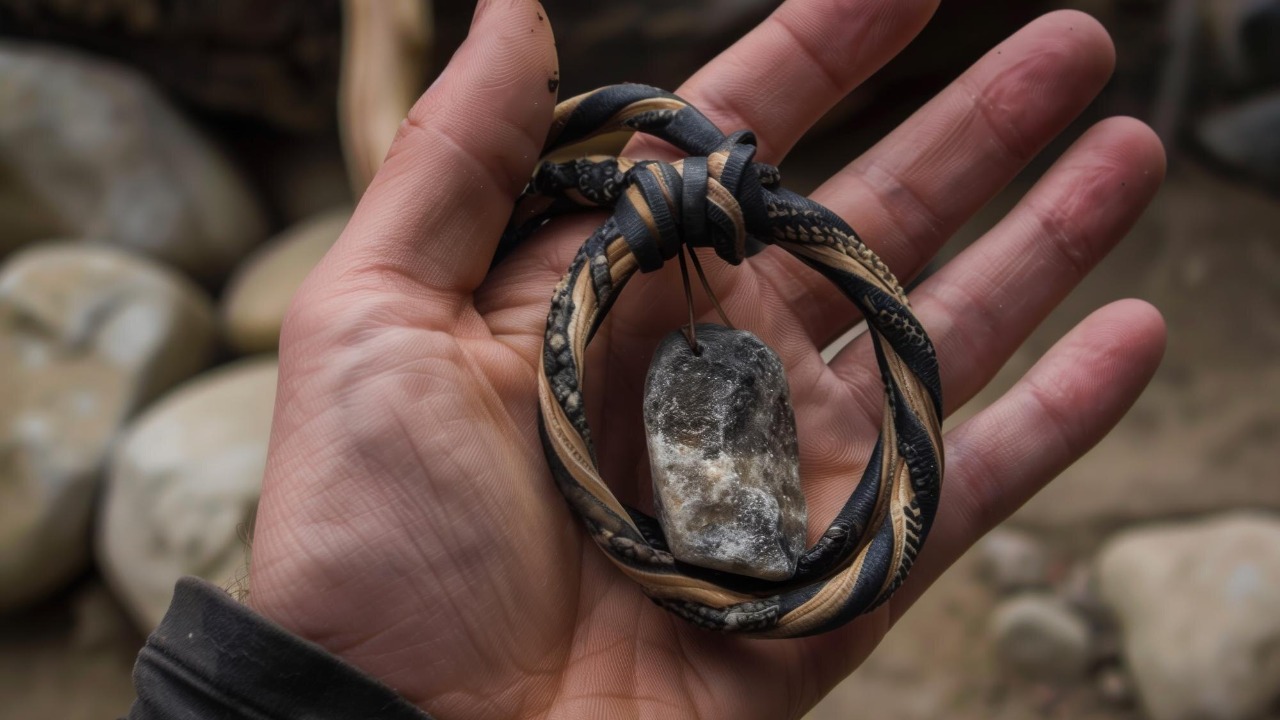

Deep beneath the paving stones of Jerusalem’s sacred precincts, archaeologists have uncovered a small lead disc that is forcing a big rethink of the city’s early medieval story. The rare pendant, decorated with a menorah and found under a temple complex, appears in a layer where it simply should not exist, challenging long‑held assumptions about who was visiting and worshipping near the ancient sanctuary.
The object is modest in size but outsized in implications, tying together questions of faith, pilgrimage, and survival in a city that has been conquered, rebuilt, and reimagined across centuries. As I trace what researchers have revealed so far, the pendant becomes less a curiosity and more a missing line in the historical record of Jerusalem’s Jewish community.
The dig that went deeper than expected
The story begins in the Davidson Archaeological Park of Jerusalem, where excavations have been peeling back layers of stone and soil to expose the remains of monumental structures near the Temple Mount. Archaeologists were already working in a zone dense with ritual architecture when they pushed their trench down roughly 26 feet, into strata that predate the visible ruins above. It was in this deep, compacted fill, beneath what they identified as a temple complex, that the small disc emerged from the dust, an anomaly in both depth and context.
By the time the team realized what they were holding, the pendant had already disrupted expectations about what should lie in that layer. The excavation was designed to clarify the construction phases of the surrounding sanctuary, not to produce a personal object that pointed to a very different story of individual devotion. Yet the piece, recovered during systematic work in the Davidson Archaeological Park of Jerusalem, forced the team to ask how such an item had ended up sealed so far below the later temple remains.
A tiny disc with a powerful symbol
At first glance, the object is unassuming: a disc of Lead, gray and weathered, small enough to rest on a fingertip. Closer inspection revealed a carefully incised menorah, the seven‑branched lampstand that has served as a central emblem of Jewish worship since antiquity. The design is not a casual doodle. It is a deliberate rendering, framed within the circular outline of the pendant, suggesting that whoever made it intended it to be worn as a visible declaration of identity and faith.
Archaeologists describe the piece as a disc‑shaped pendant that would have hung from a cord or chain around its owner’s neck, a personal amulet rather than an official cult object. The combination of material and iconography links it to a broader family of menorah jewelry known from late antique and early medieval contexts, but this example stands out for its context near the Tem and its association with a sacred precinct that later generations would connect directly to the destroyed Second Temple. One detailed analysis of the Mysterious Menorah Pendant emphasizes how unusual it is to find such a personal item in this exact spot in Jerusalem’s Old City.
Why it “shouldn’t have been there”
What has truly stunned specialists is not only what the pendant depicts, but where and when it appears in the archaeological sequence. The layer that yielded the disc is associated with a period when conventional narratives suggest Jewish presence and pilgrimage to the area around the Temple Mount had largely faded, especially under shifting imperial and religious regimes. In that framework, a Jewish worshipper leaving behind a menorah amulet beneath a temple complex is something that, in the words of one account, simply “shouldn’t have been there.”
Yet the soil does not lie. The stratigraphy indicates that the pendant was deposited before the later construction above it, meaning that a Jewish individual carrying this symbol of devotion was active in this sacred landscape at a time when many historians would not have expected such activity. Reporting on how Archaeologists Found the Rare Pendant Beneath the Temple underscores that this chronological mismatch is precisely what makes the discovery especially surprising.
Dating a 1,300-year-old mystery
To understand the pendant’s implications, researchers have focused on its age. Stylistic comparison and contextual clues point to an early medieval date, around 1,300 years ago, placing the object in the centuries after the destruction of the Second Temple and well into the era of shifting control over Jerusalem. That timeframe aligns with other menorah jewelry from the broader region, but finding such a piece in this particular sacred zone gives the date added weight. The pendant is not an isolated curiosity from an unknown period, but a datable artifact that anchors Jewish devotional practice in a specific historical window.
One report describes the object explicitly as a rare 1,300-year-old lead pendant discovered in Jerusalem and decorated with the image of a menorah, noting that it is only the second such find from the city. A separate presentation refers to a “1,300-YEAR-OLD MENORAH PENDANT SHOWS” Jews did not stop visiting Jerusalem, using the same chronological marker to argue that Jewish engagement with the city’s holiest spaces continued long after many written sources fall silent. Together, these references to a 1,300-YEAR-OLD artifact help fix the pendant firmly in a period when its very existence near the temple precinct complicates standard historical timelines.
Evidence that Jews “didn’t stop” coming to Jerusalem
Once the dating is accepted, the pendant becomes more than a decorative trinket. It turns into a data point in a larger debate about continuity and return. For years, scholars have wrestled with how to trace Jewish presence in Jerusalem after the catastrophic events that reshaped the city in late antiquity. Written sources can be patchy or polemical, and large public buildings rarely preserve the intimate traces of individual worshippers. A small lead disc with a menorah, dropped or deliberately placed near a sacred complex, offers a rare glimpse of a person who carried their identity into a contested holy space.
That is why some commentators have seized on the pendant as proof that Jews “didn’t stop” visiting Jerusalem, even in periods when political control and official religious policy might have discouraged or restricted their access. The video presentation that highlights the YEAR, OLD, MENORAH, PENDANT, SHOWS theme frames the object as tangible evidence that Jewish pilgrims or residents continued to seek out the city’s holiest ground. In this reading, the pendant is not just an isolated artifact, but part of a pattern in which small finds, like the Archaeologists pendant Here, quietly document a stubborn continuity of devotion that official narratives often overlook.
How this pendant fits into a broader pattern of menorah finds
Although this discovery is startling in its context, it does not stand entirely alone. Archaeologists have identified other menorah pendants and amulets from Jerusalem and beyond, suggesting that wearing the seven‑branched lamp as a personal emblem was a recognized practice among Jews in late antiquity and the early Middle Ages. These objects vary in material and craftsmanship, from finely worked gold to humble lead, but they share a common function as portable declarations of faith and identity.
What sets the Davidson Park pendant apart is its combination of age, location, and rarity. One account notes that archaeologists discovered a rare 1,300-year-old lead pendant in Jerusalem decorated with a menorah and emphasizes that it is only the second such pendant known from the city, underscoring how thin the archaeological record is for this kind of personal Jewish devotional object. When I compare that with the detailed discussion of the disc-shaped pendant found during excavations in the Old City, it becomes clear that each new menorah amulet from this landscape carries disproportionate interpretive weight.
Personal devotion in a contested sacred landscape
For me, the most striking aspect of the pendant is its intimacy. Grand monuments and official inscriptions tell us what rulers wanted remembered, but a small lead disc, worn close to the skin, speaks to private hopes and fears. The choice of Lead, a soft and inexpensive metal, suggests that the owner was not wealthy, yet still invested in carrying a symbol that connected them to the memory of the Temple and to a wider community of believers. In a city layered with competing claims, the pendant reads like a quiet assertion of belonging.
Placed against the backdrop of a temple complex that would later be overbuilt and reinterpreted, the amulet hints at how ordinary people navigated a sacred landscape in flux. Its presence beneath later structures shows that Jewish worshippers or visitors were active in this area even as political and religious authorities reshaped the skyline above them. The detailed treatment of the Mysterious Menorah Pendant underscores this point, presenting the find as a rare window into the lived religious experience of Jews who moved through Jerusalem’s Old City long after the Second Temple’s destruction.
Rewriting the timeline of Jerusalem’s sacred memory
When archaeologists describe the pendant as something that “shouldn’t” have been where it was found, they are really acknowledging that the object forces a revision of established timelines. If a Jewish worshipper could carry a menorah amulet into the heart of the temple precinct 1,300 years ago, then the story of absence and return is more complicated than a simple break followed by a modern revival. Instead, the evidence points to a more jagged continuity, with individuals and small groups maintaining a relationship to the site even when official narratives suggest otherwise.
In that sense, the pendant is less an outlier and more a catalyst, prompting historians and archaeologists to reexamine other small finds and textual hints that might point to similar patterns of quiet persistence. The fact that multiple reports, from the initial note that Archaeologists in Jerusalem uncovered a rare menorah pendant to the argument that such a YEAR, OLD object SHOWS Jews did not stop visiting the city, converge on the same conclusion gives the tiny disc an outsized role in reshaping how I think about Jerusalem’s sacred memory. The pendant may be small, but the historical gap it helps to bridge is anything but.
More from MorningOverview