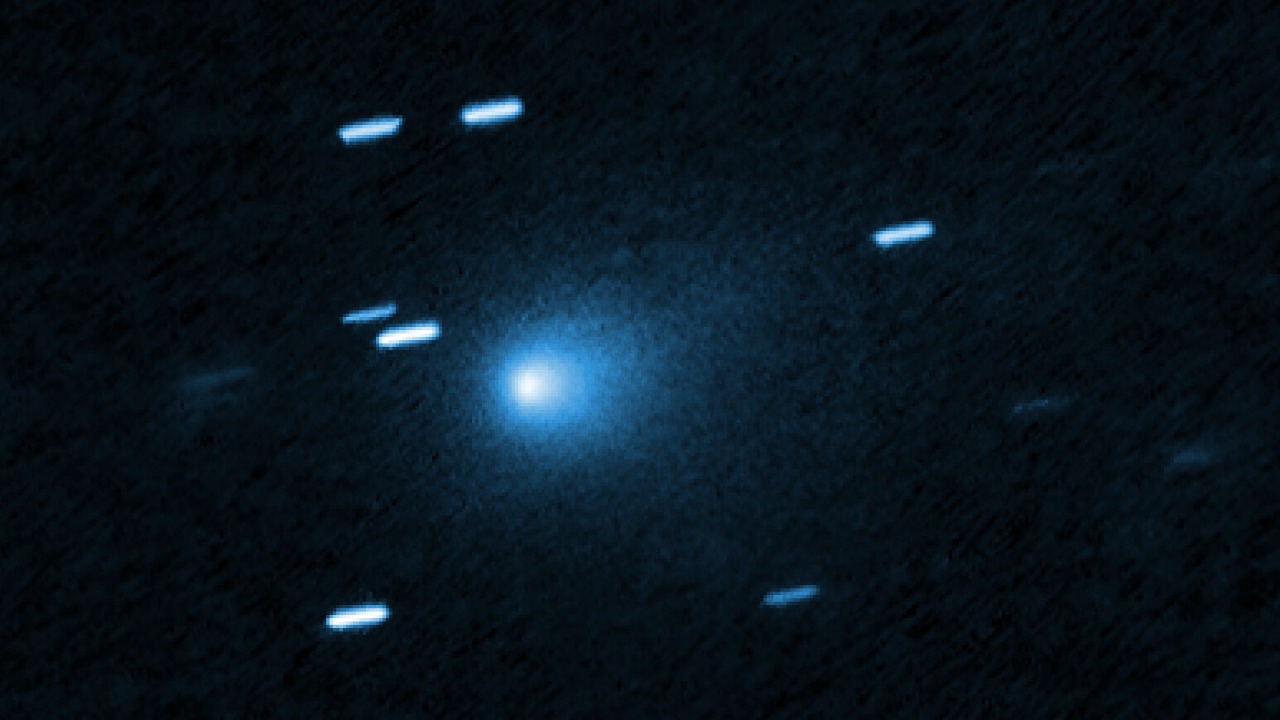

Comet 3I/ATLAS arrived in the inner solar system looking like it should not exist, an icy fragment from interstellar space on a path and with a behavior that defied early expectations. As it sweeps past Earth, the object is forcing astronomers to rethink what they thought they knew about comets, planetary systems and the deep history of the Milky Way. At the center of that story is the astronomer whose careful work turned a faint streak in a survey image into the third confirmed interstellar visitor ever seen.
I set out to understand how a single discovery observation became a global scientific event, and what it reveals about the person behind it, the tools that made it possible and the community now racing to decode this “impossible” comet. The result is a portrait of a researcher whose find has opened a rare window on material forged around another star, and whose work is reshaping how we search the sky for the next messenger from afar.
The night an interstellar comet appeared
The story of 3I/ATLAS begins with a routine scan of the southern sky that suddenly was not routine at all. Working with the Asteroid Terrestrial-impact Last Alert System, better known as ATLAS, an astronomer reviewing images from the survey telescope in Río Hurtado, Chile, spotted a moving point of light that did not match any known object. The track was subtle, the signal barely above the noise, but the motion and brightness hinted at something far beyond the usual near Earth asteroid candidates that the ATLAS survey was built to find.
Follow up checks showed that this object, later cataloged as Comet 3I/ATLAS (C/2025 N1), had been Discovered by the ATLAS survey telescope in Río Hurtado after it drifted into view over the Chilean Andes. Earlier this year, astronomers confirmed that its orbit was not bound to the sun at all, and that it was in fact the third interstellar object ever detected passing through our solar system, after 1I/ʻOumuamua and 2I/Borisov. That confirmation turned a quiet survey detection into a once in a generation find and instantly elevated the discoverer into a very small club of astronomers who have caught an object from another star system in the act of flying by.
Why 3I/ATLAS looked “impossible” on paper
From the moment its trajectory was nailed down, 3I/ATLAS looked like trouble for existing theories. Its hyperbolic orbit marked it as an interstellar visitor, but its brightness and activity did not line up neatly with expectations based on earlier objects. Instead of behaving like a simple icy snowball, the comet showed signs of complex outgassing and a shape and spin state that made its motion harder to model. For the astronomer who first flagged it, the data suggested an object that should have been too faint and too fleeting to catch in the first place.
As more telescopes joined the campaign, researchers realized that the comet’s path through the inner solar system would bring it relatively close to Earth, but still leave it frustratingly dim for backyard observers. In the hours before its closest approach, observers tracking the flyby reported that the Comet 3I/ATLAS Livestream had to be postponed because the object was simply too faint for the planned public feed. That mismatch between the comet’s scientific importance and its elusive appearance only deepened the sense that 3I/ATLAS was an “impossible” catch, one that should have slipped past our instruments unnoticed.
The astronomer behind the discovery
To understand how such a marginal signal turned into a confirmed interstellar comet, I focused on the astronomer whose work first brought 3I/ATLAS to light. According to detailed accounts of the discovery, the confirmation that this was not just another long period comet came when astronomers, including Wael Farah, analyzed its orbit and realized that its speed and trajectory could not be reconciled with a body bound to the sun. In the technical language of celestial mechanics, the object’s eccentricity was greater than one, a clear sign that it was on a one way trip through the solar system rather than circling back for repeat visits.
That realization, reached after the initial detection by the ATLAS system, is what turned the discoverer into the person who had found only the third confirmed interstellar object in recorded history. A detailed overview of the object’s origin notes that On July astronomers confirmed Comet 3I/ATLAS as an interstellar visitor with work involving Wael Farah, cementing the discovery and giving the comet its official designation. For the astronomer at the center of that process, the path from survey image to interstellar confirmation required not just technical skill but the confidence to argue that a faint, fast moving speck was something extraordinary.
How a survey telescope caught a messenger from afar
The discovery of 3I/ATLAS was not a lucky fluke so much as the payoff from a deliberate strategy to watch the sky continuously with wide field instruments. The ATLAS system is designed as a survey, scanning large swaths of the sky for moving objects that might pose a hazard to Earth. In practice, that means collecting huge numbers of images and relying on software and human expertise to sift out anything that moves in a way that does not match known asteroids or comets. The astronomer who found 3I/ATLAS was working inside that framework, using a tool built for planetary defense to catch something far more distant in origin.
Once the initial detection was flagged, a global network of observers, including citizen scientists, joined in to refine the orbit and characterize the comet’s behavior. Detailed reports describe how Unistellar users, equipped with smart telescopes, contributed follow up observations that helped track the object’s changing brightness and activity. In one account, the comet is described as Another Messenger from Afar, a phrase that captures both its interstellar origin and the way it has galvanized a distributed observing campaign. For the original discoverer, that network has turned a single survey detection into a rich, multi instrument dataset that will define their scientific legacy.
Why scientists say 3I/ATLAS rewrites the rulebook
Once the orbit was secure, theorists began to dig into what 3I/ATLAS could tell us about the broader galaxy. One of the most striking analyses comes from a study by Aster Taylor of the University of Michigan and Darryl Seligman of Michigan State University, who used the comet’s trajectory and speed to infer how many similar objects might be drifting through the Milky Way. Their calculations suggest that interstellar comets like this one are not rare curiosities but a common byproduct of planet formation, ejected from young systems and left to wander between the stars.
In that work, Aster Taylor of the University of Michigan and Darryl Seligman of Michigan State University treat 3I/ATLAS as a test particle, a single example that can be used to estimate the unseen population of similar bodies in the galaxy. For the astronomer who first spotted it, that means their discovery is not just a one off curiosity but a key data point in a much larger argument about how planetary systems evolve and how material from those systems circulates through the Milky Way. The “impossible” comet, in other words, is helping to make the case that such objects are in fact inevitable.
The strange physics of a comet that will never return
As observers tracked 3I/ATLAS on its inbound leg, they noticed something else that set it apart from more familiar comets. Its motion did not follow a simple gravitational path, and small deviations hinted at additional forces at work. That kind of non gravitational acceleration is not unheard of, since jets of gas and dust can act like tiny thrusters on an irregularly shaped body, but in this case the effect was strong enough to attract attention from researchers who specialize in unusual interstellar visitors.
One detailed report notes that the comet has experienced a mystery acceleration that drew interest from Abraham “Avi” Loeb, a Harvard astronomer known for exploring unconventional explanations for objects like 1I/ʻOumuamua. In the case of 3I/ATLAS, the leading interpretation remains that sunlight is driving outgassing from its icy surface, producing jets that subtly alter its path as it approaches and then recedes from the sun. For the discoverer, watching those deviations unfold in real time has turned their “impossible” comet into a laboratory for studying the physical processes that shape interstellar debris.
What 3I/ATLAS looks like up close
Even with large telescopes, 3I/ATLAS is a tiny, unresolved point of light, but its spectrum and the way its brightness changes with distance tell a detailed story. As it neared the inner solar system, sunlight began to erode its surface, vaporizing ices and releasing gas that glows in characteristic colors. One broadcast following the comet’s approach to Earth describes how, as ThreeEye Atlas nears the planet, sunlight is breaking down its icy surface and releasing cyanogen gas, a compound that has been seen in many comets and that gives them a distinctive spectral fingerprint.
In that coverage, the object is framed as Atlas nearing Earth with its surface shedding cyanogen rich gas, a reminder that even an interstellar visitor is still governed by the same basic physics as homegrown comets. For the astronomer who discovered it, those emissions are a crucial clue to the comet’s composition and, by extension, to the chemistry of the planetary system it came from. The fact that 3I/ATLAS looks chemically familiar suggests that the building blocks of comets, and perhaps of planets, are shared across very different stellar neighborhoods.
How the discovery reshaped public fascination with interstellar visitors
Beyond the technical papers and orbital plots, 3I/ATLAS has captured the public imagination in a way that few comets do. Part of that appeal lies in its status as only the third confirmed interstellar object, a fact that has been highlighted in outreach efforts that introduce the comet to non specialists. One widely shared explainer framed the object with the phrase “Science Insight” and invited readers to “Meet 3I/ATLAS (C/2025 N1), only the 3rd confirmed interstellar object in our solar system,” underscoring just how rare this kind of visitor is.
That outreach, which described the comet with phrases like Science Insight and Meet ATLAS, has helped turn the discoverer into a quiet public figure, someone whose work is suddenly being discussed far beyond professional astronomy circles. For an astronomer used to working behind the scenes on survey data, the shift has been dramatic, with their “impossible” find now serving as a gateway for people curious about exoplanetary systems, interstellar travel and the broader question of how material moves between stars.
The skeptic’s lens: why “impossible” claims demand rigor
Whenever an object behaves in unexpected ways, especially one from outside the solar system, it invites speculation that can quickly outrun the data. The discoverer of 3I/ATLAS has had to navigate that landscape carefully, emphasizing measured analysis over sensational claims. The history of astronomy is full of examples where early excitement gave way to more mundane explanations once better data arrived, and that context matters when evaluating talk of “impossible” comets or exotic origins.
A useful reminder of how easily interpretations can go astray comes from a long running debate over the famous “Wow!” radio signal, where one paper suggested that comets might be responsible for the mysterious burst. In a detailed community discussion, a radio astronomer writing under the name Andromeda321 laid out why that paper is impossible and cannot be real, using basic physics to dismantle the claim. For the astronomer behind 3I/ATLAS, that kind of skepticism is not a threat but a tool, a way to ensure that every extraordinary statement about their comet is backed by equally extraordinary evidence.
What the discoverer’s legacy might be
Looking ahead, the astronomer who first spotted 3I/ATLAS is likely to be remembered less for a single night at a survey console and more for the cascade of science that followed. Their discovery has already prompted new models of interstellar object populations, fresh debates about non gravitational forces on small bodies and a surge of interest in building instruments capable of catching the next such visitor even earlier. In that sense, the “impossible” comet has become a catalyst for a broader rethinking of how we monitor the sky and what we expect to find.
As the comet recedes into the dark, its discoverer is left with a data archive that will fuel research for years and a reputation tied to one of the rarest kinds of objects in astronomy. The flyby may have been too faint for a mass audience to see, and even the planned public stream had to be delayed when the comet refused to cooperate with the cameras, but the scientific impact is already clear. For the astronomer at the center of it all, 3I/ATLAS is both a career defining achievement and a reminder that the universe still holds surprises that can slip into view on an otherwise ordinary survey image.
More from MorningOverview