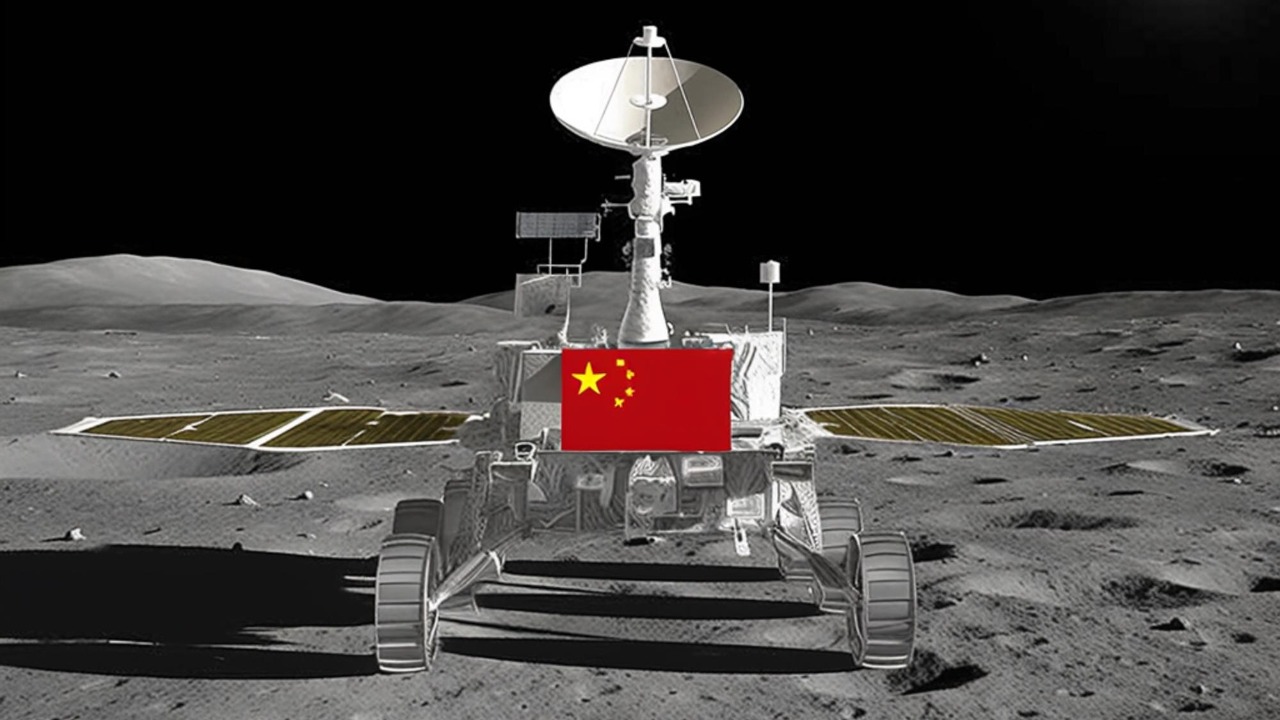

The far side of the Moon has long been a blank space in humanity’s geological record, but China has just filled in a crucial page. By bringing back pristine material from a hidden lunar basin, its Chang’e‑6 mission has uncovered meteorite dust that scientists had never directly seen on the Moon before, and it is already reshaping ideas about how water and organic‑rich rocks moved through the early Solar System.
What sounds like a niche laboratory result is in fact a rare look at the same kind of primitive debris that once bombarded both the Moon and Earth. I see this discovery as a turning point, not only for China’s space program, but for anyone trying to understand how our planet became habitable in the first place.
How Chang’e‑6 reached the Moon’s hidden hemisphere
China’s latest robotic probe, called Chang’e‑6, was designed from the start to do something no mission had attempted before, which was to collect a Sample Return from the Moon’s far side and bring it safely back to Earth. Because that hemisphere never faces Earth directly, the spacecraft had to rely on a dedicated relay satellite to send commands and telemetry across the lunar limb, a technical hurdle that had kept earlier missions confined to the near side. When the return capsule finally landed back on Chinese soil, it carried the first physical pieces of that unseen terrain.
The lander touched down inside the vast South Pole‑Aitken Basin, a scar so deep and ancient that planetary scientists have treated it as a natural drill hole into the Moon’s interior. The samples that Chang’e‑6 scooped up originated from inside this South Pole‑Aitken Basin, where it landed on the far side and then blasted off again to rendezvous with the return module in lunar orbit, a choreography that required precise timing and navigation. Earlier reporting on the mission’s trajectory and recovery has emphasized how the Chinese team threaded this path to deliver the far side material intact to laboratories on Earth, turning a once‑theoretical target into a tangible collection of rocks and dust.
The rare meteorite dust hiding in lunar soil
Once researchers began sifting through the grains from the South Pole‑Aitken Basin, they noticed something that did not match typical lunar rock. Embedded in the regolith were tiny fragments whose chemistry pointed to CI chondrites, a rare class of water‑bearing meteorite that is among the most primitive material in the Solar System. Detailed analysis of the Chang’e‑6 haul showed that this CI chondrite meteorite dust was mixed into the local soil, rather than being part of the Moon’s native crust, which meant it had arrived from space and survived the violence of impact.
Laboratory teams have described this as the first direct, physical evidence that CI chondrites bombarded the Moon early in the Solar System’s history, leaving behind a microscopic record of their passage. The grains resemble the material seen in samples from carbon‑rich asteroids like Ryugu and Bennu, which were visited by Japanese and United States missions, yet here they appear as foreign specks lodged in lunar dust. By tracing the composition of this CI chondrite meteorite dust on the far side of the Moon, scientists are effectively reading a fossilized logbook of impacts that once swept across both the Moon and Earth.
Why CI chondrites matter for water and life
CI chondrites are not just any meteorites, they are some of the most chemically primitive rocks known, preserving a mix of water, carbon, and volatile elements that mirrors the early Solar System. In scientific terms, a Chondrite is a rare form of water‑containing meteorite, and CI chondrites sit at the extreme end of that spectrum, with high proportions of hydrated minerals and organic compounds. When fragments of this material are found in lunar dust, they point to a time when similar objects were striking Earth, potentially delivering ingredients that later fed oceans and biology.
Researchers studying the Chang’e‑6 samples have focused on the ratios of hydrogen isotopes and other trace elements in the embedded meteorite grains, comparing them with those in volcanic rock and other meteorites. These ratios were consistent with CI‑type impactors, which supports current theories that such bodies helped transport water to the inner Solar System billions of years ago. By tying the far side dust to this family of impactors, the new data strengthens the case that the same class of objects that peppered the Moon also contributed to Earth’s early water inventory and perhaps to the chemistry that made life possible.
What the far side reveals that the near side could not
The far side of the Moon is not just out of sight, it is geologically distinct from the hemisphere we see from our backyards. The near side is dominated by dark volcanic plains, while the far side is more heavily cratered and preserves older crust, which makes it a better archive of ancient impacts. By sampling inside the South Pole‑Aitken Basin, Chang’e‑6 tapped into a region that has accumulated debris from a wide range of impactors, including the CI chondrites now identified in the dust.
Scientists who examined the first‑ever far side samples have emphasized that these rare fragments of meteorite debris were uncovered in a context that had never been accessible before. The surprise meteorite debris uncovered on the Moon’s far side suggests that the basin’s regolith has been quietly storing traces of collisions that date back to the earliest stages of planetary formation. Because the far side has experienced different volcanic resurfacing than the near side, the CI chondrite signature there may be less diluted, giving researchers a clearer view of how the bombardment history varied across the lunar globe and what that implies for Earth’s own impact record.
Reconstructing the early Solar System’s bombardment
Piecing together how often CI chondrites and other primitive bodies struck the Moon is central to understanding the tempo of impacts in the young Solar System. The identification of CI chondrite dust in the Chang’e‑6 samples provides a concrete data point that these objects were part of the impactor population that hit the inner planets, not just a curiosity found in meteorite collections on Earth. When I look at this result, I see it as a bridge between laboratory meteorite studies and large‑scale models of how material migrated inward from the outer Solar System.
Researchers have argued that this is the first direct, physical evidence that CI chondrites bombarded the Moon early in the Solar System’s history, rather than merely passing through the inner regions. That conclusion dovetails with dynamical simulations that show how gravitational interactions with giant planets could have scattered water‑rich asteroids toward the terrestrial zone. By anchoring those models to actual CI chondrite dust preserved in lunar regolith, the Chang’e‑6 findings help refine estimates of how much water and volatile material these bodies could have delivered to both the Moon and Earth during that chaotic era.
How scientists read a story in a handful of dust
Turning a scoop of lunar soil into a narrative about the Solar System’s past requires a chain of careful measurements. Teams working on the Chang’e‑6 material have used electron microscopes, X‑ray diffraction, and isotopic analysis to distinguish native lunar minerals from foreign meteorite grains. In the case of the CI chondrite fragments, they looked for textures and compositions that match known meteorites, such as fine‑grained matrices rich in phyllosilicates and specific patterns of volatile elements that do not appear in typical lunar basalts.
One report described how sifting through the first‑ever far side samples revealed rare inclusions whose chemistry could only be explained by an external origin, pointing directly to CI‑type impactors. Another account framed the lunar regolith as a kind of library, where layers of dust record each collision in microscopic detail, and where identifying impactors on the Moon is difficult because the surface has been churned by repeated strikes. In that view, the CI chondrite grains are like pages that survived in a heavily edited book, offering surprising clues to Earth’s history and showing that even a small patch of lunar soil can hold a remarkably rich archive of Solar System events.
Public fascination and the culture around the discovery
While the laboratory work unfolds, the story of what China found on the far side has spilled into popular culture and online debate. Space enthusiasts have shared clips and explainers that walk through how far side dust can reveal what scientists found in the dust from the far side and why that matters for understanding water and organics in the inner Solar System. These videos have helped translate technical terms like “CI chondrite” into accessible language, turning a specialized geochemical result into a broader conversation about where Earth’s oceans came from.
On social platforms, the discovery has sparked a mix of awe, humor, and speculation. In one thread titled “China Found Something Fascinating on the Far Side of the Moon,” users joked about how to respond to alien‑sounding rocks, with comments like “Burn it with fire!” from a user named Burn and side chatter about an XBOX Series X from another user called cyanescens_burn, while someone else quipped, “Isn’t that side of the moon where the real weird stuff is?” using the handle Isn. Beneath the jokes, many participants linked the CI chondrite dust to broader questions about planetary defense and the risks posed by the same kinds of asteroids on their journey to Earth’s surface, showing how a niche scientific result can quickly feed into public imagination about both cosmic origins and future threats.
China’s growing role in lunar science
For China, the Chang’e‑6 result is more than a scientific milestone, it is a statement about its place in the new era of lunar exploration. Earlier, China’s latest robotic probe, called Chang’e‑6, returned to Earth carrying the first samples ever taken from the far side of the Moon, a feat that required not only advanced propulsion and guidance but also a relay satellite parked beyond the Moon to relay its signal. That technical infrastructure now gives Chinese teams a platform for future missions that could drill deeper, explore polar ice, or even support crewed landings.
The discovery of CI chondrite dust in the far side samples underscores how quickly China has moved from catching up in spaceflight to leading in specific scientific domains. By targeting the South Pole‑Aitken Basin and returning material that no other nation had touched, the Chang’e‑6 mission has given Chinese laboratories first access to a unique dataset on lunar impacts and water delivery. In practical terms, that means Chinese scientists are now central voices in debates about how the Solar System evolved, and their measurements of the far side dust are shaping global models of impact history and volatile transport.
What comes next for Moon science and exploration
The CI chondrite dust in the Chang’e‑6 samples is unlikely to be the last surprise that the far side yields. As analytical techniques improve and more laboratories gain access to tiny portions of the material, I expect new findings about other classes of impactors, subtle variations in water content, and perhaps even traces of complex organics that survived the journey. Some researchers have already suggested that the latest finding is particularly tantalizing because it hints at a broader population of primitive asteroids that may have contributed to both lunar and terrestrial water inventories, a hypothesis that future missions can test by sampling other basins and polar regions.
At the same time, the Chang’e‑6 result is feeding into a wider rethinking of how to prioritize landing sites and instruments for upcoming missions from multiple countries. Reports on the samples brought back by the Chang’e‑6 mission, which originated from inside the South Pole‑Aitken Basin where it landed, have highlighted how isotope ratios in the dust match those in volcanic rock and meteorites, and how these ratios support current theories that CI‑type bodies delivered water billions of years ago. As agencies plan new landers, orbiters, and sample returns, the lesson from the far side is clear: the Moon’s most scientifically valuable secrets may be hiding in places that are hardest to reach, but the payoff, in terms of understanding Earth’s own story, is worth the effort.
Why a single rock can change our view of Earth
In the end, what stands out to me is how a handful of grains from a distant basin can alter our sense of home. When scientists brought a rock from the far side of the Moon and found that it held surprising clues to Earth’s history, they were not just cataloging another specimen, they were tracing a direct line from a CI chondrite impact to the conditions that made our planet habitable. The far side dust shows that the Moon has been quietly recording the same bombardment that shaped Earth, preserving evidence that our own geology has mostly erased.
That is why the discovery of CI chondrite meteorite dust on the far side of the Moon, identified in detail by teams working with the Chang’e‑6 samples and described in depth in technical analyses of the rare samples uncovered by China’s Chang’e‑6 mission, feels so consequential. It confirms that water‑rich, primitive bodies once rained down on the inner Solar System, it validates models of how those bodies moved, and it gives scientists a new tool for reading the early chapters of Earth’s story. For all the sophistication of the spacecraft and laboratories involved, the core insight is disarmingly simple: by studying what fell on the Moon, we are learning how our own world came to be.
More from MorningOverview