
Ancient DNA is turning Europe’s deep past from a sketch into a family album. Instead of guessing who first called the continent home, researchers can now read genetic traces from teeth, bones and cave sediments to reconstruct real lineages, migrations and extinctions. The emerging picture is more surprising and more tangled than the old story of a single wave of “cavemen” trudging in from the east.
By sequencing ever older genomes, scientists are finding that Europe’s earliest modern humans arrived in multiple pulses, mixed with Neanderthals, vanished, and were replaced by later groups whose descendants still live on the continent. The result is a layered ancestry in which Ice Age hunters, early farmers and steppe herders all left their mark on today’s Europeans.
The Ice Age stage: Neanderthals and the first modern arrivals
To understand who the first Europeans were, I have to start before any Homo sapiens set foot on the continent. During the Paleolithic, Neanderthals inhabited much of Europe and western Asia from as far back as 130,000 years ago, long before our species arrived. They dominated Europe’s harsh Ice Age landscapes, hunting large mammals and adapting to cold climates that would have challenged any newcomer.
When Homo sapiens finally did reach western Europe, they did so earlier and in more fits and starts than archaeologists once thought. A single tooth from France’s Rhône Valley shows that modern humans had arrived in western Europe by about 54,000 years ago, significantly earlier than many researchers had accepted. Genetic work on Ice Age remains shows that from a study of 51 ancient individuals, Neanderthal DNA in ancient Europeans gradually decreased over time, a sign that early modern humans initially interbred significantly with local hominins and then diluted that legacy as their own populations expanded.
Three waves into a contested continent
Ancient genomes now point to a stop‑start colonization of Europe rather than a single founding migration. When researchers asked When exactly modern humans entered Europe, they found that They did so in three major waves, at roughly 54,000, 45,000 and 42,000 years ago. A separate synthesis of archaeological and genetic evidence similarly describes how Modern Humans Migrate into Europe in Three Waves, at Years Ago values of 54,000, 45,000 and 42,000, and notes that Modern Europeans Originated from a complex mix of these movements.
Those early pioneers did not simply sweep aside the Neanderthals. Genetic work on some of the first first modern Europeans shows that Their DNA indicates they mixed with the Neanderthals, who, within 5,000 years, were gone as a distinct population. Another study of three very early Homo sapiens in Europe found that all three had Neanderthal ancestors just a few generations back, underscoring how intimate that contact was.
Ranis and the mystery of the first failed Europeans
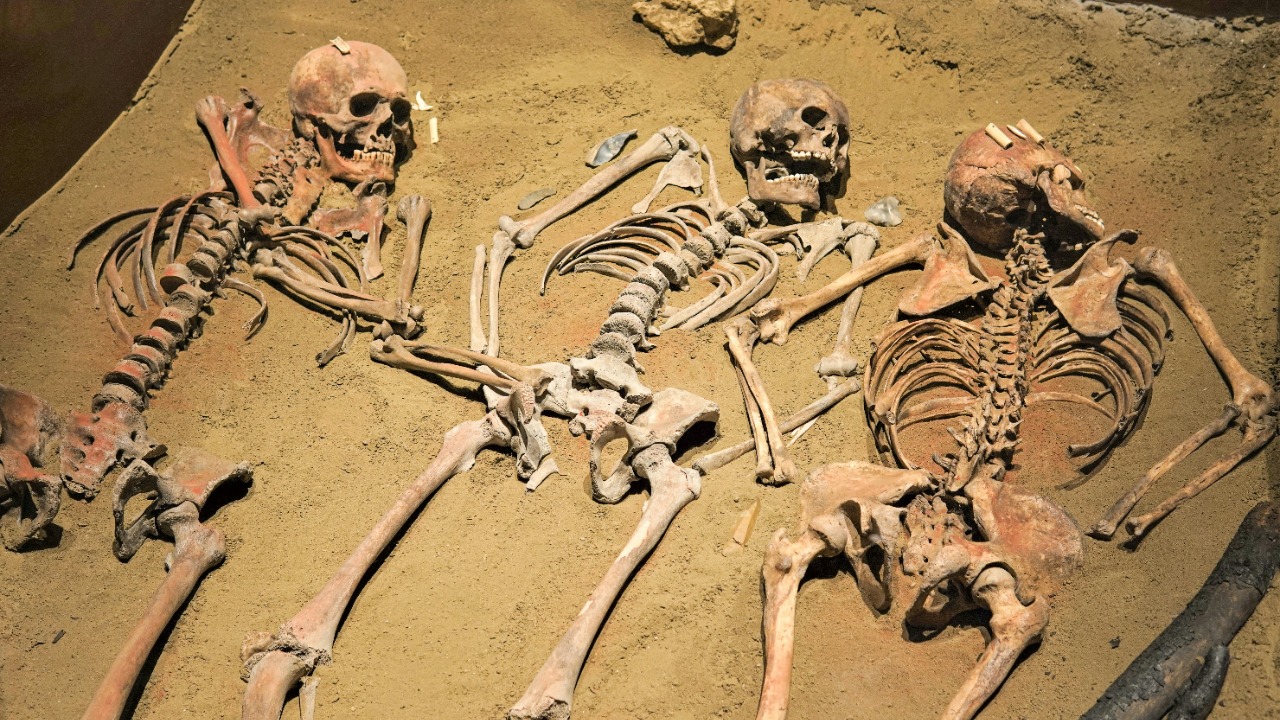
One of the most striking windows into these early waves comes from a cave near the town of Ranis, Germany. In the cave in Ranis, Germany, archaeologists recovered bone fragments belonging to six individuals, a family that included a child, a teenager and adults. Genetic sequencing revealed that these were among the Oldest modern human genomes yet found in Europe, and that their DNA formed part of a family network that stretched across the continent.
Then they died out. An illustration depicts early Europeans who lived in what is now Ranis, Germany, around 45,000 years ago, but genetic analysis shows that this group left no descendants among later Europeans. The genetic uniformity of the Ranis individuals hints at isolation, suggesting a small pioneer population that could not sustain itself once climates shifted or competition with other humans intensified. The site itself, cataloged in mapping tools for places like Ranis cave, has become a reference point for how fragile those first footholds were.
Side by side with Neanderthals in the north
Farther north, ancient DNA is clarifying how long Neanderthals and Homo sapiens shared the same landscapes. Genetic analysis of bone fragments from a site in Northern Europe shows that Neanderthals and modern humans lived side by side around 45,000 years ago. The Genetic work indicates that the two species occasionally interbred, reinforcing the picture from other early European genomes of repeated contact rather than a clean replacement.
Those northern sites help explain why so many later Europeans carry a small but consistent Neanderthal legacy. Studies of Ice Age populations show that these people persisted for many thousands of years until the arrival of farming, and researchers detected some minor shifts in ancestry as different hunter‑gatherer groups replaced one another, using methods that target specific segments of DNA. Over time, as modern human numbers grew and Neanderthals dwindled, the proportion of Neanderthal ancestry in European genomes declined, consistent with the finding that, from a study of 51 ancient individuals, Due to natural selection, the percentage of Neanderthal DNA in ancient Europeans gradually decreased over time.
Cro‑Magnons and the rise of enduring hunter‑gatherers
By around 40,000 years ago, a new kind of European hunter appears in the record, one whose descendants would shape the continent for tens of millennia. Cro Magnon people, often described as Magnons or European early modern humans (EEMH), were the first early modern humans in Europe whose cultures, such as the Aurignacian and Gravettian, spread widely and left abundant art and tools. Their genetic signatures, unlike those of the Ranis pioneers, persist in later hunter‑gatherer populations.
Ancient genomics studies have shown that present‑day Ancient DNA from Mesolithic foragers indicates that these Ice Age and early Holocene hunters formed one of three main ancestry strands that still shape modern Europeans. Genetic reconstructions of Ice Age groups show that these people persisted for many thousands of years until the arrival of farming, with only gradual turnovers between different hunter‑gatherer lineages, as documented in work on the genetic history of Ice Age Europe.
Farmers from the Middle East and a fourth ancestral “tribe”
The next major transformation came not from the north but from the south and east, when people who had domesticated plants and animals began to move into Europe. Research shows Research that Europeans are a mixture of three major ancestral populations, indigenous hunters, Middle Eastern farmers and later steppe herders from the east in the Bronze Age. Ancient DNA from early Neolithic burials shows that these farmers carried ancestry related to populations in Anatolia and the Levant, and that they largely replaced local hunter‑gatherer lineages in many regions while still intermarrying with them.
Genetic reconstructions of this period overturn the older idea that modern Europe’s population structure was set in the deep Paleolithic. One influential study concluded that But the new data paint a different picture of the genetic foundation of modern Europe, Rather than a single or a few migrations, there were multiple waves of farmers and herders who reshaped the continent’s gene pool. The discovery of a “fourth ancestral tribe” in some analyses, a population related to ancient Siberians, further complicates the picture and shows how much diversity was already present in Eurasia before these movements.
Yamnaya herders and the steppe imprint on Europe
One of the most dramatic of those later waves came from the grasslands north of the Black and Caspian seas. Ancient herders, who rode horses and drove ox‑drawn carts west out of their grassy homelands in southwest Asia, carried the genetic profile associated with the Ancient Yamnaya culture. Their expansion into Europe left a deep imprint on northern populations and has even been linked to shifts in disease risk, including variants associated with multiple sclerosis, according to work that traces how these herders’ DNA spread across the continent.
Geneticists have also used ancient DNA to probe the origins of the Yamnaya themselves. In search of that connection, Reich and his colleagues hoped to identify the genetic origins of the Yamnaya, testing whether they descended from populations in ancient Anatolia around this time. Broader syntheses of ancient genomes show that present‑day Europeans are the result of admixture between three main ancestry components, western hunter‑gatherers, early farmers and steppe herders, with the latter arriving when the Yamnaya culture migrated into Europe.
Seafaring hunter‑gatherers and a two‑way Mediterranean
Ancient DNA is also revealing that Europe’s first settlers were not confined to land routes. The genome of a man from a Tunisian site called Tunisian Djebba held a major surprise, about 6 percent of his DNA could be traced back to European hunter‑gatherers, and a woman from the site showed a similar signal. That finding dovetails with work showing that DNA analysis has revealed that Stone Age people from North Africa descended partly from European hunter‑gatherers, and that Thi ancestry likely reached Africa by boat across the Mediterranean.
The same story emerges in more detail from another study of Stone Age remains in Tunisia. The DNA showed that one of the ancient humans, who lived about 8,500 years ago, shared about 6 percent of his DNA with hunter‑gatherers from Europe, suggesting that people crossed the Mediterranean, possibly aboard long wooden canoes. These findings show that even Mesolithic foragers were capable seafarers, and that Europe’s genetic story includes not just arrivals from Africa and Asia but returns to Africa as well.
What survives in modern Europeans’ DNA
When I look at the genomes of people living in Europe today, I see the echoes of all these ancient movements layered together. Studies of early modern human remains show that the oldest DNA ever recovered from modern humans shows that some early groups in Europe mixed with Neanderthals but left no descendants, while others contributed to later populations. Work on early Homo sapiens skeletons in Bulgaria and the Czech Republic found that all three individuals had Moreover close Neanderthal relatives, yet their specific lineages also seem to have died out.
By contrast, later hunter‑gatherers, Neolithic farmers and steppe herders all left enduring marks. One synthesis of early genetic work on the continent concluded that modern Europe’s genetic foundation reflects at least three major migrations, and that in Europe at that time there were already distinct populations that would later blend. Another analysis of early modern Europeans notes that hunter‑gatherers, modern humans whose ancestors arrived in Europe tens of thousands of years ago, early farmers from the Middle East and steppe herders all contributed ancestry, and that present‑day Europeans carry DNA from all three groups. The result is that no single “first European” population stands alone in today’s genomes; instead, modern Europeans are mosaics of many ancient peoples.
A new kind of prehistory, written in genomes
What makes this moment so transformative is not just the age of the DNA, but the scale and precision of the work. Ancient genomics studies have shown that present‑day Europeans are the result of admixture between three main ancestry components, and that the Yamnaya culture migrated into Europe as part of that story, something that would have been impossible to infer from stone tools alone. Researchers now routinely extract and sequence DNA from fragmentary bones, teeth and even cave sediments, using methods that target specific segments of DNA to reconstruct population histories that span tens of thousands of years.
Those reconstructions are also forcing archaeologists to revisit long‑held assumptions about culture and identity. The realization that some of the Oldest modern human lineages in Europe left no descendants, while later arrivals from the Middle East and the steppe reshaped the gene pool, undercuts any simple link between “first settlers” and present‑day identities. It also highlights how dynamic Europe’s population history has always been, from the Neanderthals who dominated the continent for more than 130,000 years to the farmers and herders who arrived only a few thousand years ago. Even the landscapes that hosted these dramas, from the caves around Ranis region to the broader central German plateau, are now being reinterpreted through this genetic lens.
More from MorningOverview