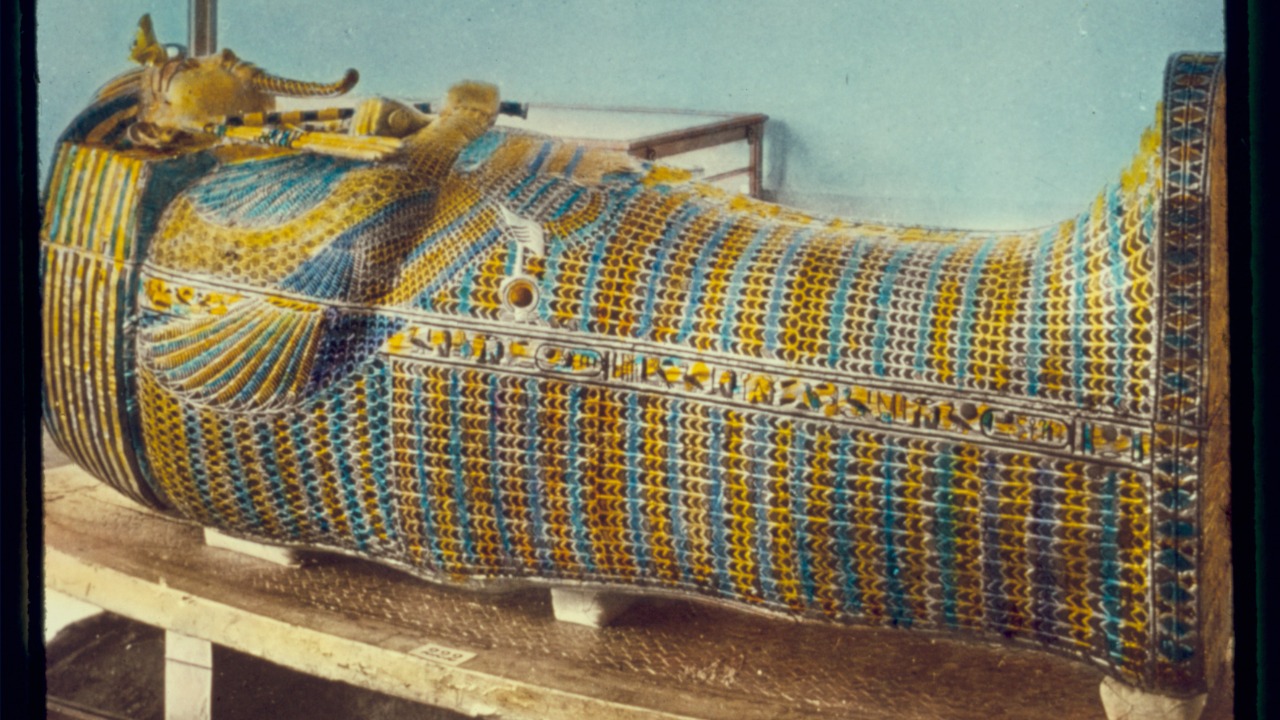

For more than a century, a cluster of alabaster containers from the burial of King Tut has taunted archaeologists with a simple but stubborn question: what, exactly, did these elegant jars once hold. Now a Yale-led team argues that the answer is opium, a finding that would tie the teenage pharaoh to a far older and wider story of ancient drug use. Their work, built around a single Egyptian alabaster vase and a battery of chemical tests, is beginning to recast those “mysterious jars” not as decorative puzzles but as evidence of a sophisticated pharmacological culture.
The new research does not claim that King Tut’s tomb was a narcotics cache, and it stops short of declaring the mystery definitively solved. Instead, it offers a carefully framed probability: that opium was part of an aromatic mixture once stored in alabaster vessels like the ones sealed in his burial chamber, and that similar recipes circulated from Egypt to the courts of Xerxes. That argument, and the scientific trail behind it, is already reshaping how I think about luxury, medicine, and ritual in the late Bronze Age.
From puzzling jars to pharmacological lead
For generations, the alabaster jars from King Tut’s burial chamber have been treated as beautiful enigmas, cataloged for their craftsmanship while their original contents remained speculative. Egyptologists knew that the vessels were linked to perfumes and unguents, yet the organic traces inside had degraded so badly that even modern lab work struggled to move beyond vague labels like “resin” or “oil.” The result was a kind of scholarly stalemate, with the jars sitting in museum cases as symbols of how much of Tutankhamun’s world still lay just out of analytical reach.
The new Yale-led work breaks that stalemate by shifting attention from the famous tomb to a less glamorous but better preserved alabaster vase in a research collection. In a detailed study, researchers argue that this vessel, carved from Egyptian alabaster and linked stylistically and materially to the jars from King Tut’s burial, preserves chemical fingerprints of opium within its residue. One report on the project notes that the team now thinks “it is possible, if not probable” that alabaster jars found in King Tut’s tomb once contained opium as part of an aromatic blend, a conclusion grounded in the analysis of similar vessels in museum collections worldwide.
The Yale Ancient Pharmacology Program’s breakthrough
The turning point came when the Yale Ancient Pharmacology Program, known as YAPP, decided to treat an ancient alabaster vase not as a static artifact but as a chemical archive. Instead of focusing solely on inscriptions or iconography, the team sampled the residue clinging to the interior and ran it through modern analytical techniques designed to pick out specific plant-derived compounds. That approach reflects a broader shift in archaeology, where laboratories now treat pots and jars as microscopic landscapes that can preserve traces of what people once ate, drank, or inhaled.
According to the project’s own description, YAPP’s researchers found chemical traces of opium in an ancient Egyptian alabaster vase, a result they framed as a new window into how ancient societies used potent plant-based substances. The group highlighted that this was not a random stone container but a carefully carved vessel whose material and form tie it to elite contexts, including royal burials. In a public note, the Yale Ancient Pharmacology Program described how its study identified opium in an Egyptian alabaster vase, presenting the find as a landmark in the scientific recovery of ancient drugs and sharing the result through the Yale Peabody Museum.
A vase for Xerxes, written in four ancient languages
The specific alabaster vase that unlocked this story is remarkable even before the chemistry comes into view. It is linked to Xerxes, the Achaemenid ruler better known from Greek histories than from Egyptian tombs, and it carries inscriptions in four ancient languages that proclaim his authority. That multilingual text, carved into a vessel made of Egyptian stone, captures a world in which imperial power, local craftsmanship, and long-distance trade converged in a single object.
In the lab, that same vase became a test case for whether opium could be detected in the microscopic residues that survived inside. YAPP’s lab manager, Crandall, played a central role in the analysis, which identified opiate markers in the residue and tied them to the broader question of how ancient elites used psychoactive substances. The team emphasized that they had “now found opiate compounds” in this alabaster vase linked to Xerxes and written in four ancient languages, a result that they argue opens a new chapter in understanding opium in these ancient societies and that is detailed in a report on the YAPP laboratory findings.
From Xerxes to King Tut: a shared opium story
What makes this single vase so consequential for King Tut is not just the opium signal but the way it connects two seemingly distant courts. The vessel’s inscriptions tie it to Xerxes, yet its alabaster and form are rooted in Egyptian traditions that also shaped the jars in Tutankhamun’s tomb. That overlap suggests that recipes for aromatic mixtures, including opium, may have circulated across political boundaries, carried by artisans, merchants, and scribes who moved between imperial centers.
Resarchers at Yale have framed the discovery as evidence that opium use in antiquity stretched from Xerxes to King Tut, with the examination of an ancient alabaster vase providing the crucial bridge. They argue that their findings, combined with prior work on Egyptian and Near Eastern residues, point to a long and complex history of opium in elite ritual and medicinal settings that we are only now beginning to understand. In their account, the examination of this vase becomes the pivot that links Xerxes, King Tut, and a broader pattern of ancient opium use, a connection laid out in detail in a Yale research summary.
Revisiting King Tut’s jars with fresh evidence
Armed with the Xerxes vase data, scholars have gone back to the long-debated alabaster jars from King Tut’s burial with a sharper set of questions. Instead of asking in general terms what kinds of perfumes or oils they might have held, they now look for specific parallels in vessel shape, stone type, and residue patterns that could indicate similar opium-laced mixtures. The logic is comparative: if an Egyptian alabaster vase from a royal context elsewhere preserves opium, then jars carved from the same material for a pharaoh’s tomb become prime candidates for the same kind of contents.
One detailed account of the new work describes how mysterious jars found in King Tut’s tomb have perplexed scholars for a century, and how the latest research finally reveals what they likely held. The Yale-led study invites readers to see these containers not as neutral perfume bottles but as part of a cultural system in which opium was embedded rather than taboo, a substance woven into ritual, medicine, and elite display. That reframing is central to the argument that the jars from King Tut’s tomb, which have perplexed scholars for a century, can now be reinterpreted in light of new research that reveals what they held, as outlined in a report on how new research finally reveals what they contained.
Howard Carter’s notes and the chemistry of residue
The scientific case for opium in Tutankhamun’s world does not rest on chemistry alone. It also leans on the written record left by Howard Carter, the archaeologist who excavated tomb KV62 and documented its contents in meticulous notes. Those records describe how ancient robbers had broken into the burial and targeted certain containers, suggesting that whatever the jars held was valuable enough to attract thieves even after centuries underground. That pattern of selective looting now looks different when viewed through the lens of opium-laced aromatics.
On the laboratory side, chromatograms from the Xerxes vase revealed compounds such as noscapine and hydrocotarnine, which are associated with opium and help anchor the interpretation of the residue. Researchers have pointed out that the combination of these chemical markers with Carter’s original excavation notes for tomb KV62 supports a reinterpretation of what the alabaster jars in King Tut’s burial likely contained. In this reading, Howard Carter’s documentation of the tomb, combined with the chromatogram that revealed noscapine and hydrocotarnine, becomes a key piece of evidence in an argument that opium in an ancient vase helps rewrite the story of Tutankhamun’s tomb, as detailed in an analysis of how Carter’s notes support this reinterpretation.
Ancient opium as medicine, ritual, and luxury
Once opium enters the picture, the alabaster jars stop looking like mere perfume bottles and start to resemble multi-purpose pharmacological tools. In an elite Egyptian context, a mixture that combined fragrant oils with opium could have served as a pain reliever, a sedative, or a ritual aid that altered consciousness during ceremonies. The fact that such mixtures were stored in finely carved alabaster suggests that they were not everyday commodities but high-status substances reserved for royal or temple use, perhaps applied to the body, inhaled, or poured as offerings.
Archaeological commentary on the new findings emphasizes that the discovery of opium in an ancient alabaster vase points to a broader pattern of drug use in early complex societies. One analysis describes how, from Xerxes to King Tut, the examination of an ancient alabaster vase in the Yale Peabody Museum’s Babylonian Collection reveals that opium was part of a shared cultural repertoire that crossed political borders. By situating the vase within the Yale Peabody Museum and its Babylonian Collection, the report underscores how the examination of this object illuminates opium use in ancient cultures from Xerxes to King Tut, a perspective laid out in a discussion of how new discoveries suggest opium use in ancient cultures.
Why alabaster matters: stone, status, and scent
The choice of Egyptian alabaster is not incidental to this story. This translucent stone, prized for its soft glow and ability to keep contents cool, was a favored material for containers that held precious oils and unguents. In a world without glass bottles or refrigeration, alabaster offered both practical benefits and a visual signal of luxury, making it the logical medium for mixtures that combined expensive aromatics with potent plant extracts like opium. When I look at the jars from King Tut’s tomb through that lens, they read as carefully engineered devices for preserving and displaying powerful substances.
The Yale team’s focus on an alabaster vase in the Babylonian Collection reinforces that point by showing how Egyptian stonework traveled and was repurposed in other imperial settings. A separate account of the project notes that the examination of an ancient alabaster vase in the Yale Peabody Museum’s Babylonian Collection, framed under the theme “From Xerxes to King Tut,” reveals how such vessels functioned as cross-cultural carriers of both scent and pharmacology. By tracing the examination of this alabaster vase across contexts, researchers argue that Egyptian stone containers were central to the way opium and other aromatics were stored and circulated, a view developed in a report that highlights the role of the Yale Peabody Museum’s Babylonian Collection.
Public science, Instagram, and the opium reveal
One striking feature of this project is how quickly its technical findings have filtered into public view. Instead of confining the opium discovery to specialist journals, the Yale Ancient Pharmacology Program has used social media to showcase both the vase and the science behind it. That choice reflects a growing recognition that the story of ancient drugs, from opium to wine additives, resonates with contemporary debates about medicine, addiction, and cultural attitudes toward psychoactive substances.
In one widely shared post, the Yale Peabody Museum highlighted that a new study from the Yale Ancient Pharmacology Program had found chemical traces of opium in an ancient Egyptian alabaster vase, pairing the announcement with images and brief explanations of the methods involved. A related post reiterated that opium was found in an ancient Egyptian alabaster vase, using accessible language to connect laboratory work with the broader narrative of ancient pharmacology. Together, these posts, including a second update that again noted opium in an ancient Egyptian alabaster vase and was shared through a separate Instagram channel, show how the team is using digital platforms to bring a complex scientific story to a broader audience.
How far does the opium hypothesis reach?
Even with the new chemical evidence, the argument that King Tut’s jars once held opium-laced mixtures remains a hypothesis, albeit a well-supported one. The alabaster vase linked to Xerxes provides a strong analogy, and the parallels in material, form, and elite context make it reasonable to see the jars from Tutankhamun’s tomb as part of the same tradition. Yet the residues in those specific jars are degraded, and direct detection of opium in them remains technically challenging, which is why researchers speak in terms of possibility and probability rather than absolute proof.
In one synthesis of the project, the team notes that they think it is possible, if not probable, that alabaster jars found in King Tut’s tomb contained opium as part of an aromatic mixture, a conclusion drawn from the combination of chemical data, comparative vessel analysis, and historical context. That cautious phrasing matters, because it keeps the door open for future tests that might refine or even revise the current picture. For now, the opium hypothesis offers a compelling way to connect King Tut’s mysterious jars to a wider story of ancient pharmacology, grounded in the examination of an alabaster vase that has become a touchstone for understanding how opium moved through the worlds of Xerxes and King Tut, as first outlined in a detailed discussion of how King Tut’s tomb may have been linked to opiates.
More from MorningOverview