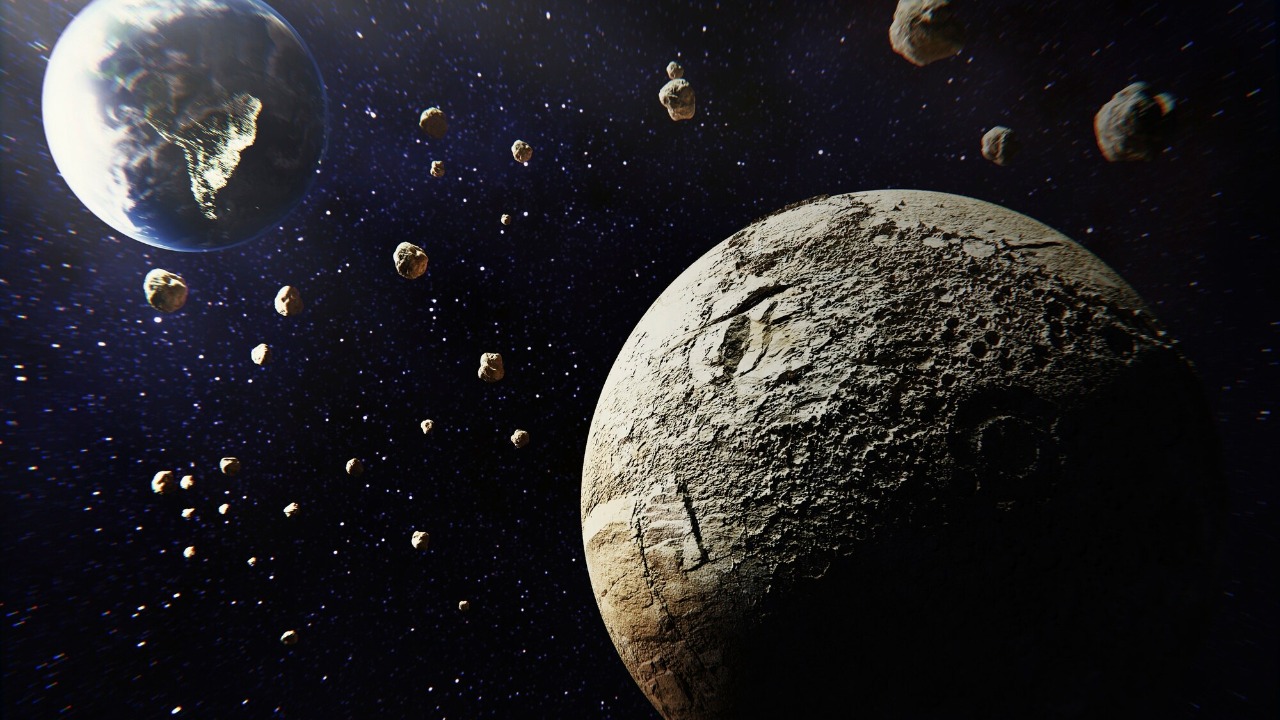

Violent collisions between young worlds have turned a nearby planetary system into a sprawling construction site of dust and debris, giving astronomers a rare, time-lapse view of planetary birth by destruction. Instead of a single serene exoplanet, telescopes are now watching a chaotic scene of shattered space rocks, expanding clouds, and fading wreckage that rewrites what we thought we knew about how planets grow up.
By tracking how these dusty plumes brighten, spread, and disappear, researchers are catching planetary formation in the act, not as a static snapshot but as an unfolding drama. I see this system as a kind of cosmic crash lab, where nature is stress testing young planets and leaving behind forensic clues in every grain of dust.
A nearby star system that refused to sit still
The star at the center of this story, Fomalhaut, has long been a favorite target for anyone trying to understand how planets form around other suns. It sits close enough in cosmic terms, bright and relatively young, wrapped in a broad disk of dust that signals an active, evolving planetary system. For years, that disk looked like a textbook example of a debris ring sculpted by unseen worlds, until the system started behaving less like a static diagram and more like a live experiment in celestial demolition.
Back in 2008, astronomers thought they had scored a landmark discovery when they spotted what looked like a faint point of light near Fomalhaut in visible wavelengths, a candidate exoplanet that quickly became a poster child for direct imaging. That object, initially celebrated as a triumph, has since been reinterpreted as a transient dust cloud, now known as cs1, likely created when two sizable bodies smashed together in the outer reaches of the system.
From “exoplanet” to expanding dust cloud
What looked at first like a stable, dust-covered world turned out to be anything but. As astronomers kept watching, the supposed planet’s light changed, its shape blurred, and its position drifted in ways that did not match the orbit of a solid object circling Fomalhaut. Instead of tracing a neat, predictable path, the source spread out and faded, behaving more like a plume of debris racing away from a violent impact than a compact globe reflecting starlight.
That shift in interpretation, from planet to pulverized rubble, hinged on the realization that the bright spot was expanding and dispersing over time. Detailed follow-up work showed that the cloud’s motion and growth fit the physics of a catastrophic collision between large icy or rocky bodies, not the steady glow of a long-lived exoplanet. In other words, what had been hailed as a new world was really the aftermath of a cosmic crash, a conclusion that has now been reinforced by broader analyses of mysterious dust clouds in the system.
Violent space rock smashups as the driving force
Once astronomers accepted that the “planet” was actually a debris plume, the bigger picture snapped into focus: Fomalhaut’s dusty environment is being constantly reshaped by violent space rock smashups. Instead of a quiet ring of leftover material, the system looks more like a demolition zone where massive bodies collide, fragment, and grind each other down, feeding a steady stream of fine particles into the surrounding disk. The result is a dusty wreck that is not a one-off accident but part of an ongoing cycle of destruction and rebuilding.
Analyses of the system’s changing brightness and structure point to repeated collisions between large objects, each event injecting fresh material into the debris field and leaving behind expanding clouds that gradually thin out. One recent synthesis describes how these impacts in a nearby planetary system have created a complex pattern of dust, with some regions brightened by recent wreckage and others dimmed as older debris disperses into space.
Hubble’s long view of catastrophic collisions
What makes this case so compelling is the length and precision of the observational record. The Hubble Space Telescope has been returning to Fomalhaut for years, building a time series that lets astronomers watch the system evolve rather than freezing it in a single moment. With that long view, subtle changes in the dust ring and sudden appearances of new features stand out, revealing the fingerprints of catastrophic collisions that would otherwise be invisible.
Using Hubble’s sharp vision, researchers have identified not just one, but at least two distinct debris clouds that appear to be the aftermath of massive impacts between large bodies in the outer system. In one case, catastrophic collisions were effectively witnessed in slow motion, as an initially compact source gradually stretched into a diffuse cloud before fading from view, a sequence that matches expectations for the dispersal of impact debris in a low gravity environment.
Dusty debris from not one, but two cosmic crashes
As the data accumulated, it became clear that the system’s drama was not limited to a single spectacular crash. Scientists studying the images realized they had stumbled on the dusty debris from two separate cosmic collisions, each involving massive space rocks that slammed together with enough energy to vaporize and fragment their surfaces. These events injected huge amounts of fine material into the surrounding region, briefly lighting up the system before the dust began to spread and thin.
In both cases, the debris clouds followed a similar arc: they brightened as the fresh dust reflected starlight, then expanded and faded as the remains spread out and eventually disappeared altogether. That pattern, captured in detail by Scientists using Hubble, provides a kind of template for recognizing similar events in other systems, turning Fomalhaut into a reference case for what a fresh planetary collision looks like in scattered light.
How astronomers caught a cosmic crash on camera
From an observational standpoint, catching such a crash is a matter of patience, precision, and a bit of luck. When astronomers initially spotted a bright object in the Fomalhaut system, they reasonably assumed it was a dust-covered exoplanet reflecting the star’s light, because that was the simplest explanation that fit the early data. Only after repeated imaging and careful tracking did the inconsistencies pile up, forcing a rethink of what the object really was.
As the source’s changing shape and trajectory became impossible to reconcile with a solid planet, the collision scenario gained traction. The realization that the object was an expanding debris cloud, not a stable world, turned that early detection into a rare example of a cosmic crash caught on camera, offering a direct window into the violent processes that shape young planetary systems.
What these dusty wrecks reveal about planet formation
For planetary scientists, the real payoff is not just the spectacle of destruction, but what it reveals about how planets grow and evolve. Collisions of this scale do not happen in isolation; they are the natural outcome of a crowded, dynamically active disk where countless bodies jostle for stable orbits. The presence of large debris clouds implies that sizable protoplanets or planetesimals have already formed and are now interacting in ways that can both build and erode worlds.
By modeling the size, brightness, and evolution of the dust plumes, researchers can infer the masses and compositions of the colliding bodies, as well as the architecture of the surrounding disk. Those clues feed into broader efforts to understand how a disk of dust swirling around a new-born star gradually assembles into a mature planetary system, a process that missions planned by NASA and others aim to probe with ever more sensitive instruments.
A cosmic car crash that clarifies the rules of the road
One way I think about Fomalhaut’s drama is as a cosmic car crash that reveals the hidden traffic patterns of a young planetary system. Just as a pileup on a highway exposes where lanes merge or where visibility is poor, these collisions highlight regions where orbits cross, resonances pile up, or gravitational nudges from larger bodies destabilize smaller ones. The dust clouds are not random; they trace the underlying structure of the system’s gravitational “roads.”
Analyses framed as Cosmic Catastrophes emphasize that these wrecks are not mere curiosities, but key tests of our models of planetary formation, forcing theorists to account for both the frequency and the scale of such impacts in systems that may eventually host Earthlike worlds.
Why a dusty wreck around Fomalhaut matters for our own origins
It is tempting to treat Fomalhaut’s chaos as something exotic and distant, but the physics at work there almost certainly played out in our own solar system’s youth. The leading explanations for features like the Moon’s formation or the tilted axis of Uranus involve giant impacts between protoplanets, events that would have generated their own transient dust clouds if anyone had been watching from afar. In that sense, the dusty wreck around Fomalhaut is a glimpse of our own past, replayed on a nearby stage.
By studying how debris from these collisions spreads, dims, and eventually vanishes, astronomers can better estimate how often such events occur and how long their signatures linger, which in turn shapes how we interpret observations of other dusty wrecks across the galaxy. For me, that is the deeper significance of these violent space smashups: they turn distant star systems into laboratories where we can test ideas about how worlds like ours come to be, one collision at a time.
More from MorningOverview