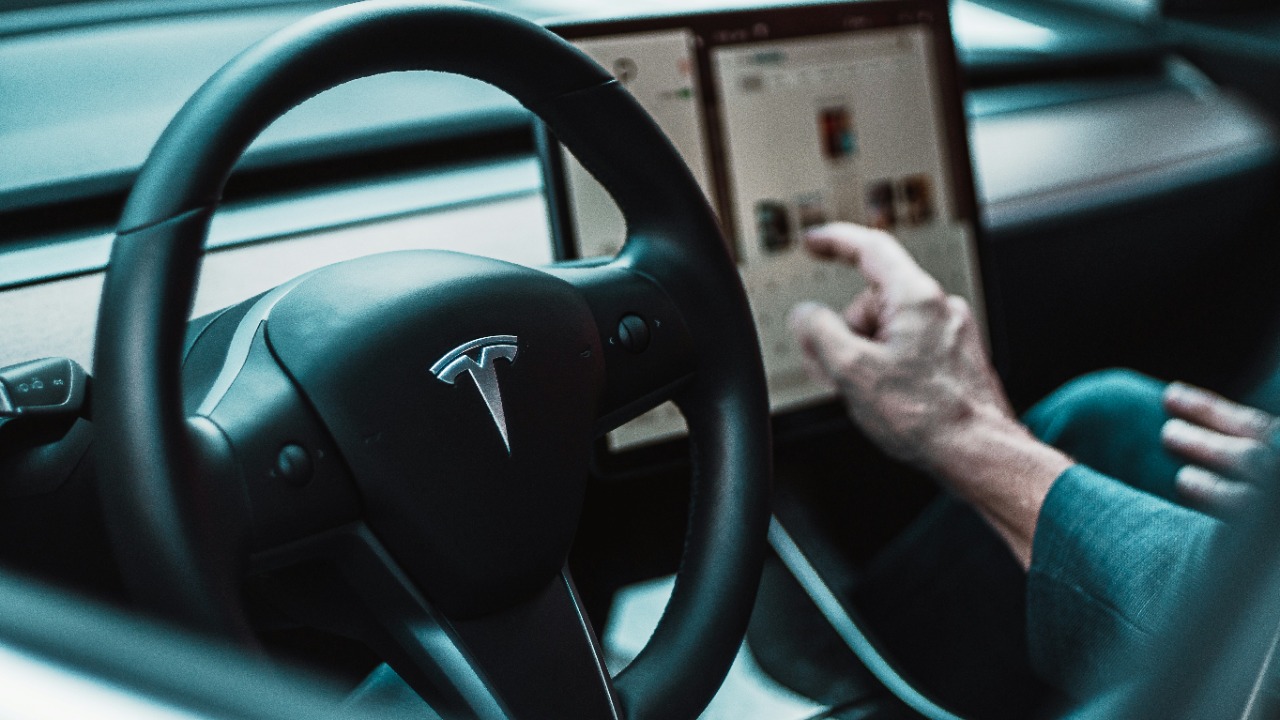

On a clear day in American suburbs, a Tesla owner can watch the car steer itself with eerie confidence, then see the system abruptly give up the moment it faces the sun. The same software that glides through traffic lights and lane changes can suddenly flash a warning and hand control back to the human because the cameras are blinded by glare. That gap between impressive autonomy and a very basic failure point is now one of the sharpest tests of Tesla’s promise that Full Self-Driving is ready for prime time.
The tension is simple to describe and harder to solve: FSD can feel “great” when conditions are ideal, yet a low afternoon sun can still turn a six-figure electric car into a nervous novice. As Tesla pushes toward robotaxis and unsupervised driving, the question is no longer whether the software can handle complex city streets, but whether it can handle something as ordinary as Dec sunlight hitting a windshield at the wrong angle.
The viral clip that turned sunlight into a dealbreaker
The most vivid illustration of this problem comes from a Tesla owner who shared a video of his car cruising along smoothly until it pointed straight into the sun and the automation simply bowed out. In the clip, the driver praises the system’s capabilities, then watches as the interface warns that it “can’t drive into Sun” and disengages, forcing him to take over just when visibility is hardest. That moment, when a supposedly advanced driver-assist feature taps out because of a bright sky, undercuts the idea that Full Self-Driving is ready to replace human judgment.
The owner’s experience, framed as “Tesla Owner Says FSD Is Great Except for the Part Where It Can, Drive, Sun,” has resonated because it captures both sides of the technology in a single drive. On one hand, the car behaves like a confident chauffeur, handling routine navigation with ease. On the other, it reveals a brittle dependence on camera vision that cannot cope with direct glare, a limitation highlighted in the original Tesla Owner Says FSD Is Great Except for the Part Where It Can report.
What the cameras actually see when glare hits
From the outside, the failure looks almost absurd: the sun comes out, and a car packed with sensors loses its nerve. Inside the system, the explanation is more mechanical. When sunlight hits the front-facing cameras at just the wrong angle, it can wash out the image so thoroughly that the software no longer has a reliable picture of the road. In the viral incident, footage taken by the car’s front camera showed the scene ahead turning into a white smear, with lane markings and vehicles effectively erased by the glare.
That visual washout is not a minor inconvenience, it is a core safety constraint. If the neural network behind FSD is trained to interpret lines, shapes, and colors, then a frame filled with pure brightness is essentially a missing input. The owner who shared the clip is known as one of the system’s most enthusiastic supporters, yet even he acknowledged that the camera view was unusable when the sun hit it head-on, a detail captured in the Footage description of the event.
Inside the hardware: off-gassing, dirty housings, and Norma’s warning
Glare alone is not the only culprit. Some Tesla owners have discovered that the camera housings themselves can make the problem worse. One detailed explanation from a user named Norma points to “an extreme amount of off-gassing” inside the camera enclosure, which leaves a film on the lens and degrades image quality. In that account, the issue is not just the sun, but the combination of harsh light and a slightly fogged camera window that turns a challenging condition into a complete failure.
Norma’s warning cuts against the assumption that camera-only systems will naturally improve as software gets smarter. If the inside of the housing is dirty, the neural network is starting from a compromised picture before glare even arrives. That perspective, shared in a discussion titled “How can we have full autonomy if the sun glare is going to be,” argues that the path to reliable autonomy has to run through better hardware maintenance and design, not just code updates, a point laid out in the Norma thread.
Past weather fixes show Tesla can move fast, but not on everything
There is precedent for Tesla tackling vision problems aggressively when they become too visible to ignore. After owners raised alarms about poor camera performance in rain and snow, the company pushed both software and hardware changes that improved how the system handled bad weather. In a detailed breakdown, one commentator noted that “we all know the piece just dropped earlier this weekend about Tesla’s camera quality and its ability to see in” difficult conditions, then walked through how the company had already started to resolve major camera problems in bad weather.
That history matters because it shows Tesla can iterate quickly when a weakness threatens the narrative of relentless progress. The same company that responded to rain and snow complaints with targeted fixes is now facing a more fundamental challenge from the sun itself. The earlier analysis of how Tesla resolved camera issues in storms underscores that hardware and software tweaks are possible, but it also highlights that each new edge case, from fog to glare, requires its own engineering push.
Everyday drivers say the sun is FSD’s “weakness”
For owners who use FSD on daily commutes, the sunlight problem is not an abstract lab test, it is a recurring frustration. One driver described how “Sun glare affects the camera as already documented and mentioned by a lot of people here,” then went further, arguing that the real danger comes when glare hits traffic lights and reflective surfaces. In that account, the system can misinterpret signals or lose track of lane boundaries on a route that the driver takes every day, turning a familiar drive into a series of nervous handoffs.
The same user framed the issue bluntly as “the powers of the sun is FSD’s weakness,” a phrase that captures how a basic environmental factor can undermine a sophisticated product. The post, shared in a community focused on Tesla’s driver-assist features, lays out how repeated disengagements in the same spots erode trust, even among fans who want the technology to succeed. That sentiment is preserved in the Sun discussion, where the author emphasizes that the problem shows up on a route “that I take every day.”
Why glare is a bigger deal for a robotaxi than a human
Human drivers have a simple toolkit for dealing with harsh light: flip down a visor, adjust speed, or squint through a bright patch until the view clears. For a robotaxi, that kind of improvisation is not acceptable. One analysis of Tesla’s 2025 Full Self-Driving roadmap spells out the stakes clearly, noting that “Why This Matters” is that a human can shrug off a moment of poor visibility, “But for” a fully autonomous service, “I couldn’t see because of the sun” is not a defense that regulators or passengers will accept.
That same roadmap looks ahead to FSD running unsupervised in select cities, which would move the system from a driver-assist feature to a primary operator of the vehicle. In that context, a car that disengages whenever it faces a low sun is not just inconvenient, it is commercially unviable. The analysis of Tesla’s plans for Why This Matters and “But for” a Robotaxi underscores that glare is not a niche bug, it is a barrier to the business model Tesla is trying to build.
The technical truth: why Tesla’s vision stack struggles with sunlight
Under the hood, Tesla’s approach to autonomy leans heavily on cameras and neural networks, with no lidar and limited radar support. That design choice makes the quality of each pixel critical. When a bright sun floods the sensor, it can push parts of the image beyond the camera’s dynamic range, turning details into flat white patches. A technical explainer on why Tesla’s full self-driving struggles with sunlight walks through how this saturation confuses the perception stack, which expects to see contrast and edges, not a uniform glare.
In that breakdown, the host greets “EV enthusiasts” and then unpacks the “surprising truth” that even advanced image processing can be overwhelmed by direct light. The video argues that the problem is not unique to Tesla, but is especially acute for a system that relies almost entirely on vision. It also notes that training data can only go so far if the raw sensor input is blown out. The analysis in Tesla sunlight coverage reinforces what owners see on the road: when the camera is blinded, the software has little choice but to disengage.
“Sunglasses” for cameras and the promise of hardware upgrades
One of the more intriguing developments in Tesla’s hardware story is the claim that its cameras now have built-in “sunglasses” to expand their dynamic range. A detailed technical thread describes a textured layer in front of the sensor that helps manage bright light, arguing that “For Tesla, this technology represents the critical hardware upgrade needed to bridge the gap between ‘supervised’ and” more autonomous driving. The idea is that by shaping how light hits the sensor, the camera can preserve detail in both bright and dark areas of the scene.
The same explanation notes that while the texture itself provides some benefit, the real gain comes from how it increases the camera’s dynamic range, giving the neural network more usable information in high-contrast situations. If that upgrade works as described, it could reduce the frequency of glare-induced washouts that plague current owners. The claim that Tesla cameras have “sunglasses” and that this is a crucial step toward more capable autonomy is laid out in a post that concludes, “For Tesla, this technology represents the critical hardware upgrade needed to bridge the gap,” a point detailed in the For Tesla explanation.
Between great and not good enough: how owners are adapting
In the meantime, drivers are building their own workarounds for a system that can be brilliant one minute and unreliable the next. Some owners time their FSD use to avoid the worst glare, enabling it on shaded stretches and taking over manually when the road turns into the sun. Others treat the feature as a helpful assistant on highways but refuse to trust it in urban canyons where reflections and low-angle light can confuse the cameras. The pattern is consistent: FSD is “great” when the environment cooperates, but the human remains the real driver whenever conditions get tricky.
That lived experience sits awkwardly beside Tesla’s marketing of Full Self-Driving as a step toward hands-off travel. The viral clip of a car that “can’t drive into Sun” crystallizes the gap between aspiration and reality, and the technical deep dives into off-gassing, camera housings, and dynamic range show that the fix will not be a single over-the-air update. As owners like the American Canto driver, the commuters who say “the powers of the sun is FSD’s weakness,” and technical voices like Norma keep documenting these failures, the pressure on Tesla is clear: if the company wants to move from supervised assistance to true autonomy, it has to prove that its cars can handle the most ordinary challenge of all, a bright Dec afternoon.
More from MorningOverview