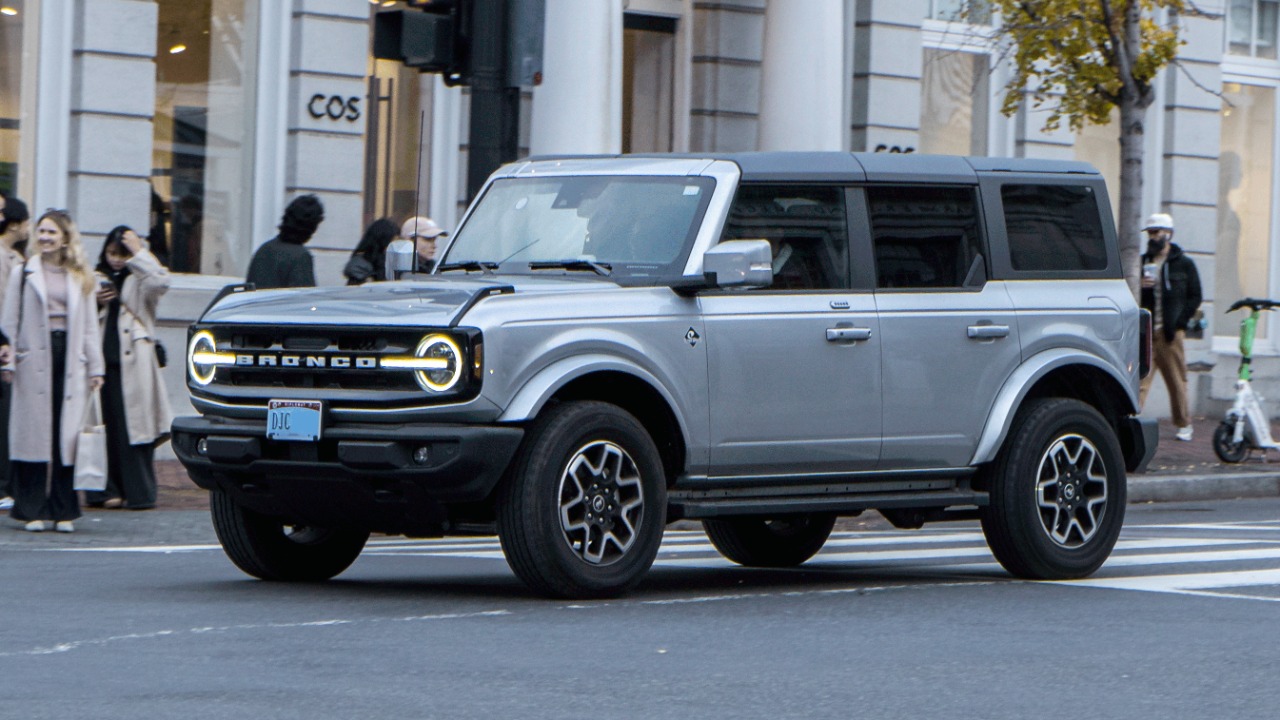

The first electrified Bronco is not rolling out in Detroit or Denver, but in crowded Chinese cities and on that country’s growing web of expressways. Ford’s China-only Bronco EREV arrives as a pragmatic, range-extended off-roader that looks less like a compliance experiment and more like a serious attempt to future-proof one of the brand’s most important nameplates. If this is the template for how Ford blends heritage with new energy tech, it is a more convincing opening move than many expected.
Instead of chasing headline-grabbing specs at any cost, the Bronco EREV leans on a balanced package of usable electric range, familiar Bronco attitude, and pricing that undercuts a lot of Western-market EV SUVs. I see it as a strategic test bed: a way for Ford to learn in the world’s toughest EV arena while quietly sketching the outlines of what a global Bronco EV family could become.
The Bronco that skipped America
Ford has effectively created a parallel Bronco universe for China, one where the badge sits on a dedicated electric platform rather than the ladder-frame hardware that underpins the U.S. truck. The result is the Ford Bronco New Energy, a family that includes both the pure EV and the range-extended Ford Bronco (EREV), built in the Nanchang factory and listed in official materials as the Ford Bronco New Energy. On paper it is a clean-sheet product, yet visually and conceptually it is still meant to read as a Bronco to Chinese buyers who may never see the U.S. model in person.
That split personality is deliberate. In China, the Bronco is pitched as a modern “new energy” SUV rather than a retro rock crawler, and the spec sheet reflects that shift. The electric Ford Bronco for China (sometimes referred to as the Ford Bronco for China) keeps the squared-off stance and upright glass, but it is sized and packaged to compete with domestic crossovers that live as much in urban traffic as on muddy trails. That context helps explain why the first Bronco with a plug is launching in Shanghai showrooms instead of U.S. dealerships.
Two Flavors of Future: BEV and EREV
Rather than betting everything on a single drivetrain, Ford chose a dual-path strategy that mirrors how Chinese buyers actually use their vehicles. Under the “Two Flavors of Future” approach, the Bronco New Energy line offers a full battery-electric variant and the Bronco EREV, which pairs a battery pack with a small combustion engine that acts purely as a generator. The pure EV is aimed at drivers with reliable access to charging, while the range-extended version is designed to calm anxiety about long-distance trips in a country where charging infrastructure is still uneven, a split that is spelled out in early coverage of the Two Flavors of Future.
For the EREV specifically, the hardware is straightforward but smartly tuned. The EREV version uses a 43.7 kWh battery and a 1.5T engine, good for 220 km (137 miles) all-electric range before the generator needs to wake up, figures that are quoted verbatim in technical breakdowns of The EREV. Combined, the system is meant to deliver the day-to-day feel of an EV with the long-haul flexibility of a conventional SUV, which is exactly the compromise many Chinese buyers still say they want.
Powertrain and performance: more than a paper exercise
On the road, the Bronco EREV is not trying to be a drag-strip monster, but it is far from underpowered. Reports from Chinese test drives describe a twin-motor setup that delivers brisk acceleration and confident passing power, with the gasoline engine staying mostly in the background as a quiet generator. One early reviewer, known online as Telescope, spent time with the electrified Bronco and came away impressed with how seamlessly the system blended electric thrust with the backup engine, noting that the package felt well suited to both city commuting and a weekend getaway, impressions that are echoed in local coverage of the Bronco EREV.
The pure EV version, meanwhile, leans harder into outright output. Detailed specs from China note that they feature dual motors: the front motor delivers a peak power of 130 kW, while the rear motor produces 180 kW, giving the battery-only Bronco a serious shove when both ends are working together, a setup summarized in technical notes that state They features dual motors: the front motor delivers a peak power of 130 k, while the rear motor produces 180 k. That kind of output puts the Chinese-market Bronco in the same performance conversation as many premium crossovers, even if its mission is more about versatility than outright speed.
Pricing, positioning, and the JMC-Ford factor
For all the engineering effort, the Bronco EREV would not matter much if it were priced out of reach. Instead, Ford has come in aggressively. The electric Ford Bronco off-road SUV from the JMC-Ford joint venture entered China with a starting price of 229,800 yuan, a figure that translates to roughly the low-thirty-thousand-dollar range and is explicitly listed as 229,800. That pricing puts the Bronco squarely in the crosshairs of domestic “new energy” SUVs from brands like BYD and Great Wall, while still carrying the cachet of an imported American nameplate built locally.
Ford had already signaled its intent when it opened preorders earlier in the year. In Nov, the company announced that it would open orders for the electric Bronco in China, starting at under $33,000, positioning the SUV as a relatively attainable entry into the off-road-inspired EV segment and explicitly noting that the $33,000 threshold was a key psychological marker. By leveraging the JMC partnership and local production, Ford can keep costs in check while still delivering a product that feels more premium than its price tag suggests.
Launch timing and Ford’s China strategy
The rollout cadence shows how seriously Ford is treating this program. After the initial reveal over the summer, the company moved quickly to lock in a launch window and start deliveries. Corporate communications framed the milestone clearly: Ford Confirms China Launch Date for Electric Bronco as Deliveries Begin Dec 19, underscoring that the first wave of customers would get their vehicles before the end of the year and that the China-specific SUV would blend off-road cues with urban practicality, a message captured in the announcement that Ford Confirms China Launch Date for Electric Bronco and that Deliveries Begin Dec.
By the time those first keys changed hands, more detailed specs were public. Reports from Dec, attributed to Lei Kang and timestamped in GMT, laid out how Ford would offer both BEV and EREV options for the electric Bronco in China, with a wheelbase of 2,950 mm that plants the SUV firmly in the midsize segment and gives it enough interior space to feel family-friendly, details that appear in coverage noting that Lei Kang described how Ford would position the BEV and EREV twins. That dual-offer strategy is central to Ford’s broader China play, which increasingly revolves around flexible electrification rather than a one-size-fits-all EV push.
Design: Bronco attitude, Chinese priorities
Visually, the Bronco New Energy walks a careful line between familiar and fresh. The boxy silhouette, upright grille, and squared-off fenders are all nods to the U.S. Bronco, but the proportions and detailing are tuned for Chinese tastes and regulations. Early walkarounds emphasize that the Ford Bronco EV for the Chinese market shares little mechanically with the American truck, yet still looks every bit the rugged SUV, with coverage noting that the Ford Bronco EV that debuts for the Chinese market is a kind of “Forbidden Fruit Model Shows Potential Of” what a global Bronco EV could be.
Underneath the styling, the packaging reflects Chinese priorities. The Bronco New Energy measures out to a footprint that is easier to park in dense cities than the U.S. Bronco, and its curb weight, quoted at 4,945 pounds in some technical rundowns, is more in line with other midsize electric SUVs than with full-size off-roaders. That balance allows Ford to sell the Bronco as both a lifestyle toy and a practical daily driver, a positioning that would be harder to pull off if it simply electrified the existing body-on-frame truck described in U.S. marketing materials that invite shoppers to Enjoy exceptional off-road performance in the Ford Bronco.
How the EREV actually feels to drive
Specs only tell part of the story, and early seat time suggests the Bronco EREV is more polished than some skeptics expected. Chinese reviewers who have lived with the vehicle describe a driving experience that feels primarily electric, with the 1.5T engine fading into the background unless the battery is depleted or the driver demands sustained high-speed cruising. One long-form video review from Dec walks through the system in plain language, explaining that basically you are still buying an electric vehicle but it has a small generator engine that does not power the wheels directly, a point made explicitly in a popular clip titled Dec that breaks down how the range extender works in practice.
On enthusiast forums, the reaction has been cautiously optimistic. A detailed owner-style writeup on r/electricvehicles, posted under the heading “Ford (China Only) Bronco PHEV / EREV Review,” frames the Bronco as a credible alternative to both plug-in hybrids and full EVs, with the author comparing it to other crossovers and noting that the EREV layout suits long commutes in Asia where charging can be inconsistent, a perspective that appears in a thread that also surfaces More posts you may like, including WTS AR60 Asia listings that underline how global the audience for such vehicles has become. Those early impressions matter, because they hint at how a similar configuration might be received if Ford ever decides to export the concept beyond China.
Comparing the China Bronco to the U.S. icon
From a brand perspective, the Bronco EREV is a fascinating contrast with the gasoline-only Bronco that U.S. buyers know. The American truck is marketed as a hardcore off-roader with removable doors, locking differentials, and a focus on trail capability, a package that dealership materials summarize with lines about how drivers can Ford Bronco performance being further augmented by a number of available special features. The Chinese Bronco, by contrast, is built on a unibody-style EV platform and prioritizes efficiency, cabin tech, and urban comfort, even if it still wears skid plates and all-terrain tires.
That divergence raises an obvious question about the Bronco’s identity. Is it a specific type of off-road machine, or is it a flexible badge that can stretch across multiple formats as long as the styling cues line up? In China, Ford is clearly betting on the latter. The Bronco New Energy is marketed as a “new energy” SUV first and a trail rig second, and its EREV powertrain is a nod to the reality that many Chinese buyers want the look and occasional capability of an off-roader without the fuel bills or emissions of a traditional 4×4. If anything, the Chinese experiment may give Ford a roadmap for how to electrify the U.S. Bronco without alienating its core fans.
Why the EREV formula makes sense in China
China’s EV market is both advanced and uneven, which is exactly the environment where a range-extended SUV can shine. In major coastal cities, fast chargers are common and pure EVs are already mainstream, but in smaller cities and rural areas, infrastructure gaps remain. By offering a Bronco that can run 220 km (137 miles) on its 43.7 kWh battery before relying on gasoline, Ford is effectively giving buyers a safety net that pure EV rivals cannot match, a point that technical breakdowns of 43.7 k and 220 km, 137 miles make clear.
There is also a regulatory angle. Chinese policymakers have been supportive of EREV and plug-in hybrid architectures as transitional technologies, especially for larger vehicles like SUVs that are harder to decarbonize quickly. By positioning the Bronco EREV as part of its “new energy” portfolio, Ford can tap into incentives and license-plate advantages that make the vehicle more attractive in crowded cities where conventional gasoline SUVs face restrictions. That policy backdrop helps explain why the Bronco EREV is launching in China first, even though the concept could arguably appeal to suburban buyers in North America and Europe as well.
What this means for Ford’s global EV roadmap
From a global strategy standpoint, the Bronco EREV looks like a low-risk, high-learning experiment. Ford gets to test a new platform, a new powertrain configuration, and a new brand positioning in a single market that is already comfortable with rapid iteration. If the Bronco New Energy family sells well and owners report positive experiences with the EREV system, those lessons can feed directly into future products, whether that is a Ranger-sized pickup with a similar layout or a more rugged Bronco EV for export. The fact that the Bronco New Energy is already cataloged as both a Ford Bronco (EV) and a Ford Bronco (EREV) in official documentation underscores how seriously the company is treating this branch of the family tree, as seen in the way the Ford Bronco New entries are structured.
There is also a branding upside. By creating a “forbidden fruit” Bronco that only Chinese buyers can get, Ford has inadvertently stoked interest among enthusiasts elsewhere who are watching the launch from afar. Coverage that labels the Chinese Bronco EV as a “Forbidden Fruit Model Shows Potential Of” a future global Bronco EV hints at the halo effect this SUV could have, even if it never leaves China in its current form, a sentiment captured in early writeups of the Forbidden Fruit Model Shows Potential Of the Bronco New Energy. If Ford plays this right, the China-only Bronco EREV could end up shaping expectations for what an electric Bronco should be everywhere else.
More from MorningOverview