
A small gold disc pulled from the soil just outside Jerusalem’s Temple Mount is reshaping how scholars picture Jewish life in the city more than a millennium ago. The rare 1,300-year-old menorah medallion, preserved against the odds beneath centuries of rubble, offers a vivid, personal link between the sacred landscape of the mount and the people who once moved through its shadow.
Rather than a grand monument or royal inscription, this find is intimate, wearable, and unmistakably Jewish, its tiny motifs packed with meaning. I see in it not only a striking artifact of Late Byzantine devotion, but also a quiet challenge to long-held assumptions about who felt at home around one of the world’s most contested holy sites.
The moment a glint of gold surfaced near the Temple Mount
The story begins in the dust of an excavation trench, where routine work suddenly turned into a once-in-a-career discovery. Archaeological worker Ayayu Belete was clearing debris from an ancient structure near the southern edge of the Temple Mount when a flash of metal caught his eye. At first glance it might have been a stray coin or a bit of modern trash, but as he lifted the object and brushed away the soil, he realized he was holding a small disc that carried a carefully worked menorah symbol, not a random piece of scrap.
That instant of recognition, when Ayayu Belete understood that the object in his hand was a deliberate piece of religious jewelry, is what gives this find its human charge. It is one thing to read about Late Byzantine Jerusalem in academic monographs, quite another to imagine the last person who clasped this pendant around their neck before it slipped into the rubble of a collapsing building. The fact that an Archaeological worker could spot and identify such a small object in the churned earth underscores how much of the past still lies hidden in plain sight around the Temple Mount.
A Late Byzantine building, sealed by destruction
The medallion did not emerge from an isolated pit, but from inside a substantial Late Byzantine-era building that had been buried under a thick layer of collapse. That context matters. It suggests the pendant was not a stray loss in an open field, but part of the life of a specific urban space, perhaps a home, workshop, or communal facility that once stood just outside the sacred precinct. When the structure fell, whether through earthquake, violence, or gradual decay, its contents were sealed away, creating a time capsule that preserved this small piece of jewelry for roughly thirteen centuries.
Archaeologists describe the building as part of a broader complex of Late Byzantine remains around the southern approaches to the Temple Mount, a zone that has seen repeated cycles of construction and demolition. The fact that the newfound medallion was discovered inside a Late Byzantine building, rather than in later fill, gives scholars confidence that it truly belongs to that era and was not introduced by later activity. The collapse layer that entombed the structure, while destructive in its own time, is what allowed the medallion to survive in such remarkable condition.
A “rare 1,300-year-old” pendant with unmistakable Jewish iconography
What sets this object apart is not only its age but its clarity. Described by excavators as a rare 1,300-year-old medallion, the pendant is decorated with menorahs that leave no doubt about its Jewish character. The phrase “rare 1,300-year-old” is not hyperbole in this case. Very few pieces of personal jewelry from this period in Jerusalem carry such explicit Jewish symbols, and even fewer have been found so close to the Temple Mount itself. The medallion’s survival, complete with its loop for suspension, gives us a nearly intact example of how Late Byzantine Jews chose to display their identity on their bodies.
The disc-shaped pendant features a loop at the top and a seven-branched menorah motif that would have been instantly recognizable to anyone in the city at the time. Described as a rare menorah amulet with deep religious meaning, it fits into a broader tradition of protective and declarative jewelry, where wearers combined faith, memory, and perhaps a hope for divine favor in a single object. The fact that this particular amulet is explicitly described as A rare menorah amulet underscores how unusual it is to find such a clear, undamaged example from this turbulent chapter in Jerusalem’s past.
Design details: a disc, a loop, and layered symbols
At first glance, the medallion’s design seems straightforward: a round disc, a suspension loop, and a central menorah. Yet each of these elements carries weight. The disc shape would have allowed the pendant to lie flat against the chest, making the menorah visible to anyone facing the wearer. The loop at the top suggests it hung from a chain or cord, perhaps alongside other amulets or beads. This was not a hidden charm tucked into clothing, but a public statement of identity and devotion, worn where it could be seen.
The seven-branched menorah at the heart of the design is more than decorative. In Jewish tradition it evokes the candelabrum of the ancient Temple, a symbol of divine presence and national memory. To wear that image within sight of the Temple Mount, centuries after the destruction of the Second Temple, is a powerful act of spiritual continuity. The reporting on the discovery notes that the medallion is decorated with menorahs and that its iconography reflects the deep significance of this symbol for the community that produced it. In that sense, the Rare 1,300-year-old medallion is both jewelry and theology, compressed into a few centimeters of worked metal.
Jerusalem’s layered sacred geography around the Temple Mount
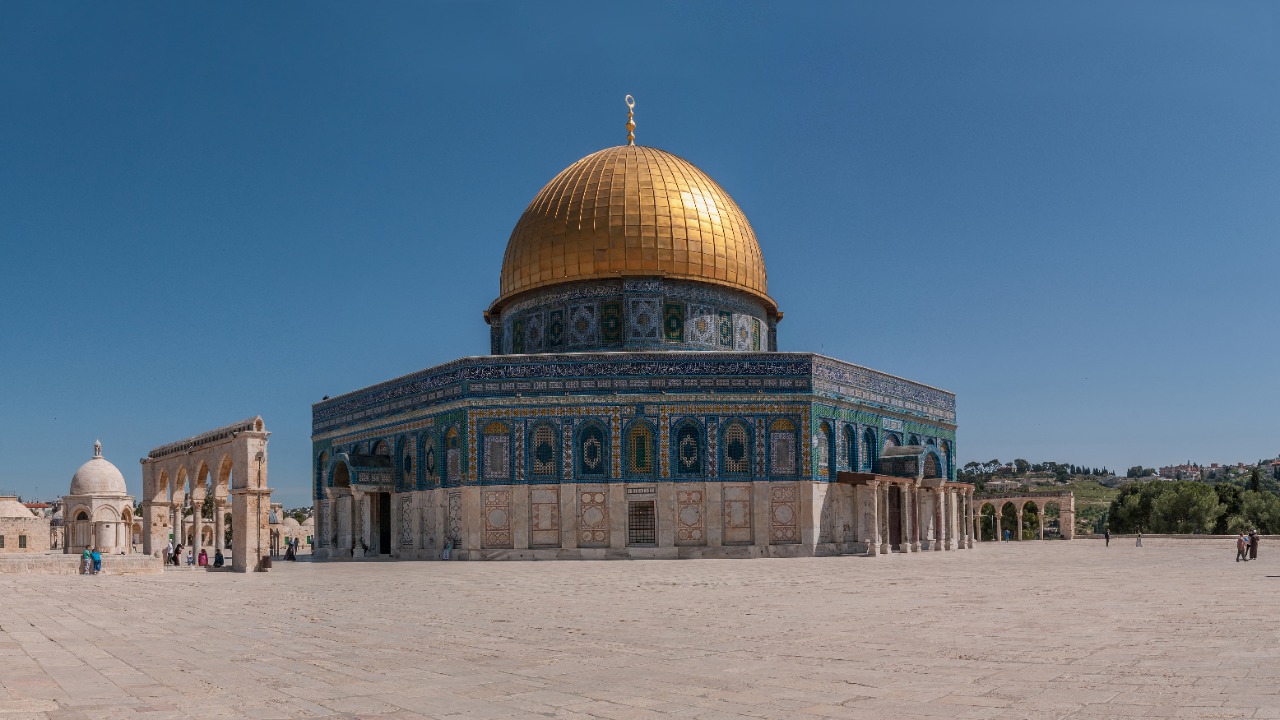
To grasp the full resonance of this find, it helps to picture its setting. The Temple Mount, known in Arabic as the Noble Sanctuary, is one of the most contested and symbolically charged pieces of real estate on earth. For Jews it is the site of the First and Second Temples, the axis of ancient worship and sacrifice. For Muslims it is home to the Al-Aqsa Mosque and the Dome of the Rock, central to Islamic tradition and identity. Christians, too, have long woven the mount into their understanding of Jerusalem’s sacred topography. Any artifact recovered from its immediate surroundings therefore sits at the intersection of overlapping religious narratives.
The medallion surfaced in Jerusalem just outside this elevated platform, in a zone that has seen continuous occupation, renovation, and conflict for centuries. The reporting that credits the discovery to By Nisha Zahid notes that the Temple Mount is known in Arabic as the Noble Sanctuary, a reminder that even the names used for this place carry layers of history and politics. By linking the pendant to the area around the mount, the excavation anchors Jewish presence in a landscape that later became, and remains, central to Islamic devotion as well. The reference to By Nisha Zahid and the Arabic designation highlights how the same stones can hold different meanings for different communities, even as they share the same physical ground.
Late Byzantine Jerusalem: a city in transition
The Late Byzantine period in Jerusalem was an era of flux, with imperial Christianity dominant but other communities still very much present. Churches and monasteries dotted the city, pilgrims streamed in from across the Mediterranean, and civic life revolved around Christian institutions. Yet Jewish and Samaritan populations persisted, sometimes marginalized, sometimes integrated, always negotiating their place in a city that had been theirs long before Constantine. The medallion’s date, around 1,300 years ago, places it in the final generations before the early Islamic conquest, when the city’s religious balance would shift again.
Finding a clearly Jewish amulet in a Late Byzantine building near the Temple Mount complicates any neat picture of a purely Christian urban core. It suggests that Jews not only lived in or near the Christian-dominated quarters, but also felt secure enough to wear overt symbols of their faith in public. The fact that the newfound medallion was discovered inside a Late Byzantine structure, and that it is explicitly linked to that era in the excavation reports, reinforces the idea that Jewish religious life continued in the city’s heart even as imperial policy and Christian institutions set the official tone. In that sense, the medallion is a small but potent piece of evidence for a more entangled, multi-faith Jerusalem than older narratives sometimes allow.
Personal devotion and protective power in a turbulent age
Jewelry like this medallion rarely served a purely ornamental role in Late Antiquity. Amulets were thought to protect the wearer from illness, misfortune, and spiritual harm, blending scriptural motifs with folk beliefs about the unseen world. A rare menorah amulet with deep religious meaning would have carried layers of significance for its owner. The menorah could invoke the memory of the Temple, signal loyalty to God’s covenant, and act as a kind of portable sanctuary in a city where the original sanctuary lay in ruins.
The reporting on the discovery emphasizes that the medallion’s symbolism reflects the deep significance of the menorah for the community that produced it. In a period marked by political upheaval, doctrinal disputes, and shifting imperial borders, such an object could serve as a quiet anchor, a reminder of continuity amid change. The description of the pendant as a rare menorah amulet with deep religious meaning, preserved from a turbulent chapter in Jerusalem’s past, captures that dual role. It was both a statement of identity and a shield against the uncertainties of daily life, worn close to the heart in a city where sacred and secular dangers often overlapped.
What the medallion reveals about Jewish presence near the mount
Archaeologists have long debated how close Jews lived and worshipped to the Temple Mount in the centuries after the Second Temple’s destruction. Written sources speak of bans, restrictions, and occasional visits, but the archaeological record has been patchy. This medallion does not settle every question, yet it offers a concrete data point: a clearly Jewish object, used as personal adornment, found inside a Late Byzantine building just outside the mount. That alone suggests that Jews were not confined to distant quarters, but moved through, and perhaps resided in, the immediate vicinity of the city’s most charged sacred space.
The fact that the medallion is described as a rare menorah amulet with deep religious meaning, discovered in Jerusalem near the Temple Mount, strengthens the case that its owner saw the area as part of a living Jewish landscape, not merely a memory of past glory. Combined with other finds from the same excavation, it may help scholars refine maps of Jewish habitation and movement in Late Byzantine Jerusalem. While the sources do not yet provide a full demographic breakdown, the presence of this pendant in a collapsed building near the mount is a tangible reminder that Jewish life persisted in the city’s core, even when official power lay in other hands.
From trench to global spotlight: how a small find travels
Once the medallion left the soil, its journey from trench to conservation lab to public announcement followed a familiar but important path. Conservators would have cleaned the surface carefully, stabilizing any fragile areas and documenting the object from multiple angles. Epigraphers and iconography specialists then examined the menorah design, the shape of the loop, and any additional motifs to confirm the dating and cultural attribution. Only after that internal vetting did the excavation team present the find to the wider world, framing it as a rare 1,300-year-old medallion decorated with menorahs found near Jerusalem’s Temple Mount.
That framing matters because it shapes how the public understands the object’s significance. By emphasizing both the age and the proximity to the Temple Mount, the team highlighted the medallion’s value as a bridge between ancient Jewish worship and the modern cityscape. The description of the object as a rare menorah amulet with deep religious meaning, discovered in a Late Byzantine building and linked to the sacred precinct known in Arabic as the Noble Sanctuary, invites readers to see it not as an isolated curiosity but as part of a long, contested story about who belongs in Jerusalem’s holiest spaces. In that sense, the medallion’s journey from a collapsed room to global headlines mirrors the broader struggle to interpret the city’s past in a way that does justice to all who have called it home.
Why this tiny medallion matters for Jerusalem’s future debates
Archaeological finds in Jerusalem rarely stay confined to academic journals. They are quickly drawn into contemporary debates about heritage, sovereignty, and religious rights. A small gold disc with a menorah may seem modest compared with monumental architecture, yet its location and symbolism give it outsized relevance. It offers material proof that Jews in the Late Byzantine period wore explicit religious symbols near the Temple Mount, a fact that can be, and likely will be, cited in arguments about historical continuity and claims to the area.
At the same time, the medallion’s discovery in a city where the Temple Mount is also revered as the Noble Sanctuary underscores the need for careful, inclusive storytelling. The same excavation that yielded a rare menorah amulet also sits within a landscape that is sacred to Muslims and significant to Christians. Recognizing that complexity does not diminish the medallion’s importance for Jewish history; it situates it within a shared, if often contested, urban tapestry. As I see it, the real power of this 1,300-year-old pendant lies not only in what it reveals about one community’s past, but in how it can encourage a more nuanced conversation about Jerusalem’s layered identities, where a single object can carry meaning for many, without erasing the particular story it so beautifully preserves.
More from MorningOverview