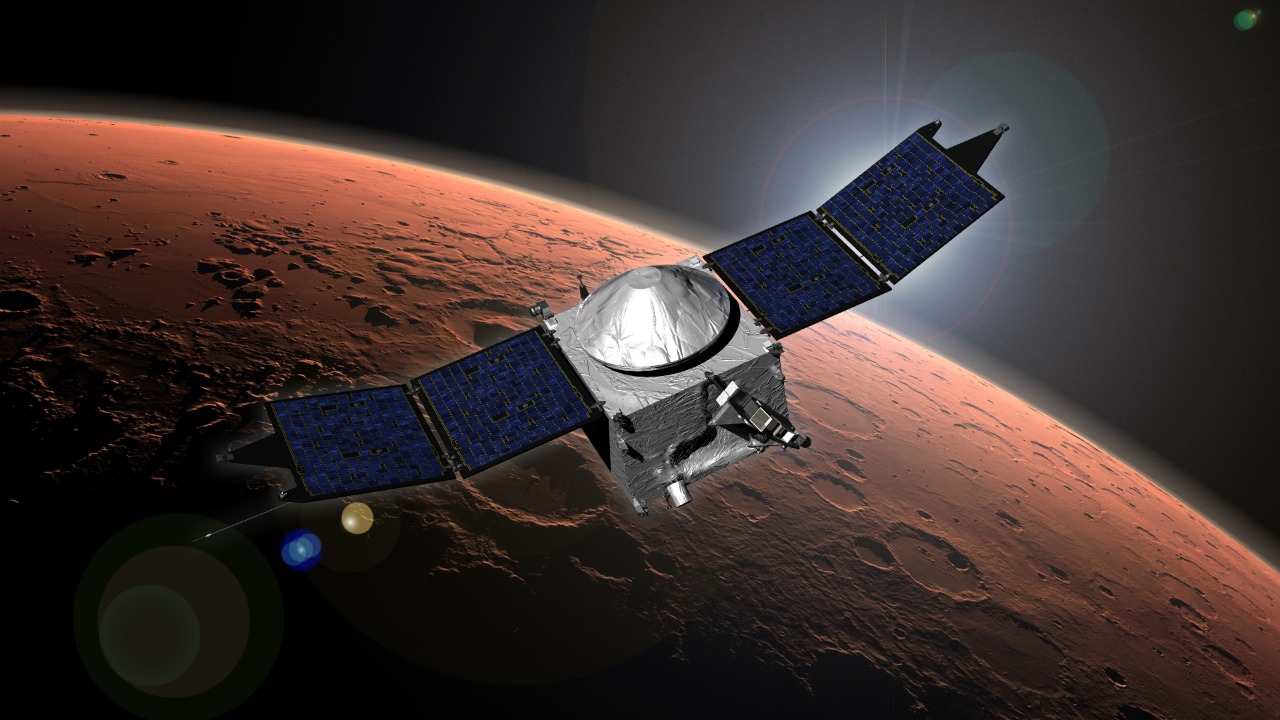

The Mars Atmosphere and Volatile EvolutioN mission, better known as MAVEN, has slipped into an unnerving silence just as it finished a rare close look at an interstellar visitor sweeping through the inner solar system. The loss of contact with a long lived NASA Mars probe at the very moment a comet from deep space brushes past its orbit is the kind of coincidence that reshapes both engineering priorities and scientific expectations.
As engineers work to reestablish control, the episode has turned a workhorse atmospheric orbiter into the center of a mystery that stretches from the red planet to the edge of interstellar space. I see in this pairing of a quiet spacecraft and a noisy comet a revealing stress test of how far current exploration hardware can be pushed when the cosmos offers a fleeting, once in a generation target.
How a veteran Mars orbiter became a linchpin of deep space science
Long before it went quiet, MAVEN had already carved out a central role in Mars exploration as a kind of atmospheric historian. NASA describes NASA’s MAVEN (Mars Atmosphere and Volatile EvolutioN) spacecraft as a dedicated probe of how the planet’s upper air has been stripped away over time, a process that helps explain why a world that once held liquid water is now cold and dry. In orbit around Mars, it has spent years sampling charged particles, solar wind interactions and the tenuous gases that still cling to the planet, turning a single satellite into a long running climate archive.
The mission’s importance is not just historical, it is also practical, because MAVEN has served as a communications relay for surface missions and a context provider for other orbiters. NASA notes that the spacecraft has been orbiting Mars while other assets, including Mars rovers exploring the Martian surface, continue their work, which means any disruption to its operations ripples through a wider network of robotic explorers. When a probe with that kind of centrality suddenly stops talking, the stakes go well beyond one set of instruments.
The moment the signal vanished and the first hints of an anomaly
The first sign that something had gone wrong came when ground controllers simply stopped hearing from the spacecraft. NASA has said that an Anomaly Has Led to Sudden Signal Loss with one of its spacecraft orbiting Mars, language that reflects both the abruptness of the event and the fact that the root cause remains under investigation. Engineers racing to reestablish contact are working through fault trees that range from power and attitude control problems to potential damage in the communications chain.
In a separate update, NASA teams described how they were actively working the Teams Work MAVEN Spacecraft Signal Loss problem, confirming that ground stations did not observe a signal when they expected one. That absence is more than a missed check in, it is a sign that either the spacecraft cannot point its antenna correctly, cannot generate enough power to transmit, or is in a safe mode that has not yet been decoded from Earth. Each of those scenarios implies a different path to recovery and a different risk to the mission’s future.
Reports of a spacecraft tumbling in Mars orbit
As more details filtered out, a picture emerged of a probe that might be physically struggling to keep its bearings. One account described the Spacecraft as “rotating in an unexpected manner” and suggested that its orbit could have shifted, complicating efforts to lock onto its signal. If MAVEN is indeed tumbling, its solar arrays and high gain antenna would sweep unpredictably through space, starving the bus of power and breaking the tight pointing needed for high data rate communications.
That kind of uncontrolled rotation is one of the most feared failure modes for an aging spacecraft, because it can quickly cascade into thermal problems and battery depletion. The fact that this description surfaced alongside the broader narrative of signal loss hints at a dynamic event rather than a slow degradation, something that might have been triggered by a hardware fault, a software glitch or an external disturbance. Until controllers can command the spacecraft to damp out any rotation and reorient its antenna, even the most powerful ground transmitters will be shouting into the void.
A Florida launch, a long journey and a sudden silence
The silence is all the more jarring when set against MAVEN’s long and steady career. The orbiter is an 11 foot tall spacecraft that launched from Florida on Nov. 18, 2013, a detail highlighted in coverage that framed the current problem as a Communication breakdown. After leaving Florida, MAVEN spent months cruising through interplanetary space before slipping into Mars orbit, where it has been studying the atmosphere and volatile components that shape the planet’s climate.
Over the years, NASA has emphasized that MAVEN has been orbiting Mars studying its atmosphere while also supporting other missions, a dual role that made it a quiet backbone of the Mars program rather than a headline grabbing flagship. That makes the current loss of contact feel like a sudden blackout in a control room that had grown used to a steady stream of data. For a spacecraft that has already survived the harsh radiation and temperature swings of deep space for more than a decade, the timing of this failure is as striking as the failure itself.
The interstellar comet that brushed past Mars
At almost the same time that MAVEN began to struggle, an object from beyond the solar system was threading its way past Mars and toward Earth. NASA identifies Comet 3I/ATLAS as the third known interstellar comet, a body that is not gravitationally bound to the Sun and is instead passing through on a one way trajectory back into interstellar space. The agency’s Observation Timeline notes that the ATLAS survey telescope in Chile provided the First Sighting Reported on July 1, 2025, turning what had been a faint smudge into a carefully tracked visitor.
Subsequent observations have shown that Comet 3I/ATLAS is behaving in ways that challenge existing models of how such objects shed gas and dust as they heat up. One report described the system as behaving with a chemical intensity that has already baffled astronomers, a phrase echoed in a video segment on Earth Maven that underscored how unusual the comet’s activity appears. For scientists who study how material from other star systems compares to the building blocks of our own, the chance to watch this object evolve as it sweeps past Mars and then Earth is a rare gift.
From Mars orbit, a rare view of a visitor from outside the solar system
Before it went silent, MAVEN had already begun to capitalize on that opportunity. A report from the University of Colorado described how the spacecraft provided Mars spacecraft observations of a comet from outside our solar system, giving scientists a view from Mars that complemented telescopes closer to Earth. Curry noted that MAVEN was never designed to observe objects like comets, yet its instruments were pressed into service to capture how the interstellar object interacted with the space environment around Mars.
That improvisation reflects a broader pattern in planetary exploration, where spacecraft built for one purpose are often repurposed when a unique alignment or transient event presents itself. In this case, MAVEN’s vantage point in Mars orbit allowed it to watch the interstellar comet from a position that no Earth based observatory could match, sampling the charged particles and fields that bathed the object as it swept past. The fact that such a valuable and unplanned dataset may now be cut short by the spacecraft’s silence only heightens the sense of a narrow window closing.
Close approach to Earth and a growing sense of cosmic timing
While MAVEN’s fate is being debated in control rooms, Comet 3I/ATLAS is still on course for its closest pass by our planet. Coverage of the object’s trajectory notes that the interstellar comet 3I/ATLAS is making its closest approach to Earth on a Friday in Dec. 19, 2025, after which it will head back into interstellar space. Scientists confirm that this path will not bring the comet dangerously close to the planet, but it will offer a brief period when professional and amateur observers alike can study a body that will never return.
Other observers have stressed that the object, while dramatic, is still a natural comet and not an alien spacecraft. One analysis framed the event under the headline that Interstellar object Comet 3I/ATLAS is still not an alien spacecraft, even as instruments like The Gemini Multi Object Spectrograph and TGO’s CaSSIS instrument captured detailed views. That insistence on natural explanations sits in tension with the very real sense of cosmic timing that comes from watching a Mars orbiter falter just after it brushed past the same interstellar visitor.
Two weeks after the Mars flyby, the comet still baffles scientists
The mystery surrounding Comet 3I/ATLAS did not fade after it passed Mars, it deepened. A report noted that Two weeks after it whizzed past Mars, the interstellar object 3IATLAS continues to baffle scientists, a reminder that even with modern instruments, some aspects of cometary physics remain stubbornly opaque. The same piece emphasized that the object’s behavior near Mars challenged expectations, suggesting that its composition or internal structure might differ significantly from comets that formed in the outer reaches of our own solar system.
That lingering confusion matters because it shapes how researchers interpret any data MAVEN may have collected before its silence. If the comet’s outgassing and dust production are not following familiar patterns, then the plasma and field measurements recorded by the Mars orbiter could reveal new kinds of interactions between interstellar material and a planetary environment. The fact that scientists are still puzzling over the comet’s behavior weeks after the Mars encounter underscores how much is at stake if the spacecraft’s archives cannot be fully retrieved.
Inside NASA’s multi orbiter effort to recontact MAVEN
On the engineering side, NASA has not been content to wait and hope that MAVEN calls home on its own. The agency has described how NASA’s Mars Reconnaissance Orbiter, Mars Odyssey and ESA’s (European Space Agency’s) ExoMars Trace Gas Orbiter have all relayed attempts to contact the silent spacecraft. Using this network of orbiters as radio intermediaries allows controllers to send commands and listen for faint replies from multiple vantage points, increasing the odds that a misaligned antenna or altered orbit will still fall within someone’s field of view.
At the same time, NASA has stressed that Mars Reconnaissance Orbiter, Mars Odyssey and the ESA European Space Agency ExoMars Trace Gas Orbiter are continuing their own science missions even as they support the rescue effort. That balancing act reflects a hard learned lesson in planetary exploration, where no single spacecraft can be allowed to monopolize the attention of the entire fleet, even in a crisis. For MAVEN, it means that any path back to normal operations will likely involve incremental steps, from a first carrier tone to restored telemetry and eventually a return to full science mode, if the underlying anomaly can be cleared.
A probe goes dark and public fascination spikes
Outside the engineering community, the combination of a silent Mars orbiter and a dramatic interstellar comet has captured public imagination. One widely shared account framed the situation as a Should You Leave Assets style mystery, noting that On Monday the space agency confirmed that the MAVEN spacecraft had gone dark after a close encounter with an interstellar visitor nearing Earth. That same report reminded readers that the probe had been a key link in the chain of missions that includes rovers exploring the Martian surface, tying the technical anomaly to a broader narrative of exploration.
According to the American space agency, the loss of direct data from MAVEN makes it harder to track how the atmosphere of Mars might change as the comet passes, a gap that has already drawn criticism from some quarters for the poor quality of alternative models. The juxtaposition of a financial planning style headline about whether to leave assets to Your Children in a Trust or as a Gift with a story about a silent Mars orbiter speaks to how space news now competes in a crowded attention economy. Yet beneath the click friendly framing lies a genuine unease about how fragile our robotic presence around other worlds can be.
What the silence means for Mars science and future missions
For Mars scientists, the immediate concern is the potential loss of a unique dataset on how an interstellar comet interacts with a planetary atmosphere. NASA has already said that NASA says Maven spacecraft that was orbiting Mars has gone silent, a blunt acknowledgment that the flow of new measurements has stopped. That silence affects not only studies of the current comet passage but also long term monitoring of how solar activity strips away the Martian atmosphere, a process that requires continuous observation to capture rare events like solar storms.
There is also a practical dimension, because MAVEN has been part of the relay infrastructure that supports Mars rovers such as Curiosity and Perseverance. While other orbiters can pick up much of the slack, losing one node in that network reduces redundancy and flexibility, especially during periods when Earth and Mars are poorly aligned for direct communication. If the anomaly that triggered the Sudden Signal Loss cannot be resolved, mission planners will need to factor that gap into strategies for future landers and sample return efforts, reinforcing the case for robust, multi spacecraft architectures around every target world.
More from MorningOverview