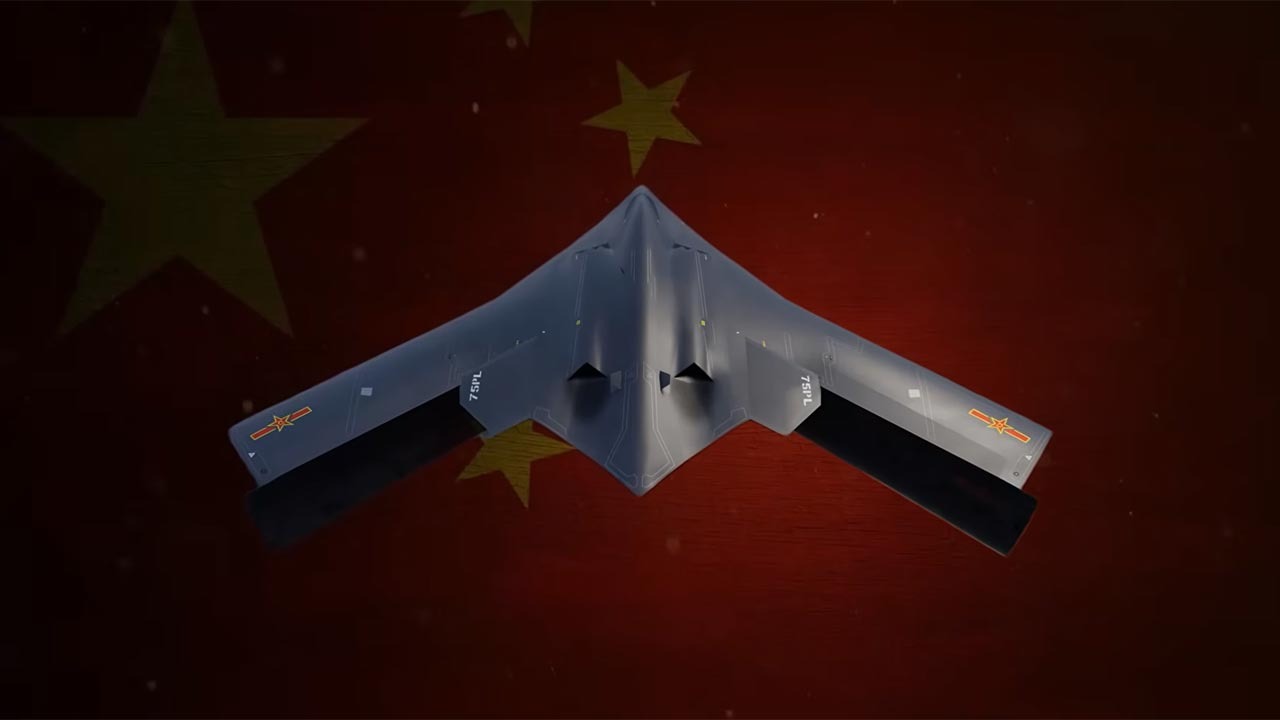

China’s long-rumored H-20 stealth bomber is still shrouded in secrecy, but it is already reshaping how the United States thinks about airpower and deterrence in the Pacific. Even before the aircraft leaves the hangar, U.S. planners are treating it as a strategic signal that Beijing intends to hold American bases and carrier groups at risk far beyond the first island chain. The H-20 is less a single platform than a message about where China wants the balance of power in the skies to tilt next.
From rumor to reality: how the H-20 entered the U.S. threat calculus
For more than a decade, the H-20 existed mostly as a silhouette in Chinese propaganda videos and a subject of speculation among defense analysts. That ambiguity has been part of the point, allowing Beijing to suggest a leap in capability without revealing the details that would let adversaries fine tune their defenses. U.S. assessments now treat the H-20 as a central piece of China’s next-generation bomber force, even though hard data on payload, sensors, and signatures remains limited and is pieced together through classified sensor assessment work rather than public specifications.
What has changed recently is not that the H-20 suddenly appeared on a runway, but that Chinese officials and state-linked outlets have started talking about it as an inevitable part of the arsenal. U.S. government reporting now states that The PRC is developing a new generation of long-range bombers, likely named the H-20, and that the aircraft may debut sometime in the coming years. That official acknowledgment has moved the H-20 from rumor into the formal threat matrix that shapes U.S. Air Force investment decisions and war plans.
China’s “New” stealth bomber as strategic message, not just hardware
Beijing is presenting its “New” H-20 not simply as another aircraft, but as a symbol of China’s arrival as a peer strategic airpower. Chinese internet and social media have amplified images and renderings of the “New” Xi’an H-20, framing it as a Stealth Bomber Has a clear Message for the U.S. Air Force. The narrative is that China can now field a bomber that belongs in the same conversation as the American B-2 and B-21, able to penetrate defended airspace and threaten high-value targets across the Indo-Pacific.
That messaging is aimed as much at Washington as at regional audiences. By showcasing a “New” stealth platform, China is signaling that it intends to complicate U.S. force posture and planning across the Pacific, from Guam to Japan and Australia. The H-20 is being positioned alongside submarines, long-range missiles, and other systems as part of a broader effort to deter U.S. intervention by raising the potential cost of any conflict, a point underscored in Chinese discussions that the bomber is meant to shape U.S. Air Force planning across the Indo-Pacific rather than simply mirror American capabilities.
What we actually know: range, timing, and the Pentagon’s mixed messages
Despite the hype, the H-20 remains a paper airplane in one critical sense: it has not yet entered operational service. U.S. defense reporting has assessed that China’s H-20 long-range stealth bomber is unlikely to make its public debut until the 2030s, with the Pentagon stating that it is expected to “feature a stealthy design” but is still years away from operational reality. That timeline tempers some of the more breathless commentary, reminding policymakers that the H-20 is a future challenge, not a fully fielded fleet.
Even within the U.S. government, there are differing tones about how urgent the H-20 threat really is. Earlier assessments cited by The War Zone reported that Pentagon intelligence officials described the H-20 as “not really” a concern compared with other systems that the United States has coming down the pipeline. That view was echoed when a senior official in WASHINGTON told reporters that China’s new H-20 stealth bomber was “not really” a concern for the Pentagon, at least in the near term. The result is a nuanced picture: the bomber is treated as a serious long-term factor in U.S. planning, but not yet a crisis that outranks more immediate challenges like missiles, cyber, and space.
Designed for one mission: holding U.S. bases and carriers at risk
Where the H-20 does stand out is in its apparent focus on a single, high-impact mission set. Analysts argue that China’s H-20 Stealth Bomber Was Designed for Just 1 Mission Only, namely to strike U.S. and allied bases and naval forces across the Pacific in the opening stages of a conflict. Reporting on the program describes how the aircraft is optimized to deliver long-range cruise missiles and other stand-off weapons against hardened targets, with the design choices framed around that Stealth Bomber Was Designed for Just Mission Only, a focus that has already begun to influence U.S. and allied military planning.
That singular mission profile makes the H-20 a classic anti-access, area denial tool. By threatening airfields in Guam, logistics hubs in Japan, or carrier strike groups operating east of the first island chain, the bomber would aim to blunt U.S. power projection before it can fully mobilize. The Image Credit of the H-20 Bomber that has circulated in open sources reinforces this concept, depicting a flying wing platform that prioritizes stealth and payload over versatility. For U.S. planners, the implication is clear: any conflict with China would likely begin with a coordinated strike package that includes H-20 sorties targeting the very infrastructure that underpins American operations in the region.
How many bombers, how fast: the race to 100 and what it means
Numbers matter in strategic aviation, and here the projections around the H-20 are especially sobering for the U.S. Air Force. Some assessments suggest that China Could Have a Fleet of 100 H-20 Stealth Bombers by 2035 if production ramps up as expected. Very little is known about the exact production plan, and While the public renderings are sparse, the scale of that potential fleet would represent a dramatic expansion of China’s ability to sustain long-range strike operations over time rather than rely on a handful of prestige aircraft.
Those projections are grounded in official U.S. reporting that tracks China’s bomber modernization. The Pentagon’s annual military report has highlighted that the H-20 is expected to have a significant range and payload, with some estimates suggesting it could carry both conventional and nuclear weapons, a detail that is folded into broader assessments of China’s strategic aviation and missile Fleet of Stealth Bombers. If Beijing does move toward a triple-digit H-20 inventory, the United States would face not just a boutique threat but a massed bomber force capable of sustained campaigns, forcing a rethink of how many B-21s, tankers, and defensive systems it needs to keep pace.
Comparing the H-20 to American bombers: B-52, B-2, and B-21
To understand the warning embedded in the H-20, it helps to compare it with the aircraft that have long anchored U.S. strategic airpower. The American B-52 remains a workhorse, with the B-52H and future B-52J variants expected to fly well into the 2050s, but it is not a stealth platform and would rely on stand-off weapons and escorts in any high-end fight. Recent comparisons of American B-52 vs China’s H-20 bomber have focused on Power, range, and payload, noting that China’s H-20 stealth bomber is still delayed but is intended to leapfrog older designs by combining stealth with long reach, a contrast highlighted in assessments that pit the venerable American 52 against a notional Chinese flying wing.
At the higher end, the H-20 is often discussed alongside the B-2 and the emerging B-21 Raider, which are designed for deep penetration of sophisticated air defenses. U.S. analysts note that, though hard details on the H-20’s payload and signatures are scarce, internal assessments already treat it as a conceptual peer to the B-2 and B-21, a point reflected in classified comparisons that look at how each bomber might fare against integrated air and missile defenses. For the U.S. Air Force, the challenge is to ensure that the B-21 Raider program stays on schedule and that legacy platforms like the B-52 and B-2 are modernized enough to remain credible in a world where China is fielding its own stealth bomber rather than relying solely on older H-6 variants.
Why U.S. Air Force generals are losing sleep
Even with the H-20 still in development, senior officers in the United States are already gaming out how it could change a future war in the Pacific. Analyses of China’s New H-20 Stealth Bomber Keeps U.S. Air Force Generals Up at Night emphasize that the bomber is part of a broader modernization push that includes long-range missiles, advanced fighters, and improved command and control. The concern is not just the aircraft itself, but how a stealthy, long-range bomber could be integrated into a coordinated strike package that overwhelms U.S. defenses and erodes the ability to operate from forward bases, a scenario that has already begun to keep Air Force Generals Up at Night.
Those worries are magnified by the bomber’s potential nuclear role. If the H-20 is eventually certified to carry nuclear weapons, it would give China a true nuclear triad with land-based missiles, ballistic missile submarines, and air-delivered weapons. That would complicate U.S. extended deterrence commitments to allies like Japan and South Korea, which have long relied on American bombers as visible symbols of protection. For U.S. commanders, the H-20 is therefore not just a tactical challenge but a strategic one, forcing them to think about how to signal resolve and reassure partners in an environment where China can fly its own stealth bombers near contested areas.
Part of a larger family: H-20, JH-XX, and China’s bomber ecosystem
The H-20 does not exist in isolation. It is emerging alongside other Chinese projects like the JH-XX, a medium-range stealth strike aircraft that would complement the H-20 by operating at shorter ranges with a different mission set. Analyses of China’s New H-20 and JH-XX Stealth Bombers Have a Message for the U.S. Air Force describe how the two platforms could work together, with the H-20 handling deep strikes against distant bases and the JH-XX focusing on regional targets and maritime operations. Together, these Stealth Bombers Have a combined Message for the Air Force: China intends to field a layered bomber force, not just a single prestige aircraft.
That ecosystem approach mirrors how the United States pairs its own bombers with fighters, tankers, and ISR platforms to create strike packages tailored to specific missions. In China’s case, the H-20 and JH-XX would likely be integrated with long-range anti-ship and land-attack missiles, as well as space and cyber capabilities, to stress U.S. integrated air and missile defenses. For American planners, the rise of a Chinese bomber family means that countering the H-20 alone is not enough; they must think about how to defend against a spectrum of stealthy strike aircraft operating at different ranges and altitudes, supported by a growing network of sensors and command systems.
Pearl Harbor and the geography of deterrence
Perhaps the most striking claim about the H-20 is that it could reach targets once considered safely out of range. Analysts have argued that China’s New H-20 Stealth Bomber Could Attack Pearl Harbor, a symbolic and strategic reference that underscores how far the bomber’s projected range might extend. Discussions of China’s Newest Aircraft describe the H-20 as long rumored and repeatedly teased by Chinese officials, widely assessed to be able to threaten targets that have underpinned regional deterrence for decades, including key logistics hubs and command centers deep in the Pacific.
That potential reach changes the geography of deterrence. If the H-20 can credibly threaten Hawaii or other rear-area facilities, the United States would need to invest more heavily in homeland air and missile defenses, dispersal of forces, and hardened infrastructure. It would also need to think differently about how to reassure allies who might worry that Washington would hesitate to respond to regional aggression if its own bases were at greater risk. In that sense, the H-20’s most powerful effect may be psychological, forcing U.S. leaders to contemplate scenarios in which the Pacific is no longer a one-way power projection environment but a contested space where Chinese bombers can reach far beyond the first island chain.
Why the H-20 is a warning, even before it flies
For all the uncertainty that still surrounds the H-20, the bomber has already achieved one of Beijing’s likely objectives: it has compelled the United States to take China’s long-range airpower ambitions seriously. The combination of a projected Fleet of 100 aircraft, a design optimized for a single high-impact mission, and integration into a broader ecosystem of stealth bombers and missiles sends a clear signal that China is not content to rely on legacy platforms. Even if some U.S. officials still describe the program as “not really” a near-term concern, the steady drumbeat of analysis and war-gaming shows that the H-20 is now a central factor in how the Air Force thinks about the next several decades.
In that sense, the H-20 is already doing what strategic bombers have always done best: shaping the behavior of adversaries through the threat of what they might one day be able to do. Whether it ultimately matches the performance of the B-21 Raider or falls short, the aircraft has forced Washington to accelerate its own modernization, rethink the vulnerability of its bases, and invest in defenses that can cope with a world where China fields its own stealth bomber fleet. The warning has been sent, and the real test for the U.S. Air Force is how quickly it can adapt before the H-20 moves from renderings and assessments into operational squadrons.
More from MorningOverview