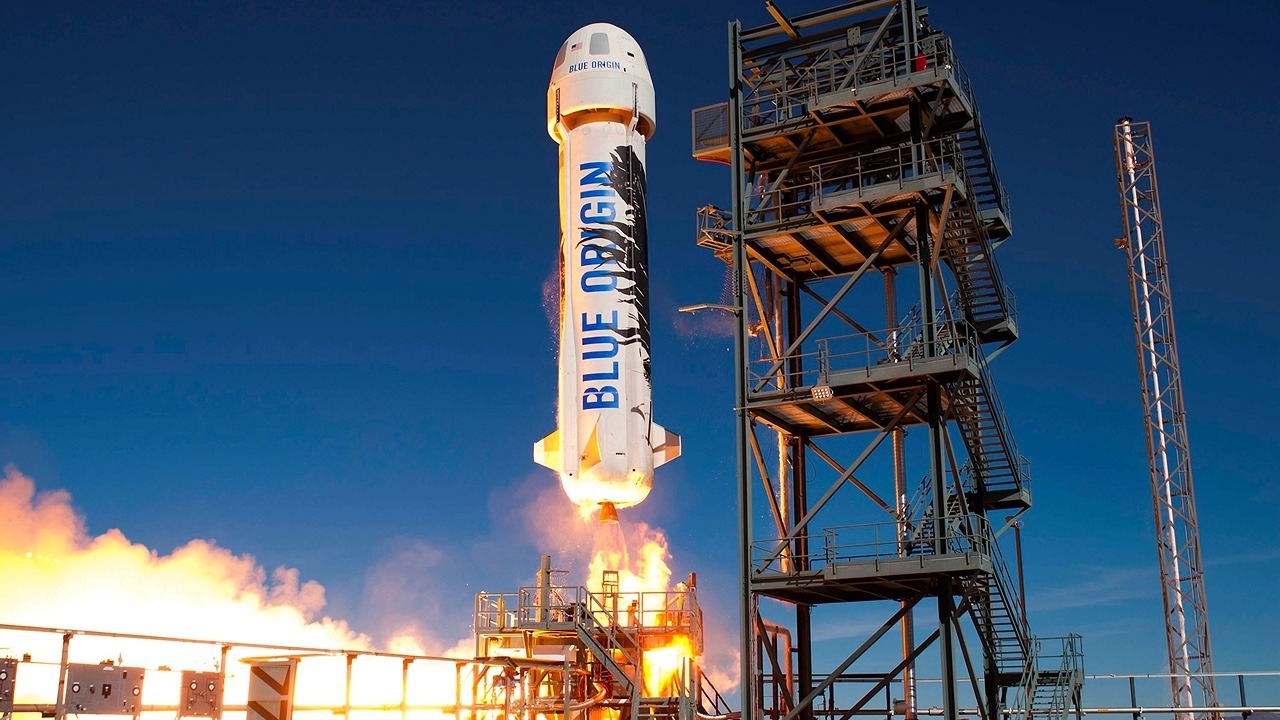

Blue Origin’s latest New Shepard mission was supposed to mark a milestone for both commercial spaceflight and disability inclusion, carrying the first space tourist who uses a wheelchair. Instead, the company halted the countdown less than a minute before liftoff, turning a historic celebration into a high-stakes waiting game for the crew and for a global audience watching online. The scrubbed launch underscores how fragile even well rehearsed space tourism flights remain, and how much symbolic weight now rests on getting this particular mission safely off the ground.
The delay does not erase the significance of what Blue Origin is attempting: flying a passenger who relies on a wheelchair into suborbital space alongside a diverse group of paying customers and veteran industry figures. It does, however, sharpen the focus on safety, engineering discipline, and the expectations that come with selling short, spectacular trips to the edge of space as a repeatable product rather than a one-off stunt.
How Blue Origin’s NS-37 countdown unraveled in West Texas
From the outset, Blue Origin framed this New Shepard flight as a routine yet meaningful step in its growing manifest, with the company planning to send its reusable capsule and booster on the mission designated NS-37 from its private Launch Site One in West Texas. Public schedules described how Blue Origin will launch its next New Shepard flight, NS-37, from West Texas, with a webcast beginning well before liftoff to showcase the experience. The company has used this remote desert site to create a controlled environment for its suborbital tourism business, far from population centers but close to the communities that have grown up around the spaceport.As the countdown ticked toward launch, live streams invited viewers to Watch live as Blue Origin launches its New Shepard crewed flight, NS-37, from Launch Site One in West Texas, highlighting the mission’s mix of seasoned space professionals and first time tourists. The broadcast emphasized that this was the company’s 37th New Shepard mission, a number that signals both experience and the expectation that such flights should now proceed with airline like regularity, even as they remain technically complex rocket launches.
The last minute scrub and what Blue Origin revealed
The drama peaked in the final moments of the countdown, when controllers called a halt just before ignition and announced that the team had decided to terminate the attempt for the day. In the live commentary, viewers heard that Dec flight controllers said they had decided to terminate the countdown, a phrase that instantly shifted the tone from celebratory to clinical. The decision came so late that the rocket and capsule were already fully configured for flight, underscoring how quickly conditions can change even after hours of apparent stability.A separate clip invited audiences to Watch as Blue Origin scrubbed its launch of crewed flight NS-37 from Launch Site One in West Texas less than a minute before liftoff, capturing the moment when the countdown clock froze and the mission team cited a last minute “observation.” That vague term, common in launch operations, signals that some parameter fell outside the strict limits required for flight, and that engineers chose to stand down rather than accept additional risk for a mission carrying private citizens.
A historic passenger: the first wheelchair user headed for space
At the heart of this mission is a passenger whose presence would make spaceflight history, a person who uses a wheelchair and has trained to experience microgravity alongside other tourists. Reporting has highlighted how, for the first time, For the 1st time ever, a person who uses a wheelchair will fly to space, turning what might otherwise be another suborbital hop into a landmark for disability representation. The scrubbed launch delays that moment but does not diminish its importance for advocates who have long argued that space should be accessible to people with a wide range of bodies and abilities.
Other coverage has framed the mission as a “space joyride” that will carry this trailblazing passenger alongside more traditional customers, noting that Joining Benthaus are fellow tourists on a Blue Origin flight that blends personal adventure with global symbolism. The fact that a wheelchair user is not flying as a government selected astronaut but as a paying participant on a commercial vehicle underscores how private companies are now setting the pace on inclusion, and how their design choices can either widen or narrow who gets to see Earth from above.
Inside the NS-37 crew: veterans, investors and a local enthusiast
The passenger list for NS-37 reads like a cross section of the modern space economy, combining industry veterans, financial professionals and local fans who have followed Blue Origin’s progress from nearby communities. One report notes that the crew of Blue Origin’s NS-37 flight includes Joey Hyde and Hans Koen, alongside other named passengers, illustrating how the company markets seats to both high net worth individuals and figures with deep technical backgrounds. That mix helps reassure potential customers that experienced eyes are watching the systems even as the mission is billed as a leisure experience.
Additional profiles describe Who will be part of the crew on Blue Origin’s next space mission, including Joey Hyde from Florida Ha, and highlight how each passenger brings a different narrative to the flight, from scientific training to philanthropic interests. That diversity is part of the sales pitch: a New Shepard seat is not just a ticket to space, it is an entry into a curated cohort of people who can afford the experience and who often see it as a capstone to careers in finance, technology or research.
Local roots and global attention around Launch Site One
Although the mission is marketed worldwide, its physical and emotional center of gravity remains in West Texas, where Launch Site One has become both a workplace and a source of local pride. One profile notes that Jason Stansell is a space enthusiast from West Texas with a computer science degree from Tulane University, and that Blue Origin has highlighted his story as part of the mission’s human interest arc. His presence on the flight connects the high tech operation to the communities that live within sight of the launch tower and have watched the company’s test flights for years.
Coverage of the scrub itself emphasized that the 37th New Shepard mission was set to lift off from this same region, with one report summarizing that The Brief described Blue Origin’s 37th New Shepard rocket launch from West Texas as a historic step because of the first passenger who uses a wheelchair. That framing shows how the local site has become a stage for global firsts, with residents and regional media treating each launch as both an economic driver and a moment when their corner of Texas becomes the focus of worldwide attention.
Why Blue Origin hit pause: safety, optics and the “observation”
Blue Origin has not publicly detailed the exact technical trigger behind the last minute “observation,” but the decision to scrub so close to liftoff reflects a conservative safety culture that is essential when flying non professional crews. One account explained that Blue Origin scrubs space tourist rocket launch with first wheelchair user due to last minute ‘observation’, language that suggests engineers saw something in telemetry or hardware behavior that did not match expected patterns. In a world where every anomaly can be replayed endlessly on social media, the company has strong incentives to err on the side of caution, even if that means disappointing customers and rescheduling complex logistics.
Another report framed the event as a historic launch that was scrubbed on a Thursday, noting that When Blue Origin was working toward a Thursday Dec. 18 launch in Texas, the company was already balancing schedule pressure with the need to protect its safety record. That tension is particularly acute for a mission carrying the first wheelchair user to the edge of space, since any mishap would not only be a human tragedy but also a major setback for efforts to prove that commercial spaceflight can be inclusive without compromising on risk standards.
Adapting New Shepard for a passenger who uses a wheelchair
Behind the scenes, preparing New Shepard for a passenger who uses a wheelchair required more than just public messaging, it demanded concrete changes to training and ground operations. Reporting has highlighted that He spent two decades at SpaceX and remains influential in the aerospace community, a reminder that some of the people involved in shaping this mission have long experience designing systems for human spaceflight. That background likely informed how Blue Origin approached questions such as how to board and secure a passenger who cannot climb the capsule ladder in the same way as other tourists, and how to plan emergency egress procedures that account for mobility devices.
Other coverage has described how the mission would lift off at 9:30 a.m. ET, with the wheelchair user experiencing the same suborbital arc and microgravity period as the rest of the crew, rather than a modified or shortened profile. That parity is central to the symbolism of the flight: the goal is not to create a separate, lesser experience for disabled passengers, but to demonstrate that with the right design choices, a standard New Shepard mission can safely include someone who uses a wheelchair without altering the core trajectory or timeline.
From scrubbed launch to the next attempt: what comes next
With NS-37 now on hold, attention has shifted to when Blue Origin will be ready to try again and how the company will communicate about the cause of the scrub. One listing of upcoming space events noted that When is the next Blue Origin rocket launch in Texas became a central question even before the first attempt, reflecting strong public interest in the mission’s timing. Now that the initial window has closed, the company will need to weigh technical readiness, crew schedules and weather conditions before setting a new date, all while keeping customers and regulators informed.
Local and national outlets have already begun treating the scrub as a prelude rather than a failure, with one segment describing how The Brief framed Blue Origin’s NS-37 launch as a historic step that was simply delayed by the last minute issue. That narrative gives the company some breathing room, but it also raises expectations that the next attempt will proceed smoothly, since a second scrub for the same mission would invite tougher questions about reliability and readiness.
Why this mission matters for space tourism and accessibility
Even in a crowded field of commercial launches, the NS-37 mission stands out because it tests whether space tourism can move beyond a narrow demographic of able bodied, ultra wealthy thrill seekers. The fact that For the 1st time ever, a person who uses a wheelchair will fly to space on a commercial rocket sends a signal to both competitors and regulators that accessibility is no longer a theoretical aspiration but a concrete design requirement. If Blue Origin can demonstrate that its systems and procedures can safely accommodate such passengers, it will set a benchmark that other operators will be hard pressed to ignore.At the same time, the scrubbed launch is a reminder that inclusion does not eliminate risk, and that the stakes are higher when a mission carries symbolic weight for marginalized communities. One video recap that invited viewers to Watch as Blue Origin scrubbed its launch with Benthaus set to become the first wheelchair user captured the emotional whiplash of seeing a long awaited milestone postponed at the last possible moment. When the mission finally flies, its success will be measured not only in altitude and flight time, but in how convincingly it shows that space tourism can be both aspirational and genuinely open to people whose bodies have historically been excluded from such adventures.
The broader landscape: Blue Origin’s place in a changing space economy
NS-37 is not happening in a vacuum, it is part of a broader shift in which private companies are racing to define what human spaceflight looks like in the 2020s and beyond. One background profile notes that He spent two decades at SpaceX and remains influential in the aerospace community, a reminder that talent and expertise now flow between companies like SpaceX and Blue Origin as they compete and collaborate in different market segments. The presence of former executives and engineers from rival firms on Blue Origin flights underscores how intertwined the industry has become, and how individual careers can bridge corporate rivalries.Meanwhile, Blue Origin continues to cultivate its own identity, with public facing materials inviting people to explore Blue Origin’s place in the commercial space landscape through virtual tours and promotional content. The company’s decision to prioritize a mission featuring the first wheelchair user to reach space reflects a strategic bet that leadership on inclusion can differentiate its brand, even as it competes on price, reliability and spectacle with other suborbital and orbital providers.
More from MorningOverview