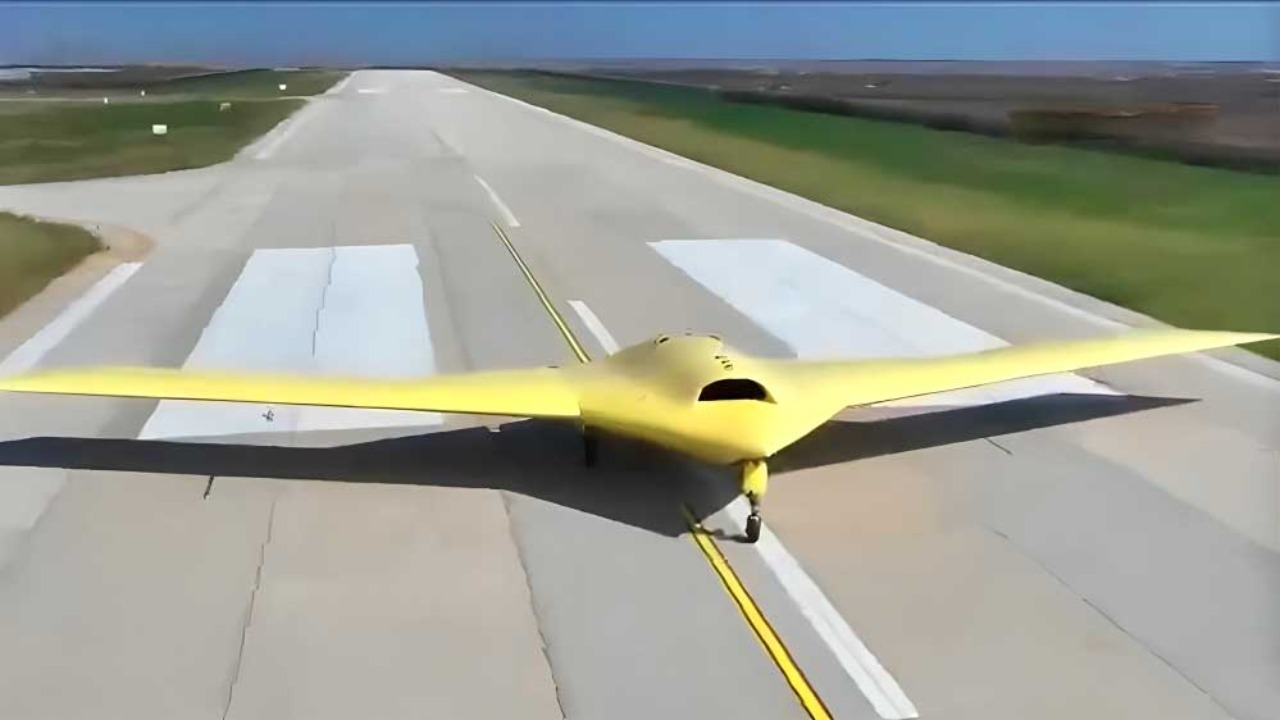

China’s latest combat drone is not just another addition to its growing unmanned arsenal, it is a purpose built signal to the United States that the next contest over air superiority will be fought by machines that are hard to see and even harder to stop. With the CH‑7 now flying at operational altitudes and wrapped in a flying wing design that almost disappears from radar, the balance between U.S. air defenses and Chinese strike power is shifting in ways that planners in Washington can no longer treat as theoretical.
By pairing stealth shaping with long endurance, high altitude performance and a sensor suite tailored for hunting ships and missile batteries, the CH‑7 is designed to probe, map and eventually punch holes in the very air defense networks the United States and its allies rely on. I see it as a platform built from the outset to stress American radars, surface to air missile systems and carrier groups, not simply to match Western drones but to exploit their known vulnerabilities.
China’s stealth leap: CH‑7 moves from model to operational sky
For several years, the CH‑7 existed mainly as a static mock up and a set of ambitious claims, a sleek flying wing rolled out at air shows as a promise of what China might field in the future. That changed when China conducted the first real flight of the long endurance stealth UAV, moving the CH‑7 from display stand to active test article and signaling that the program has cleared the basic hurdles of airworthiness and control at altitude, a milestone that marks a genuine leap in China’s uncrewed combat aviation.
Reporting on that initial flight describes how the design places the engine air intakes above the fuselage and partially conceals the exhaust nozzles to reduce radar and infrared signatures, a configuration that aligns with the broader trend of China and CASC investing heavily into advanced uncrewed warfare systems that can survive in contested airspace, as seen in the design places engine air intakes above the fuselage.
From radar ghost to high altitude workhorse
The core of the CH‑7’s threat lies in its ability to behave like a radar ghost while operating where traditional air defenses expect to see large, bright targets. China has emphasized that the new stealth drone almost disappears from radar and has already demonstrated a first flight that reached an altitude of 16,000 meters, a combination that allows it to loiter above most short range defenses while remaining difficult to track, as highlighted when China’s new stealth drone, the CH-7, which almost disappears from radar, makes its first flight, reaches an altitude of 16,000 meters.
Publicly available information indicates that the CH‑7 drone has a wingspan of 89.5 feet and a cruising speed of 380 m, figures that place it in the same broad performance class as Western high altitude UAVs but with a stealth optimized airframe that complicates detection and engagement, according to Publicly available information indicates the CH-7 drone has a wingspan of 89.5 feet and a cruising speed of 380 m.
Maiden flight and the message to U.S. air defenses
When a new combat drone takes to the sky, the first flight is as much a strategic communication as it is a technical test, and the CH‑7 is no exception. China’s state broadcaster CCTV reported that the CH‑7 high altitude platform has completed its maiden flight, with details such as the cruising speed and the decision to keep some performance parameters classified underscoring that Beijing sees this aircraft as a frontline asset rather than a mere technology demonstrator, a point reflected in coverage that notes CCTV reported that the CH-7 high-altitude platform has completed its maiden flight.
Analysts have framed that debut as a direct signal to Washington, arguing that China’s CH‑7 flying wing stealth drone has a clear message for U.S. air defenses, namely that future conflicts will see waves of low observable, long range UAVs probing for gaps, mapping radar emissions and cueing strikes against launch sites and naval vessels, a role captured in assessments that describe how China’s CH-7 Stealth Drone Has a Message for U.S. Air Defenses.
Design choices that frustrate tracking and interception
The CH‑7’s airframe reflects a deliberate effort to frustrate both radar tracking and missile guidance, borrowing from the flying wing lineage while adding details tailored to the drone’s mission profile. The air intake is placed atop the fuselage and the slotted exhaust nozzle is semi concealed, while radar wave absorbing materials are used to reduce the signature of the aircraft, a combination that makes it harder for ground based sensors to get a clean return and for heat seeking weapons to lock on, as described in technical notes that explain how The CH-7’s air intake is atop the fuselage, whilst the slotted exhaust nozzle is semi-concealed.
Those shaping choices are backed by a structural scale that gives the drone both reach and payload capacity, with information from exhibitions detailing a wingspan of 27.3 meters and a maximum take off weight of 8,000kg, while its service ceiling is 16km and its endurance 16 hours, figures that show how The CH‑7 now combines stealth with the ability to stay on station long enough to map and exploit air defense patterns, as laid out in data noting that The CH-7 now has a maximum take-off weight of 8,000kg, whilst its wingspan is believed to have increased to 27.3m.
Performance envelope: speed, altitude and endurance as force multipliers
Stealth alone does not make a drone strategically significant; it is the pairing of low observability with speed, altitude and endurance that turns the CH‑7 into a genuine force multiplier. Observations at the test event showed that China’s stealthy spy drone is capable of a top speed of 570 m, a figure that, combined with its high altitude profile, allows it to reposition quickly across a theater, compressing the time between detection of a target and the arrival of long range strike weapons that it might guide, as highlighted in accounts that note China’s 570 m top speed-capable stealthy spy drone completes maiden flight.
At the same time, China has signaled that the CH‑7 is intended to operate as a high altitude, high speed drone whose onboard systems can sustain long missions, with its service ceiling of 16km and endurance of 16 hours giving it the ability to maintain persistent coverage over maritime chokepoints or missile fields, a role that dovetails with its radar and electronic support payloads and is reinforced by specifications that list those exact performance metrics, as seen where Information from the exhibition detailed the specs of the aircraft, which include a wingspan of 27.3 meters.
Sensors and missions: from surveillance to strike targeting
What makes the CH‑7 particularly unsettling for U.S. planners is not just that it can survive in contested airspace, but that it is built to find and feed targeting data against the very assets Washington depends on to project power. Its onboard radar enables long range air and maritime surveillance and is capable of detecting large surface vessel targets while remaining undetected by adversaries, a profile that aligns neatly with the task of tracking carrier strike groups and amphibious formations across the Western Pacific, as described in reports that emphasize how Its onboard radar enables long-range air and maritime surveillance.
Beyond pure sensing, the CH‑7 is being framed as a platform that can support electronic support and jamming capabilities, as well as provide targeting for long range strike weapons, with the 11th Academy of the China Aerospace Science and Technology Corporation, or Academy of the China Aerospace Science and Technology Corporation, CASC, announcing via state owned media that the drone is intended to integrate into a broader kill chain that links sensors, shooters and command networks, a role captured in descriptions that the Academy of the China Aerospace Science and Technology Corporation, CASC has outlined.
Engineers, autonomy and the road to operational deployment
Behind the sleek airframe and strategic messaging lies a methodical engineering campaign to prove that the CH‑7 can operate with minimal human input, a key requirement if China intends to deploy it in large numbers across a wide theater. Engineers have examined the CH‑7’s independent takeoff, landing and other capabilities, testing how well its flight control systems can handle complex scenarios without constant ground intervention, a process that has reportedly delivered the desired results and fueled speculation about its eventual missions, as noted in coverage that highlights how Engineers examine CH-7’s independent takeoff, landing and other capabilities.
Those trials build on years of incremental progress, with the existence of the CH‑7 known since at least 2024 but, until the recent flight campaign, only seen in static display or limited taxi tests at events such as the Zhuhai air show in China, a trajectory that mirrors how other advanced UAVs have moved from concept to operational status and underscores that the current phase is about refining autonomy, integrating payloads and validating the drone’s role in joint operations, as reflected in accounts that recall how The existence of the CH-7 has been known since at least 2024.
Regional timing: Taiwan tensions and strategic signaling
The timing of the CH‑7’s maiden flight is not accidental, coming as tensions spike over Taiwan and as both Beijing and Washington rehearse scenarios that assume contested skies and dense missile salvos. China has reportedly conducted the maiden flight of its CASC developed CH‑7 flying wing stealth drone just as political and military frictions around the island intensified, a sequencing that suggests the test campaign is meant to be read in Taipei, Tokyo and Washington as a demonstration of new tools that could be brought to bear in any future crisis, as seen in video analysis noting that China has reportedly conducted the maiden flight of its CASC‑developed CH‑7 “flying wing” stealth drone.
From my perspective, that context matters as much as the technical specifications, because it frames the CH‑7 not as a distant future capability but as a near term factor in deterrence calculations on both sides of the Taiwan Strait. By showcasing a stealthy, long range UAV that can hunt ships and missile batteries while staying largely invisible to radar, China is signaling that any U.S. intervention would face a more complex and saturated threat environment, one in which uncrewed systems like the CH‑7 are used to peel back layers of air defense and expose high value assets to follow on strikes.
Export ambitions and the broader drone ecosystem
China’s drone programs rarely exist in isolation, and the CH‑7 is emerging within a broader ecosystem of uncrewed systems that Beijing has already begun to export or at least market abroad. Earlier information indicated that China’s new stealth drone, the CH‑7, would debut in its maiden flight at an airfield in northwest China and that it is being positioned for reconnaissance, strike and communication missions in complex scenarios, a framing that hints at eventual foreign sales once domestic needs are met, as suggested in descriptions that China’s new stealth drone, the CH-7, will debut in its maiden flight at an airfield in northwest China.
At the same time, Chinese reporting has stressed that information from the exhibition detailed the specs of the aircraft, which include a wingspan of 27.3 meters and a focus on guiding long range strike weapons toward high value targets, a combination that would be attractive to states seeking a cheaper alternative to Western stealth platforms and that could, over time, spread the challenge now facing U.S. air defenses in the Pacific to other regions where American forces operate, as captured in technical summaries that state that Information from the exhibition detailed the specs of the aircraft, which include a wingspan of 27.3 meters.
What U.S. air defenses must learn from the CH‑7
For U.S. air defenders, the CH‑7 is less a bolt from the blue than the logical next step in a trend that has been visible for years, but its arrival in the sky rather than on a show floor forces a reckoning with how quickly China is closing the gap in stealthy, long range uncrewed systems. The fact that Engineers have already validated independent takeoff and landing, that Its onboard radar enables long range surveillance of large surface vessels, and that The CH‑7 now combines a maximum take off weight of 8,000kg with a 27.3m wingspan and 16 hour endurance, all point to a platform that will be fielded in meaningful numbers and used to stress every layer of U.S. and allied air defense architecture.
In practical terms, that means American planners will need to invest in sensors that can detect low observable flying wings at high altitude, interceptors that can engage targets with small radar and infrared signatures, and electronic warfare tools that can disrupt the data links and autonomy algorithms that Engineers have worked so hard to refine. The CH‑7 is a warning shot in that sense, a reminder that the next battle over air superiority will be fought not just by crewed fighters and bombers but by stealthy drones that can loiter for 16 hours, sprint at 570 m, and quietly map every radar and missile battery that stands between China and its strategic objectives.
More from MorningOverview