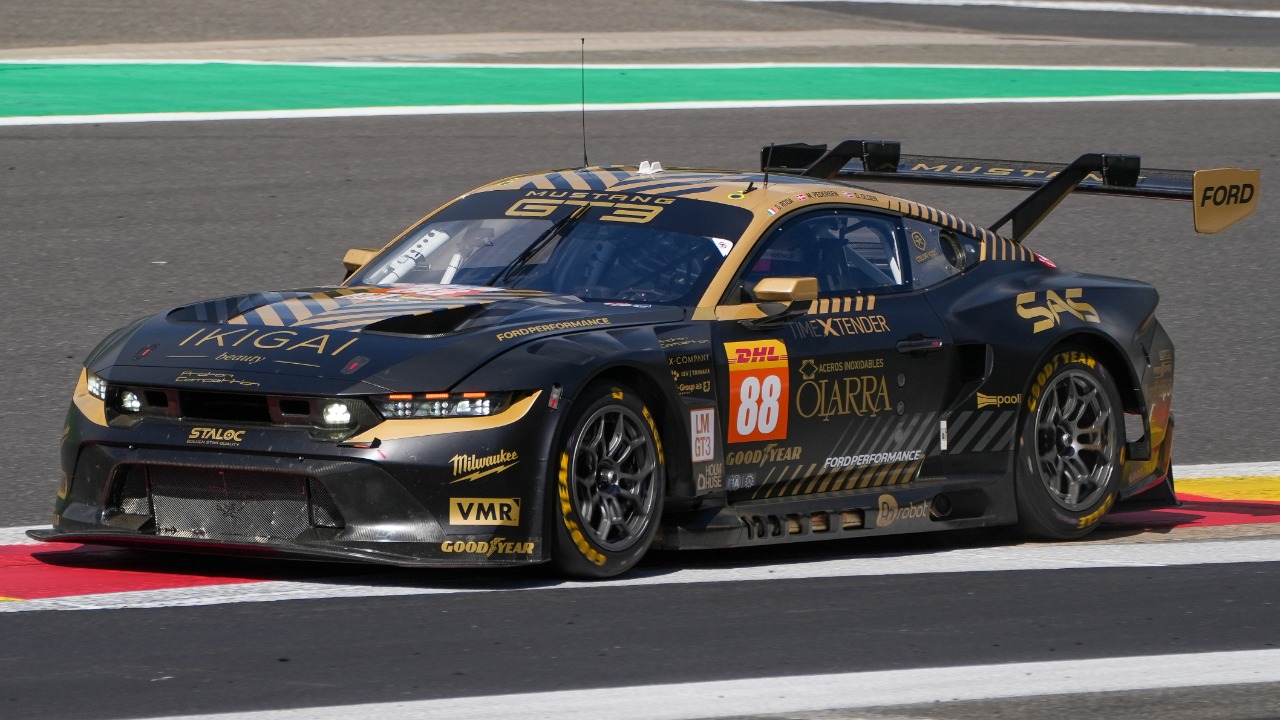

The Mustang GTD arrived as a statement of intent, a road-legal track weapon built to chase European royalty on their home circuits and reset expectations for an American muscle car. Now the Mustang GT3 Evolution race car hints that Ford is already working on the next step, a sharper, more focused GTD that could turn the Corvette rivalry into a full-blown arms race.
By tightening the feedback loop between its factory racing program and its halo road car, Ford is signaling that the GTD is not a one-and-done special but a platform that will evolve. The question is no longer whether the Mustang can hang with the best from Stuttgart or Bowling Green, but how quickly the next iteration can turn hard-won race data into a Corvette-beating lap time.
How the Mustang GTD reset expectations at the Nürburgring
Ford did not ease the Mustang GTD into the spotlight, it threw the car straight at the Nürburgring and let the stopwatch do the talking. The company publicly targeted a sub-seven-minute lap, and when the car delivered a blistering 6 minutes and 57 seconds, it instantly reframed what a front-engined American coupe could do on the world’s most demanding circuit. That 6:57 figure, with the final seconds cited as 57, put the GTD in rarefied company and made clear that this was not just a drag-strip Mustang with aero add-ons but a purpose-built track machine.
The lap was more than a bragging right, it was a proof of concept for Ford’s strategy of building a road car that borrows heavily from its GT3 program. The Nürburgring run showed that the GTD’s wild bodywork, race-bred suspension and aggressive powertrain calibration were not marketing theater but functional hardware capable of delivering a sub-seven-minute lap in a car that still carries a license plate. That early success set the baseline for everything that follows, and it is the benchmark the next evolution will have to clear to justify the hype around a faster, more focused version of the Mustang GTD, as seen in Ford’s own Mustang GTD coverage.
Corvette’s counterpunch and the American Nürburgring hierarchy
Corvette was never going to let Ford enjoy the Nürburgring spotlight uncontested, and the response from Bowling Green has been emphatic. In subsequent runs, Top Corvettes Now Fastest American Cars Around the German circuit, with All three Corvettes proving their worth over the full lap and pushing the Mustang GTD down the domestic leaderboard. The fact that All of these Corvettes could eclipse the Ford’s time underscores how quickly the balance of power can shift when rival engineering teams are chasing the same stopwatch.
The rivalry is no longer about which badge can claim the fastest American car in a straight line, it is about who owns the Nordschleife. When All three Corvettes moved ahead of the Ford Mustang GTD, the message was clear: the Mustang’s 6:57 was a milestone, not a finish line. That competitive pressure is exactly what makes the emerging Mustang GT3 Evolution so intriguing, because it suggests Ford is already working on the next answer to the Corvettes that now sit atop the American Nürburgring pecking order, as detailed in reports that describe how Top Corvettes Now Fastest American Cars Around the circuit and how All three Corvettes delivered on that promise.
Why raw numbers still favor the Corvette
On paper, the Corvette remains the blunt instrument in this fight, and the performance sheets back that up. In head-to-head testing, Performance numbers favor the Corvette almost everywhere, with 0–60 m acceleration figures that are hard to ignore. The Corvette is quoted at roughly 2.3 seconds to 60 m, while the GTD trails at about 3.2, and the Corvette’s top speed stretches to a claimed 233, giving it a clear edge in straight-line metrics that still matter to buyers and engineers alike.
Those figures are a reminder that the Mustang GTD is fighting an uphill battle against a car that is not only lighter and more mid-engined in its layout, but also optimized for explosive acceleration and high-speed stability. Yet even in that comparison, the testing notes that raw numbers tell only part of the story, hinting that the GTD’s strengths lie in consistency, braking stability and the way it can be leaned on lap after lap. That nuance is crucial as Ford looks to the Mustang GT3 Evolution for clues on how to close the gap, because shaving tenths off acceleration or adding a few miles per hour at the top end will not be enough on their own to overturn the Corvette’s advantage in 0–60 m, 2.3 versus 3.2 and a towering 233 mph, as laid out in the detailed Performance comparison between the Corvette and the GTD.
Inside Ford’s Mustang GT3 Evolution and what it signals
The Mustang GT3 Evolution is more than a mid-cycle refresh of a race car, it is a rolling laboratory that previews where the GTD could go next. Ford has framed the project as a way to sharpen its GT3 entry with incremental gains in aero efficiency, mechanical grip and durability, all within the constraints of Balance of Performance rules. The very name, Mustang, paired with Evolution Could Tease, hints that this is a deliberate step toward a Quicker package that can translate directly into road-car improvements once the lessons are digested.
In practical terms, the GT3 Evolution suggests Ford is experimenting with revised bodywork, underfloor management and possibly cooling solutions that could later appear on a more extreme GTD. Because the GT3 car must live within strict regulations, any advantage it finds in airflow over the nose, diffuser tuning or suspension geometry is hard-earned and data-rich. That is exactly the kind of development that can migrate to a road-going halo car with fewer constraints, and it is why the phrase Corvette appears in the same breath as Evolution Could Tease and Quicker in discussions of this program. The implication is clear: Ford is using its GT3 campaign as a proving ground for the next GTD, one explicitly aimed at a Corvette-beating lap time, as outlined in coverage of how Ford sees the Mustang GT3 Evolution Could Tease a Quicker response to the Corvette.
Translating GT3 race tech into a faster GTD
Turning GT3 race learnings into a road-legal GTD is not as simple as copying parts, but the pipeline is already visible. The GTD’s aggressive aero package, with its towering rear wing and deep front splitter, is essentially a softened version of GT3 hardware, and the Evolution car’s refinements will likely inform the next iteration of that bodywork. If the race team finds a more efficient way to generate downforce at the front axle or to stabilize the car through high-speed compressions, those changes can be adapted to a GTD that is free from series-mandated restrictors and weight penalties.
Suspension and chassis tuning are even more fertile ground. The GT3 Evolution’s revised kinematics, damper curves and anti-roll bar settings will be logged over thousands of racing kilometers, giving Ford a rich dataset on how the Mustang responds to different setups on varied circuits. A future GTD can cherry-pick the most effective combinations, then pair them with road-legal tires and a more compliant ride height. The result would be a car that feels more planted and predictable at the limit, exactly the traits that shave seconds off a Nürburgring lap and help close the gap to the Corvettes that currently sit ahead of the Mustang GTD in the American hierarchy.
The GTD’s engineering depth and where it can still grow
Even in its current form, the Mustang GTD is already a deeply engineered machine, and that foundation is what makes an evolution model so promising. The exterior is just a snapshot of the engineering depth that has gone into the project, from its complex cooling channels to its active aero elements and track-focused suspension. With the help of Multi link rear suspension and sophisticated adaptive dampers, the car can switch from a relatively compliant road setting to a hunkered-down track stance that maximizes grip and stability.
That dual personality is central to the GTD’s appeal, but it also points to where Ford can push harder. A more extreme evolution could lean further into the track side of the equation, perhaps sacrificing a bit of everyday comfort for sharper responses and higher sustained cornering loads. The current car already feels like an RS or Black Series-style road racer in spirit, yet the GT3 Evolution program suggests there is still untapped potential in areas like weight distribution, brake cooling and aero balance. Those are exactly the domains where a few percentage points of improvement can translate into meaningful time gains, especially on a circuit as long and varied as the Nürburgring, as highlighted in detailed reviews that note how the Sep evaluation of the Mustang GTD emphasizes the role of Multi link sophistication in delivering that RS or Black Series-style road racer feel.
Ford Performance’s racing ecosystem as a development engine
The Mustang GT3 Evolution and GTD do not exist in isolation, they are part of a broader Ford Performance ecosystem that treats racing as a development lab. From NASCAR stock cars to Grand Am sports racers and entries in the World Rally Championship, Ford has built a culture where lessons from one series can inform another. That cross-pollination is particularly valuable for a car like the GTD, which sits at the intersection of road and race and can benefit from everything the company learns about durability, heat management and driver feedback across its programs.
When Ford engineers talk about using motorsport to accelerate road-car development, they are not speaking in abstractions. The same teams that analyze tire wear in endurance events or aero sensitivity in high-speed oval racing can feed their insights into the Mustang GT3 Evolution, which then becomes a bridge to the next GTD. It is a virtuous cycle, and one that is explicitly acknowledged in official material that invites fans to Discover the broader world of Discover the Ford Performance programs in NASCAR, Grand Am and the World Rally Championship, all of which contribute to the knowledge base that will shape the next-generation GTD.
Where a future GTD must improve to beat Corvette
If Ford wants the next GTD to reclaim bragging rights from Corvette, the targets are clear. First, the car must find more pace in the slow and medium-speed sections where traction and mechanical grip dominate, areas where the mid-engined Corvette architecture naturally shines. That means further refining the GTD’s rear suspension, differential tuning and torque delivery so it can put power down earlier and more cleanly out of tight corners, clawing back time that is currently lost to wheelspin or stability control intervention.
Second, the Mustang has to chip away at the Corvette’s advantage in outright acceleration and top speed without compromising its newfound composure. That could involve weight reduction through more extensive use of carbon fiber, powertrain tweaks that unlock a bit more shove on the straights, or aero refinements that cut drag while preserving downforce. The Mustang GT3 Evolution is already probing those trade-offs in a regulated environment, and the data it generates will be invaluable as Ford decides how far it can push the next GTD toward a more single-minded track focus while still keeping it usable on the road.
Why the Mustang–Corvette rivalry is entering a new phase
The emerging picture is of a rivalry that has matured beyond quarter-mile times and spec-sheet one-upmanship into a nuanced battle over lap times, consistency and driver confidence. The Mustang GTD’s 6:57 Nürburgring run proved that Ford can build a front-engined coupe that plays in the same arena as Europe’s finest, while the subsequent surge from All three Corvettes showed that Chevrolet is equally committed to owning the “fastest American” crown. With the Mustang GT3 Evolution now in the mix, the stage is set for a second act in which both brands lean even harder on their racing programs to shape their flagship road cars.
From my vantage point, that is the most exciting development of all. The GTD is no longer just a halo Mustang, it is a rolling scoreboard for Ford’s entire performance philosophy, and the Corvette has become the benchmark that keeps the pressure on. If the GT3 Evolution delivers the gains its name implies, the next GTD will arrive not as a mild update but as a sharpened weapon aimed squarely at the Corvettes that currently sit ahead of it on the Nürburgring charts. For enthusiasts, that means the lap-time war is far from over, and the real winners will be the drivers who get to experience the results on both road and track.
More from MorningOverview