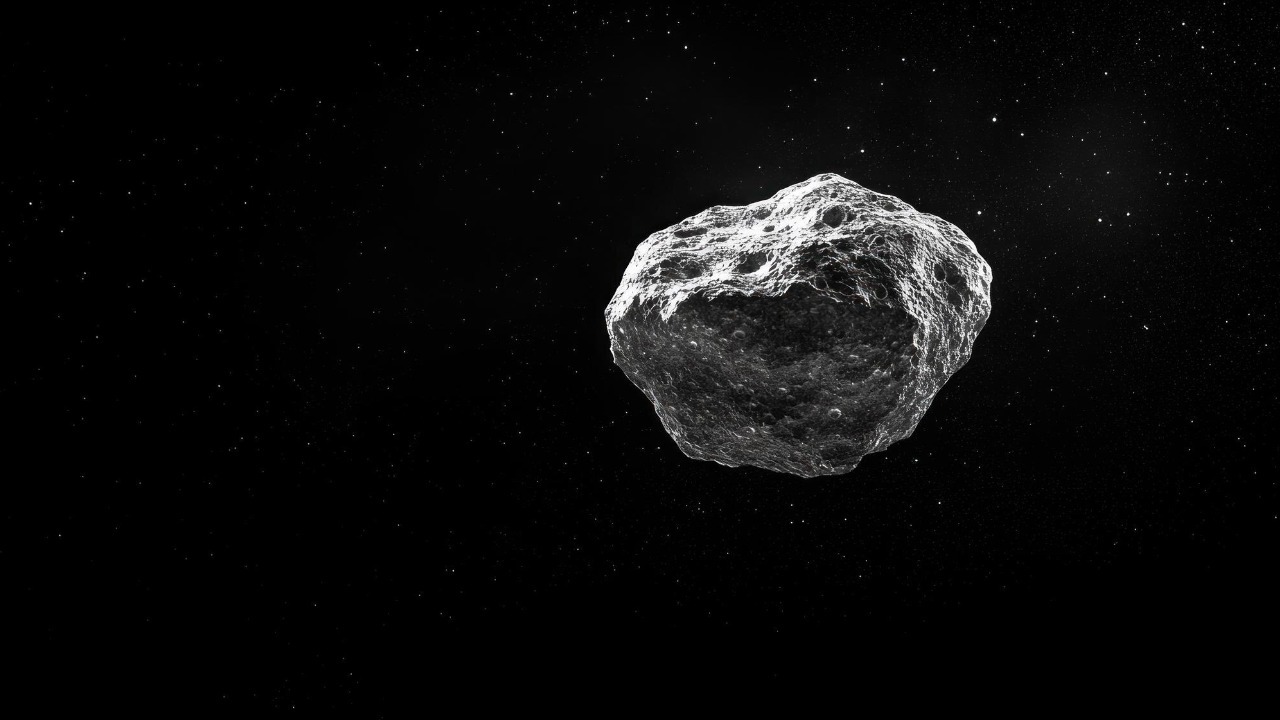

NASA is tracking a plane-sized asteroid known as 2025 XM as it hurtles toward Earth’s neighborhood at roughly 9,753 miles per hour, a reminder of how busy and carefully watched our cosmic surroundings have become. The object will pass safely by, but its speed and size put it squarely in the category of space rocks that scientists take seriously when they model potential impact risks. I see this flyby as part of a broader story about how we monitor near misses, weigh genuine hazards, and learn more about the ancient debris that still shares Earth’s orbit around the sun.
Asteroids like 2025 XM are not isolated curiosities; they are part of a steady stream of Near-Earth Objects that NASA and its partners catalog, simulate, and visualize in real time. As more of these objects are discovered, the public is encountering a new normal in which “plane-sized” and “bus-sized” rocks regularly skim past our planet, often closer than the moon, yet with no realistic chance of impact. Understanding why that is true, and how scientists know it, is essential context for interpreting the latest close approach.
What we know about asteroid 2025 XM
The asteroid drawing attention this week, 2025 XM, is described as roughly the size of a commercial airplane and is racing through space at about 9,753 miles per hour relative to Earth. That speed, while dramatic, is typical for small bodies in near-Earth orbits, which routinely travel at tens of thousands of miles per hour as they fall around the sun. Reporting from PASADENA, Calif, notes that NASA has been closely tracking this object as it approaches Earth, treating it as part of the agency’s routine survey of nearby space rather than as an emergency.
In coverage from PASADENA, Calif, the object is identified explicitly as 2025 XM, a large asteroid approaching Earth at 9,753 miles per hour, with its size compared to a commercial airplane to give a sense of scale that non-specialists can grasp. The same reporting explains that NASA uses that size estimate to determine whether an asteroid crosses the threshold of what scientists call a “potentially hazardous object,” a classification that depends on both diameter and how close the orbit brings it to Earth. Those details about 2025 XM’s speed, scale, and hazard threshold are laid out in the description of how NASA tracks 2025 XM approaching Earth at 9,753 miles per hour.
How NASA tracks a fast, plane-sized rock
To follow an object like 2025 XM with enough precision to rule out an impact, NASA relies on a global network of telescopes and radar systems that feed into centralized databases. Observatories repeatedly measure the asteroid’s position against background stars, then refine its orbit as more data comes in, shrinking the uncertainty in where it will be during its closest approach to Earth. In PASADENA, Calif, specialists at NASA’s Jet Propulsion Laboratory play a central role in this process, running orbital simulations that project the asteroid’s path years or even decades into the future.
The PASADENA, Calif reporting on 2025 XM underscores that this tracking is not a one-off scramble but part of a standing program that constantly updates trajectories for thousands of objects. That same coverage explains how NASA uses these observations to decide whether an asteroid meets the criteria for a potentially hazardous object, combining its size, its minimum distance from Earth, and its long-term orbital evolution. The operational side of this work, including the role of PASADENA, Calif in refining orbits and issuing updates, is highlighted in the account of how PASADENA, Calif teams monitor 2025 XM.
2025 XM in a crowded neighborhood of Near-Earth Objects
Asteroid 2025 XM is only one of several sizable rocks passing relatively close to Earth this week, which is why scientists emphasize that such flybys are part of a pattern rather than an anomaly. NASA’s catalog of Near-Earth Objects includes thousands of asteroids and comets whose orbits bring them into Earth’s vicinity, and new entries are added regularly as survey telescopes scan the sky. The agency and its partners maintain this watch specifically to determine whether any of these bodies pose an impact threat, and to understand how they move through the inner solar system.
According to a detailed overview of space situational awareness, NASA and its partners maintain a watch for Near, Earth Objects that pass within Earth’s vicinity, then analyze their orbits to determine if any pose an impact threat. That same explanation notes that this monitoring covers both asteroids and comets, treating them as part of a single population of small bodies that can intersect Earth’s orbit. The broader context for 2025 XM, and the way it fits into this systematic survey of nearby space, is laid out in the description of how NASA and its partners maintain a watch for Near, Earth Objects.
Other asteroids on NASA’s radar this week
The focus on 2025 XM comes as NASA is also tracking several smaller objects, including bus-sized asteroids that will pass even closer to Earth but are far less massive. One such rock, designated 2025 XF1, has been described as roughly the size of a bus and is being monitored as it approaches our planet this week. Another object of similar scale is also on the agency’s list, illustrating how multiple small bodies can share the spotlight during a single stretch of days.
Reporting on these additional objects explains that 2025 XF1 is not the only space rock being monitored by NASA this week, and that the agency is also tracking another bus-sized asteroid on a nearby trajectory. The same coverage notes that these asteroids are remnants from the formation of the solar system about 4.6 billion years ago, which is why scientists are eager to study them even when they pose no danger. Those details about 2025 XF1, the second bus-sized rock, and their ancient origins are summarized in the account of how NASA is tracking bus-sized asteroids that formed about 4.6 billion years ago.
Why “bus-sized” and “plane-sized” asteroids still matter
Descriptions like “bus-sized” and “plane-sized” can make these asteroids sound modest, but even relatively small rocks carry enough energy to cause serious regional damage if they were to hit Earth. A bus-sized object can release energy comparable to a large conventional weapon, while a plane-sized asteroid like 2025 XM would pack a far more powerful punch, especially if it reached the ground rather than breaking up in the atmosphere. That is why NASA treats these objects as worthy of close tracking even when the calculated risk of impact is effectively zero.
Coverage of NASA’s current monitoring efforts notes that 2025 XF1 and another bus-sized asteroid are both being followed closely, with their sizes compared to familiar vehicles to help the public visualize their scale. The same reporting emphasizes that these objects are part of a broader population of small bodies that NASA studies to understand how the solar system evolved, not just to guard against impacts. The dual role of these bus-sized asteroids, as both scientific targets and potential hazards, is highlighted in the explanation of how NASA is tracking a bus-sized asteroid approaching Earth this week.
Comet 3I/ATLAS and the interstellar visitors
While 2025 XM and its bus-sized companions are native to our solar system, scientists are also watching an entirely different kind of visitor: the interstellar comet 3I/ATLAS. This object is on a trajectory that will carry it past Earth before it heads back out of the solar system for good, making its current flyby a one-time opportunity for close study. Its path and speed are very different from those of near-Earth asteroids, but it shares the same basic status as a small body whose orbit brings it into Earth’s neighborhood.
Detailed coverage of Comet 3I/ATLAS explains that the object is now headed toward its closest approach to Earth, and that it will pass by our planet before leaving the solar system and disappearing into interstellar space. Earlier analysis of this object noted that it would make its closest pass by Earth in December, after spending months in the morning sky as it approached the sun. The description of how the object is now headed toward the inner solar system, and how it will still be in the morning sky as it nears Earth, is laid out in the report on the interstellar object Comet 3I/ATLAS heading toward the sun and Earth.
The week’s closest approaches: 2025 XN4 and 2025 XX2
Beyond 2025 XM, 2025 XF1, and Comet 3I/ATLAS, NASA’s tracking list this week includes several other small bodies that will pass relatively near Earth. One of the most notable is 2025 XN4, a space rock that is expected to come within roughly 123,000 miles of our planet, closer than the average distance to the moon. Another object, 2025 XX2, measures around 33 feet in diameter and is projected to make its own close pass, again with no realistic chance of impact.
Reporting on these flybys specifies that the asteroid designated 2025 XN4 is expected to pass within about 123,000 miles of Earth, and that 2025 XX2, measuring around 33 feet in diameter, is projected to make a separate close approach. The same account notes that both objects are being monitored as part of NASA’s routine survey of near-Earth space, with their sizes and distances carefully calculated. Those concrete figures for 2025 XN4’s distance and 2025 XX2’s diameter are detailed in the description of how 2025 XN4 and 2025 XX2 are expected to pass near Earth.
How NASA visualizes the near-Earth environment
For anyone trying to make sense of this flurry of names and designations, NASA has built tools that turn orbital data into something you can see and explore. One of the most important is a real-time visualization platform that lets users zoom through a 3D model of the solar system, track specific asteroids, and watch their paths relative to Earth. I find that this kind of interface helps bridge the gap between abstract orbital elements and an intuitive sense of how close, or how distant, a given flyby really is.
The core of this visualization effort is a web-based application that plots the positions and trajectories of thousands of objects, including 2025 XM and other Near-Earth Objects, in an interactive environment. Users can click on individual asteroids, adjust the timeline, and see how their orbits evolve over years or decades, all using the same underlying data that scientists rely on. That capability is described in the overview of NASA’s Eyes on Asteroids app, which presents the near-Earth environment as a dynamic, explorable neighborhood.
From tracking to public awareness: why communication matters
Tracking asteroids is only part of the job; explaining what those tracks mean for everyday life on Earth is just as important. When a plane-sized rock like 2025 XM makes headlines, the public wants to know not only how fast it is moving but whether it poses any real danger, and how scientists can be so sure of their answers. Clear communication about risk, uncertainty, and the limits of current knowledge helps prevent both complacency and unnecessary panic.
NASA has leaned into this communication challenge by building tools and platforms that reveal the near-Earth object neighborhood in accessible ways, including interactive visualizations that show how close approaches unfold over time. One detailed account describes how NASA’s Eyes, Asteroids platform reveals our Near, Earth Object Neighborhood Through a new 3D real-time visualization tool, allowing users to explore asteroids and comets with a click or a swipe. That explanation of how the tool works, and how it is meant to bring the near-Earth environment into public view, is laid out in the description of how NASA’s Eyes, Asteroids Reveals Our Near, Earth Object Neighborhood Through visualization.
How 2025 XM compares with other recent close calls
To put 2025 XM in perspective, it helps to compare it with other recent objects that have passed near Earth, including those described as bus-sized or racing toward our planet. Earlier this week, NASA highlighted a bus-sized asteroid whose approach prompted questions about whether such a small object could still be dangerous. Another report framed a similar rock as “racing toward Earth,” a phrase that captures the drama of orbital motion but can obscure the fact that the calculated trajectories keep these bodies at safe distances.
One detailed analysis of these events explains that NASA’s close call involved a bus, sized asteroid racing toward Earth, and then walks through what the object is, how its orbit was determined, and why it did not qualify as a serious impact threat. The same coverage underscores that NASA tracks these asteroids precisely to avoid surprises, using each flyby as a chance to refine models and test detection systems. Those insights into how a bus, sized asteroid racing toward Earth was evaluated, and why it was ultimately considered safe, are laid out in the account titled NASA Tracks Bus, Sized Asteroid Racing Toward Earth.
Media coverage and the “plane-sized” label
The phrase “plane-sized asteroid” has become a staple of headlines, and 2025 XM is no exception, with coverage emphasizing both its scale and its approach toward Earth. That framing can be useful, since most people have a clear mental image of a commercial airplane, but it can also blur important distinctions between different kinds of close passes. A plane-sized rock that misses Earth by millions of miles is a very different situation from a smaller object that passes between our planet and the moon.
Recent reporting on 2025 XM notes that NASA is monitoring a plane-sized asteroid approaching Earth and that 2025 XM is not the only asteroid whizzing through Earth’s neighborhood this week, highlighting the crowded nature of near-Earth space. The same coverage points out that multiple objects of varying sizes are being tracked simultaneously, reinforcing the idea that 2025 XM is part of a larger pattern rather than a singular threat. Those details about the plane-sized asteroid and the other rocks whizzing through Earth’s vicinity are summarized in the account explaining that 2025 XM is not the only asteroid whizzing through Earth’s neighborhood.
What scientists are learning from these flybys
Every close approach, whether by a plane-sized asteroid like 2025 XM or a smaller bus-sized rock, is an opportunity for scientists to refine their understanding of how these bodies move and what they are made of. Radar observations can reveal an asteroid’s shape and rotation, while optical measurements help determine its composition and surface properties. Over time, these data feed into models of how asteroids respond to sunlight, gravitational nudges, and other forces that can subtly alter their orbits.
Recent coverage of NASA’s monitoring efforts notes that the agency is not only tracking the positions of these objects but also collecting samples and studying their physical properties to understand the building blocks of the solar system. One report on a plane-sized asteroid approaching Earth points out that the same teams involved in tracking near-Earth objects are also analyzing asteroid samples from space, linking flybys to laboratory work on returned material. That connection between real-time tracking and physical analysis is highlighted in the description of how NASA is tracking a plane-sized asteroid while studying asteroid samples from space.
The bigger picture: living with a dynamic sky
Stepping back from the specifics of 2025 XM, 2025 XF1, 2025 XN4, 2025 XX2, and Comet 3I/ATLAS, what emerges is a portrait of a solar system that is far from static. Earth moves through a shifting field of rocks and ice, some as small as pebbles, others as large as mountains, all governed by the same gravitational rules that keep the planets in their orbits. The fact that NASA can track a plane-sized asteroid moving at nearly 10,000 miles per hour and confidently predict a safe flyby is a measure of how far planetary defense has come.
At the same time, the steady drumbeat of close approaches is a reminder that this work is never finished, and that new discoveries can still surprise even seasoned observers. Live coverage of the interstellar comet 3I/ATLAS, for example, notes that 3I/ATLAS has dominated the conversation about small bodies this week as it prepares for its closest approach to Earth before leaving our solar system for good. That sense of a dynamic, evolving sky, in which new objects like 3I/ATLAS appear and depart while familiar asteroids like 2025 XM glide past, is captured in the ongoing updates on the closest approach of interstellar comet 3I/ATLAS to Earth.
More from MorningOverview