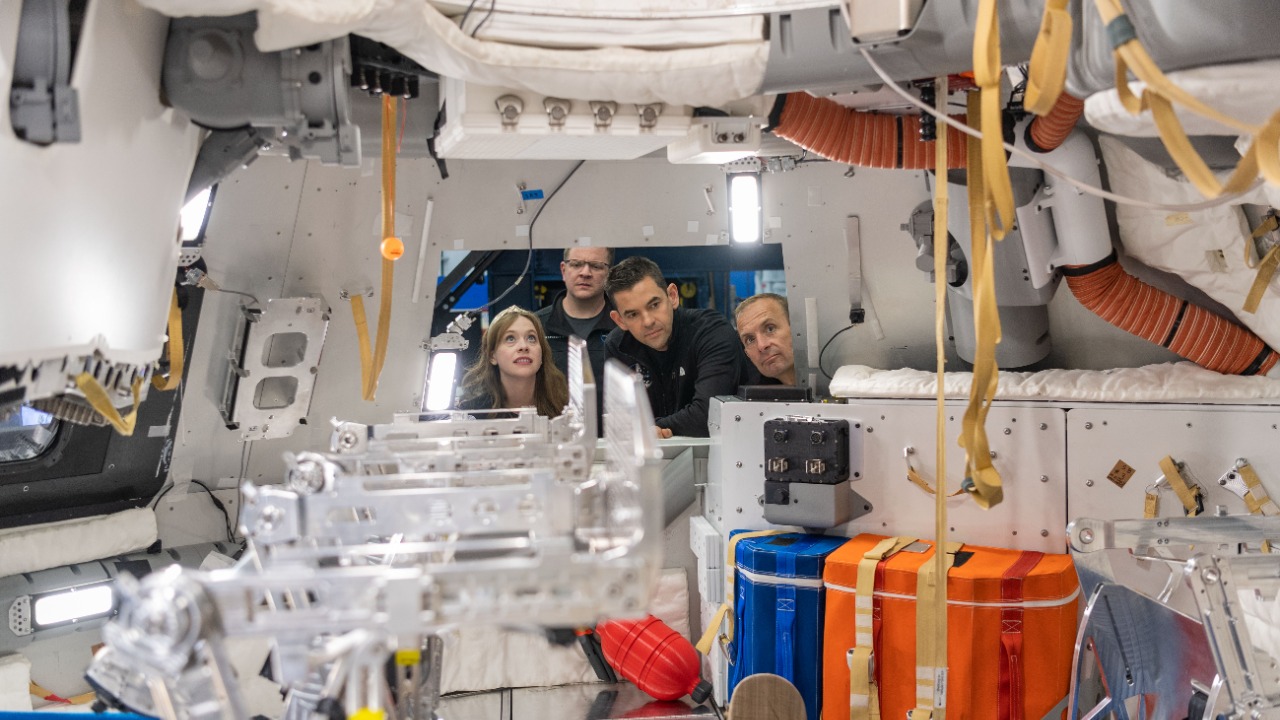

Billionaire entrepreneur Jared Isaacman, a private astronaut who has flown with SpaceX, is now set to run NASA, capping a remarkable rise from payments executive to the most powerful job in American civil space policy. His confirmation signals a decisive bet by Washington on commercial-style leadership at a moment when the United States is racing to return crews to the Moon and cement its position in deep space.
Isaacman arrives with close ties to Elon Musk and a track record of pushing private spaceflight into new territory, and his tenure will test how far the agency can lean into that model without losing its public mission. I see his appointment as a stress test for NASA’s balance between government stewardship and market competition in the twenty‑first century space race.
The Senate’s verdict and Trump’s space bet
The United States Senate has now confirmed Jared Isaacman as NASA administrator, turning President Donald Trump’s high‑profile nominee into the public face of the agency. The confirmation followed a contentious process that revolved around his wealth, his status as a private astronaut and his close alignment with the president’s vision for a more commercially driven space program, but in the end the votes were there to put him in charge of NASA’s sprawling portfolio of science, exploration and technology programs, a decision reflected in detailed coverage of the Senate confirmation.
For President Trump, Isaacman’s ascent is more than a personnel move, it is a statement about how he wants America to compete in space. Reports on the confirmation describe him explicitly as a Billionaire Trump nominee, underscoring how personally invested the White House has been in this choice and how directly the administration is tying NASA’s leadership to its broader Moon strategy.
From payments and fighter jets to private astronaut
Isaacman’s résumé looks very different from that of a traditional NASA chief, and that is precisely the point. He is the founder and chairman of Shift4 Payments, a major payment processor, and he also created Draken International, a company that provides advanced tactical aviation services using fleets of fighter aircraft, experience that has given him a deep familiarity with both high‑risk operations and complex government contracting.
On top of that business background, Isaacman has literally strapped into the rockets he now oversees. He has flown as a private astronaut with SpaceX, including commanding the Inspiration4 mission, and he has backed a series of commercial flights that push toward more ambitious activities such as the first all‑civilian spacewalk, a trajectory highlighted in reporting that describes him as a billionaire who has flown with SpaceX and funded missions designed to carry out a spacewalk.
A nomination withdrawn, then revived
Isaacman’s path to the administrator’s office was not straightforward, and the twists say a lot about the political stakes around NASA. He was first nominated for the role earlier in the Trump presidency, only to see that nomination pulled back months later amid questions about his business ties and the optics of putting a billionaire private astronaut in charge of a public agency, a sequence laid out in coverage noting that Isaacman was first nominated and then withdrawn before being renominated.
When Trump returned to Isaacman as his choice to lead NASA, it signaled that the White House saw no better standard‑bearer for its approach to space than a billionaire entrepreneur with deep ties to commercial launch providers. The revived nomination set up a second, more intense round of scrutiny over his prior associations and potential conflicts, scrutiny that the Senate approval process acknowledged even as it ultimately cleared him to take the job.
Musk ally at the helm of a public agency
Isaacman’s closeness to Elon Musk and SpaceX is one of the defining features of his appointment, and it is already shaping expectations for how he will run NASA. Reports on the confirmation repeatedly describe him as a Musk ally and private astronaut, emphasizing that the Senate confirms private astronaut, Musk ally Jared Isaacman as NASA chief, a framing that raises both hopes for faster innovation and concerns about favoritism.
At the same time, Isaacman has made clear that he sees competition, not monopoly, as the key to American strength in orbit and beyond. Coverage of his views notes that the billionaire entrepreneur believes bringing in more private sector competition is essential to winning the space race, a point echoed in analysis that the Senate confirms Musk ally Jared Isaacman while expecting him to manage relationships with multiple commercial partners, not just SpaceX.
The Moon race and America’s strategic message
Isaacman is taking over NASA at a moment when the Moon is once again a geopolitical prize, not just a scientific destination. The Trump administration has framed the Artemis program and related initiatives as a race in which America must return to the lunar surface before its “great rival” and establish an enduring presence there, language that appears in reporting on how America will return to the Moon and build a long‑term foothold.
That framing is not just rhetoric, it is a strategic directive for the new administrator. Another account of his confirmation underscores that the Billionaire Trump nominee confirmed to lead NASA amid Moon race will be judged on whether he can translate that ambition into hardware on the pad and astronauts on the surface, all while keeping NASA’s scientific and Earth‑focused missions from being crowded out.
Artemis delays, budget fights and a crowded agenda
Isaacman inherits an agency whose flagship human exploration program is both central to national prestige and under significant strain. Reporting on his confirmation notes that Both the United States and its main competitor want to establish a long‑term human presence on the lunar surface, but NASA’s Artemis program has faced delays and cost pressures that will now land squarely on his desk.
Those same accounts emphasize that Isaacman will have to steer the agency through contentious debates over its future budget and priorities, deciding how to balance lunar landers, Mars planning, Earth science satellites and commercial space station support. The description of him as a billionaire entrepreneur confirmed as the new NASA chief underscores that he is expected to bring a hard‑nosed approach to the agency’s future budget and long‑term program mix.
Managing organizational turbulence inside NASA
Even before the final confirmation vote, analysts were warning that Isaacman would be stepping into a NASA already in flux. One assessment of his likely tenure argued that if confirmed, Isaacman would oversee the agency during a particularly transformative era, with internal restructuring, new commercial partnerships and shifting political expectations all converging at once, a view captured in a piece that described how Isaacman will oversee NASA during a particularly transformative era.
That same analysis stressed that his leadership will be judged on whether he can stabilize the organization while still expanding the United States role in deep‑space exploration, a dual mandate that would challenge even a seasoned government insider. For a newcomer from the private sector, the test will be whether his experience scaling Shift4 Payments and Draken International can translate into managing a sprawling federal bureaucracy with powerful congressional stakeholders and a global scientific community watching every move.
Balancing public mission and private ambition
Isaacman’s confirmation has also sharpened an old question about NASA’s identity in the commercial era. On one hand, his career embodies the rise of billionaire‑backed space ventures and the belief that private capital can accelerate innovation; on the other, he now leads an agency whose legitimacy rests on serving the public interest, not any one company’s bottom line, a tension that came through in hearings where the Senate, Jared Isaacman and NASA were all invoked in the context of the twenty‑first century space race.
In those exchanges, Isaacman signaled that he understands the symbolic weight of his new role, telling lawmakers he would not let private interests override NASA’s broader mission while still arguing that commercial partnerships are essential to staying ahead. The coverage of his testimony, framed under National Politics, shows a nominee trying to reassure skeptics that a billionaire entrepreneur can be a responsible steward of a taxpayer‑funded agency even as he leans into the competitive instincts that made him successful.
What Isaacman’s rise means for the next decade in space
With the confirmation fight behind him, Isaacman now has to turn a bold narrative into concrete results. The reporting that the US Senate has approved him after a thorough review of prior associations underscores how much political capital has been invested in his success, and how quickly that support could erode if Artemis slips further or if perceptions of favoritism toward Musk and other allies take hold.
At the same time, his unusual blend of entrepreneurial drive, operational experience from Draken International and first‑hand time in orbit gives him a perspective no previous NASA administrator has brought to the job. If he can harness that background to deliver a sustainable lunar presence, nurture a competitive commercial ecosystem and keep NASA’s scientific work thriving, his tenure could redefine what it means for America to lead in space in the decades ahead.
More from MorningOverview