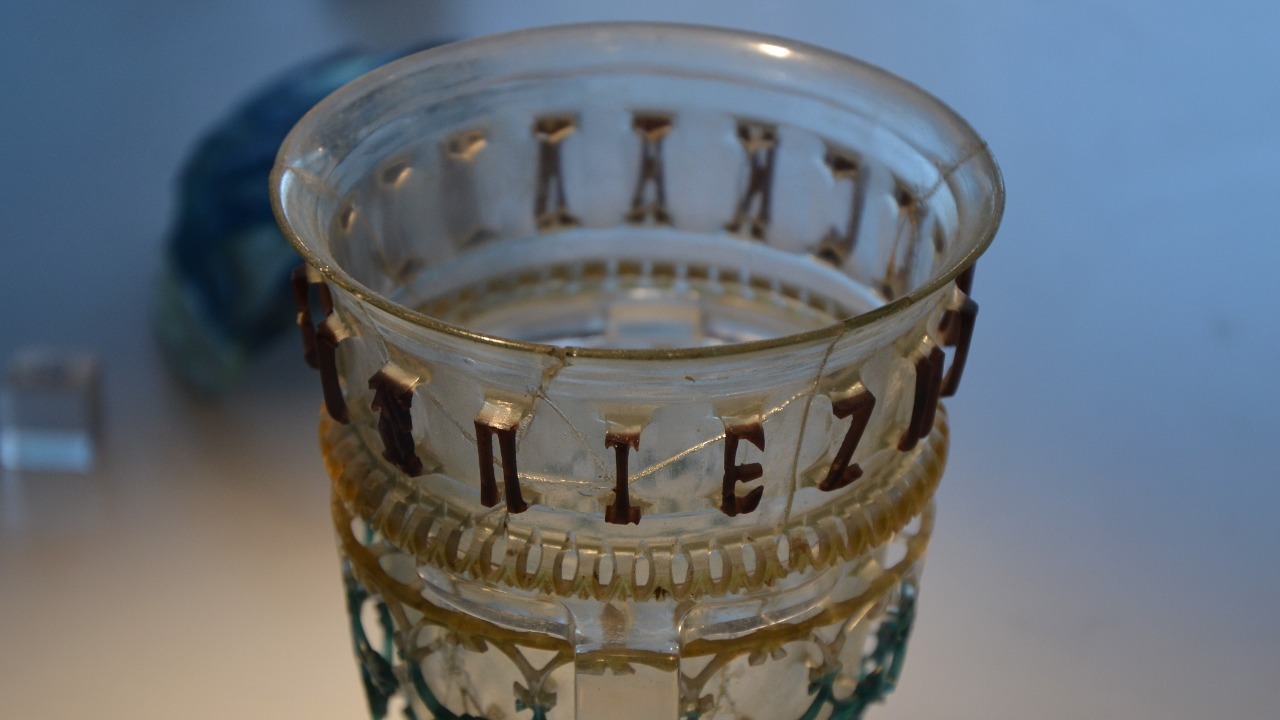

In a quiet gallery, a single turn of a Roman glass cup has rewritten what historians thought they knew about one of antiquity’s most dazzling crafts. Hidden for roughly 1,500 years in plain sight, a set of tiny marks has opened a new window onto the minds and methods of the empire’s master glassmakers, and it is reshaping how I understand both ancient technology and modern materials science.
The discovery does more than add a curious footnote to museum labels. It links a forgotten “language” of workshop symbols to cutting edge research on photonic crystals, nanostructures and even future optical devices, revealing that Roman glass is not just a relic of the past but a living laboratory for the technologies of tomorrow.
The museum moment that changed the story
The breakthrough began with a simple gesture: a Roman glass cup at the Metropolitan Museum was turned around, and what had always been displayed as its “back” suddenly became the focus. On that newly revealed side, a history professor noticed faint, almost ghostlike markings that had been overlooked by generations of curators and visitors, even though the vessel had been catalogued, exhibited and photographed for decades. That quiet act of rotating the object, a literal change of perspective, exposed a 1,500‑year‑old secret that had been hiding in the museum’s own vitrines.
Reporting on the find describes how a museum visit “sparked a revelation” when the Roman cup was reoriented and its overlooked symbols came into view, prompting a reassessment of long held assumptions about how Roman glass was made and organized in workshops. The unnoticed details, documented when the vessel was finally examined from all sides, are now central to new research that traces how a single turn of the wrist can upend an entire scholarly narrative about Roman craftsmanship.
Hidden signatures and the rise of Rome’s master glassmakers
Once scholars knew where to look, the markings on that cup no longer seemed like random scratches. They resembled deliberate workshop signs, the kind of coded signatures that artisans use to track orders, quality or authorship. Research into similar objects has revealed that Roman glassmakers, far from being anonymous laborers, left behind a sophisticated system of symbols that quietly asserted their presence and expertise. These marks suggest an organized industry in which individual workshops, and perhaps even specific masters, claimed responsibility for their work.
Archaeologists studying comparable vessels have identified what they describe as “hidden signatures” on Roman glass, including pieces at the Metropolitan Museum that bear subtle, incised signs only visible when the object is turned and examined under the right light. One report on Hidden Signatures Reveal Ancient Rome notes that these marks point to “Master Glassmakers” whose work was delicate even by modern standards, reinforcing the idea that Roman glass was a prestige technology managed by highly skilled specialists rather than faceless workshops.
A professor, a cup and a 1,500‑year‑old oversight
The person who first recognized the significance of the markings was not a materials scientist but a history professor, someone trained to read texts and images rather than atomic lattices. During that pivotal museum visit, the professor realized that the faint lines on the Roman cup were not decorative flourishes but intentional signs that had somehow escaped notice for roughly fifteen centuries. The oversight was not due to negligence so much as habit: the cup had always been displayed from a particular angle, and its most revealing side was literally turned away from view.
Coverage of the discovery explains that the professor identified the hidden markings on an ancient Roman cup and argued that they reveal new secrets of the empire’s glassware, including how pieces were commissioned, produced and possibly traded. The account emphasizes that the symbols had been “photographed out of the frame,” a telling detail that captures how institutional routines can blind even experts to what is right in front of them, until someone finally rotates the object and sees the Roman cup anew.
The “language” of workshop marks
As more examples have come to light, the markings on Roman glass are starting to look less like isolated curiosities and more like a coherent system, a kind of visual shorthand shared across workshops. Some symbols appear to repeat, suggesting that they might indicate a particular workshop, artisan or production batch. Others seem to cluster in ways that hint at quality control or internal accounting, the quiet paperwork of an ancient luxury industry etched directly into the product itself.
Researchers analyzing these signs argue that they form a hidden “language” on ancient Roman glass, one that was meaningful and intentional rather than merely decorative. One study notes that it is “clear that such symbols were not merely ‘decorative’ but were instead meaningful and intentional in a way not previously recognized,” and that this coded system was originally featured on a vessel known as Nautilus. The same work, which describes how ancient Roman glass reveals a hidden language, suggests that these marks could eventually allow historians to map networks of production and distribution across the empire.
Workshop codes and the organization of an ancient industry
Understanding those symbols matters because it changes how I see the Roman glass trade itself. Instead of a loose collection of artisans working in isolation, the evidence points to a structured industry with internal standards and shared conventions. Workshop marks could have helped track which furnace produced a batch, which team cut the decoration or which client commissioned a particular motif. In other words, the marks are not just signatures, they are management tools etched into silica.
Archaeological reporting on Hidden Workshop Marks Reveal Secrets of Ancient Rome Glass describes how these incised codes shed light on the organization of glass artisans, including how tasks were divided and how quality was monitored. The same research, illustrated with an Image Credit to Christa Koppermann, suggests that the marks can be used to reconstruct workshop hierarchies and production chains, turning what once looked like random scratches into a detailed record of how an ancient craft economy actually functioned.
From buried shards to photonic crystals
While curators and historians decode the language of marks, physicists and engineers are reading Roman glass in a different way, at the level of molecules and light. Buried fragments of ancient vessels have developed iridescent skins that are not simply the result of weathering but of complex structural changes over centuries. In some cases, the glass has reorganized itself into layered patterns that interact with light in highly specific ways, creating what scientists recognize as photonic crystals.
One study of a Roman glass fragment found that its distinctive iridescent patina stems from a photonic crystal structure formed over time, with layers of material that have regularly alternating packing density. This periodic structure manipulates how light propagates through the glass, much like engineered photonic materials used in modern optics. The research, which details how photonic crystals formed in ancient Roman glass, shows that the same objects now yielding hidden workshop marks are also quietly hosting advanced optical architectures that scientists are only beginning to exploit.
How ancient glass turns into a modern material
The transformation of Roman glass does not stop at pretty colors. Over centuries underground, molecules in the glass rearrange and recombine with surrounding minerals, creating entirely new substances with properties that did not exist when the vessel left the furnace. In effect, time and soil act as a slow motion fabrication lab, turning discarded cups and bowls into novel materials that can guide, filter or trap light in ways that interest today’s engineers.
Researchers have documented how buried ancient glass forms a new substance with potential modern applications, showing that the interface between the original glass and infiltrating minerals can produce a nanostructured layer suitable for optical devices. One report describes how a team led by Fiorenzo Omenetto and Giulia Guidetti analyzed Roman shards and found that the resulting material could function as a nanophotonic component, a finding detailed in a study published in the Proceedings of the National Academy of Sciences USA. A companion account explains how Researchers discovered that these rearranged molecules could be harnessed for communications, lasers and solar cells, turning archaeological waste into a platform for future photonics.
The Roman Empire’s accidental photonic lab
What makes this story so striking is that the Romans did not set out to build photonic crystals or nanophotonic components. They wanted durable, beautiful glass, and they achieved that through recipes and techniques that were advanced for their time but still rooted in empirical craft. Yet the combination of their materials, their firing methods and the burial environments of their discarded wares has produced structures that modern scientists deliberately design in clean rooms and fabrication facilities.
Analyses of these materials describe how substances with periodic optical structures, known as photonic crystals, can manipulate the way light propagates, and how a particular Roman glass object presents a unique case of such a crystal. One account, framed around the idea that Materials with these periodic structures were effectively a secret of the Roman Empire, underscores how ancient artifacts are now being treated as natural experiments in long term material evolution, experiments that no modern lab could afford to run on such timescales.
Nanotechnology, long before the word existed
The idea that Roman glass hides advanced physics is not entirely new. For years, scientists have marveled at a famous 1,600‑year‑old goblet that changes color depending on how light hits it, appearing green in reflected light and red in transmitted light. That effect is caused by nanoparticles of gold and silver embedded in the glass, a level of control over matter at the nanoscale that would not be formally described for more than a millennium. The artisans who made it did not know the term “nanotechnology,” but they clearly understood how to achieve its visual effects.
Detailed studies of this goblet have shown that the color shift arises from a precise distribution of metallic nanoparticles, leading researchers to describe the Romans as pioneers of nanotechnology. One analysis notes that modern home pregnancy tests exploit a separate nano based phenomenon to turn a white line pink, drawing a direct line from ancient glass to contemporary diagnostics. The same work, which explains how Today’s tests use nanoparticles to ensnare target molecules, reinforces the idea that Roman artisans were manipulating matter at scales that modern scientists now quantify and model.
From Lycurgus to lab bench: the goblet that would not stop teaching
The same 1,600‑year‑old goblet, often cited as a benchmark for ancient nanotechnology, continues to inspire new lines of inquiry. Its color changing behavior has become a case study in how embedded nanoparticles interact with light, and its survival has allowed multiple generations of researchers to revisit it with ever more sensitive instruments. Each new analysis reveals additional layers of complexity in how the glass was formulated, fired and cooled, and how the metallic inclusions were distributed.
One widely cited account of the goblet explains that since the researchers first analyzed its composition, they have used its behavior as a model for designing modern sensors and optical devices. The same reporting, which describes how this 1,600‑year‑old goblet shows that the Romans were nanotechnology pioneers, underscores how a single artifact can bridge the gap between art history and applied physics, turning a museum piece into a reference design for contemporary engineering.
Artisans, not lone geniuses
It is tempting to frame the professor who turned the cup, or the scientists who decoded the goblet, as lone geniuses who single handedly unlocked ancient secrets. That narrative is seductive, but it obscures the collective nature of both Roman craftsmanship and modern research. The hidden marks on the glass point to teams of artisans, apprentices and workshop managers, all contributing to a shared visual language and technical repertoire. Likewise, the studies that reveal photonic crystals and nanoparticles are the work of interdisciplinary groups that span archaeology, physics and engineering.
Cultural critics have long warned that the myth of the lone creative genius can distort how we understand innovation, pointing to examples like the way Apple is typically described as the product of a single visionary rather than a vast network of designers and engineers. One essay on the myth of the lone creative genius argues that this framing skews the truth behind a person’s success, and the same critique applies neatly to Roman glass. The newly discovered workshop marks and the complex material transformations they record are reminders that both ancient and modern breakthroughs are almost always collaborative, even when a single name ends up in the headline.
From coins and cups to contemporary craft
The renewed attention to Roman glass also resonates with how contemporary artists and makers approach materials. Today’s metalworkers, glass artists and jewelers often treat historical objects as both inspiration and raw material, reworking them into new forms that highlight their original craftsmanship while adding modern twists. The act of turning a cup to reveal hidden marks is not so different from the way a skilled engraver might rotate a coin under a loupe, searching for the right angle to cut a new pattern into an old surface.
One striking example comes from a reel that shows an artist transforming vintage coins into miniature masterpieces, carving intricate reliefs that respect the original design while adding new layers of meaning. The clip, which notes that it was Originally reposted in 2025, highlights the same blend of engineering accuracy and artistic mastery that defined Roman glass workshops. In both cases, the object becomes a palimpsest of skill and time, carrying traces of multiple makers who each leave their mark, sometimes literally, on its surface.
Why a small twist still matters
What lingers after tracing this story from museum gallery to nanophotonic lab is how much can hinge on a small physical gesture. Turning a cup a few degrees revealed a set of marks that had been waiting, silently, to be read. Those marks, in turn, connected to a broader pattern of workshop codes, buried photonic structures and nanoparticle effects that tie Roman glass to some of the most advanced technologies in use today. The empire’s artisans did not know they were building future optical components, but their work has become a testbed for exactly that.
As I follow the research on buried shards that form new substances with modern applications, on photonic crystals that emerge from centuries of weathering, and on nanoparticles that make a goblet glow red from within, the lesson feels clear. The past is not static. It changes every time someone looks again, turns an object, or asks a different question. In the case of Roman glass, one simple twist has not only revealed a 1,500‑year‑old secret but also reminded us that even the most familiar artifacts can still surprise us, if we are willing to see them from another side.
More from MorningOverview