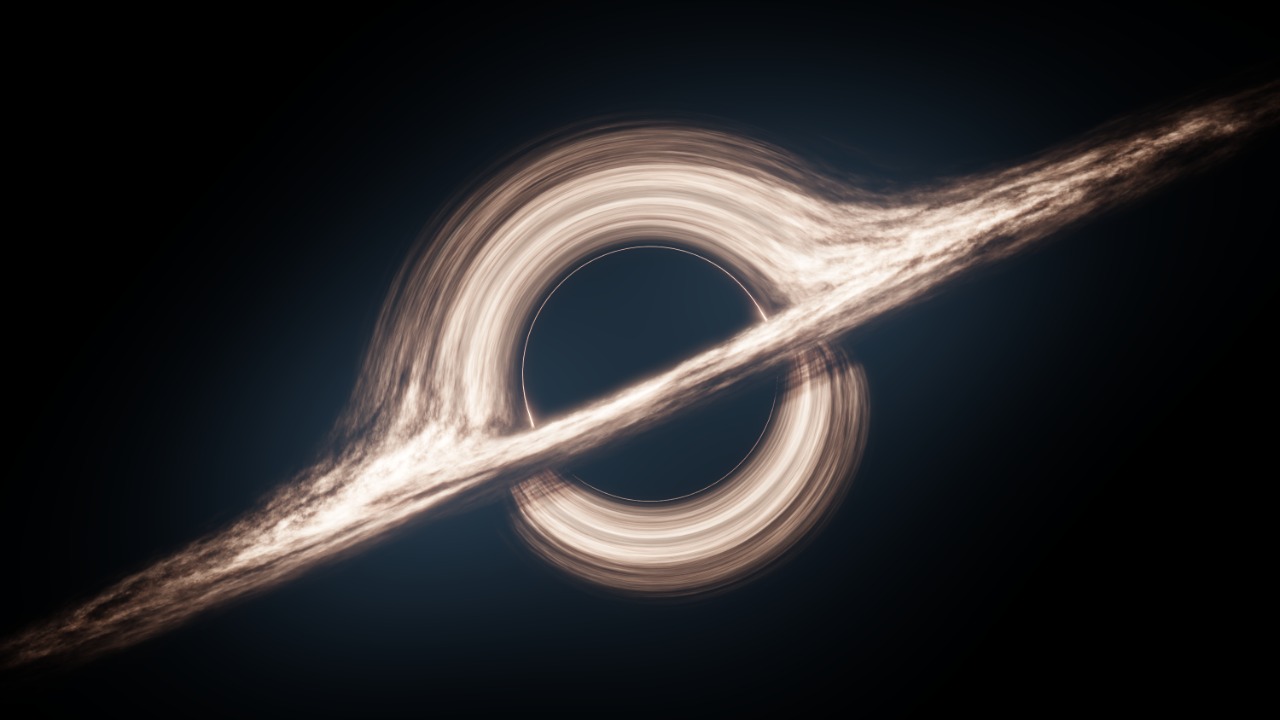

Astronomers have finally watched a black hole do something Albert Einstein only described on paper, twisting the fabric of spacetime itself as it devoured a star. In a rare cosmic accident, a supermassive black hole shredded a passing sun, then set its own surroundings wobbling in a way that reveals a genuine spacetime whirlpool. The result is one of the clearest real-world tests yet of general relativity in its most extreme regime, and a preview of how black holes quietly sculpt their host galaxies over billions of years.
The rare cosmic accident that set spacetime spinning
The story begins with a star that wandered too close to a supermassive black hole and paid the ultimate price. Pulled apart by tidal forces, the star was stretched into a stream of gas that wrapped around the black hole and settled into a hot, glowing disk of debris. Astronomers call these violent flares tidal disruption events, or TDEs, and in this case the event unfolded when a star was torn apart in what researchers describe as a rare and unusually well timed encounter, a setup that allowed them to track the aftermath in exceptional detail through a coordinated observing campaign across the spectrum, from optical light to high energy X rays and radio waves that lit up as the debris spiraled inward and formed a disk and jet system around the black hole across the spectrum.
As the shredded star’s remains circled the black hole, the system did something even stranger than flare. The disk of debris and the narrow jet of material blasting away from the black hole began to wobble together, as if the entire structure were precessing like a spinning top that has been nudged off balance. That shared wobble, tracked in both X rays and radio signals, is what turned an already dramatic TDE into a once in a generation physics experiment, because it signaled that the black hole’s own spin was dragging nearby spacetime into a slow, relentless whirl.
Einstein, frame dragging, and the Lense–Thirring prediction
More than a century ago, Albert Einstein’s theory of general relativity predicted that a spinning mass would not just sit in spacetime but would twist it, a subtle effect known as frame dragging. In 1918, Josef Lense and Hans Thirring worked out how this would look around a rotating body, showing that orbits near a spinning mass should slowly precess, an effect now called Lense–Thirring precession. In the new black hole observation, the massive object at the center of the TDE appears to be spinning in just such a way that it drags spacetime with it, forcing the orbiting debris disk and its jet to precess together in a pattern that matches the Lense–Thirring description and turns a once theoretical idea into a directly observed phenomenon Lense–Thirring precession.
Essentially, the massive black hole at the center of the TDE is spinning so rapidly that it drags spacetime along with it, forcing nearby matter to follow a warped path that would be impossible under Newtonian gravity alone. This theoretical phenomenon was discovered after being predicted by Einstein more than a century ago, and in this case the precessing disk and jet provide a clean, geometric tracer of how space itself is being twisted at a blistering pace close to the event horizon, where gravity is strong enough to bend light and time in ways that match general relativity’s most exotic equations predicted by Einstein.
How astronomers actually saw spacetime wobble
Turning a mathematical prediction into a measurement required a carefully choreographed set of observations. As the TDE brightened, Dec astronomers tracked the evolving flare in optical light, where data showed a blue, hot source, and in X rays, where the innermost regions of the disk revealed how close the gas was skimming to the black hole. At the same time, radio telescopes watched the jet, which carried material away at nearly the speed of light, and together these instruments recorded a synchronized wobble in both the disk and the jet that could not be explained by random turbulence or a lopsided explosion, but instead pointed to a coherent precession of the entire structure around the black hole’s spin axis optical data showed.
By measuring the radio waves and X rays emanating from the disk and the jets of just such a tidal disruption event, Dec researchers were able to reconstruct how the debris spiraled inward and how its orientation changed over time. A star was torn apart, creating a disk of debris, and as this debris spiraled inward it emitted X rays and radio signals that rose and fell in a pattern that traced the wobble of the disk and jet together, a clear signature that the black hole’s spin was dragging the surrounding spacetime and forcing the entire structure to precess in lockstep around an extreme cosmic object radio waves and X rays.
A wobbling star and a feasting black hole
While the TDE provided a dramatic, short lived laboratory, another line of evidence came from a quieter but equally telling system where a star orbits a ravenous supermassive black hole that is ripping it apart more gradually. In that case, Astronomers have observed a star wobbling in its orbit around a feasting black hole, with the star’s path deviating from a simple ellipse in a way that signals the black hole is dragging the very fabric of spacetime around it, a behavior that again matches the expectations of frame dragging and the Lense–Thirring effect near a spinning mass star wobbling.
Dec observations of that system show the star’s orbit precessing in a way that cannot be explained by the gravity of nearby stars or gas alone, but instead points to the black hole’s own rotation as the driver of the wobble. The Astronomers Spot Star “Wobbling” Around Black Hole report describes how the star’s motion, tracked over multiple orbits, reveals a subtle but persistent shift that lines up with the predictions of general relativity, turning the system into a long term testbed for how a spinning black hole can torque the orbits of nearby objects and gradually reshape its stellar neighborhood Astronomers Spot Star.
“A real gift for physicists” and a clean test of relativity
For theorists who have spent decades calculating how black holes should twist spacetime, the new observations are more than just a curiosity, they are a rare chance to check the math against reality in a regime that is almost impossible to reproduce in any other way. Dec researchers describe the event as a Real Gift for Physicists, because the black hole just twisted spacetime and proved Einstein right again, with a star’s violent destruction by the black hole producing a signal that matches the frame dragging predicted by general relativity and leaving little room for alternative explanations that would preserve Newtonian gravity alone Real Gift for Physicists.
Researchers confirm Einstein’s theory through a rare observation near black hole, noting that a torn apart star in a very distant galaxy has provided direct evidence that Einstein’s theory of general relativity correctly describes how gravity behaves even in the extreme environment close to a supermassive black hole. Dec Researchers emphasize that the pattern of emission from the TDE, combined with the precession of the disk and jet, lines up with the equations of general relativity in a way that strengthens confidence in the theory and constrains any competing models that might try to tweak gravity on cosmic scales Researchers confirm Einstein’s theory.
Why this spacetime whirlpool matters for galaxies
Beyond confirming a century old prediction, the detection of a spacetime whirlpool around a black hole has far reaching implications for how galaxies grow and evolve. Understanding frame dragging helps improve models of how black holes launch jets, because the way spacetime is twisted near the event horizon influences how magnetic fields thread the disk and how energy is extracted from the black hole’s spin to power narrow, relativistic outflows that can heat or strip gas from their host galaxies over long periods, regulating star formation and the growth of galactic bulges through feedback that depends sensitively on the black hole’s rotation and the geometry of its surrounding spacetime helps improve.
The wobbling disk and jet in the TDE also offer a way to measure the black hole’s spin, a quantity that is notoriously difficult to pin down but crucial for understanding how black holes grow through mergers and accretion. By matching the observed precession rate to the predictions of Lense–Thirring precession, astronomers can infer how fast the black hole is rotating and how its spin axis is oriented relative to the inflowing gas, information that feeds directly into simulations of galaxy evolution and helps explain why some galaxies host powerful, tightly collimated jets while others remain comparatively quiet despite harboring black holes of similar mass.
Einstein’s theory passes yet another extreme test
Each new observation of a black hole twisting spacetime adds to a growing body of evidence that Einstein’s theory remains remarkably accurate even where gravity is strongest. Dec reports describe how Einstein’s theory is confirmed by a black hole caught twisting spacetime, with the black hole’s disk and jet wobbling together and material in the jet traveling at nearly the speed of light, behavior that matches the relativistic predictions for how matter should move in a strongly curved, rotating spacetime and leaves little room for large deviations from general relativity in this regime nearly the speed of light.
At the same time, the Nautilus account of how astronomers observe spacetime whirlpool for the first time underscores that this theoretical phenomenon was discovered after being predicted by Einstein, and that the new data provide one of the clearest demonstrations yet that his equations correctly describe not just gentle gravitational fields but the violent, rapidly changing environment near a supermassive black hole. By Jake Currie notes that the observed precession and emission patterns align with the expectations of general relativity, reinforcing the theory’s status as the best available description of gravity while still leaving open the possibility that even more extreme tests, perhaps involving merging black holes or neutron stars, could someday reveal subtle departures from Einstein’s framework By Jake Currie.
From abstract math to a visible spacetime vortex
For decades, frame dragging and Lense–Thirring precession lived mostly in textbooks and computer simulations, abstract consequences of a theory that had already passed many other tests. What has changed with the TDE and the wobbling star is that astronomers can now point to specific systems where spacetime’s twist is not just inferred but traced in the motion of real matter, from the synchronized precession of a disk and jet to the subtle orbital shifts of a star that circles a supermassive black hole. Dec accounts of how astronomers observe spacetime whirlpool for the first time emphasize that the massive black hole at the center of the TDE was spinning in such a way that it dragged spacetime with it, turning an invisible curvature into a measurable, time varying signal that can be followed across multiple wavelengths and compared directly with theoretical models spacetime whirlpool.
In that sense, the new observations mark a shift from treating black holes as distant, almost mythical objects to seeing them as laboratories where the deepest ideas in physics can be tested with the same rigor applied to particle collisions at the Large Hadron Collider or precision measurements of atomic clocks. Dec coverage of how astronomers caught a spacetime whirlpool around a black hole as first predicted by Einstein notes that the event was not just about timing, but about the quality and breadth of the data, which together allowed researchers to isolate the signature of frame dragging from other effects and to show that the black hole’s spin was indeed sculpting the motion of matter in its immediate vicinity in exactly the way general relativity prescribes spacetime whirlpool around a black hole.
More from MorningOverview