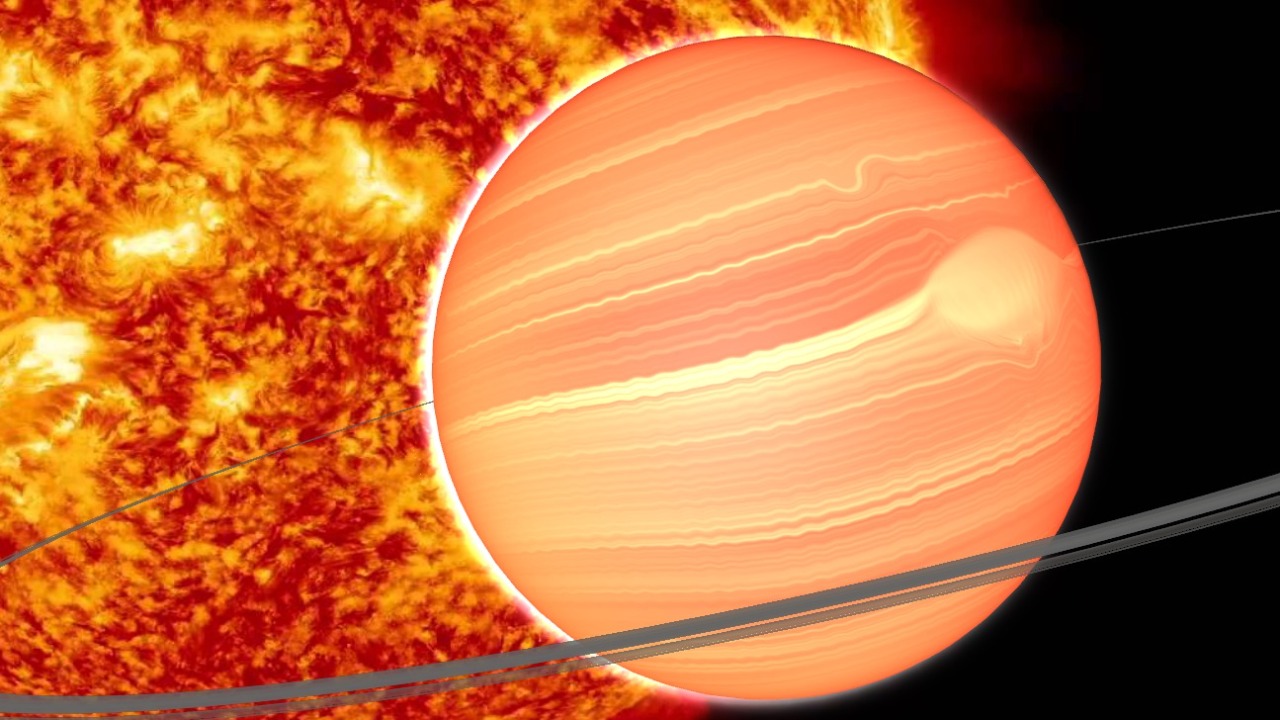

Hot Jupiters, the blisteringly close cousins of our own Jupiter, were once treated as cosmic misfits. Now their orbital patterns are turning into a kind of forensic record, revealing how these giants were built, how they migrated, and which of them survived a violent youth. By tracing subtle alignments, eccentricities, and hidden companions, I can see a new picture emerging in which these worlds are less chaotic accidents and more products of distinct, decipherable histories.
Instead of a single origin story, the latest research points to multiple pathways that sculpt hot Jupiter systems, from smooth spirals through gas disks to disruptive gravitational shoves. The orbits we measure today, from nearly circular scorchers to eccentric warm giants, are exposing that secret past and forcing astronomers to rethink how planetary systems, including our own, assemble and evolve.
From oddities to orbital laboratories
When the first planet was found hugging its star at a fraction of Mercury’s distance, it looked like an outlier that theory had not prepared for. Over time, as more of these hot Jupiters turned up, their orbits stopped being curiosities and started to look like data sets, with patterns in inclination, eccentricity, and spacing that encode how they got so close. Recent work on hidden patterns in these orbits argues that the way these giants circle their stars is not random at all but reflects distinct migration histories that can be read like a planetary crime scene.
That shift in perspective, from freak objects to orbital laboratories, is reshaping how I think about planetary formation in general. Instead of treating each hot Jupiter as an exception, researchers now use them as controlled experiments in extreme physics, comparing their tight orbits with the more sedate paths of giants farther out. Studies that track how Hot Jupiters moved inward from their birthplaces show that these worlds can illuminate the same questions we ask of our own outer planets, only with the volume turned up.
Two main origin stories: smooth migration and violent scattering
At the heart of the debate over hot Jupiter origins sit two broad scenarios. In one, these giants form far from their stars and then drift inward through a relatively gentle interaction with the surrounding gas disk, preserving nearly circular, well-aligned orbits. In the other, they are kicked onto highly elongated paths by gravitational run-ins with other planets or stellar companions, then gradually circularize as tides with the star bleed away orbital energy. The latest orbital analyses argue that both channels are real, and that the current distribution of hot Jupiter orbits reflects a mix of smooth and violent pasts rather than a single dominant route.
Evidence for this split personality shows up when I compare hot Jupiters with their more distant cousins. Theoretical work on migration finds that the primary drivers of migration include interactions with the protoplanetary disc that generate density waves and redistribute angular momentum, a recipe for the smoother pathway. At the same time, dynamical models of systems where a single giant dominates show how scattering and high eccentricities can arise, while in low-mass star systems where no single giant rules, multiplicity is instead generally maintained, hinting that the presence or absence of a hot Jupiter can reshape the entire planetary architecture.
Orbital fingerprints: what “hidden patterns” really mean
When researchers talk about hidden patterns in hot Jupiter orbits, they are not invoking anything mystical. They are pointing to statistical regularities in how these planets line up with their stars’ equators, how stretched their paths are, and how often they share space with smaller neighbors. The Dec project on New Orbital Clues Reveal How Hot Jupiters Moved Close to Their Stars, for instance, separates systems where the giant’s orbit is nearly circular and well aligned from those where it is tilted or eccentric, and uses that split to infer whether the planet likely migrated smoothly or was tossed inward later.
Another layer of pattern recognition comes from looking for nearby companions that are hard to spot directly but leave dynamical fingerprints. Detailed surveys have uncovered evidence for hidden nearby companions to hot Jupiters, and these new discoveries provide strong evidence that at least some hot Jupiters have quiescent dynamical histories that are more common than previously thought. If a hot Jupiter can coexist with a close neighbor on a stable orbit, that is a powerful hint that it did not bulldoze its way inward through violent scattering, but instead followed a calmer route that preserved the surrounding architecture.
Magnetic barriers and the role of the protoplanetary disk
Even in the smoother scenario, hot Jupiters do not simply slide inward without resistance. The gas and dust disk that feeds their growth can also act as a brake, especially where magnetic fields carve out cavities or change the flow of material. In one theory of hot Jupiter formation, the interaction of this disk with a newly formed gas giant causes the planet to migrate inward until it reaches a region where magnetic forces and dust push against the planet strongly enough to halt its progress. That idea of magnetic barriers helps explain why so many hot Jupiters pile up at similar distances from their stars instead of plunging all the way in.
These disk interactions also leave orbital signatures that I find increasingly important. If a planet’s inward journey is governed by torques from the gas, its orbit tends to stay nearly circular and aligned with the disk, which itself is usually aligned with the star’s equator. That is very different from the outcome of a gravitational brawl, where a planet can be flung onto a highly inclined or eccentric path. Theoretical treatments of how these planets generally form further out and either migrate in through interactions with the protoplanetary disc or via the von Zeipel–Lidov–Kozai mechanism followed by tidal circularization show that the disk route and the high inclination route should produce very different orbital fingerprints, which is exactly what observers are now starting to see.
Violent histories: scattering, tides, and broken age patterns
Not every hot Jupiter bears the mark of a gentle upbringing. Some sit on orbits that are still noticeably eccentric or misaligned, even after billions of years of tidal interaction with their stars. That is a strong clue that they were once on far more extreme paths, likely kicked inward by encounters with other massive planets or by the gravitational pull of a distant companion star. Over time, tides between the star and planet circularize the orbit and can even shrink it further, but they do not always erase the evidence of that earlier chaos.
Recent demographic work that focuses on a hot Jupiter sample around single Sun-like stars with kinematic properties finds that the distribution of these planets with stellar age is not smooth. Instead, researchers report a broken age pattern that constrains hot Jupiter origin and tidal evolution and points to long term evolution with multichannel formation. In other words, some hot Jupiters likely arrive early through disk migration, while others are delivered later by scattering or Kozai cycles, and the way their orbits change with time under tidal forces helps separate those populations.
Warm Jupiters and eccentric giants that “shouldn’t exist”
To understand hot Jupiters, I find it useful to look slightly farther out, at the so-called warm Jupiters that orbit at a few tenths of an astronomical unit and often carry large eccentricities. These worlds sit in a regime where tides are weaker, so their orbits can preserve the memory of past interactions more clearly. Astronomers are investigating a strange class of exoplanets known as eccentric warm Jupiters, massive gas giants that move in ways never seen before, and some of these giants should not exist according to older formation models that assumed more orderly architectures.
These eccentric giants bridge the gap between distant, Jupiter-like planets and the tightest hot Jupiters, and their orbits are forcing theorists to rewrite long-standing rules. Work on These Giant Planets Are So Weird They are Making Astronomers Rewrite the Rules highlights how exploring planetary extremes and how unique orbital configurations challenge standard migration scenarios. Some warm Jupiters may be stalled migrants that never made it all the way in, while others could be in the middle of a high eccentricity pathway that will eventually turn them into hot Jupiters once tides have more time to act.
Colossal outliers and rare orbits as Rosetta stones
Every so often, a single planet arrives that seems tailor made to test competing theories. A colossal planet in a rare orbit, for example, can act as a Rosetta stone for understanding how hot Jupiters form. When a giant world swings between a distant aphelion and a close brush with its star, its atmosphere and orbit both become laboratories for extreme physics, revealing how tides, radiation, and dynamics interact over a single orbit.
Researchers studying one such colossal planet have said they are especially interested in what they can learn about the dynamics of this planet’s atmosphere after it makes one of its close passes, because that is exactly the kind of system they were hoping to find. The discovery, reported in a study of a colossal planet in rare orbit, offers clues to the origins of hot Jupiters by showing a possible intermediate stage where a giant is still on an elongated path but already feeling intense stellar tides that could eventually circularize it into a close-in orbit.
Lessons from our own outer planets
Although our solar system does not host a hot Jupiter, its outer planets still provide a crucial reference point for interpreting exoplanet orbits. Their gigantic mass and unique features provide a window into the solar system’s history, potentially revealing how migration and resonances shaped the current layout. When I compare Jupiter and Saturn’s relatively sedate orbits with the wild paths of some exoplanet giants, the contrast underscores how contingent planetary architectures can be.
Educational analyses of the outer planets argue that Their outer planets’ gigantic mass and current state encode evidence of past interactions, just as hot Jupiter orbits do in other systems. The difference is that in our case, the giants stayed far enough out that their migration did not strip the inner system, leaving room for Earth. In systems where a hot Jupiter dominates, that same process can erase or rearrange smaller worlds, which is why the presence of a close-in giant is often linked to a very different planetary census.
Why multiplicity and companions matter
One of the most striking orbital clues to a hot Jupiter’s past is whether it has company. If a close-in giant shares its system with smaller planets on stable, near-circular orbits, that suggests a relatively calm history in which the giant migrated inward without ejecting or engulfing its neighbors. If, instead, the hot Jupiter stands alone, that solitude can be a sign that earlier gravitational upheavals cleared the field, leaving a single survivor hugging the star.
Surveys of stellar and planetary populations show that for low-mass stars, in whose planetary systems a single giant does not dominate, multiplicity is instead generally maintained. That contrast with systems where a hot Jupiter or other massive giant dominates reinforces the idea that these planets are not just passive tracers of formation, they are active sculptors of their environments. When I see a hot Jupiter with hidden nearby companions, as in the Mar study of Jupiters where they found quiescent dynamical histories, it tells me that even among close-in giants, there is a spectrum from wrecking ball to gentle migrant.
Rewriting the rules of planetary systems
Put together, the orbital patterns of hot Jupiters, warm Jupiters, and their eccentric cousins are forcing a rewrite of the basic rules that once guided planetary science. Instead of a single, solar system inspired template, I now see a landscape where multiple formation channels operate side by side, with magnetic barriers, disk torques, scattering events, and tidal evolution all leaving distinct signatures in the orbits we measure. The Dec work on Hot Jupiters that were once cosmic oddities but then later moved inward, combined with the Dec analysis of hidden patterns in hot Jupiter orbits, shows that these signatures are now precise enough to separate smooth from violent histories.
That shift has consequences far beyond the study of a few exotic giants. As researchers use these orbital fingerprints to back out how often different migration channels operate, they are also refining estimates of how many systems might host Earth-like planets in stable, temperate zones. The same dynamics that can drag a giant inward can also destabilize or protect smaller worlds, and the emerging picture from Hidden Patterns, Dec orbital clues, and eccentric warm giants is that planetary systems are more diverse, and more dynamically active, than the tidy model we once inferred from our own backyard.
More from MorningOverview