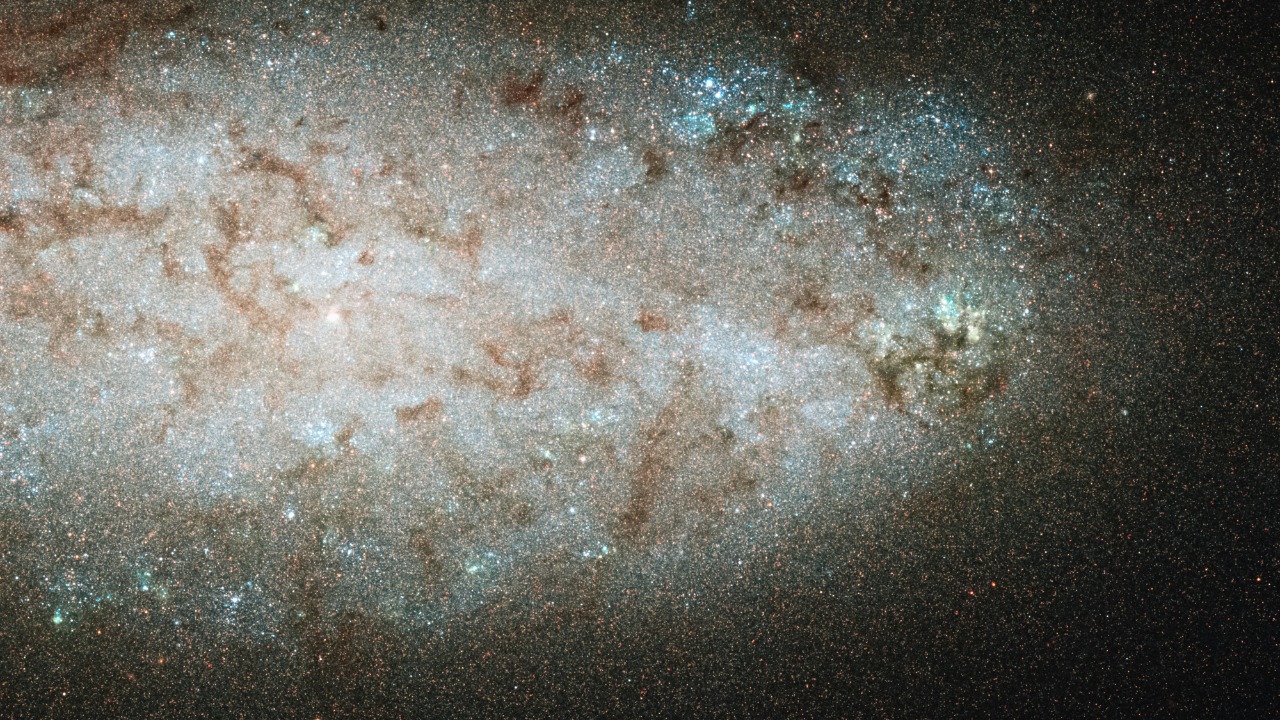

NASA is preparing to turn the center of our own galaxy into a precision test bed, using the Nancy Grace Roman Space Telescope to build the most detailed infrared map of the Milky Way ever attempted. Instead of treating our galaxy as a backdrop, the mission will treat it as a data-rich laboratory, tracing stars, dust and dark structures that have remained hidden behind veils of interstellar material. In practical terms, that means a carefully designed survey that can see through the densest regions of the galactic plane and far side, revealing how the Milky Way is structured and how it has evolved.
Roman’s mission and why NASA is targeting the Milky Way now
NASA has spent years shaping the Nancy Grace Roman Space Telescope into a flagship observatory built to answer big cosmological questions, but the agency is now putting equal emphasis on what the mission can do in our own backyard. Roman is designed as a wide-field infrared observatory that can scan huge swaths of sky in a single pointing, a capability that makes it uniquely suited to chart the crowded, dust-obscured regions of the Milky Way that smaller-field telescopes struggle to cover efficiently. By committing a major portion of the mission to a structured galactic survey, NASA is effectively turning a cosmology workhorse into a dual-purpose mapper of our home galaxy.
The core spacecraft and its observing strategy are laid out in NASA’s description of the Roman Space Telescope, which highlights its wide field of view and infrared sensitivity as the key tools for this job. Those same design choices that make Roman powerful for dark energy studies also allow it to capture dense star fields in the galactic bulge and disk in a fraction of the time earlier missions required. By folding a Milky Way mapping program into this broader mission profile, NASA is aiming to extract maximum science from a single observatory rather than flying separate, more narrowly focused spacecraft.
The infrared advantage: seeing through the Milky Way’s dust
The decision to map the Milky Way in infrared is not a stylistic choice, it is a technical necessity. Visible light is scattered and absorbed by the thick bands of dust that thread through the galactic plane, which is why images of the Milky Way from Earth show dark lanes cutting across the starry band. Infrared wavelengths, especially those Roman will use, can slip through much of that dust, turning what looks like an opaque curtain into a translucent screen and revealing stars and structures that have been effectively invisible to optical surveys.
Reporting on NASA’s plan underscores that the Roman Space Telescope will map the Milky Way in infrared specifically to exploit this dust-penetrating power. That approach will let scientists trace stellar populations on the far side of the galaxy and in its central bulge, where extinction is so severe that optical counts are badly incomplete. By combining Roman’s infrared view with existing visible-light catalogs, researchers will be able to correct for dust effects more precisely and build a three-dimensional picture of where stars actually reside, not just where they appear to be when dust is ignored.
The bulge survey: 691 square degrees and 3,500 full moons of sky
At the heart of NASA’s mapping strategy is a massive survey of the Milky Way’s central bulge, the dense, spheroidal region around the galactic center that holds a large fraction of the galaxy’s stars. The main component of this survey is planned to cover 691 square degrees, an area of sky that NASA equates to about 3,500 full moons. That scale is crucial, because the bulge is not a compact dot but a sprawling structure that stretches across a wide band of the inner galaxy, and only a survey on this scale can capture its full shape and stellar content.
By designing the program explicitly as a survey, NASA’s Roman team is signaling that this is not a set of isolated snapshots but a coherent, statistically robust map of the bulge region. The 691 square degree footprint will allow astronomers to trace gradients in stellar age, metallicity and density from the very center of the galaxy out into the inner disk. It will also provide a uniform dataset for studying variable stars, microlensing events and compact objects that reveal themselves through subtle changes in brightness across the survey area, all anchored to the same observing strategy and calibration.
Reaching the far side: mapping the Milky Way’s hidden half
One of the most ambitious aspects of the Roman plan is its focus on the far side of the Milky Way, a region that has remained frustratingly underexplored because it lies behind the thickest dust and the densest star fields. From our vantage point inside the galactic disk, the far side is effectively behind the bright glare of the inner galaxy, which has made it difficult to measure how the spiral arms and bar extend into that hemisphere. Roman’s wide-field infrared vision is designed to cut through that barrier and turn the far side from a rough sketch into a detailed map.
NASA’s own description of the program notes that Roman will be used to map our galaxy’s far side, offering new insights into the structure of the central bulge and the “bar” that stretches across it. By resolving individual stars and tracing their distribution across the far side, the mission will help determine whether the Milky Way’s bar is symmetric, how the spiral arms connect to it, and whether there are asymmetries or warps that current models miss. For the first time, astronomers will be able to compare the near and far sides of the disk with similar depth and resolution, turning the Milky Way from a half-known system into a more complete, global structure.
Using cosmic dust as a tool, not just an obstacle
Cosmic dust is often treated as a nuisance that blocks light and complicates observations, but Roman’s Milky Way program is built on the idea that dust can be a powerful tracer of galactic physics if it is measured accurately. By observing in infrared and combining those data with models of dust emission and absorption, Roman will allow scientists to map where dust is concentrated, how it is distributed relative to stars and gas, and how it shapes the conditions for star formation. Instead of simply correcting for dust, the mission will turn it into a primary data product.
NASA has outlined how Roman will use cosmic dust to unveil our home galaxy, emphasizing that the mission’s infrared sensitivity will reveal the Milky Way’s “less sparkly” components that do not stand out in optical images. A complementary description from the mission’s science team explains that NASA’s Nancy Grace Roman Space Telescope will help scientists better understand the Milky Way by tracing how dust and stars interact across the disk and bulge. By treating dust as both a foreground to correct and a subject to study, Roman will give researchers a more nuanced view of how the galaxy recycles material and builds new generations of stars.
From design review to execution: how Roman was built for this job
The ability to carry out such an ambitious galactic survey is rooted in decisions NASA made years ago about Roman’s hardware and mission profile. The telescope’s wide-field instrument, large focal plane and stable pointing were all chosen to support deep, repeated imaging of large areas of sky, which is exactly what a Milky Way mapping program requires. Those design choices were locked in when NASA announced that Roman had passed its Critical Design Review, or CDR, clearing the way for full-scale construction of a spacecraft optimized for wide-field infrared surveys.
That same hardware will now be turned toward the galactic center and disk, leveraging the mission’s survey-grade stability and sensitivity for local science as well as cosmology. The Roman mission overview notes that NASA has revealed a plan to map the Milky Way with the Roman Space Telescope, explicitly positioning the Nancy Grace Roman Space Telescope as a tool for both extragalactic and galactic research. By aligning the Milky Way program with the telescope’s original design strengths, NASA is minimizing the need for compromises or hardware changes and instead focusing on how to allocate observing time and optimize survey footprints.
What Roman will actually see: stars, structure and the galactic bar
When Roman begins its Milky Way campaign, the raw images will be crowded with stars, but the science payoff lies in the patterns those stars trace across the sky. In the bulge, Roman will map how stellar density changes with distance from the center, revealing whether the inner galaxy is more boxy, peanut-shaped or spherical than current models suggest. In the disk, the mission will track how star counts and colors vary along the spiral arms and across the bar, helping to pin down where recent star formation has been most active and how material flows through the inner galaxy.
NASA’s description of the far-side program notes that Roman will make it possible to “see through the densest part of our galaxy and properly explore it for the first time,” a statement that captures both the technical challenge and the scientific opportunity. By resolving individual stars even in the most crowded regions, Roman will allow astronomers to identify distinct stellar populations, such as old, metal-rich bulge stars and younger, metal-poor disk stars, and to map how they are arranged relative to the bar and spiral arms. That level of detail will feed directly into dynamical models that try to explain how the Milky Way’s bar formed, how long it has been in place and how it influences the orbits of stars throughout the inner galaxy.
Data access and the Roman Research Nexus
For a survey of this scale to transform our understanding of the Milky Way, the data cannot remain locked away in proprietary archives for long periods. NASA has committed to making Roman’s processed data publicly available online, which will allow researchers around the world to mine the Milky Way maps for their own questions, from star clusters and stellar streams to compact objects and variable stars. That open-data approach is particularly important for a mission that will generate enormous catalogs of sources and time series that can support many different lines of inquiry.
NASA has indicated that, after processing, Roman’s data will be available to the public via the Roman Research Nexus and the Barbara A. Mikulski Archive for Space Telescopes, often referred to simply as the Barbara A. archive. By routing Milky Way survey products through these established platforms, NASA is ensuring that the maps, catalogs and time-domain data will be accessible to both professional astronomers and advanced amateurs. That infrastructure will turn Roman’s galactic survey into a shared resource, where different teams can cross-check results, build on each other’s work and apply new analysis techniques as they emerge.
Roman’s camera and the scale of the dataset
The sheer volume of information Roman will collect on the Milky Way is tied directly to the capabilities of its wide-field camera. The instrument is designed to capture an enormous number of pixels in each exposure, allowing it to image large areas of sky at high resolution without stitching together countless small frames. For a project that aims to cover hundreds of square degrees in the crowded galactic plane, that combination of resolution and field of view is essential to keep the survey feasible within the mission’s lifetime.
Recent reporting highlights that the Nancy Grace Roman Space Telescope Will Explore Billions of Galaxies With a 288MP Camera, and those same 288 megapixels will be turned on the Milky Way’s bulge and disk. NASA’s mission overview emphasizes that the Roman observatory was built to conduct wide-field surveys, and the Milky Way mapping plan is a direct application of that design. With each exposure capturing a dense tapestry of stars and dust structures, the resulting dataset will be large enough to support not only the primary survey goals but also a wide range of secondary studies that exploit the depth and coverage of the images.
How Roman’s Milky Way map fits into the broader mission
Roman’s Milky Way survey is not an isolated side project, it is woven into a broader mission that also targets dark energy, exoplanets and the large-scale structure of the universe. The same wide-field infrared imaging that will map the galactic bulge and far side will also be used to study distant galaxies and gravitational lensing, while the mission’s time-domain capabilities will support both microlensing searches for exoplanets and variability studies within the Milky Way. That overlap means the galactic survey will benefit from, and contribute to, the calibration and analysis pipelines built for Roman’s other science programs.
Coverage of NASA’s plan to Map the Milky Way with the Roman Space Telescope notes that the Nancy Grace Roman Space Telescope is set to tackle multiple science themes, with the Milky Way mapping effort standing alongside its cosmological and exoplanet surveys. By structuring the mission this way, NASA is ensuring that the investment in Roman’s hardware, from its 288MP camera to its stable platform, pays off across a spectrum of questions, from the fate of cosmic expansion to the detailed anatomy of our own galaxy. The Milky Way map is a central part of that vision, turning Roman into both a deep-space observatory and a cartographer of the place we call home.
More from MorningOverview