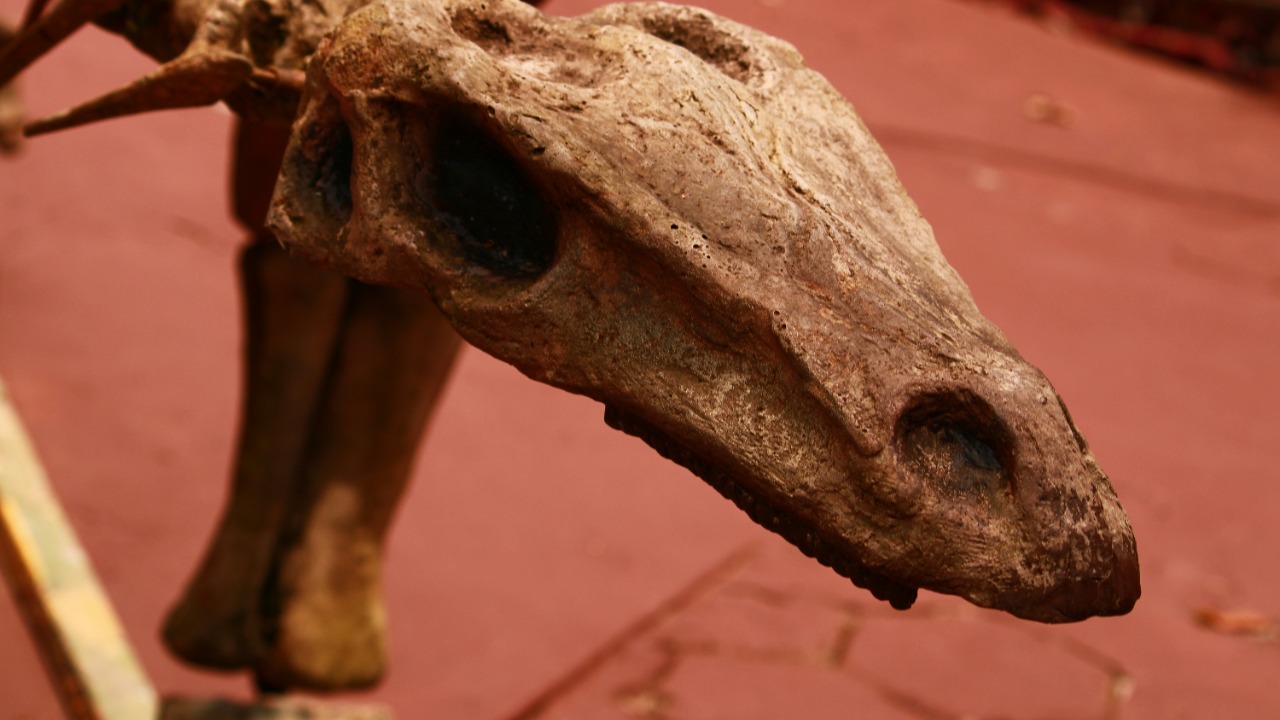

A single 4,000-year-old sheep bone, pulled from a windswept burial mound in Central Asia, is forcing scientists to rethink how one of history’s most feared diseases first spread. Instead of leaping straight from rodents to people, the earliest known plague may have quietly smoldered in livestock, reshaping the story of a prehistoric epidemic that shadowed the Bronze Age.
By tracing ancient DNA preserved inside that animal, researchers are now tying a specific strain of plague to the movements of herders, their flocks, and the trade routes they opened across continents. The find does not just add a new character to the cast of the Black Death’s distant ancestor, it offers a concrete clue to what fueled a Bronze Age plague that rippled from Europe into Asia and then vanished.
The sheep bone that changed the plague story
The turning point came from a fragment that might easily have been overlooked, a 4,000-year-old sheep bone recovered from a burial site near the border of what is now Kazakhstan. When researchers extracted genetic material from this modest relic, they found unmistakable traces of the plague bacterium, revealing that a domesticated animal, not a human, carried one of the earliest known infections linked to a prehistoric epidemic. The discovery connects a specific animal host to a disease that had long been reconstructed only from scattered human remains and genomic fragments.
Ancient DNA specialists decoded the pathogen’s genome from this 4,000-year-old specimen and showed that it belonged to a lineage active in the Bronze Age, a period when mobile herders and expanding trade networks were transforming Eurasia. The work, which identifies a domesticated sheep as a carrier of early plague, builds on evidence that a 4,000-year-old domesticated sheep unearthed at a Central Asian kurgan held a pathogen that later disappeared about 3,000 years afterward, tying livestock directly to a disease that once swept across the steppe and then faded from the record.
From mysterious epidemic to livestock-linked outbreak
For years, the Bronze Age plague was a puzzle, a genomic ghost glimpsed in human teeth and bones without a clear sense of how it moved so far or so fast. Archaeologists could see that a plague lineage had spread widely, but the mechanism remained speculative, with rodents and their parasites assumed to be the main culprits. The sheep bone changes that narrative by pointing to a domesticated herd animal as a plausible bridge between wild reservoirs and human communities, especially in societies where people, animals, and stored grain shared the same confined spaces.
Researchers now argue that this early plague lineage likely circulated in herding economies where Sheep were central to daily life, from meat and milk to wool and ritual sacrifice. By tying the pathogen to a specific animal, the study offers the first concrete evidence that livestock played a major role in this disease spillover, suggesting that the same animals that powered Bronze Age wealth and mobility also helped carry a deadly bacterium across long distances.
What the ancient genome reveals about Bronze Age Yersinia
The genetic blueprint recovered from the sheep bone shows that the culprit was an early form of the bacterium later known as Yersinia pestis, but with crucial differences from the strain that caused the medieval Black Death. When scientists reconstructed this Bronze Age Yersinia genome, they found that it lacked key adaptations that allow modern plague to spread efficiently through fleas, a detail that reshapes how the disease must have moved through ancient populations. Instead of explosive flea-borne outbreaks, the pathogen appears to have relied on more direct routes, such as contact with infected animals or their tissues.
Laboratory comparisons indicate that this prehistoric lineage sat on a different branch of the Yersinia family tree, one that never evolved the full suite of traits that later turned the Black Death into a fast-moving pandemic. The Cell study that sequenced this Bronze Age Yersinia genome from sheep shows how the pathogen’s evolution unfolded over millennia, highlighting a stage when it could infect mammals but had not yet become the flea-optimized killer that devastated medieval Europe.
Why fleas and rats were not yet driving the disease
Modern readers tend to picture plague as a story of rats and their parasites, with Fleas carrying the bacterium Yersinia pestis from rodent to rodent and eventually to humans. That model fits the Black Death, when flea-borne transmission from infected rats to people triggered waves of bubonic disease across cities and trade routes. In the Bronze Age, however, the newly sequenced strain appears to have been missing the genetic tools that make this flea cycle so efficient, which means the classic rat–flea–human chain was likely not the main driver of early outbreaks.
Genetic analyses of the ancient genome show that it could not be transmitted by fleas in the same way as later strains, making long-distance spread through rodent infestations alone difficult to explain. One report on this 4000-year-old discovery notes that Genetic studies show it could not be transmitted by fleas, forcing scientists to look instead at how herders, their animals, and their movements might have carried the bacterium across the landscape, with close contact at corrals, slaughter sites, and seasonal camps providing ample opportunities for infection.
How herders and their flocks could have fueled a Bronze Age plague
Once livestock enter the frame, the geography of the Bronze Age plague starts to make more sense. Mobile pastoralists moved their flocks across vast distances in search of pasture, linking river valleys, steppe corridors, and mountain passes into a web of seasonal routes. If a pathogen like early Yersinia pestis was circulating in sheep or other herd animals, every migration, trade caravan, or gift exchange could have doubled as a disease corridor, carrying infection from one community to another without relying on dense urban centers or shipborne rats.
The DNA Study that reveals a carrier of the world’s earliest-known plague in a 4,000-year-old domesticated sheep underscores how tightly human fortunes were tied to their animals. One account notes that One pathogen Hermes and his colleagues encountered in the remains of a 4,000-year-old domesticated sheep unearthed at a Central Asian burial mound likely moved between people and animals in both directions, with human-to-sheep and sheep-to-human transmission plausible in crowded camps where butchering, milking, and shelter all took place in close quarters.
A plague that spread from Europe into Asia, then vanished
The Bronze Age plague lineage identified in the sheep bone did not stay put. Genomic comparisons show that related strains appeared in human remains across a wide arc, from Europe into what is now modern-day Russia and onward into Central Asia, tracing a path that mirrors known migration and trade patterns. Scientists now think they may have solved how a plague mysteriously spread from Europe into Asia by tying it to livestock movements, rather than assuming a purely rodent-driven wave that somehow leapt across thousands of kilometers of varied terrain.
Yet this lineage did not survive into the era of the Black Death. The same reports that track its spread also note that the strain recovered from the 4,000 year old sheep eventually vanished about 3,000 years later, replaced by other branches of Yersinia pestis that had evolved more efficient flea-borne transmission. That rise and fall suggests a dynamic evolutionary landscape in which one plague lineage could dominate for centuries, only to be outcompeted by a more transmissible variant that would later fuel medieval pandemics.
Clues from Britain and beyond about how early plague behaved
The Central Asian sheep is not the only window into this ancient disease. In Britain, researchers have identified the oldest evidence of plague in the region, showing that the bacterium was already circulating there more than 4,000 years old, long before the medieval outbreaks that dominate popular memory. As one detailed account By James Ashworth explains, the pathogen’s presence in prehistoric Britain indicates that early Yersinia pestis was capable of reaching the far edges of Europe, even without the dense cities and maritime trade that later amplified its spread.
Those British finds, combined with the Central Asian sheep genome, suggest that the Bronze Age plague behaved differently from its medieval descendant. Instead of explosive urban epidemics, it may have produced more localized, sporadic outbreaks tied to specific communities, trade hubs, or herding routes. The pattern fits a pathogen that lacked full flea-borne efficiency but could still move with people and animals, occasionally flaring into deadly clusters before receding again into its animal reservoirs.
Why this is the “First Case Beyond Humans”
What makes the sheep bone so significant is not just its age but its status as the first confirmed non-human host of this early plague lineage. Previous ancient DNA work had focused heavily on human remains, reconstructing Yersinia pestis genomes from teeth and bones but leaving open the question of which animals, if any, were involved in maintaining the pathogen between human outbreaks. The new study, described as a 4,000-Year-Old Sheep Bone Shows Evidence of the Plague, a First Case Beyond Humans, finally anchors the disease in a specific animal host, proving that the bacterium infected livestock as well as people.
That confirmation matters because it validates long-standing suspicions that domesticated animals were not just passive victims but active participants in the ecology of early plague. The report invites readers to Learn how this First Case Beyond Humans reshapes our understanding of disease reservoirs, showing that herds could have served as both amplifiers and bridges, connecting wild rodent populations to human communities in ways that pure rodent models cannot fully explain.
Reconstructing the ancient outbreak in the lab
Behind the headlines about a 4,000-year-old sheep is a complex laboratory effort to coax fragile DNA from bone and then piece together a complete pathogen genome. Researchers had to distinguish genuine ancient sequences from modern contamination, align the fragments to known Yersinia pestis references, and then test which genes were present or missing. The resulting reconstruction, detailed in the Bronze Age Yersinia pestis genome from sheep study in Cell, allowed scientists to pinpoint the evolutionary stage of the bacterium and infer how it likely behaved in its ancient hosts.
Those lab results are what make it possible to say with confidence that the Bronze Age strain lacked the full flea-adapted toolkit of later pandemics. By mapping which virulence factors and transmission-related genes were absent, the team could argue that the disease probably spread through direct contact, bodily fluids, or perhaps respiratory droplets in close quarters, rather than through the classic flea bite route. That level of genomic resolution turns a single bone into a detailed case study of how a prehistoric pathogen functioned inside a living animal.
Rewriting the origin story of one of history’s deadliest diseases
For centuries, the origin story of plague has been told as a tale of rodents, fleas, and crowded medieval cities, with livestock playing at most a supporting role. The new evidence from the 4,000-year-old sheep forces a revision, placing domesticated animals at the center of the earliest known plague ecology. One analysis of this 4,000-year-old sheep offers first evidence linking livestock to Bronze Age plague, arguing that herding economies were not just backdrops but engines for the pathogen’s spread across Eurasia.
Another report on the same 4,000-year-old sheep offers first evidence linking livestock to Bronze Age plague emphasizes how the find connects archaeology, genetics, and anthropology, with teams from institutions such as the Max Planck Institute for Evolutionary Anthropology and Seoul National University collaborating to decode the ancient genome. Together, these studies suggest that the deep history of plague is inseparable from the story of domestication itself, in which the animals that sustained human societies also opened new pathways for deadly microbes.
What a 4,000-year-old sheep can teach us about future pandemics
The Bronze Age outbreak is long gone, but the dynamics it reveals are uncomfortably familiar. Today, most emerging infectious diseases still arise at the human–animal interface, where domesticated species, wildlife, and people interact in dense, rapidly changing environments. The case of the 4,000-year-old sheep shows that this pattern is not new, it is a deep-rooted feature of human history, stretching back to the earliest herding cultures that crisscrossed the Eurasian steppe. Understanding how a pathogen like early Yersinia pestis moved through those systems can sharpen our sense of how modern zoonoses might behave.
Contemporary researchers investigating how a 4,000-year-old sheep just helped solve one of history’s deadliest mysteries argue that tracing ancient spillovers can inform surveillance strategies today, highlighting which animal hosts and trade networks deserve the closest watch. As another analysis of how a Sheep Might Solve the Mystery of how the Bronze Age plague spread so widely points out, the key is not only the pathogen’s biology but also the social and economic systems that carry it. In that sense, the humble sheep bone from Central Asia is more than an archaeological curiosity, it is a warning that the same forces that once turned herds into vectors of plague still shape the way diseases move through our interconnected world.
More from MorningOverview