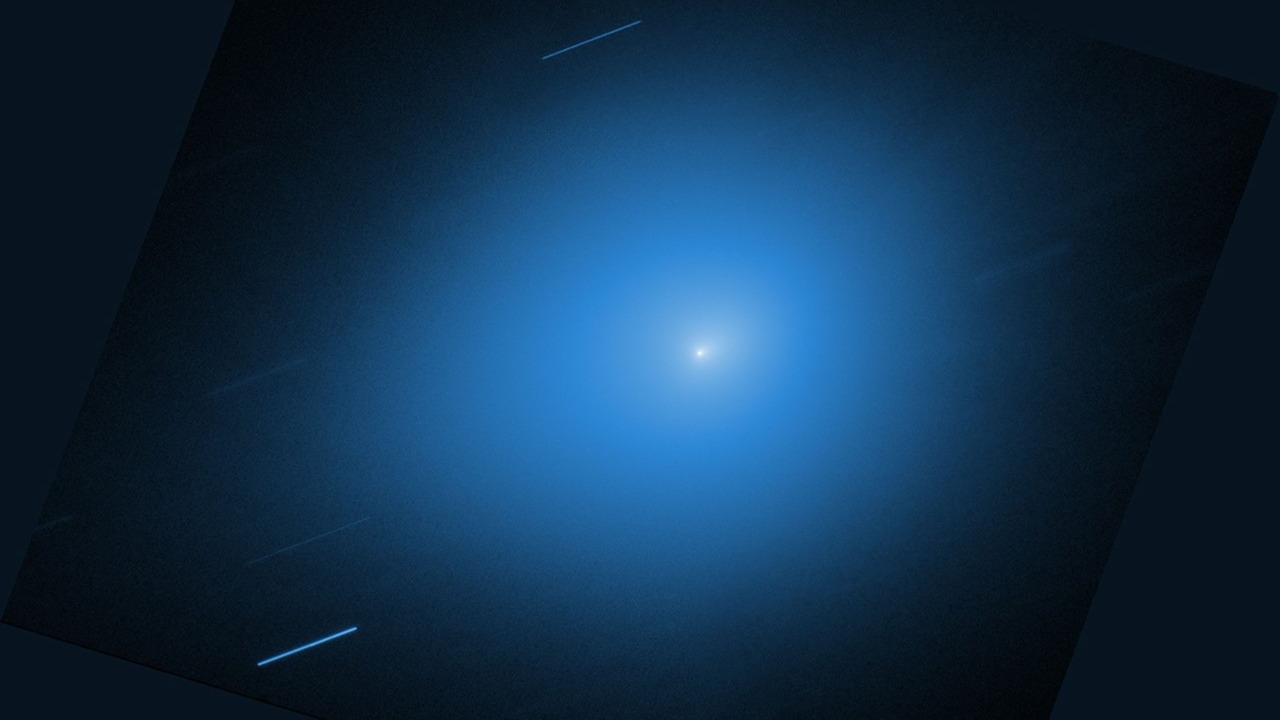

As the interstellar comet 3I/ATLAS sweeps past our planetary neighborhood, scientists say they have spotted a fresh and deeply puzzling anomaly in its behavior, adding a new twist to an object that was already testing the limits of current models. The discovery arrives just as 3I/ATLAS makes its closest pass by Earth, turning a rare flyby into a live experiment in how alien ice and rock behave under the glare of our Sun.
Instead of resolving the debate over what this visitor really is, the latest finding sharpens it, forcing researchers to weigh exotic explanations against the messy, volatile physics of comets that formed around another star. I see a pattern emerging: each new observation of 3I/ATLAS answers one question while opening two more, and the newest anomaly fits that pattern perfectly.
What makes 3I/ATLAS so unusual in the first place
To understand why a fresh irregularity around 3I/ATLAS matters, it helps to remember how rare the object is. According to NASA’s own Quick Facts, this is the third known object to pass through our solar system from interstellar space, following 1I/ʻOumuamua and 2I/Borisov. That alone makes Comet 3I/ATLAS a once in a generation laboratory for testing how material forged around distant stars behaves when it dives toward the Sun.
Researchers have already confirmed that Comet 3I/ATLAS is on a one way trajectory that will carry it through the inner solar system and then fling it back into interstellar space, never to return. NASA’s Stats emphasize that this interstellar object is not a threat to Earth, and that its path is being tracked precisely to keep our skies safe. That combination of rarity, safety and accessibility is why every new quirk in its behavior is being scrutinized so intensely.
A close pass by Earth raises the stakes
The timing of the latest anomaly is not an accident. The interstellar comet 3I/ATLAS is making its closest approach to Earth on a Friday in Dec, a flyby that has been anticipated for months by observatories around the world. Coverage of where 3I/ATLAS is right now notes that scientists expect the object to swing past Earth and then head back into interstellar space, making this week the best and only window to catch its strangest behavior in high resolution.
Live coverage of the flyby has underscored how completely 3I/ATLAS has dominated the skywatching agenda as it nears its closest pass. Reports tracking the encounter explain that 3I/ATLAS has taken over the observing schedules of professional and amateur astronomers alike, since once it leaves our solar system for good there will be no second chance to study it up close Here. That intensity of attention is exactly what allowed scientists to spot the new irregularity in its motion and emissions.
The earlier anomalies that set the stage
Even before this week’s finding, 3I/ATLAS had built a reputation as a troublemaker for standard comet theory. One of the first surprises was a strange protrusion seen as the object approached Earth, a feature that did not fit neatly into the usual picture of a smooth coma and tail. In coverage of that discovery, Pennsylvania State University astronomer Jason Wright, writing in a blog post, initially described the overall behavior as “Nothing really shocking there,” but the same reporting highlighted that the protrusion could be a fragment or jet being broken off the main body of 3I/ATLAS 3I/ATLAS Showing Strange Protrusion. That tension between routine comet physics and oddly specific structures has hovered over the object ever since.
At the same time, a separate line of work focused on the chemistry of the material streaming off the comet. Reporting on a major early result described how Scientists Make Surprising 3I/ATLAS Discovery, But It’s Not Aliens, emphasizing that 31/Atlas is a mysterious object that has sparked speculation but is now known to be shedding some of the most unusual chemical products reported to date Scientists Make Surprising. Those early anomalies, structural and chemical, primed the community to treat any fresh oddity not as a fluke but as another clue to how this interstellar body is put together.
The new “spin cycle” anomaly
The latest twist is all about how 3I/ATLAS is rotating. Scientists now say they have found another anomaly in the way the comet spins, a pattern that does not match the simple tumbling or steady rotation expected from a natural chunk of ice and rock. Reporting on this finding describes a “Spin Cycle” effect, in which the object’s rotation appears to be changing in a way that lines up with the orbital periods of planets in a striking coincidence, suggesting that something about its spin state is out of the ordinary Scientists Say They.
On its face, a weird rotation might sound like a minor technical detail, but for comet scientists it is a central diagnostic. The way a comet spins tells researchers how jets of gas are venting from its surface, how its mass is distributed and whether it has been torqued by past encounters. When that spin behavior itself becomes anomalous, as in this new “Found Another Anomaly About ATLAS” result, it suggests that the internal structure or outgassing pattern of 3I/ATLAS is unlike what has been cataloged in comets that formed in the solar system. That is why this new irregularity is being treated as a genuine puzzle rather than a rounding error.
How Avi Loeb’s spacecraft idea fueled the debate
The discovery of a fresh spin anomaly lands in a conversation already shaped by one of the most controversial voices in astrophysics. Earlier this year, a high profile Harvard astrophysicist, Dr. Avi Loeb, argued that 3I/ATLAS might not be a comet at all, but an alien spacecraft passing through our neighborhood with an unknown mission. A detailed analysis of that claim from the Center for an Informed Public at the University of Washington describes how Harvard astrophysicist Avi Loeb’s speculation helped turn 3I/ATLAS into a viral “alien spaceship” story online, long before the latest spin data arrived.
Loeb has not limited himself to broad speculation. In a separate essay, he laid out Nine Reasons This Scientist Is Suspicious the Object Screaming Past the Sun Is a City Sized Alien Spacecraft, arguing that Its Trajectory, reflectivity and other properties could be better explained by an artificial origin than by a natural comet. That piece even raised the possibility of industrially produced nickel alloys as part of the object’s makeup, a claim that has been widely challenged by other astronomers Nine Reasons This Scientist Is Suspicious the Object Screaming Past the Sun Is. The new spin anomaly inevitably feeds into that narrative, even as most researchers continue to look first for natural explanations.
Why many astronomers still see a natural comet
For every new irregularity that seems to support exotic ideas, there has been a counter argument from scientists who study comets for a living. Jason Wright, the Pennsylvania State University astronomer who initially said there was “Nothing really shocking there” about 3I/ATLAS’s early behavior, has been one of the most prominent voices pushing back on claims of artificial origin. In a detailed breakdown titled Loeb’s 3I/ATLAS “Anomalies” Explained, he argues that each of the supposed anomalies can be understood as the normal behavior of comets as they heat up and shed material, without invoking alien engineering Loeb.
That skeptical view is reinforced by the broader context of how 3I/ATLAS is being studied. NASA’s own early briefing on the object, summarized in a report on four key things just revealed about the interstellar comet, framed it as a rare window into how comets form in other solar systems. In that account, NASA officials described 3I/ATLAS as a natural interstellar comet whose unusual properties are precisely what make it scientifically valuable, not evidence of a City Sized Alien Spacecraft Last. From that perspective, the new spin cycle anomaly is another data point in a complex natural system rather than a smoking gun.
The X-ray glow that deepened the mystery
The spin behavior is not the only fresh irregularity to emerge as 3I/ATLAS nears Earth. Earlier this month, X-ray observatories reported that the comet was emanating unusual X-rays, a signal that immediately raised questions about what kind of interaction was taking place between its gas cloud and the solar wind. A detailed breakdown of those findings explains that XRISM observations revealed a wide X-ray glow extending nearly 250,000 miles around the comet, forming a diffuse cloud of gas that marked the first confirmed detection of this kind of emission from an interstellar comet Here.
Crucially, that same analysis stressed that the X-ray anomaly could be explained by known processes, such as charge exchange between highly ionized solar wind particles and neutral atoms in the comet’s coma. In other words, the glow was unusual because 3I/ATLAS is the first interstellar comet bright enough and close enough for this effect to be seen so clearly, not because it required exotic physics. When combined with the new spin cycle behavior, the X-ray data paint a picture of a comet that is extreme but still operating within the bounds of natural cometary science.
How the public conversation veered toward aliens
While scientists have been busy parsing spin states and X-ray spectra, the public conversation around 3I/ATLAS has often taken a very different path. The Center for an Informed Public’s analysis of how 3I/ATLAS was turned into a spaceship online traces how social media amplified Dr. Avi Loeb’s speculation into a full blown narrative that the comet was an alien craft. That report notes that a high profile Harvard astrophysicist, Avi Loeb, speculated that 3I/ATLAS might be an alien spacecraft visiting our neighborhood with an unknown mission, and that this framing quickly spread far beyond the original scientific context Avi Loeb.
Local and national news coverage has had to navigate that tension between viral speculation and sober reporting. One account from Michigan, for example, framed the flyby under the headline that an Intersteller comet is making its closest approach this week and asked What to know, emphasizing that 3I/Atlas is a rare interstellar object that has sparked spaceship rumors but is being treated by NASA as a natural comet as Atlas makes its closest approach Intersteller. The new spin anomaly is arriving in a media environment already primed to see every deviation from the norm as potential evidence for or against the alien hypothesis.
What scientists hope to learn from the spin anomaly
Inside research teams, the focus is less on proving or disproving alien spacecraft theories and more on what the spin behavior can reveal about how 3I/ATLAS formed. If the rotation is changing in response to jets of gas venting from specific regions, that pattern can map out where volatile ices are concentrated on the surface and how the comet’s interior is layered. NASA’s early briefing on 3I/ATLAS, summarized in the four key things report, described the object as a rare window into how comets form in other solar systems, and the new spin data sharpen that window by turning the entire comet into a kind of three dimensional seismograph for its own internal structure NASA.
There is also a practical payoff. By comparing the spin cycle of 3I/ATLAS with that of comets that formed in the solar system, researchers can test whether our local comets are typical or unusual in a galactic context. NASA’s Dec Quick Facts page already frames 3I/ATLAS as a benchmark for understanding interstellar visitors, and the new anomaly adds another dimension to that benchmark. If the spin behavior turns out to be common among interstellar comets, it could reshape how scientists model the early stages of planet formation around other stars.
Why the story of 3I/ATLAS is not finished yet
The most striking thing about 3I/ATLAS is how quickly the narrative around it keeps evolving. Earlier coverage of its chemical oddities stressed that Scientists Make Surprising ATLAS Discovery, But It’s Not Aliens, and that 31/Atlas is a mysterious object whose unusual chemical products are still being cataloged Discovery. The new spin cycle anomaly slots into that same pattern: a fresh surprise that deepens the mystery without overturning the basic conclusion that we are looking at a comet, not a City Sized Alien Spacecraft.
As 3I/ATLAS completes its closest pass and begins the long journey back into interstellar space, the data gathered this week will be pored over for years. Reports tracking where 3I/ATLAS is now emphasize that ATLAS has dominated the observing agenda as it nears Earth, precisely because once it leaves, the only thing left will be the measurements and the models built on top of them ATLAS. The new anomaly in its spin is not the final word on this interstellar visitor, but it is a reminder that when a comet arrives from another star, even the most basic properties, like how it turns, can defy expectations.
More from MorningOverview