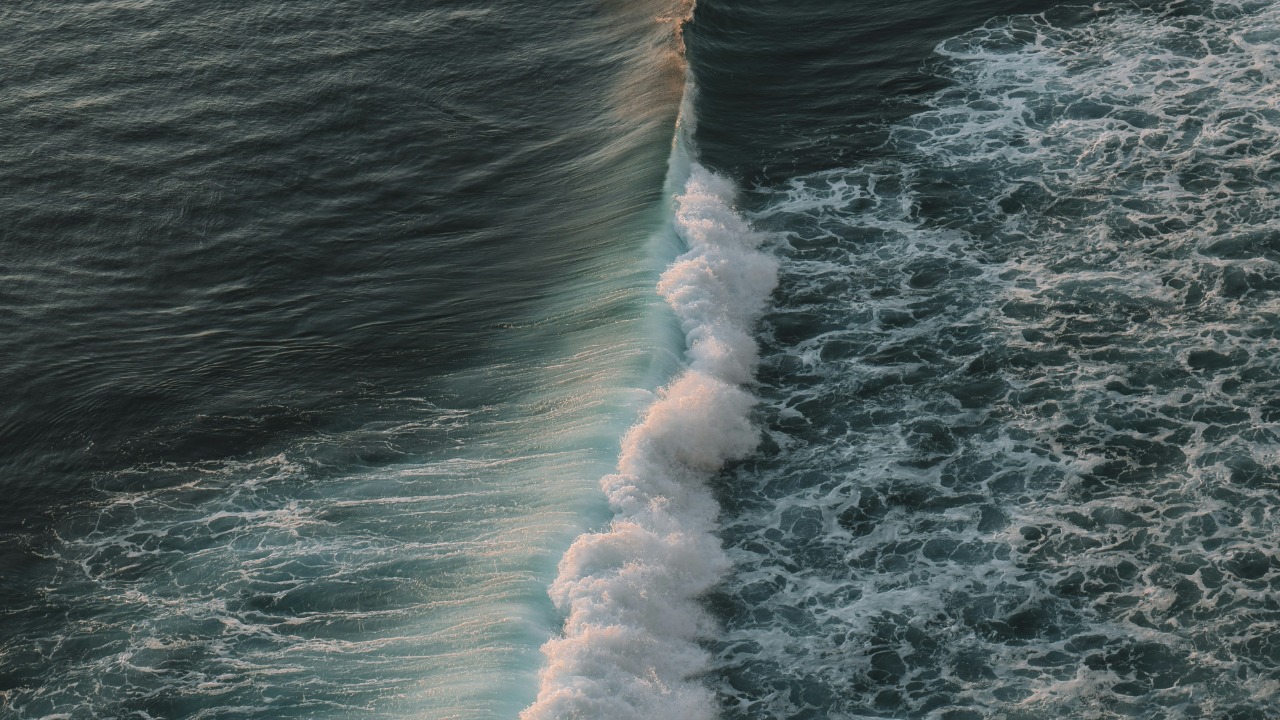

Where freshwater rivers spill into salty seas, nature is constantly balancing chemical differences that quietly release energy. Scientists are learning how to tap that invisible power gradient, turning the meeting point of rivers and oceans into a new kind of renewable generator that runs whenever water flows. I see this frontier, often called “blue energy,” moving from lab experiments to early infrastructure, with engineers racing to turn a subtle natural process into a dependable power source.
The overlooked energy where fresh and saltwater collide
Every time river water mixes with seawater, the two solutions try to equalize their salt content, and that mixing process carries a measurable energy punch. Instead of burning fuel or catching wind, blue energy technologies aim to capture the work done as ions move from low salinity to high salinity environments, a gradient that exists at virtually every estuary on Earth. The physics is straightforward: dissolved salts split into charged particles, and when those particles migrate across a boundary between fresh and salty water, they can be guided through devices that convert their motion into electricity.
What makes this resource so compelling is its consistency. Unlike solar panels that dim under clouds or wind turbines that stall on calm days, river mouths keep delivering fresh water to the sea, day and night, in wet years and dry ones. The salinity difference between river and ocean does not depend on weather in the same way that sunlight and wind do, which gives blue energy the potential to provide a stable baseline of power that complements more variable renewables. For coastal regions already shaped by their rivers, the idea of drawing electricity from the same mixing zones that support fisheries and shipping is starting to look less like a curiosity and more like a strategic asset.
From concept to coast: Japan’s Fukuoka plant as a test case
The clearest sign that this technology is leaving the lab is on the shoreline of Japan, where a national pilot is now feeding power into real infrastructure. In the city of Fukuoka, engineers have built what is described as the first national osmotic plant, a facility that uses the salinity difference between incoming river water and the nearby sea to generate electricity. The project is not just a proof of concept tucked away in a research park, it is tied directly to local water management, showing how blue energy can be woven into existing coastal systems.
According to technical descriptions of the project, the Fukuoka installation began operating on Aug 5, 2025, with an expected annual output of 880,000 kWh per year that will support a desalination facility. That figure is modest compared with a large fossil fuel plant, but it is significant for a compact system that can sit near existing water infrastructure and operate whenever river and seawater are available. The fact that this plant is framed as a national project in Japan, rather than a one-off demonstration, signals that policymakers see osmotic power as a serious candidate for future energy portfolios, not just a scientific curiosity.
How membranes turn salt gradients into electricity
At the heart of many blue energy systems are specialized membranes that control how ions move between fresh and salty water. One approach uses ion-selective barriers that allow either positively charged or negatively charged particles to pass, but not both, creating a voltage difference that can be harvested. Researchers working with Ion-exchange membranes emphasize that these materials do not require bulk water to flow through them, which sharply reduces the fouling that plagues traditional filtration systems and keeps maintenance demands lower.
In practice, stacks of these membranes are arranged in alternating layers, with channels of river water and seawater flowing side by side. As ions move through the Ion-exchange membranes, they create an electrochemical potential that can be tapped in an external circuit, much like a battery that is constantly recharged by the natural mixing of the two waters. Because the membranes themselves are solid and only the ions migrate, the system avoids the high pressures and mechanical wear associated with conventional desalination, making it better suited to long-term operation at estuaries where reliability is as important as raw output.
Pressure-based systems and the limits of nonrenewable energy
Another major branch of blue energy technology relies on pressure rather than direct ion transport, using the natural tendency of water to move across a semi-permeable barrier from low to high salinity. In pressure retarded osmosis, often shortened to PRO, freshwater is drawn through a membrane into a salty solution, increasing the volume and pressure on one side. That pressure can then be used to drive a turbine, converting the osmotic flow into mechanical work and, ultimately, electricity. Engineers see this as a way to harness the same physics that underpins desalination, but in reverse, turning a process that usually consumes energy into one that produces it.
Researchers studying these systems frame them against a backdrop of finite fossil resources, noting that Nonrenewable energy sources, as they are currently employed, are quite likely to go extinct very soon. Within that context, Pressure retarded osmosis and related methods such as reverse electrodialysis are presented as promising alternatives that can operate wherever fresh and saltwater meet. The challenge is to refine membranes and system designs so that they deliver meaningful power without excessive losses, a task that has pushed researchers to explore new materials and configurations that can withstand years of exposure to complex natural waters.
Nanoporous electrodes and the rise of capacitive mixing
Beyond membranes and pressure-driven systems, a newer class of devices treats salinity gradients as a way to charge and discharge electrodes, much like a supercapacitor that runs on saltwater. In these setups, water with different salt concentrations is alternately flushed through channels that contain porous conductive materials, and the changing ion content shifts the electrical charge stored on the surfaces. By cycling between high and low salinity streams, the system can generate a flow of electrons in an external circuit, effectively turning the act of Mixing solutions into a power source.
Researchers working on this approach focus heavily on nanoporous electrodes with surface functionalisation, tailoring the chemistry of the pores so they attract or repel specific ions more efficiently. That fine control over ion behavior can boost the amount of energy extracted per cycle and reduce losses that would otherwise erode performance. Because capacitive mixing does not rely on high pressures or large moving parts, it offers a potentially compact and modular way to harvest blue energy in places where building large membrane stacks or turbines would be impractical, such as along industrial outfalls or in urban estuaries with limited space.
Salinity gradient energy in the lab: from abstract to application
In the laboratory, scientists often refer to this resource as salinity gradient energy, or SGE, and they treat it as a distinct category within the broader renewable landscape. Experimental setups typically combine carefully controlled streams of river-like and seawater-like solutions, then measure how much power can be drawn as they mix across different devices. One recent study framed its Abstract around the idea that Salinity gradient induced blue energy generation using two complementary materials can significantly improve SGE harvesting, highlighting how material science is now central to progress.
By focusing on the microscopic interactions between ions and surfaces, researchers are finding ways to squeeze more electricity out of each unit of water that passes through their systems. The same work underscores that SGE, known as blue energy, is harvested from mixing seawater with river water in controlled environments that mimic real estuaries. As these experiments move from benchtop cells to pilot-scale rigs, the gap between theoretical potential and practical output is narrowing, giving policymakers and investors more confidence that the physics can be translated into infrastructure that matters at the grid level.
Why estuaries could anchor coastal energy security
For coastal communities, the appeal of blue energy is not just its novelty but its fit with existing vulnerabilities. Many of the world’s largest cities sit at river mouths, where they already manage complex interactions between freshwater supplies, tidal dynamics, and industrial activity. Adding salinity gradient systems to that mix could provide a local, predictable source of electricity that reduces dependence on imported fuels and buffers the grid against shocks. Because the resource is tied to geography rather than weather, it offers a different kind of resilience than solar rooftops or offshore wind farms.
In practice, that might mean colocating osmotic plants with desalination facilities, as in Fukuoka, so that the same intake and discharge structures serve both water treatment and power generation. It could also involve integrating blue energy modules into flood control barriers or port infrastructure, turning passive concrete into active energy assets. The key is that estuaries already concentrate engineering attention and investment, which makes them natural candidates for early deployments. If these systems prove reliable and cost effective, they could become a standard feature of coastal planning, much like wastewater treatment plants or seawalls.
The engineering hurdles still standing in the way
Despite the promise, the path from pilot plants to widespread adoption is crowded with technical and economic obstacles. Membranes that perform well in the lab can degrade quickly in real estuaries, where biofilms, suspended sediments, and fluctuating temperatures conspire to clog pores and reduce ion transport. Even Ion-exchange membranes that resist fouling better than traditional filters still face gradual performance losses that must be managed through cleaning regimes or periodic replacement, both of which add cost. Pressure-based systems, meanwhile, must balance the osmotic pressure they can safely exploit against the mechanical limits of turbines and pipes.
On top of those physical challenges, blue energy technologies compete in a market where solar and wind costs have fallen sharply and storage options like lithium-ion batteries are maturing. To gain a foothold, osmotic and capacitive systems need to demonstrate not only technical feasibility but also compelling economics over their full life cycle. That means improving membrane durability, boosting energy density in nanoporous electrodes, and designing modular units that can be manufactured and installed at scale. It also means proving that integration with existing infrastructure, such as desalination plants or wastewater outfalls, can offset some of the upfront expense by sharing facilities and maintenance teams.
From niche experiments to a pillar of the clean energy mix
As I look across the emerging projects and research, I see blue energy moving through the same phases that solar and wind once did, from niche experiments to targeted pilots and, eventually, to mainstream options in specific geographies. The Fukuoka plant, with its 880,000 kWh per year output and direct link to desalination, is an early example of how salinity gradients can be folded into real-world systems rather than treated as isolated curiosities. Laboratory advances in Ion-exchange membranes, Pressure retarded osmosis, and capacitive mixing with nanoporous electrodes are steadily raising the ceiling on what these technologies can deliver.
If those trends continue, the places where rivers meet the sea could become quiet engines of the energy transition, supplying steady power that complements the peaks and valleys of sun and wind. The resource is not a silver bullet, and it will not replace Nonrenewable fuels on its own, but it adds another tool to the kit at a time when every reliable, low carbon option matters. For coastal nations that already live at the edge of fresh and saltwater, the idea that their estuaries might help keep the lights on is no longer speculative. It is starting to look like a practical way to turn a constant, natural mixing process into a new pillar of the clean energy mix.
More from MorningOverview