
The discovery of a carved stone in ancient Magdala has given archaeologists a rare, almost cinematic glimpse into how Jews in the Second Temple period may have pictured the sacred menorah in Jerusalem. At roughly 2,000 years old, the block’s intricate imagery is now being hailed as the earliest known depiction of the seven-branched lampstand that once stood in the Temple itself. For historians of Judaism and early Christianity alike, the stone is not just an artifact, but a visual bridge between text, ritual and the lived religious world of the first century.
As I trace the story of this object from excavation trench to museum display, what stands out is how much meaning has been carved into a single block of limestone. The Magdala stone compresses geography, theology and memory into a compact three-dimensional model, inviting fresh debate over how Jews outside Jerusalem imagined the holiest site in their world and how that vision survived the trauma of the Temple’s destruction.
Unearthing a carved mystery in Magdala
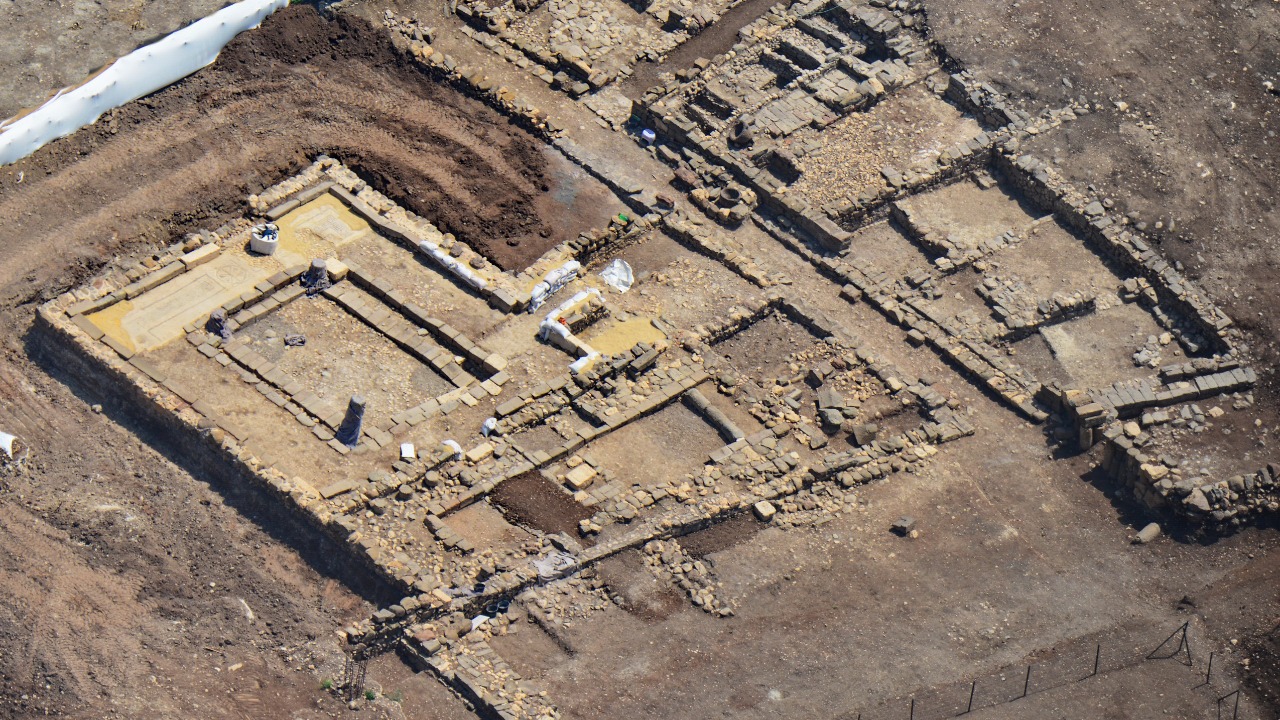
The stone at the center of this debate surfaced not in Jerusalem, but in the ruins of a synagogue on the shore of the Sea of Galilee. Archaeologists uncovered the block during excavations at Magdala, a town in northern Israel, where they were exploring the remains of a first century prayer hall now known as the Migdal Synagogue. The find quickly became known as the Magdala stone, a carved centerpiece that appears to have been deliberately placed within the synagogue’s main space, suggesting it played a central role in the community’s religious life and visual imagination of the Temple.
Scholars describe the Magdala stone as a carved stone block, rectangular in shape, with reliefs on multiple sides that reference sacred objects and spaces associated with Jerusalem. The stone was uncovered during systematic excavations at the Migdal Synagogue in Israel, and its significance was recognized almost immediately, to the point that the artifact has since been displayed in institutions such as the Jewish Museum of Rome, underscoring how quickly it moved from local discovery to international symbol of early Jewish art. The very fact that such a richly decorated object sat Inside a Synagogue that is counted among the oldest ever found in Israel has only intensified interest in what its images are trying to say.
A 2,000-year-old image of the Temple menorah
The most arresting feature of the Magdala stone is a relief that many experts identify as a seven-branched menorah, carved in a way that suggests the artist was thinking specifically of the lampstand in the Jerusalem Temple. On one face of the block, a central shaft rises from a base, flanked by three branches on each side, forming the familiar seven-branch pattern that has come to define Jewish ritual iconography. The proportions and placement of this carving, combined with other Temple-related motifs on the stone, have led researchers to argue that this is not a generic lamp, but a deliberate attempt to represent the Temple menorah itself.
What makes this carving extraordinary is its age. Based on the archaeological context of the Migdal Synagogue and associated pottery, the stone is dated to the late Second Temple period, making it roughly a 2,000-year-old artifact. That timeframe places the carving before the Roman destruction of the Temple, which is why some specialists now describe it as the world’s oldest known depiction of a menorah. One detailed analysis of the Magdala stone’s iconography argues that the discovery of a carved seven-branch menorah ever found in such an early context fundamentally reshapes how we understand Jewish visual culture in the decades when the Temple still stood in Jerusalem.
From Galilee to Jerusalem: a local window on the Jerusalem Temple
Although the stone was found in Galilee, its imagery is saturated with references to the Jerusalem Temple, suggesting that worshippers in Magdala oriented their spiritual lives toward the capital’s sanctuary. The front of the Magdala stone has been interpreted as a kind of micro-architecture, with carved elements that evoke the entrance to the Temple, columns and perhaps even the curtain that separated sacred spaces. One influential reading proposes that the stone was designed so that a worshipper standing in the Migdal Synagogue would feel as though they were looking into, or even entering, the Jerusalem Temple itself, despite being physically distant from it.
In this view, the Magdala stone becomes more than decoration, it functions as a three-dimensional map of the Jerusalem Temple, compressing its key symbols into a portable, local focus of devotion. A detailed study of the carved block describes how its front face may represent the façade of the Jerusalem Temple, while other sides show ritual objects associated with the inner sanctuary, effectively turning the stone into a miniature Temple that could be approached and contemplated by the Jewish community in Magdala. By embodying the Jerusalem Temple in this way, the stone allowed worshippers to align their prayers with the rhythms of the capital’s sacrificial cult without ever leaving Galilee.
The Migdal Synagogue and one of Israel’s oldest prayer halls
The context in which the Magdala stone was found is as important as the object itself. The Migdal Synagogue, sometimes referred to as The Migdal Synagogue or Magdala Synagogue, is an ancient Jewish prayer hall discovered at the site of the old town of Magdala on the western shore of the Sea of Galilee. Archaeologists date the building to the Second Temple period, which means it was in use at the same time as the Temple in Jerusalem, making it one of the earliest known synagogues in the region and a crucial piece of evidence for how Jews gathered for communal worship outside the capital.
Within this synagogue, the Magdala stone appears to have occupied a prominent position, possibly near the center of the main hall where worshippers would have seen it during readings and prayers. The Migdal Synagogue’s own documentation highlights a Menorah image as a key feature of the site, noting that the Magdala stone is a carved block whose reliefs likely reference the menorah that stood in the Temple in Jerusalem. The combination of an early synagogue, a carved representation of the Temple menorah and other sacred motifs in a single building gives historians a rare, integrated snapshot of Jewish religious life in Galilee during the final decades of the Second Temple era.
Magdala, hometown of Mary Magdalene and crossroads of faiths
The town that yielded this stone is already familiar to many readers from the New Testament. Magdala is often referred to as the Hometown of Mary Magdalene, the woman remembered in Christian tradition as a close follower of Jesus. The archaeological site sits on the western shore of the Sea of Galilee, where ancient streets, markets and ritual baths have been uncovered, painting a picture of a bustling Jewish town that also sits at the intersection of Jewish and early Christian memory. For Christian pilgrims, Magdala has become a place to connect the Gospel narratives with the physical landscape of first century Galilee.
Modern guides to the site emphasize how Magdala’s layered significance draws both Jewish and Christian visitors. One detailed overview describes Magdala as the Hometown of Mary Magdalene and highlights the Magdala Stone as an enigmatic stone that fascinates both scholars and women and men of Christian faith, precisely because it links the Jewish synagogue world of Jesus’s time with the later Christian veneration of Mary Magdalene. In this sense, the carved block is not only a Jewish artifact, but also a touchstone for interfaith reflection on how both traditions remember the same landscape and era.
The Temple menorah: from sanctuary lamp to enduring symbol
To grasp why a carved menorah on a synagogue stone matters so much, it helps to recall the central place of the lampstand in Temple ritual. The Temple menorah was a seven-branched lamp made of pure gold, described in biblical texts as standing in the sanctuary of the Jerusalem Temple and kept perpetually lit. Its design, with a central shaft and three branches on each side, became one of the most recognizable symbols of Jewish worship, representing both divine light and the covenant between God and Israel. For Jews living in the Second Temple period, the menorah was not an abstract emblem, but a real object burning in a real building in Jerusalem.
Archaeological and textual studies of the Temple menorah trace its fate after the Roman destruction of the Second Temple, when the lampstand was carried away as part of the spoils of the destroyed temple. A detailed overview of the Temple menorah notes that following the Roman destruction of the sanctuary, the menorah was depicted among the spoils of the destroyed temple on the Arch of Titus in Rome, a visual record that has long shaped modern reconstructions of its appearance. The Magdala stone, however, offers a different kind of evidence, a local Galilean artist’s attempt to carve the menorah as it was imagined while the Temple still stood, potentially predating the Roman triumphal imagery by decades.
Why scholars call this the earliest carved menorah
The claim that the Magdala stone preserves the earliest known carved menorah rests on a combination of dating, context and comparison with other artifacts. The synagogue in which it was found is securely dated to the late Second Temple period, and the stone itself was discovered in situ within that building, which means the carving must predate the Temple’s destruction. When researchers compare this 2,000-year-old carving to later depictions, such as those on the Arch of Titus or in post-destruction synagogue mosaics, they find that the Magdala menorah stands out as the oldest representation of a seven-branched menorah ever found in a Jewish ritual context.
One comprehensive overview of the site underscores that Inside this Synagogue, one of the oldest ever found in Israel, was a large carved stone block that became known as the Magdala Sto and that this object contains what is widely regarded as the oldest representation of a menorah ever found. Another detailed report on the Magdala stone’s imagery notes that the long sides of the block carry additional Temple-related motifs and that the discovery of a carved seven-branch menorah ever found in such an early synagogue setting has led specialists to describe it as the world’s oldest known depiction of a menorah. Taken together, these assessments explain why the stone has moved so quickly from excavation report to headline artifact in discussions of early Jewish art.
Reading the stone: a carved map of sacred space
When I look at the scholarly reconstructions of the Magdala stone, what strikes me is how deliberately the artist seems to have organized the imagery. The front face, with its menorah and architectural motifs, appears to be the focal point, while the long sides carry additional symbols that may represent Temple furniture, altars or even the showbread table. This arrangement suggests that the stone was meant to be approached from specific angles, inviting worshippers to move around it and, in effect, to walk through a carved map of sacred space. The reliefs are not random decorations, but a structured visual theology carved into limestone.
One in-depth analysis of the Magdala stone’s iconography describes how the front of the Magdala block depicts symbols of the Jerusalem Temple in a way that allows a viewer to feel as though they are approaching the sanctuary, though entering the Temple itself remained restricted in reality. The same study notes that the carved surfaces may have been painted originally, which would have made the menorah and other motifs even more vivid to first century eyes. By compressing the Jerusalem Temple into a portable, carved object, the stone gave the Jewish community in Magdala a tangible focus for their prayers and a way to visualize the holiest site in their religious universe without leaving Galilee.
From excavation trench to global icon
Since its discovery, the Magdala stone has traveled far beyond the confines of its original synagogue, both physically and in the scholarly imagination. Conservators and curators have treated it as a key artifact for exhibitions on early Judaism, and it has been loaned to institutions such as the Jewish Museum of Rome, where visitors encounter it as a centerpiece of displays on the Second Temple period. The stone’s journey from a buried block in a Galilean floor to a glass case in a European museum mirrors the broader trajectory of Jewish history, from local worship in Magdala to global diaspora memory.
Specialist reports on the artifact emphasize that the Magdala stone is not only a rare example of early synagogue art, but also a crucial witness to how Jews outside Jerusalem visualized the Temple and its menorah. One detailed archaeological overview notes that the stone was uncovered during excavations at the Migdal Synagogue in Israel and that its carved reliefs have since been central to debates about the development of synagogue worship and the use of images in Jewish religious spaces. As further studies appear, including technical analyses of the carving techniques and any remaining pigment, the stone’s status as a 2,000-year-old visual testimony to the Temple menorah is likely to become even more firmly entrenched in both academic literature and public consciousness.
A Galilean stone that reshapes the story of Jewish art
For historians of religion, the Magdala stone forces a reconsideration of long-held assumptions about how and when Jews began to depict their holiest objects. Earlier scholarship often suggested that Jews avoided visual representations of sacred items like the menorah until after the Temple’s destruction, when memory and mourning encouraged new forms of symbolic art. The presence of a carefully carved menorah in a functioning Second Temple period synagogue in Magdala complicates that narrative, showing that at least some Jewish communities were already comfortable placing such imagery at the heart of their worship spaces.
Detailed coverage of the Magdala discovery, including reports that describe the artifact as a 2,000-year-old carving from Jerusalem in terms of its iconographic focus, underline how this single stone has become a reference point for discussions of early Jewish visual culture. One widely cited account of the find notes that the Magdala stone’s menorah is now regarded as the world’s oldest known depiction of a menorah and that its discovery has prompted fresh comparisons with later images, such as those on the Arch of Titus. By anchoring debates about Jewish art in a specific, datable object from a known synagogue, the Magdala stone gives scholars a firmer foundation for tracing how the menorah moved from Temple lamp to enduring symbol of Jewish identity.
Why this ancient carving still matters today
Standing in front of the Magdala stone today, whether in a museum or at the reconstructed site in Galilee, I am struck by how much is condensed into its weathered surfaces. The carved menorah is not only a window into the ritual life of a first century Jewish community, it is also a reminder of how deeply the Jerusalem Temple shaped the imagination of Jews living far from its courts. For Christians who visit Magdala as the Hometown of Mary Magdalene, the stone adds another layer, linking the synagogue world of Jesus’s contemporaries with the later Christian memory of his followers.
Modern guides and archaeological summaries of Magdala highlight how the Magdala Stone has become a focal point for both scholarly debate and spiritual reflection, described as an enigmatic stone that continues to fascinate visitors from around the world. A detailed virtual library entry on the artifact underscores that Inside this Synagogue, one of the oldest ever found in Israel, the discovery of the Magdala Sto with its oldest representation of a menorah ever found has reshaped how we talk about Jewish art, worship and identity in the Second Temple period. In that sense, the stone’s power lies not only in what it shows about the past, but in how it continues to illuminate the ongoing conversation about what it means to remember, represent and reimagine the sacred.
More from MorningOverview