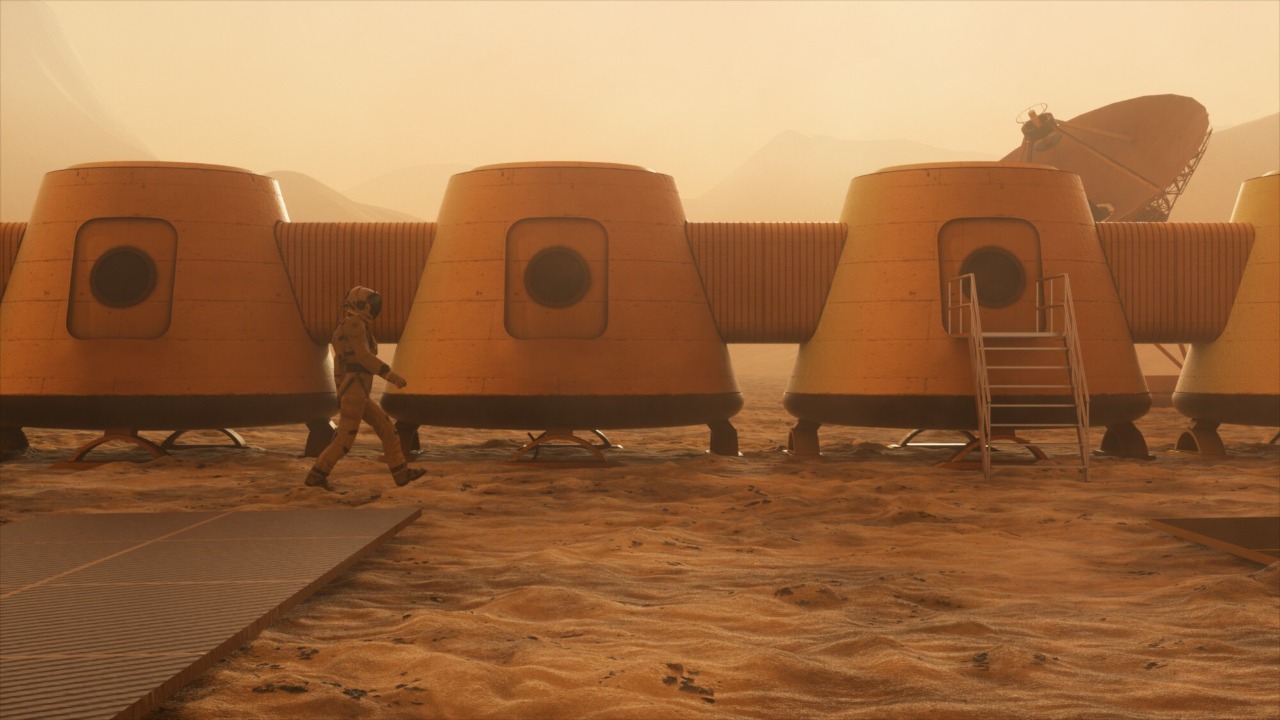

Mars planners are increasingly treating ice not just as a resource to drink or split for rocket fuel, but as a structural material that could shape the first real neighborhoods on another world. Instead of burying metal cans in regolith, architects and engineers are sketching translucent domes and vaulted shells that use frozen water as both shield and shelter, turning a liability of the Martian cold into an asset.
The idea is simple to state and complex to execute: harvest local ice, print it into thick walls, and let that frozen shell handle radiation, pressure, and even mental health in ways traditional habitats struggle to match. I see a growing body of research and design work converging on the same conclusion, that ice could move from background resource to primary building material for long term bases on Mars.
Why water ice is suddenly central to Mars base design
For decades, mission concepts treated water as something to ship or mine in small quantities, but the emerging architecture for Mars assumes it will be abundant enough to build with. Designers behind the MARS ICE HOUSE concept argue that Water is the basis for life and that Our solar system is proving to be increasingly saturated with Water, a premise that underpins their proposal to 3D print entire shells from frozen water rather than rely on heavy imported metals and composites, as detailed in their Mars Ice House work. That shift reframes ice from consumable to infrastructure, a material that can be replenished and reshaped as crews come and go.
Geologists are reinforcing that optimism by mapping where Martian ice actually sits. A recent analysis of mid latitude terrain found that Any future surface mission, robotic or human, would benefit from targeting areas where ice is close to the surface, because those zones combine accessible frozen water with slopes flat enough for safe landings and operations, according to a USGS subsurface ice study. When I connect those dots, the logic is straightforward: if crews are going to land where ice already lies just below the dust, it becomes far more practical to treat that ice as a structural feedstock rather than a scarce commodity to be hoarded.
The Mars Ice House vision: living inside a frozen lantern
The most vivid expression of this idea so far is the MARS ICE HOUSE, a habitat that treats ice as both wall and window. Its creators describe a tall, light filled shell that encloses a pressurized living volume, with the outer structure made of 3D printed water ice that glows in the Martian sun and filters harsh radiation, a concept laid out in detail on the dedicated MARS ICE HOUSE habitat site. Rather than bury astronauts underground, the design leans into transparency, turning the frozen envelope into a kind of lantern that maintains views of the Martian landscape while still protecting the people inside.
At the heart of that philosophy is a simple phrase from the project team, that The Universe is Awash with Water, and that by taking advantage of water as a building material, they can create a double shell that combines structural strength with the protection of redundant pressure envelopes, as they explain in their description of how MARS, ICE, HOUSE uses layered ice and membranes for safety on the Mars Ice House habitat page. I read that as a deliberate inversion of the usual space architecture trade, where mass is minimized at all costs; here, water mass is a feature, not a bug, because it doubles as radiation shielding, thermal buffer, and emergency reservoir.
How an ice shell actually keeps astronauts alive
Turning that poetic vision into engineering reality depends on some very specific material choices. The Mars Ice House team emphasizes that Water is the basis for life but also a surprisingly capable structural medium when frozen into thick shells, and they propose using a transparent ETFE membrane as a sacrificial skin that keeps the 3D printed ice from sublimating into the thin Martian atmosphere, a strategy they outline in their technical description of how More than five million cubic kilometers of water ice in the solar system could support a prototype in the next phase on the Mars Ice House technical brief. That ETFE layer is not just a bag; it is a critical barrier that lets the ice behave like a solid wall instead of a block of dry ice slowly vanishing into the air.
The same documentation notes that Figure 1 in their materials shows how a transparent ETFE membrane keeps the 3D printed shells from sublimating into the Martian atmosphere, and that it also serves as a psychological window, allowing natural light to flood the interior and supporting morale and psychological well being, as described in their discussion of how the Figure and ETFE interact with the Martian environment in the Mars Ice House membrane concept. In my view, that dual role is crucial: the same transparent skin that preserves the ice also preserves a sense of connection to the outside world, something crews will need just as much as air and water.
Radiation, pressure, and the physics of clear ice domes
Radiation is the existential threat for any long term Mars base, and ice offers a surprisingly elegant countermeasure. Modeling work on clear ice domes suggests that Models of thick, distilled ice shells can block a significant fraction of cosmic radiation while still transmitting enough visible light to keep interiors bright, and that such domes could be built using ice sourced and distilled on Mars, as described in a recent analysis of how Models and Mars specific conditions intersect in proposed ice structures on clear ice habitat research. That combination of shielding and daylight is hard to achieve with metal cans or buried modules, which either block light entirely or require complex windows that become weak points.
Engineers are also probing how to keep such domes structurally sound as they warm and cool. In the modeled ice domes, hydrophobic seals reinforced the dome by preventing any interior melted water from seeping into cracks and refreezing in ways that could destabilize the shell, a detail researchers highlight as a key factor they hope to investigate further in their simulations of In the layered ice structures that might one day dot the Martian surface, as described in recent dome modeling work. I see that as a reminder that ice architecture is as much about controlling micro scale water behavior as it is about grand domes, since a few millimeters of melt in the wrong place could propagate into serious cracks over time.
Where the ice actually is, and why that shapes the map of future bases
All of this depends on landing where the ice is both abundant and reachable. The USGS team that examined Martian mid latitudes reports that Understanding where and how ice is preserved tells us not only about past surface processes on Mars but also helps us pick sites that are flat enough for safe landings and rich enough in frozen water to sustain crews, as they explain in their discussion of how Mars surface features reveal buried ice in a recent mapping effort. That kind of terrain analysis is not abstract; it will decide which valleys or plateaus become the first real addresses on another planet.
Planetary scientists at WEST LAFAYET in Indiana have gone further, arguing that What lies beneath Mars subsurface ice could be a key to sustaining future habitats on other planets, because buried ice layers record climate history and also provide a stable, shielded reservoir for life support, as they describe in their research that connects What and Mars subsurface ice to long term astrobiology, climatology and geology research from WEST LAFAYET in a subsurface ice study. When I look at those findings alongside the architectural concepts, the implication is clear: the best base sites will be places where a few meters of digging or drilling unlock both a construction material and a scientific archive.
Lessons from Earth: ice creep, Greenland tunnels, and structural limits
Designers do not have to guess how ice behaves under load, because Earth has already run some extreme experiments. A declassified Cold War project in Greenland, often cited in space forums, showed that Materials deform from creep when they are relatively close to their melting point, and that the ice along the trench walls experienced slow but relentless flow that distorted tunnels and forced engineers to rethink long term stability, as one detailed discussion of Mar era engineering notes in its explanation of how Materials and ice creep affected vessel habitats under the domes in the Project Iceworm analysis. That history is a cautionary tale for Martian architects who might be tempted to treat ice as a static concrete rather than a very slow moving fluid.
On Mars, the colder temperatures and lower gravity will change the creep rates, but not eliminate them. Any serious design will have to account for how thick shells sag over years, how joints redistribute stress, and how maintenance crews might shave, refreeze, or reinforce aging structures. I see the Greenland experience as a reminder that the romance of living in a crystal dome has to be matched by a hard nosed understanding of glaciology, or the same slow motion failures could play out on another world where repair missions are far harder to mount.
Mars Ice Home and the inflatable future of frozen architecture
NASA linked these ideas directly to mission planning with the Mars Ice Home concept, which treats ice as a refillable shield wrapped around a lightweight core. The team behind Mars Ice Home describes how Mars Ice Home will have three key elements, The Inflatable Structure Element that provides the initial shape, the Deployment Systems Element that positions and fills the shell, and the Access and egress systems that let crews move safely between interior and exterior, as laid out in their description of how Mars Ice Home aligns its thickest ice with the direction with strongest incoming radiation in the Mars Ice Home concept. That modular breakdown turns ice architecture into a sequence of deployable systems rather than a monolithic building project.
Engineers evaluating the idea point out that One key constraint is the amount of water that can be reasonably extracted from Mars, but they also note that the advantages of the Mars Ice Home include the ability to use local ice to build a thick, translucent shell that can later be melted and refilled for the next crew, as explained in a technical overview that highlights how One of the main benefits is reusability and how Mars surface resources can be tapped for shielding in the Mars Ice Home assessment. I read that as a pragmatic bridge between short stay missions and permanent bases, a way to give early crews robust protection without committing to heavy, permanent infrastructure on the first landing.
From concept art to astronaut life: what living in ice might feel like
For all the engineering detail, the human experience inside these structures may decide whether they succeed. Early coverage of the Mars Ice Home concept imagined astronauts kicking a ball around in low gravity yards carved out of frozen courtyards, suggesting that Jan era mission planners were already thinking about how contemplative astronauts might use their ice yards as both playground and refuge, as described in a feature that mused that Jan could be the month when crews finally see their ice home to live in too in a vision of ice homes. That kind of imagery matters, because it frames ice not as a cold prison but as a medium for light, space, and even recreation.
Architects have also stressed the importance of translucency and views. A report from United States Architecture News described how a first Marc Ice Home was unveiled by NASA as a habitat made of translucent ice to protect astronauts from the harsh Martian environment, noting that the design balanced shielding with daylight and that the project drew 36 as a specific metric of interest in its early coverage, as detailed in the Marc Ice Home announcement. When I consider those choices, I see a deliberate attempt to avoid the cave like feel of buried modules and instead create spaces where crews can see the sky filtered through meters of frozen water, a daily reminder of both their vulnerability and their ingenuity.
Engineering the skin: membranes, pockets, and light
The outer skin of these habitats is where material science meets psychology. One detailed description of the Mars Ice Home notes that the design means water ice will be used to fill the translucent pockets on the outside of the habitats, while a cellular inner structure provides strength and insulation, creating a layered wall that glows in sunlight and diffuses radiation, as explained in a Jan era breakdown of how the design means water ice becomes both shield and window in the Mars ice home design. That pocketed approach also makes it easier to repair damage, since individual cells of ice can be melted and refilled without compromising the entire shell.
At the same time, planetary scientists are reminding designers that Martian ice will rarely be perfectly clear. A recent NASA study of polar deposits notes that Although dust particles may obscure light in deeper layers of the ice, they are key to explaining how subsurface pools of liquid water might persist within a dusty snowpack or glacier, as described in an analysis that explores how Although dust and ice interact in Martian caps in the subsurface ice possibilities study. I take that as a reminder that real Martian ice shells will likely be streaked and cloudy, more like compacted snow than crystal glass, and that architects will need to design for a range of optical properties rather than a single ideal transparency.
From speculative to serious: why ice is no longer a fringe idea
When I step back from the individual studies and concept sketches, what stands out is how quickly ice has moved from science fiction backdrop to serious engineering option. The MARS ICE HOUSE team frames their work around the idea that the Universe is Awash with Water and that by treating water as a structural medium, not just a consumable, they can unlock entirely new forms of habitat that are lighter to launch and heavier in place, as they argue in their broader narrative about MARS, ICE, HOUSE and the role of water in space architecture on the Mars Ice House overview. That philosophy aligns neatly with the geological evidence that Mars is not a dry desert but a frozen reservoir waiting to be tapped.
At the same time, the detailed modeling of dome mechanics, the mapping of subsurface ice, and the careful breakdown of systems like The Inflatable Structure Element and Deployment Systems Element in Mars Ice Home show that this is no longer just concept art. With Any future surface mission now being planned around accessible ice, and with What lies beneath those deposits framed as a key to sustaining future habitats, the question is less whether ice can be used at all and more how far we can push it before its quirks outweigh its advantages. For now, the balance of evidence suggests that frozen water will not just support life on Mars, it may quite literally be what Mars bases are made of.
More from MorningOverview