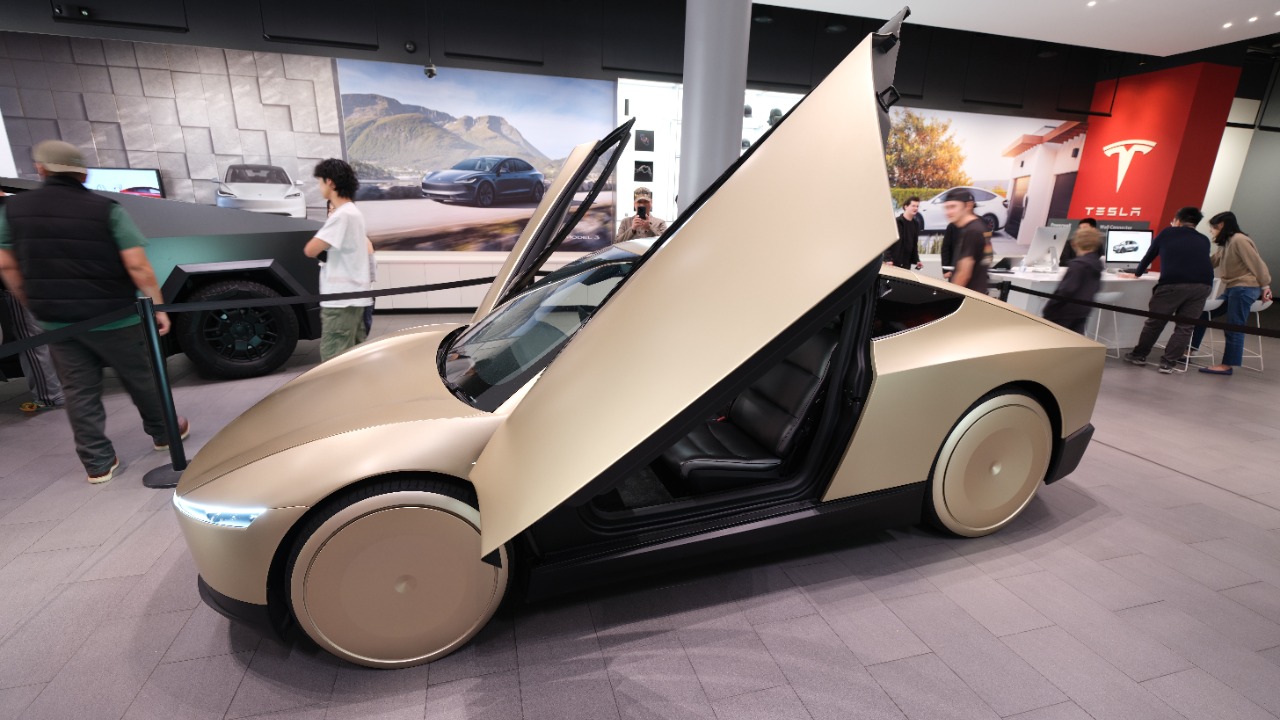

Tesla has quietly crossed a line that has defined the self-driving race for a decade: its robotaxis are now circulating in Austin without a human safety driver behind the wheel. The move shifts Tesla’s autonomous program from supervised experiment to a true driverless test, raising the stakes for safety regulators, investors, and anyone who shares the road with these cars.
With vehicles now navigating city streets on their own, Tesla is testing not just software but public tolerance for a future where ride-hailing cars arrive empty. The company is betting that its vision-led approach can scale faster and cheaper than rivals, even as fresh crash reports and a major delay to other long-promised tech underline how much risk still sits under the hood.
The leap to driverless testing in Austin
Tesla’s latest phase of robotaxi development centers on Austin, where the company has begun running ride-hailing vehicles that operate without an in-car safety monitor. The company has framed this as the next logical step after years of supervised trials, shifting from a model where a human sat ready to intervene to one where the car is expected to handle the full driving task on public streets.
Reporting on the program describes Tesla CEO Elon Musk confirming that the company is now testing driverless robotaxis in Austin, Texas, with no human safety monitor in the front seat, a milestone that aligns with his long-standing pledge to remove safety monitors from the fleet once the software was ready for real-world use on city roads. That progression is reflected in coverage that tracks how Tesla CEO Elon Musk has shifted from supervised pilots to fully driverless trials in Austin, Texas, and in detailed accounts of how these vehicles are now circulating on Austin’s streets without a backup driver.
How Musk’s vision-only bet shapes the robotaxi rollout
At the heart of Tesla’s driverless push is Musk’s insistence that cameras and neural networks, not a mix of lidar and radar, will ultimately dominate autonomous driving. He has argued that a vision-only system is closer to how humans perceive the road, and that simplifying the hardware stack will make it easier to deploy robotaxis at scale once the software matures.
In Austin, Musk has been explicit that the company is relying on this camera-centric approach, describing it as simpler, cheaper, and more scalable than multi-sensor setups that combine lidar, radar, and high-definition maps. Local coverage notes that Musk says the vision-only setup is not only more scalable but could cut the cost of a ride by about 50 percent, and it is estimated that Tesla could eventually have as many as 60 robotaxis operating in Austin if the program expands as planned.
What driverless looks like on Austin’s streets
On the ground, the shift to driverless testing has turned parts of Austin into a live demonstration of Tesla’s autonomy ambitions. Residents are seeing Tesla Robotaxis circulate with no one in the driver’s seat, a visual that signals a clear break from earlier tests where a human “safety monitor” sat ready to grab the wheel if the system faltered.
Eyewitness accounts describe Tesla Robotaxis spotted in Austin with no safety monitor and, in some cases, no occupants at all, underscoring that the company is not just simulating autonomy but actually running empty vehicles as part of its test program. Coverage of the rollout notes that Tesla Robotaxis spotted in Austin with no “safety monitor” are being treated as a big step toward the company’s long-stated robotaxi dreams, with some vehicles reportedly running routes without any occupants in the car.
Inside Musk’s promise to remove safety monitors
Musk has spent years promising that Tesla would eventually operate a fleet of fully driverless cars, and the Austin tests are his most concrete attempt yet to deliver on that pledge. He has framed the removal of safety monitors as both a technological milestone and a business necessity, arguing that the economics of robotaxis only work when the human in the front seat is gone.
Recent reporting notes that Musk has now said Tesla robotaxis without safety monitors are running in Austin, fulfilling an earlier commitment to strip human supervisors from the vehicles once the software could handle the full driving task. In one account, he describes how, if you live in Austin, you might see these cars appear gradually and then all at once, a nod to the way disruptive technologies often seem to arrive overnight after years of incremental progress, a description captured in coverage of Musk explaining how the fully driverless vehicles deliver on his earlier promise to remove safety monitors from the fleet.
How the tests work and who gets to ride
For now, Tesla’s driverless robotaxis in Austin are not a mass-market Uber rival but a controlled experiment with a limited pool of riders. The company appears to be using a curated group of participants rather than opening the service to anyone with the Tesla app, a strategy that lets engineers monitor performance closely while limiting exposure if something goes wrong.
Coverage of the program notes that Tesla is testing driverless robotaxis in Austin without a human safety monitor, but that these vehicles are not yet carrying actual paying customers in a broad commercial launch. One report, which urges readers to Follow Lakshmi Varanasi for updates, explains that every time Lakshmi publishes a story readers get an alert, and that the current phase of testing involves Tesla robotaxis in Austin that are not yet serving actual paying customers, even as the company positions the program as a precursor to a full ride-hailing service.
Crash reports and the “Supervisor Paradox”
The move to remove safety drivers comes against a backdrop of crash reports that highlight how difficult it is to manage the handoff between human supervisors and automated systems. Even before the fully driverless phase, Tesla’s robotaxi fleet had logged multiple incidents while a human was still in the car, raising questions about how effective those supervisors really were at preventing collisions.
One analysis describes what it calls “The Supervisor Paradox,” arguing that crashes are happening even when a human is present because the role of a passive overseer is inherently flawed. That piece notes that Tesla has reported another robotaxi crash even with a supervisor in the vehicle, and that the company has now started testing without a supervisor at all, a tension captured in coverage that labels the situation The Supervisor Paradox and details how the company’s own filings show incidents occurring despite the presence of a human monitor.
What Tesla’s own safety data says
To counter concerns about crashes, Tesla points to its internal safety statistics, which paint a far more favorable picture of its driver-assistance technology than critics often acknowledge. The company’s Q3 2025 Vehicle Safety Report, for example, claims that cars using Autopilot experience far fewer accidents per mile than those driven by humans without assistance.
According to that report, Tesla’s Q3 2025 Vehicle Safety Report documents Autopilot achieving record safety performance, with the company stating that its Autopilot system is nine times safer in terms of crash rates per mile than human drivers achieve in comparable conditions. One summary of the data, labeled an Executive Summary, emphasizes that Tesla’s Q3 2025 Vehicle Safety Report shows Autopilot delivering record safety performance with crash rates that are nine times lower than human driving, while another analysis notes that Tesla’s new Safety Report shows Autopilot nine times safer than humans in Q3 2025, even if the figure is slightly lower than the one the company released in Q3 2024, a comparison highlighted in coverage of Tesla publishing updated safety metrics.
Regulators, reporting, and the growing crash tally
Regulators are watching Tesla’s robotaxi experiments closely, particularly as the company moves from supervised to unsupervised operation. Each new crash report feeds into a broader debate over how quickly companies should be allowed to scale driverless services, and what level of transparency they owe the public about incidents and near misses.
One recent report notes that in November, observers had counted seven total robotaxi crashes as of September, and that a new filing by Tesla has now added another incident to that tally. The same account explains that the latest crash involved a vehicle that was “Proceeding Straight” at the time of impact, with other details redacted, and that the updated numbers show how the fleet’s incident count has grown as testing has expanded, a pattern laid out in coverage that states In November the fleet had reached seven total crashes as of September and that now a new report filed by Tesla adds another crash where the vehicle was proceeding straight at the time.
Investor reaction and the TSLA trade
On Wall Street, the shift to fully driverless testing has been treated as a validation of Tesla’s long-term autonomy story, even as safety questions linger. Investors have spent years pricing in the possibility that Tesla could one day operate a high-margin robotaxi network, and the Austin program gives that thesis a tangible, if still early-stage, foothold.
Coverage of the market reaction notes that Tesla stock popped after the company confirmed robotaxi testing with no safety driver, with traders betting that a successful rollout could unlock new revenue streams beyond selling cars. One report highlights how Pras Subramanian, Senior Reporter, described the move as a catalyst for TSLA, and another account of the same development notes that Tesla stock pops as Robotaxi testing with no safety driver confirmed, tying the share price reaction directly to the company’s decision to move ahead with driverless trials from the Bay Area to Phoenix and Nevada.
How Austin fits into Tesla’s wider autonomy roadmap
Austin is not just a convenient testbed near Tesla’s factory, it is a proving ground for a broader strategy that spans multiple states and regulatory environments. The company has already been running supervised robotaxi pilots in other regions, and the lessons from Austin will likely shape how and where it attempts to remove safety drivers next.
Reporting on the company’s broader testing footprint notes that Tesla has been expanding its robotaxi trials from the Bay Area to Phoenix and Nevada, and that the Austin program is part of a larger push to validate the technology across different traffic patterns and regulatory regimes. One detailed account of the rollout explains that Sean O’Kane has described how the company’s move to start testing robotaxis in Austin with no safety driver fits into a timeline that began about six months after Tesla started testing supervised robotaxis and now involves coordination with the National Highway Traffic Safety Administration as the company scales its efforts.
The tension between bold promises and delayed tech
Even as Tesla accelerates its robotaxi program, the company is still grappling with delays in other high-profile technologies that Musk has championed. That tension underscores how difficult it is to turn ambitious timelines into reality, and it complicates the narrative that every bold promise will arrive on schedule.
Recent coverage highlights how Elon Musk has announced a major delay for long-awaited Tesla tech, a reminder that not every project moves as quickly as the robotaxi program in Austin. One report by Sam Westmoreland explains that Elon Musk announces major delay for long-awaited Tesla tech and lays out why that is a problem for investors who have grown accustomed to aggressive timelines, even as the company pushes ahead with driverless robotaxis in Austin.
More from MorningOverview