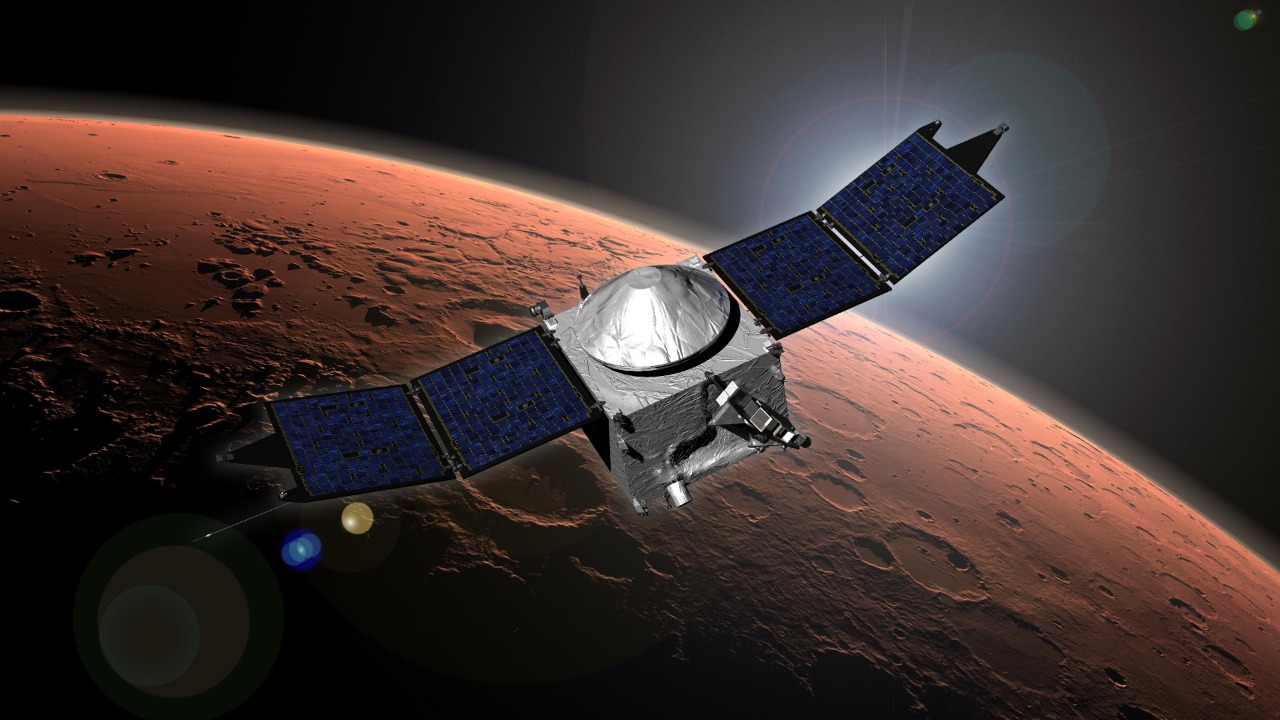

For more than a decade, a steady radio whisper has linked Earth to a workhorse spacecraft circling Mars. Now that voice has abruptly gone quiet, leaving one of NASA’s most important Martian orbiters silent at a moment when the Red Planet has never been more crowded with robots that depend on it.
The loss of contact with the MAVEN mission is not just a technical glitch, it is a stress test for how long we can lean on aging infrastructure to support an expanding presence around Mars. After ten years of signals, the sudden silence exposes both the fragility of deep space operations and the urgency of planning what comes after a veteran orbiter finally stops calling home.
How a decade of routine contact suddenly broke
The spacecraft at the center of this crisis is MAVEN, short for Mars Atmosphere and Volatile EvolutioN, a NASA orbiter that has spent years tracing how the planet’s air thinned from a thicker, wetter past into the cold world it is today. According to NASA, NASA’s MAVEN (Mars Atmosphere and Volatile) spacecraft was in a stable orbit around Mars and approaching its eleventh anniversary in orbit when controllers suddenly stopped hearing its signal. The break in contact came after more than ten years of routine communications, a span in which the mission had become a fixture of Martian science and a quiet backbone for other explorers.
Mission teams first noticed trouble when the Deep Space Network pointed its giant antennas toward Mars and, instead of the expected carrier tone, heard nothing. NASA has said that when ground stations attempted to lock onto the spacecraft, they did not observe a signal, triggering a rapid shift from normal operations into anomaly response. For a mission that had built a reputation on reliability, the abrupt silence is a jarring reminder that even long-running spacecraft can fail without much warning.
The long journey from Florida to Mars orbit
To understand what is at stake, it helps to remember how MAVEN got to Mars in the first place. The 11-foot-tall orbiter left Earth after launching atop a United Launch Alliance Atlas V rocket from Cape Canavera, beginning a journey that would carry it into Martian orbit to study the planet’s atmosphere. That launch, in Nov of 2013, set up a mission explicitly designed to answer how Mars lost much of its early water and air, a question that goes to the heart of whether the planet was once habitable.
Once it arrived, MAVEN settled into an elongated orbit that dipped into the upper atmosphere, allowing its instruments to sample charged particles and escaping gases. Over time, the spacecraft built a detailed picture of how solar wind strips away the Martian atmosphere, work that has been central to explaining how Mars for billions of years transformed from a wetter world into the cold world it is today. That scientific legacy is part of what makes the current communications blackout so unsettling for the teams who have shepherded the mission since launch.
What we know about the moment MAVEN went dark
From the outside, the loss of contact looks sudden, but for engineers it is a puzzle built from a handful of clues. NASA has confirmed that the spacecraft was operating normally until ground controllers noticed the absence of its expected downlink, and that the anomaly was first detected when the Deep Space Network failed to acquire the usual telemetry. Public updates describe how the agency’s specialists are combing through recent commands and tracking data to reconstruct the final moments before the signal vanished, a process that will shape any attempt to recover the mission.
External reporting has filled in some of the context around that timeline. One account notes that NASA has lost contact with a spacecraft that had been orbiting Mars for more than a decade, describing how the agency is investigating after Maven abruptly stopped responding while studying the planet’s atmosphere and its evolution into the cold world it is today. Another report emphasizes that the spacecraft had been orbiting Mars studying its atmosphere when NASA realized it had lost contact, underscoring that the failure occurred during routine science operations rather than a risky maneuver or major system change.
Inside NASA’s urgent recovery campaign
Once it became clear that MAVEN had gone silent, NASA shifted into a full-scale recovery effort that now spans multiple centers and international partners. The mission team, working with the agency’s Deep Space Networ, has been sending a series of commands aimed at waking the spacecraft or triggering backup communication modes, while also adjusting antenna schedules to give MAVEN more listening time. NASA has described how the Deep Space Networ is being used intensively to sweep for any hint of a carrier signal that might indicate the orbiter is still alive but unable to complete a full data link.
Those efforts have continued even as days pass without a response. One detailed account notes that NASA is continuing efforts to reestablish contact with MAVEN, describing how mission operations teams are cycling through contingency procedures while they wait for any sign that commands are getting through. Another report explains that the spacecraft and operations teams are analyzing limited tracking data and that any new information will be shared once it becomes available. For now, the recovery campaign is a mix of methodical troubleshooting and patient listening, with no guarantee that the spacecraft will ever answer.
Why MAVEN matters far beyond its own science
The silence from MAVEN is not just a blow to atmospheric science, it is a direct hit to the communications web that keeps Mars missions functioning. Over the years, the orbiter has become a key relay, passing data between rovers on the surface and Earth, a role that has grown more important as the Martian fleet has expanded. NASA itself has highlighted that MAVEN also serves as a communications node, relaying information from the surface to support rover operations, a function that now hangs in the balance while the spacecraft remains unresponsive.
That relay role is especially critical because other orbiters are aging too. In a candid assessment, a NASA blog notes that, additionally, the current science orbiters are reaching the end of their lives and that the need to refresh these assets is becoming critical for Mars operations. Losing MAVEN, even temporarily, compresses that timeline and forces mission planners to think harder about how to maintain a robust communications backbone when several of the key orbiters are well past their original design lifetimes.
The science legacy now hanging in the balance
For scientists, the prospect of a permanently silent MAVEN is painful because of how much work remains to be done. The mission’s prime phase lasted one Earth year, but its instruments have continued to deliver insights into how the Martian atmosphere responds to solar storms, seasonal changes, and long term variations in the Sun’s output. NASA has emphasized that MAVEN’s prime mission lasted one Earth year and that its data helped scientists understand Martian winds and auroras, for example, building a foundation for models of atmospheric escape that are still being refined.
Beyond the numbers, MAVEN has been central to a broader narrative about Mars as a once warmer world that lost its habitability over time. Reports on the mission’s silence describe it as one of Mars’ most important orbiters, noting that its instruments have been crucial for tracking how the upper atmosphere interacts with the solar wind and for piecing together how the planet’s climate evolved. One analysis frames the current situation bluntly, saying that NASA’s MAVEN Spacecraft Goes Silent: What Happened to Mars’ most important orbiter, and asking what this means for ongoing efforts to diagnose and resolve the issue. If the spacecraft never responds, its existing archive will still fuel research for years, but the stream of fresh observations will have ended abruptly.
How the loss ripples through the Mars fleet
Every time a Mars rover sends back a panorama or a drill sample analysis, there is usually an orbiter like MAVEN quietly handling the handoff. With the spacecraft offline, mission managers have to reroute data through other orbiters, increasing the load on an already stretched network. One report explains that efforts to reconnect with Nasa’s Maven spacecraft above Mars have so far failed, disrupting normal mission operations and forcing teams to Efforts to analyze the limited tracking data while also managing the impact on rover communications.
That strain comes at a time when the Martian environment is already challenging for radio links. Dust storms, seasonal changes in atmospheric density, and the geometry of orbits can all affect how easily signals move between surface and orbit. A separate analysis notes that MAVEN has circled Mars for more than a decade, exploring the planet and relaying data from robots on the surface, and that NASA has lost the signal from this Vital NASA Mars Orbiter Has Gone Dark while officials work to understand what happened. With one less relay in the sky, every other asset has to work harder, and the margin for error narrows.
Public reaction and the emotional weight of a silent spacecraft
Spacecraft failures are technical events, but they are also emotional ones, especially when a mission has been part of the planetary exploration story for years. As news of MAVEN’s silence spread, social media posts framed the loss in personal terms, describing the orbiter as a long serving companion at Mars. One widely shared update put it simply, saying that NASA has lost contact with its long-serving Mars orbiter MAVEN, which has been studying the Red Planet’s upper atmosphere and supporting observations and communications, a sentiment captured in an Instagram post that paired the news with a small spacecraft emoji.
Inside NASA, the tone is more restrained but no less urgent. One report describes how the agency has launched an urgent investigation after its MAVEN spacecraft dropped off the map, emphasizing that NASA’s Essential Mars Orbiter MAVEN Is Lost In Space and that the mission had a long running, otherwise nominal communications record before the anomaly. Another account notes that NASA has lost contact with MAVEN, a spacecraft that had been orbiting Mars for more than a decade, and that officials have pledged to share more information once it becomes available, a promise reflected in an update that shared once it becomes available. For the engineers and scientists who have spent years with MAVEN, the silence is not abstract, it is the sudden absence of a familiar voice in their daily work.
What the anomaly suggests about aging spacecraft
Even if MAVEN eventually checks back in, the episode is a warning about how much we ask of spacecraft that have already outlived their original plans. The orbiter was designed for a relatively short prime mission, yet it has been operating around Mars for more than ten years, weathering temperature swings, radiation, and the slow degradation of hardware in deep space. Reports on the current anomaly point out that NASA has launched an urgent investigation after its MAVEN spacecraft, described as an Essential Mars Orbiter MAVEN Is Lost In Space, suddenly stopped communicating despite a long running, otherwise nominal communications record, a pattern that often points to aging components or unexpected interactions between systems.
From a programmatic perspective, the silence underscores how thin the margin can be when multiple missions depend on a single asset. A detailed analysis of the situation notes that MAVEN has circled Mars for more than a decade, exploring the planet and relaying data from robots on the surface, and that NASA has lost the signal from this Vital NASA Mars Orbiter Has Gone Dark while officials work to understand the cause. Another report explains that NASA is continuing efforts to resume Mars MAVEN mission operations, describing how teams are adjusting antenna schedules and command strategies as they wait for a response, a process captured in coverage of MAVEN mission ops that continue despite the silence. Whether MAVEN recovers or not, the anomaly is already shaping how planners think about redundancy and risk for the next generation of Mars orbiters.
The future of Mars exploration after MAVEN’s silence
Looking ahead, the question is not only whether MAVEN can be saved, but how Mars exploration adapts if it cannot. NASA’s own internal commentary has been blunt that the current science orbiters are reaching the end of their lives and that the need to refresh these assets is becoming critical, especially as more missions rely on them for both science and communications. The loss of a single orbiter like MAVEN accelerates that timeline, forcing agencies to consider how quickly they can field replacements and whether future spacecraft should be designed with even more robust cross support capabilities.
At the same time, the episode is a reminder of how much we have already learned from a single mission. MAVEN’s decade at Mars has helped transform our understanding of atmospheric escape, solar wind interactions, and the long term climate history of the Red Planet, work that will continue to shape models and mission designs even if the spacecraft never phones home again. As one analysis of the situation notes, NASA has launched an urgent hunt as its Essential Mars Orbiter MAVEN Is Lost In Space, but the data it has already returned will remain a cornerstone of Mars science regardless of the outcome. For now, the Deep Space Network keeps listening, and the teams keep sending commands, hoping that a faint carrier tone from Mars will mark the end of this uneasy silence.
Supporting sources: NASA’s Essential Mars Orbiter MAVEN Is Lost In Space!.
More from MorningOverview