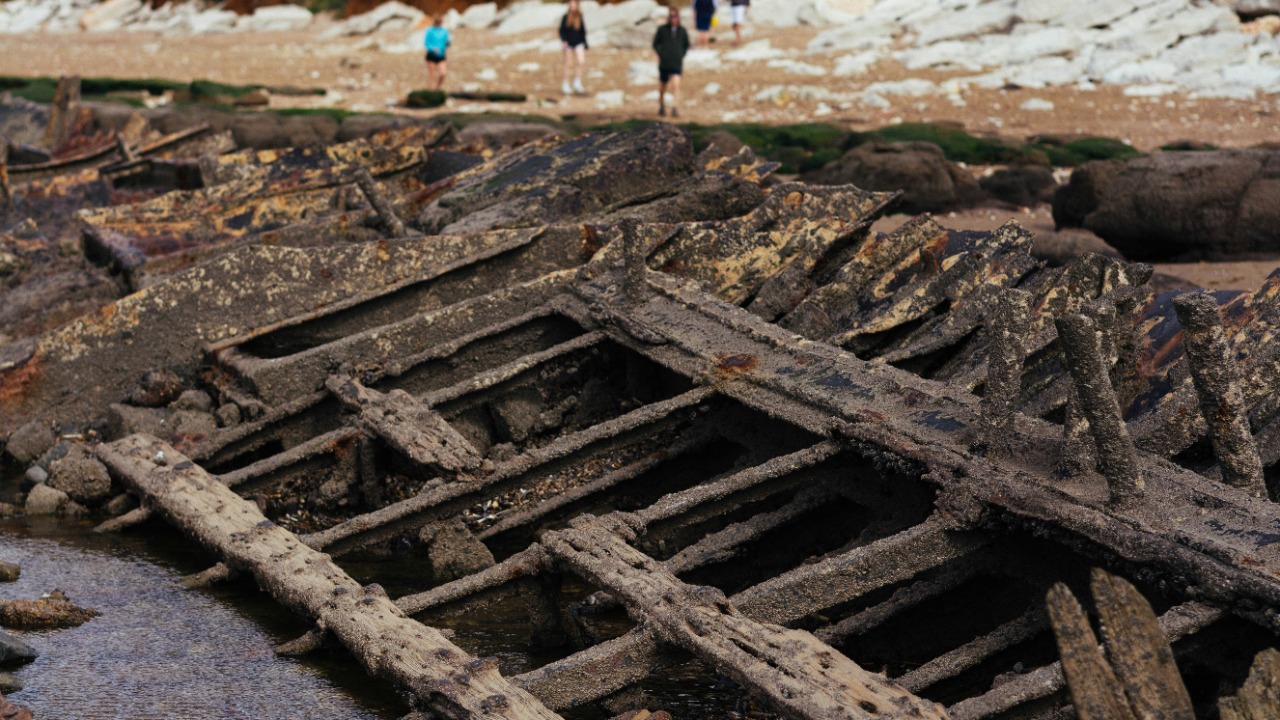

The oldest known wooden plank boat in Scandinavia has yielded an unexpectedly intimate clue about the people who once rode it into battle: a partial fingerprint pressed into ancient tar. That tiny ridge pattern, preserved for more than two millennia, is now helping researchers trace the boat’s origins, its violent mission and the wider world of Iron Age raiders who prowled the Baltic Sea.
By combining that fingerprint with chemical traces in the waterproofing and wood, archaeologists are reframing a century of assumptions about the legendary Hjortspring vessel and the warriors it carried. Instead of a purely local craft, the evidence points to a mobile, interconnected world of seaborne fighters whose reach and technology were far more sophisticated than the bare timbers in a museum case might suggest.
The Hjortspring boat and its violent last voyage
The vessel at the center of this story, often referred to simply as The Hjortspring, has long been a touchstone for understanding early naval warfare in northern Europe. Excavated from a bog on the island of Als in southern Denmark, it is recognized as the oldest wooden plank boat in Scandinavia and has been reconstructed and displayed at the National Museum of Denmark, where visitors can walk alongside its long, narrow hull and imagine the warriors who once crouched between its ribs. The craft is built from overlapping planks stitched together, a design that predates the classic Viking longship but already shows the same obsession with speed, shallow draft and coordinated rowing that would later define Scandinavian sea power.
Archaeologists have argued for years that The Hjortspring was not a trading vessel but a war machine, and the cargo it carried into the bog supports that view. The boat was found with weapons and equipment that point to a raiding force, and later analysis has tied it to an attempted attack on a Danish island more than 2,000 years ago, a failed strike that ended with the craft and its gear deliberately deposited in the wetland as a kind of ritual closure. That martial context is crucial, because it frames the newly discovered fingerprint not as a random smudge from a shipwright at rest, but as a trace left by someone involved in a high risk mission, preserved when the boat and its contents were consigned to the bog after the aborted assault.
A 2,400-year-old fingerprint in pine pitch
The new clue emerged from a substance that rarely gets star billing in maritime archaeology: the sticky black tar used to keep water out. Researchers examining small fragments of caulking from the Hjortspring hull noticed that one piece of hardened pitch carried the faint impression of human skin ridges, a partial print that had been pressed into the material while it was still soft. High resolution imaging and X ray tomography confirmed that the ridges were not random cracks but a genuine fingerprint, preserved from the time when the boat was still in active use roughly 2,400 years ago, a survival that is extraordinary even by the forgiving standards of bog preservation.
The print itself is incomplete, so it cannot be matched to any individual, but it is detailed enough to show that it came from a human finger rather than an animal or tool mark. That alone makes it a rare personal trace from the Iron Age, a moment when someone, perhaps a boatbuilder or a crew member, pressed tar into a seam and left a tiny part of their identity behind. The discovery has been described as the fingerprint of an ancient seaborne raider, a phrase that captures both the intimacy of the evidence and the violent context of the Hjortspring’s final voyage, and it has drawn attention to how much information can be extracted from what once looked like anonymous blobs of pitch.
How archaeologists read a raider’s touch
To turn that smudge into a research tool, Archaeologists and forensic specialists treated the tar fragment much like a modern crime scene sample. A high resolution X ray tomography scan allowed them to visualize the fingerprint ridges in three dimensions, separating the original impression from later cracks and distortions caused by centuries in the bog. That digital model made it possible to confirm that the pattern matched human dermatoglyphs and to assess which parts of the print were intact enough to study, even if they could never be run through a contemporary database.
The same fragment also became a chemical archive. By analyzing the composition of the pitch, Researchers could identify the type of resin used and compare it with known sources around the Baltic region, a process that turned the fingerprint into a gateway for understanding where the boat was built and how its builders sourced their materials. In effect, the team treated the Hjortspring as the vehicle at the center of a very old crime mystery, with the tar acting as both a physical trace of the person who handled it and a chemical signature of the landscape that supplied the waterproofing, a dual role that makes this single piece of evidence unusually powerful.
Pine pitch, cordage and life aboard The Hjortspring
The pitch that captured the fingerprint was not an incidental smear but part of a carefully managed repair kit that kept the Hjortspring seaworthy. The boat was waterproofed with pine pitch, which was surprising to specialists who expected local resins, and that choice suggests a deliberate decision to use material from a region with abundant conifer forests rather than whatever was closest at hand. It is likely that both caulking material and cordage were kept on the ship in order to conduct repairs while at sea, a practical necessity for a long, lightly built craft that flexed and worked in heavy water and could not afford a leaking seam in the middle of a raid.
Those details of maintenance and improvisation help flesh out the daily reality of the crew. Instead of a static museum object, the Hjortspring emerges as a living platform where warriors, rowers and shipwrights overlapped, with someone pausing in the middle of a tense voyage to press pine pitch into a gap and smooth it with a bare finger. The fact that the boat has been preserved and displayed at the National Museum of Denmark since 1937 means that generations of visitors have seen its elegant lines without realizing that a microscopic trace of that hurried repair, and the person who made it, was still embedded in the tar between its planks.
Not from Denmark after all? The Baltic connection
For decades, the default assumption was that the Hjortspring was a local product, built in Denmark for use in nearby waters. The new chemical analysis of the pine pitch and wood is now challenging that view, pointing instead toward a construction site somewhere around the Baltic, where conifer forests and specific resin signatures match the material found on the boat. This strongly suggests the boat was constructed in the Baltic, not in Denmark, a shift that turns the vessel from a purely Danish artifact into evidence of a wider maritime network that linked coastal communities across the sea more than two millennia ago.
Researchers working with Lund University have argued that if the boat came from the Baltic region, then the trees it was built from were cut down there as well, tying the Hjortspring’s timbers and tar to a specific ecological zone rather than a generic northern forest. New evidence suggests that the mysterious makers of the legendary Hjortspring boat might have come from the Baltic Sea area, a conclusion that dovetails with the pitch chemistry and reframes the vessel as a visiting raider craft rather than a homegrown defender. In that scenario, the fingerprint in the tar belongs not just to an anonymous seafarer, but to someone whose very presence in Danish waters signaled the reach of Baltic raiding parties.
A botched Scandinavian raid frozen in a bog
The archaeological context of the Hjortspring has always hinted at a violent story, but the emerging picture is now sharper and more cinematic. The boat carried warriors on an attempted attack of a Danish island over 2,000 years ago, a mission that appears to have gone badly wrong, leaving the craft and its weaponry to be captured or otherwise neutralized. Instead of being repaired and sent back into service, the vessel was dragged into the bog of Hjortspring Mose and deposited with its gear, a deliberate act that reads as both a trophy and a ritual, sealing the end of a failed incursion in the saturated peat.
Seen through that lens, the newly identified fingerprint becomes a clue from a botched Scandinavian raid, a 2,300 year old trace that links the abstract idea of “Baltic raiders” to a specific human hand that once gripped an oar or a spear. The boat has been described as a vehicle at the center of a crime mystery, not because modern law applies, but because the combination of forensic techniques and contextual evidence allows investigators to reconstruct motives, movements and outcomes in a way that feels strikingly similar to contemporary casework. The bog, which once swallowed the Hjortspring and its crew’s ambitions, has instead preserved the evidence that now lets us read their story in unprecedented detail.
From century old puzzle to forensic case file
When the Hjortspring was first excavated more than a century ago, its origin quickly became a scholarly puzzle. Archaeologists examining an ancient boat discovered in Denmark struggled to pin down where it had been built, what cultural group it belonged to and how it fit into the broader evolution of northern European seafaring. The vessel’s unusual construction, with its stitched planks and light frame, did not map neatly onto later shipbuilding traditions, and the lack of inscriptions or obvious ethnic markers left room for competing theories that persisted for generations.
The discovery of the fingerprint and the chemical profile of the pine pitch have turned that long running debate into something closer to a forensic case file that can be tested and narrowed. New fingerprint found on Hjortspring boat might help to solve century old mystery is not just a catchy phrase but an accurate description of how a single piece of evidence can unlock a stalled investigation. By tying the tar to the Baltic Sea region and confirming that a human hand pressed it into place, the new research gives weight to the idea of Baltic raiders operating in Danish waters and offers a concrete data point that older typological arguments lacked, shifting the conversation from speculation to measurable clues.
What a single fingerprint reveals about Iron Age seafaring
For me, the most striking aspect of this discovery is how much it reveals about the social world behind the Hjortspring’s sleek silhouette. The fingerprint of ancient seafarer found on Scandinavia’s oldest plank boat is a reminder that these were not anonymous “peoples” moving across a map, but individuals whose hands were calloused by rowing, carpentry and combat. The choice to waterproof the hull with pine pitch from the Baltic, to carry spare caulking and cordage on board and to risk a long sea crossing to strike a Danish island all point to a culture that was comfortable operating across open water, with the logistics and confidence to sustain extended raiding campaigns.
That level of maritime sophistication pushes back against any lingering image of early Iron Age Scandinavia as a backwater waiting for the Viking Age to begin. Instead, the Hjortspring and its raider’s fingerprint show that the building blocks of later naval dominance were already in place: specialized warboats, coordinated crews, long distance sourcing of materials and a willingness to project force across the Baltic. When I look at the reconstructed hull in photographs from The Hjortspring as currently displayed at the National Museum of Denmark, credited to Boel Bengtss, I see not just an elegant artifact but the ghost of a crew whose skills and ambitions were far ahead of their time.
Why this tiny print matters far beyond Denmark
The implications of the Hjortspring fingerprint extend well beyond the shores of Denmark or the Baltic. Fingerprint of ancient seafarer found on Scandinavia’s oldest plank boat has become a touchstone for how archaeologists can apply forensic methods to ancient materials, turning what once seemed like inert residues into rich sources of personal and geographic information. The team that located some of the tar fragments with preserved ridges has shown that even small, overlooked pieces of caulking can carry data about who handled them and where their ingredients came from, a lesson that is already encouraging researchers to reexamine old collections with fresh eyes.
That shift in perspective is visible in the way multiple projects now converge on the Hjortspring case. Fingerprint of Ancient Seafarer Found on Scandinavia’s Oldest Plank Boat has highlighted the role of Dec fieldwork and lab analysis in pushing the story forward, while Fingerprint of ancient seaborne raider found on Scandinavia’s oldest plank boat has emphasized the 2,400-year-old age of the print and its connection to a specific raid. Researchers uncover clues to mysterious origin of famous Hjortspring boat has focused on the high resolution X ray tomography that made the ridges legible, and Fingerprint of ancient seafarer found on Scandinavia’s oldest plank boat has underlined how likely it is that both caulking and cordage were stored on board for at sea repairs. Together with Fingerprint of ancient seafarer found on Scandinavia’s oldest plank boat from Lund University and Fingerprint of ancient seafarer found on Scandinavia’s oldest plank boat from Popular Archaeology, which detail how the team used a wide range of analytical techniques at institutions such as Lund University and the University of Gothenburg, these studies show how a single partial print can reshape our understanding of ancient mobility, warfare and identity across Scandinavia.
More from MorningOverview