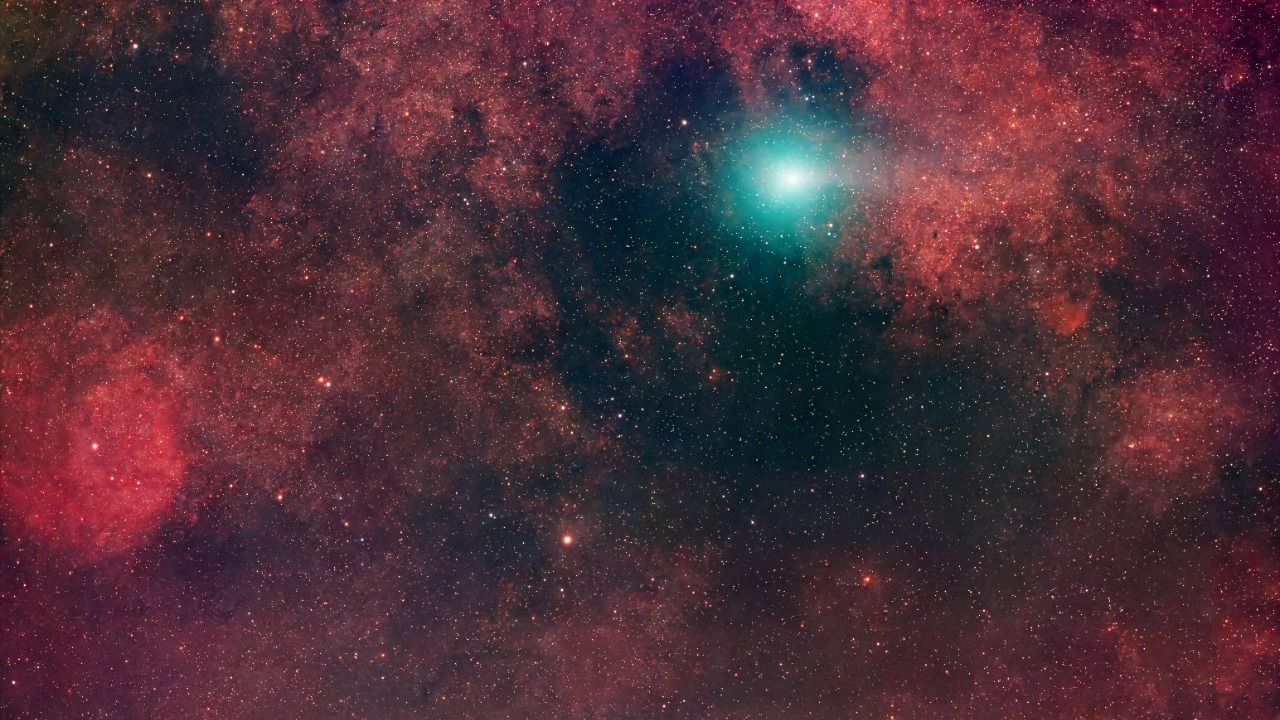

The Milky Way is glowing in ways it should not, and the usual suspects like stars, dust and black holes cannot fully account for the excess light. A growing group of physicists now argue that compact “nuggets” of dark antimatter smashing into ordinary gas could be turning the galaxy into a vast, invisible collider whose only trace is a faint ultraviolet and gamma ray shimmer.
If that idea holds up, the strange glow around our galaxy and its neighbors would not just be a curiosity, it would be one of the first concrete clues to what dark matter actually is and how it behaves on small scales. The stakes are enormous, because any explanation that works for the Milky Way must also fit the wider Universe and its web of galaxies.
The Milky Way’s unexplained glow
For more than a decade, astronomers have been wrestling with an excess of high energy light at the center of the Milky Way that standard astrophysics struggles to explain. Even after accounting for known sources such as pulsars, supernova remnants and hot gas, simulations still leave a stubborn surplus of gamma rays and a puzzling ultraviolet component that seem to hang over the galaxy’s heart like a faint halo.
Recent work revisiting the so called Galactic Center Excess has sharpened that mystery rather than dissolving it, with new simulations suggesting that the Milky Way’s glowing heart may require an additional ingredient beyond conventional sources to match the observed brightness and spatial pattern of the emission, a pattern that appears too smooth and extended to be explained solely by clumpy stellar populations in the latest models.
From gamma rays to ultraviolet: a multiwavelength puzzle
The glow problem is not confined to a single color of light, which is part of what makes it so intriguing. At the highest energies, the Fermi Gamma ray Space Telescope has mapped an excess of photons streaming from the galactic center that do not line up neatly with known astrophysical structures, while at shorter wavelengths, observers have reported a diffuse ultraviolet component spread across the Milky Way that also resists easy classification.
New research suggests that dark matter may once again hold the key to this multiwavelength mystery, with one study arguing that the excess gamma rays seen by the Fermi Gamma ray Space Telescope can be reproduced if dark matter particles annihilate or decay in a way that tracks the galaxy’s mass distribution rather than its visible stars, tipping the scales back toward exotic physics after years in which more mundane explanations had gained ground in this new analysis.
Enter the dark matter “nuggets”
Into this landscape of unexplained light comes a more radical proposal, one that treats dark matter not as a smooth sea of individual particles but as compact clumps of dark antimatter. In this picture, the Milky Way is threaded with dense nuggets that occasionally collide with ordinary gas and dust, releasing bursts of energy as matter and antimatter annihilate at their boundaries and convert mass into light.
According to one set of calculations, the puzzling ultraviolet light seen across the Milky Way could come from the destruction of such nuggets of dark matter, with each collision between a nugget and interstellar gas turning a fraction of their mass into photons that radiate away and collectively build up the observed glow when integrated over galactic scales in this dark nugget scenario.
Axion quark nuggets and the antimatter twist
The most fully developed version of the nugget idea centers on objects known as axion quark nuggets, which bundle together huge numbers of quarks and antiquarks inside a shell of hypothetical axion fields. In that framework, dark matter is not made of isolated weakly interacting particles but of macroscopic clumps that can be as dense as nuclear matter, with some nuggets composed of antimatter that would naturally annihilate when they encounter the ordinary baryons that fill the Milky Way’s disk.
Physicist Michael Sekatchev has argued that evidence shows ordinary matter forms only a very small portion of everything that is around us in the universe, and that axion quark nuggets could account for the missing mass while also offering a mechanism for matter antimatter asymmetry, since the antimatter would be locked away in these compact objects rather than free in space, a concept he outlines in detail in his presentation on axion quark nuggets.
How nuggets could light up the galaxy
If such nuggets exist, the Milky Way becomes a natural laboratory for their interactions, because the galaxy’s disk is filled with diffuse gas that constantly drifts through the dark matter halo. When regular matter collides with these antinuggets, the annihilation at the surface would heat the nugget and its surroundings, causing them to radiate across a range of wavelengths that could include the ultraviolet and gamma ray bands where the unexplained glow is strongest.
One team has suggested that this process could be happening with dark matter nuggets too, arguing that if you have regular matter colliding with these antinuggets, the resulting annihilation would convert a significant fraction of the infalling mass into photons, effectively turning each nugget into a tiny but persistent light source that, when summed over the galaxy, would match the observed excess, a mechanism they describe as “and that’s the glow” in their discussion of dark matter nuggets.
Simulations that tilt the balance toward dark matter
To test whether dark matter interactions can really account for the Milky Way’s glow, researchers have turned to increasingly sophisticated simulations that track both visible and invisible components of the galaxy. By modeling how dark matter would clump, collide and radiate over billions of years, they can compare the predicted light distribution with what telescopes actually see and ask whether exotic physics is necessary or whether known sources suffice.
One new set of simulations suggests that during the first billion years of the Milky Way’s history, the rate of dark matter collisions increased in the dense central regions, leaving behind a lingering halo of gamma rays that still surrounds the galaxy today, a pattern that lines up with the mysterious glow in the data and strengthens the case that dark matter interactions, rather than only unresolved astrophysical sources, are driving the excess in these collision focused models.
Galactic Center Excess: revisited and reinterpreted
The Galactic Center Excess has been a battleground between competing explanations, with some teams attributing it to a population of unresolved millisecond pulsars and others insisting that the smoothness of the signal points to particle physics. As new data and methods arrive, the balance of evidence has shifted back and forth, but the latest wave of analyses is again giving dark matter a serious look, especially in light of the nugget hypothesis.
Researchers revisiting the Galactic Center Excess now argue that when they incorporate updated models of the Milky Way’s structure and star formation history, the remaining glow is more consistent with a diffuse process such as dark matter annihilation than with a collection of point sources, a conclusion that dovetails with the idea that dark matter may be lighting up the heart of the galaxy through collisions and annihilations that are not tied to any specific stellar population in the revised Galactic Center models.
Hints from Andromeda and a wider gamma ray halo
The Milky Way is not the only galaxy with a glow problem, which is crucial for testing any dark matter based explanation. Observations of the nearby Andromeda galaxy, often labeled Dec in some datasets, reveal a similar excess of high energy light that extends well beyond its visible disk, suggesting that whatever is happening in our own galaxy may be part of a broader pattern tied to galactic halos rather than local quirks.
One study argues that the light could come from clumps of dark antimatter particles smashing into ordinary matter in both the Milky Way and Andromeda, with the resulting emission forming a gamma ray halo that traces the distribution of dark matter rather than stars, a configuration that would naturally explain why the glow appears so extended and diffuse around the Milky Way and Andromeda.
First evidence, or clever astrophysics?
As the models grow more sophisticated, some researchers have begun to talk about the strange glow as a potential first direct sign of dark matter, a phrase that carries heavy weight in a field that has chased the invisible for decades. A new set of simulations suggests that the Milky Way’s strange glow could reveal the first direct observation of dark matter if the excess cannot be matched by any combination of known sources, especially in the central regions where the density of dark matter is expected to peak.
Those simulations, which explicitly track how dark matter would behave at the heart of our galaxy, argue that the observed pattern of emission is difficult to reconcile with only pulsars or hot gas, and that including dark matter interactions produces a much better fit, leading the authors to describe the Milky Way’s strange glow as a possible first direct observation of dark matter in the heart of our galaxy in these Milky Way simulations.
Signals, skepticism and the search for a “smoking gun”
Even as the case for dark matter involvement strengthens, leading theorists are careful to stress that the glow is not yet a smoking gun. Astrophysicist Silk has emphasized that a clean signal, one that could not be mimicked by any known astrophysical process, would be a smoking gun in his opinion, and that the current excesses, while tantalizing, still leave room for more mundane explanations that have not been fully ruled out.
In the meantime, Silk and his collaborators are working on predicting additional signatures that would accompany dark matter induced emission, such as specific spectral shapes or spatial correlations with other tracers, so that future observations can test whether the glow really points to new physics or whether it can still be absorbed into the complex tapestry of stellar and gas processes that already populate the Milky Way in their ongoing work.
A mysterious halo around the Universe’s most familiar galaxy
Beyond the galactic center, astronomers are also probing a more extended halo of gamma rays that seems to surround the Milky Way and possibly other galaxies, stretching far into the dark matter dominated outskirts. If confirmed, such a halo would be difficult to explain with only conventional sources, since there are few stars or supernovae in those regions, but it would be a natural outcome if dark matter interactions are lighting up the space where visible matter is scarce.
One analysis has framed this as a mysterious glow surrounding the Milky Way that could be the first evidence of dark matter, with the hunt for the Universe’s most enigmatic material potentially nearing a turning point as researchers weigh whether the gamma ray halo can be reconciled with known physics or whether it demands a new component, a question that has prompted even initially skeptical scientists to take the signal seriously once they saw how robust it appeared in this gamma ray halo study.
Why the nugget idea matters now
The dark matter nugget hypothesis arrives at a moment when traditional candidates like weakly interacting massive particles have faced repeated null results in underground detectors and collider experiments. By shifting the focus to macroscopic clumps that interact with ordinary matter in different ways, the nugget framework opens up new observational channels, from ultraviolet and gamma ray glows to potential signatures in cosmic rays and even transient events when large nuggets pass through dense regions of gas.
At the same time, the idea forces theorists to confront the full complexity of galaxy formation, since any viable nugget model must reproduce not only the Milky Way’s glow but also the properties of other galaxies, clusters and the cosmic microwave background, a tall order that will require more detailed simulations like the ones already used to argue that dark matter may be lighting up the heart of the Milky Way and that the Milky Way’s strange glow could reveal the first direct observation of dark matter in the latest collision based models.
What comes next for dark matter and the Milky Way’s glow
The next few years will be decisive for the nugget idea and for dark matter explanations of the Milky Way’s glow more broadly. New instruments with sharper resolution and broader energy coverage will help disentangle diffuse emission from point sources, while improved models of pulsars, supernova remnants and interstellar gas will tighten the constraints on how much room is left for exotic physics in the gamma ray and ultraviolet skies.
If future data continue to favor a smooth, extended glow that tracks the galaxy’s dark matter halo rather than its stars, the case for dark matter nuggets or related mechanisms will strengthen, potentially turning the Milky Way and its neighbor Andromeda into the first laboratories where we see dark matter not just through its gravity but through the light it indirectly produces when it collides with ordinary matter, a prospect that would transform our understanding of both the galaxy we live in and the invisible scaffolding of the Universe itself as suggested by the nugget based models.
More from MorningOverview