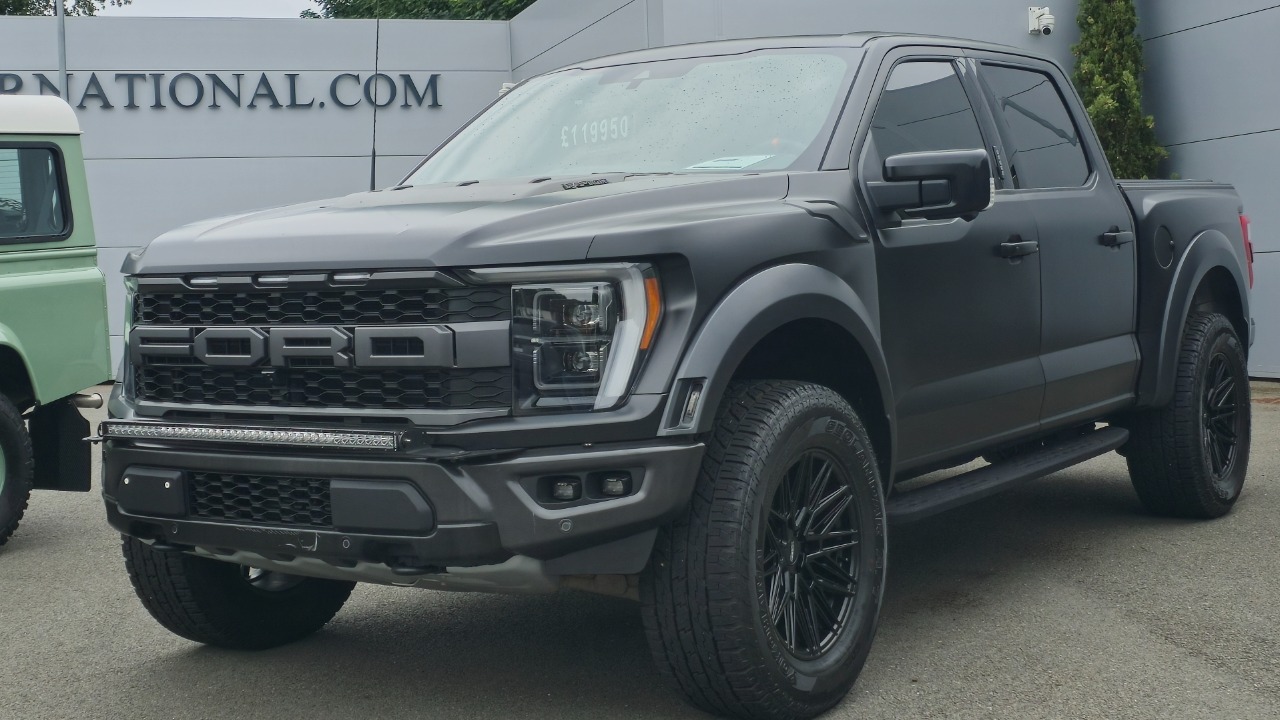

Ford is shutting down production of its flagship electric pickup and redirecting billions of dollars into batteries that will not power trucks at all, but instead stabilize the grid. The move marks a sharp turn away from the all-electric F-150 Lightning experiment and toward a future where Ford sells energy capacity as aggressively as it once sold horsepower.
I see this as more than a product cancellation. It is a public reset of Ford’s electric strategy, a bet that hybrids, extended-range trucks, and a massive Battery Energy Storage System Business will deliver steadier profits than chasing pure EV volume in a volatile market.
Lightning’s abrupt end and what it signals
The most striking fact in Ford’s pivot is its decision to stop building the all-electric F-150 Lightning altogether, effectively ending one of the most visible symbols of the U.S. truck market’s EV ambitions. Ford Motor Company has concluded that the current form of Lightning, once pitched as the future of the work truck, no longer fits its financial or strategic priorities, and production of the electric F-150 has been halted after a short and highly scrutinized run that put an electric drivetrain into a platform associated with the number 150 for generations. Reporting on the decision makes clear that Ford Motor Company is not just trimming capacity, it is pulling the plug on the current Lightning outright.
That choice sends a blunt signal about the state of the EV truck market. The Lightning was supposed to prove that mainstream pickup buyers were ready to swap gasoline for kilowatt-hours, yet Ford is now acknowledging that demand, costs, or both have not lined up with that early optimism. By ending the all-electric Lightning and absorbing the reputational hit that comes with reversing such a high-profile launch, Ford is telling investors and customers that it sees more upside in reshaping its portfolio than in doubling down on a product that has not met its internal bar.
From canceled truck to extended-range badge
Ending the current Lightning does not mean Ford is abandoning the nameplate, and that nuance matters for how I read this pivot. The company has canceled its all-electric F-150 Lightning pickup in its present form, but it plans to bring back the Lightning branding on an extended-range electric vehicle that pairs a battery pack with a gasoline-powered generator, effectively turning the truck into an EREV rather than a pure EV. In that configuration, the familiar 150 badge will sit on a truck that can run on grid power for daily driving while still relying on liquid fuel for long hauls, a compromise that Ford appears to believe will better match how truck owners actually use their vehicles, according to Ford Cancels Electric F-150 Lightning, Plans EREV Instead.
This shift from a pure battery-electric truck to an extended-range setup underscores Ford’s broader retreat from all-in EV bets. By keeping the Lightning name while changing the hardware underneath, Ford is trying to preserve brand equity with loyal truck buyers even as it quietly concedes that a gasoline-free pickup is not yet a mass-market proposition. It is a telling compromise: the company is not walking away from electrification, but it is rebalancing toward solutions that reduce range anxiety and charging constraints rather than eliminating tailpipes outright.
A $19.5 billion reckoning on EV ambitions
Behind the product headlines sits a financial story that is just as consequential. Ford is taking a $19.5 billion charge as it pivots away from its earlier EV roadmap, a staggering figure that reflects how aggressively it is writing down past investments and future expectations. That same reset includes canceling the F-150 Lightning EV outright and folding the lessons from that program into a new battery storage business, a move that acknowledges the cost of chasing scale in a segment where margins have been thin and competition intense. The charge is not just an accounting entry, it is a public admission that the first wave of Ford’s EV strategy did not deliver the returns it had projected.
In practical terms, that $19.5 billion hit clears the decks for a different kind of electrification push. Rather than pouring more capital into subsidizing expensive battery trucks, Ford is reallocating resources toward hybrids, extended-range vehicles, and stationary storage that can serve a broader range of customers. The company is effectively telling Wall Street that it would rather take the pain now, in one concentrated charge, than drip out losses over years as it tries to force an unprofitable EV lineup to scale. That choice gives Ford more room to invest in technologies and business lines it believes can reach profitability faster.
Pivoting into a $2 billion grid-scale storage bet
The most forward-looking piece of Ford’s strategy is its decision to invest heavily in grid-scale battery storage, turning its battery expertise away from trucks and toward the power sector. The company is committing roughly $2 billion to manufacturing systems that will sit alongside solar farms, wind projects, and substations, storing electricity when it is cheap and feeding it back when demand spikes. In effect, Ford is trying to turn the same cells that once powered the Lightning EV Truck into assets that utilities and large energy users can deploy to stabilize the grid, a shift detailed in its plan to pivot from the Lightning EV Truck toward $2 billion in grid-scale storage manufacturing.
I see this as Ford betting that the real money in batteries, at least in the near term, lies in selling megawatt-hours to utilities rather than selling kilowatt-hours to individual drivers. Grid operators are hungry for storage that can smooth out the variability of renewables, and industrial customers want backup power that can ride through outages and price spikes. By entering that market with a multi-billion-dollar manufacturing push, Ford is positioning itself as a supplier of critical infrastructure, not just consumer vehicles, and it is doing so at a moment when policy and corporate decarbonization targets are driving demand for exactly this kind of hardware.
Launching a dedicated Battery Energy Storage System Business
Ford is not treating storage as a side hustle, it is formalizing it as a core line of business. The company has announced that it is Launching a dedicated Battery Energy Storage System Business that will design, build, and sell complete systems rather than just cells. To feed that effort, Ford plans to repurpose existing U.S. battery manufacturing capacity and scale it to produce multiple gigawatt-hours (GWh) of storage annually by late 2027, effectively turning plants that once served vehicle programs into factories for stationary energy products. The company is signaling that this is not a pilot but a long-term industrial strategy, with its own growth targets and capital plans.
By carving out a Battery Energy Storage System Business, Ford is also creating a structure that can partner directly with utilities, developers, and large corporate buyers who think in terms of megawatts and grid interconnections rather than trim levels and towing capacity. That organizational clarity matters. It allows Ford to build specialized engineering, sales, and service teams around storage, and it gives investors a cleaner way to evaluate the performance of this new segment over time. In my view, it is a recognition that the skills needed to win in energy infrastructure are different from those that define success in consumer auto retail.
Following “The Tesla” energy playbook
Ford’s move into storage does not happen in a vacuum, it follows a path already blazed by another EV pioneer. The company is explicitly taking cues from The Tesla battery play, where Tesla built a thriving energy storage business alongside its vehicle lineup, selling products like Megapacks to utilities and large commercial customers. Ford executives have pointed to that example as proof that an automaker can leverage its battery know-how into a profitable energy segment, and they are now trying to replicate that dual-track model: fewer risky bets on mass-market EVs, more emphasis on batteries as a platform that serves both mobility and the grid.
In practice, this means Ford is pulling back on some EV programs while leaning into data, software, and AI tools that can optimize how its storage systems interact with the grid. Tesla’s experience has shown that the value of a battery is not just in its chemistry but in the algorithms that decide when to charge and discharge, and Ford appears to be internalizing that lesson. By framing its storage push as part of a broader shift into the AI boom, Ford is signaling that it wants to compete not only on hardware but also on the digital services that sit on top of those batteries, from fleet management to grid services markets.
Reinvesting in trucks, hybrids, and “Larger” customer bases
Even as Ford pivots into storage, it is doubling down on the parts of its vehicle lineup that still generate reliable cash. The company has laid out a plan to reinvest in trucks, hybrids, and more affordable EVs, positioning these products as the backbone of its automotive business while the new storage arm grows. In that framework, the canceled Lightning EV becomes a cautionary tale, while hybrid F-150s, Maverick pickups, and lower-cost crossovers become the template for how Ford intends to serve a Larger range of customers who want better fuel economy without the compromises of early EV infrastructure.
I read this as Ford returning to its core strengths while still keeping a foot in the electrification door. Trucks and SUVs remain the profit engines that fund everything else, and hybrids offer a way to cut emissions and fuel costs without asking buyers to change their habits overnight. By pairing that strategy with a push into stationary storage, Ford is effectively splitting its electrification bets: use hybrids and extended-range vehicles to keep its retail base happy, and use grid-scale batteries to tap into the energy transition on the infrastructure side.
How Ford is repurposing Lightning’s legacy
For all the disappointment around the end of the Lightning, Ford is not letting the program’s technology or brand equity go to waste. The company is taking what it learned from building high-torque, pure electric drivetrains and applying that knowledge to both its extended-range trucks and its stationary storage products. Earlier reporting on Ford’s decision to end F-150 Lightning production and start a battery storage business makes clear that the same engineering teams that delivered instant torque and pure electric driving in the Lightning are now being redirected toward systems that can deliver fast response and high power on the grid, as described in coverage of how Ford ends F-150 Lightning production and starts its storage business.
There is also a branding calculus at work. The Lightning name, once attached exclusively to a pure EV, will now live on in an extended-range format, while the underlying battery expertise migrates into products that most consumers will never see but that utilities and developers will rely on. In that sense, Ford is turning a high-profile consumer experiment into a behind-the-scenes infrastructure play, preserving the parts of the Lightning story that still resonate with buyers while quietly moving the rest into a different market entirely.
What this pivot means for the broader EV landscape
Ford’s decision to halt Lightning production and pour capital into storage will ripple far beyond its own balance sheet. Other automakers that rushed into electric pickups will now have to explain to investors why their strategies still make sense if one of the biggest truck brands in the world has decided that pure EV pickups are not yet ready to carry the business. Suppliers that tooled up for high-volume EV components will be watching closely to see whether Ford’s shift toward hybrids and stationary storage becomes a template for the rest of the industry or an outlier driven by company-specific missteps.
For the energy transition, however, Ford’s pivot could be a net positive. By moving batteries from driveways to substations, the company is helping to solve one of the thorniest problems in decarbonization: how to integrate large amounts of renewable energy into a grid that was not designed for it. If Ford can scale its Battery Energy Storage System Business as planned, repurposing U.S. manufacturing capacity to deliver GWh-scale output by late 2027, it will have turned the end of the Lightning into the beginning of a new role as a major player in the power sector. That is a very different kind of legacy than the one the original truck was supposed to leave, but it may prove more durable.
Supporting sources: Ford Cancels Electric F-150 Lightning, Plans EREV Instead.
More from MorningOverview