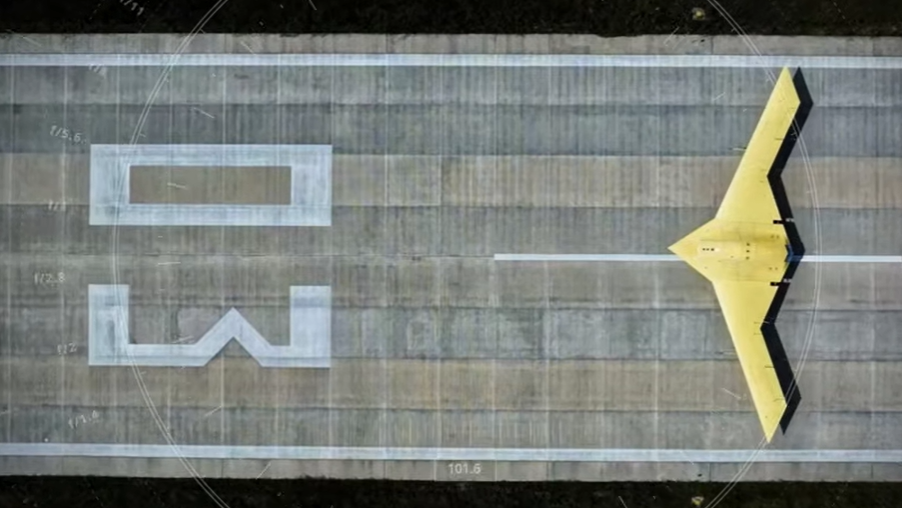

China has quietly moved a key piece of its next-generation airpower from concept to reality, with the CH-7 stealthy flying wing drone completing its first flight and entering a structured test phase. The long-anticipated unmanned aircraft, designed for high-altitude, high-speed and low-observable operations, now shifts from glossy airshow model to an operational prototype that could reshape how Beijing gathers intelligence and supports strikes far from its shores.
By validating a tailless flying wing in real flight conditions, Chinese engineers are signaling confidence that their stealth drone program is mature enough to leave the runway behind and head toward serial testing. For regional militaries and global planners, the CH-7’s debut is less about a single sortie and more about what it reveals regarding China’s ambitions in long-endurance surveillance, electronic warfare and potentially precision attack.
From airshow centerpiece to flying prototype
The CH-7’s journey began in public view when The CH was first shown at the 12th China International Aviation and Aerospace Exhibition, better known as the Zhuhai airshow, where its flying wing profile and internal weapons bays drew immediate attention as a clear nod to Western stealth bombers and reconnaissance drones. That static debut framed the aircraft as a technology demonstrator, but the recent maiden flight in northwest China confirms that the design has moved into a more serious phase of development, with structural, propulsion and control systems now proven in the air rather than on a trade-show floor, according to official descriptions of China International Aviation and Aerospace Exhibition.
Chinese state-linked reporting describes the first flight as part of a broader effort by China to field a family of high-altitude, high-speed stealth drones that can operate alongside crewed aircraft, and the CH-7 now sits at the center of that push. The aircraft’s initial sortie in Dec was conducted in northwest China, a region often used for testing advanced platforms, and officials framed the event as a milestone that validates the basic aerodynamic and systems design of the new unmanned aircraft, a point echoed in accounts of China’s high-altitude, high-speed stealth drone.
A stealthy flying wing built for altitude and reach
At the heart of the CH-7 program is a flying wing configuration that prioritizes low observability and endurance, trading the stability of a conventional tail for a cleaner radar signature and more internal volume for fuel and sensors. Chinese descriptions emphasize that the aircraft is intended to cruise at very high altitudes, with one account noting that China’s new stealth drone, the CH-7, which almost disappears from radar, makes its first flight reaching an altitude of 16,000 meters, a performance bracket that places it well above most commercial airliners and many legacy air-defense systems, according to details on China’s new stealth drone.
Published specifications for the CH-7 include a length of 10 meters (33 feet), a maximum takeoff weight of 10,000 k, and a wingspan that extends its presence across the sky while still fitting within standard hangar infrastructure, figures that place it in the same general class as some Western high-endurance combat drones but with a stronger emphasis on stealth. These numbers, which appear in Published specifications, suggest a platform large enough to carry sophisticated radar, electronic intelligence gear and potentially stand-off weapons, yet compact enough to be deployed from existing air bases without major infrastructure upgrades.
Speed, performance and the “570 m” benchmark
Performance claims around the CH-7 point to a platform that is not only stealthy but also fast enough to reposition quickly across a theater, a combination that complicates any adversary’s targeting calculus. Reporting on the program notes that China’s 570 m top speed-capable stealthy spy drone completes its maiden flight, with that 570 m figure used to underscore the aircraft’s ability to cover large distances in relatively short windows while still operating at high altitude, a capability highlighted in technical discussions of China’s 570 m top speed.
While the CH-7 is not pitched as a hypersonic or even supersonic system, its combination of speed and endurance is central to its mission set, which includes persistent surveillance, electronic support and potentially strike coordination over contested seas and border regions. The maiden flight was described as validating the core design, including propulsion integration and the aerodynamic behavior of the flying wing at the speeds and altitudes envisioned for operational use, a validation that gives Chinese planners more confidence as they move into more demanding test profiles that will stress the airframe and its systems across the full envelope implied by that 570 m performance benchmark.
Inside the test campaign: from first flight to “High Altitude Drone Completes Maiden Flight, Enters Test Phase”
The first sortie is only the opening chapter of a long test campaign, and Chinese accounts make clear that the CH-7 has now shifted into a structured evaluation regime that will probe its limits and refine its software. Official descriptions state that China’s CH-7 High-Altitude Drone Completes Maiden Flight, Enters Test Phase, language that signals a move from basic airworthiness checks to more complex trials of autonomous navigation, sensor integration and data links, as outlined in reports on High Altitude Drone Completes Maiden Flight, Enters Test Phase.
Video of the event, including footage shared in a clip titled Secret CH-7 Stealth Drone Takes First Flight in China, shows the aircraft taxiing, taking off and maneuvering in a controlled pattern, with commentary noting that the test confirmed autonomous and control functions that are especially challenging for a tailless unmanned aircraft. Those visuals, captured in the Secret CH-7 Stealth Drone video, reinforce written claims that the flight was not a simple straight-line hop but a more involved demonstration of the flight control laws and stability augmentation systems that keep a flying wing safely in the air.
Design lineage, “The CH” and seven years of development
The CH-7 does not emerge from a vacuum, and Chinese reporting situates it within a broader “CH” series of unmanned aircraft that have evolved from relatively simple reconnaissance drones into more capable strike and surveillance platforms. One detailed account notes that The CH takes to the air for the first time seven years after the design was first revealed, underscoring how long the program has been in gestation and how much iterative work has gone into refining the stealth shaping, internal systems and manufacturing techniques needed to bring a flying wing to operational maturity, a timeline laid out in coverage by Gordon Arthur.
That same reporting credits Chinese engineers with steadily solving the structural and control challenges that have historically made flying wings difficult to field, especially in unmanned form, where there is no pilot to compensate for sudden gusts or system glitches. The CH-7’s emergence after seven years of work suggests a deliberate approach that prioritized low observability and endurance over rapid fielding, and it aligns with descriptions of the broader CH family as a laddered program in which each new model adds range, payload and sophistication, culminating in this stealthy UAV that is now ready to fly as a fully integrated system.
What the “Designer” says about missions and the role of the UAV
Chinese officials and engineers have been unusually explicit about how they see the CH-7 fitting into future operations, framing it as a tool for penetrating defended airspace to gather intelligence and relay targeting data back to other platforms. One account quotes a Designer who says UAV can quickly penetrate target areas for reconnaissance and rely on stealth to send information from behind an adversary’s front line, a description that positions the CH-7 as a forward sensor node that can survive in environments where traditional drones or crewed aircraft would face higher risk, as outlined in analysis of the Designer says UAV concept.
Beyond reconnaissance, Chinese descriptions hint at roles in electronic warfare, communications relay and even coordination of surface and maritime fires, with one report noting that the CH-7 could help cue long-range missiles and naval assets by providing precise, real-time targeting data. That vision is echoed in commentary that if this is the same airframe (with vertical stabilizers) from the video that appeared a month ago on Nov. 11, 2025, it would represent a significant step toward integrating unmanned flying wings into joint operations that span air, sea and land, a point raised in coverage of China’s CH-7 flying wing drone.
Strategic context: Apasionado analysis and “Aviacionline Defensa” perspective
Outside observers have framed the CH-7 as part of a broader strategic shift in which China seeks to project power and gather intelligence across the Western Pacific and beyond without exposing pilots to the most dangerous missions. One detailed assessment by an Editor in Chief who describes himself as Apasionado por la aviación, la historia, la política y la defensa, and who leads Aviacionline Defensa, argues that the CH-7 advances China’s strategic flying wing UAV program by combining long endurance with a strong emphasis on low observability, a synthesis that could allow the aircraft to loiter near sensitive areas for extended periods while remaining difficult to track, as laid out in the Aviacionline Defensa analysis.
From that vantage point, the CH-7 is not just another drone but a strategic asset that could help China monitor carrier strike groups, patrol contested islands and track submarines or surface vessels across wide ocean spaces. The same analysis notes that by fielding a stealthy UAV with this profile, China is signaling that it intends to compete directly in the niche currently occupied by high-end Western systems, using the CH-7’s flying wing design and low radar cross-section to complicate adversary planning and potentially deter operations in areas where the drone can maintain persistent watch.
How the CH-7 fits into China’s broader drone ecosystem
China has invested heavily in a layered unmanned ecosystem that ranges from small quadcopters to large, jet-powered reconnaissance aircraft, and the CH-7 now sits at the apex of that pyramid as a flagship stealth platform. Earlier models in the CH series focused on medium-altitude, long-endurance missions with limited stealth, but the new flying wing is explicitly described as a high-altitude, high-speed stealth drone that completes its first flight in Dec, a characterization that aligns it with the most advanced tier of unmanned systems in Chinese service, as noted in reports on China’s high-altitude, high-speed stealth drone.
Within that ecosystem, the CH-7 is expected to work alongside other UAVs and crewed aircraft, with smaller drones handling tactical reconnaissance and strike missions closer to the front line while the flying wing operates further back, feeding data into command networks and supporting long-range precision fires. Chinese commentary suggests that the CH-7 will also serve as a technology pathfinder, with its advances in materials, sensor integration and autonomous control likely to filter down into future designs, reinforcing a virtuous cycle in which each new platform builds on the lessons of its predecessors and pushes China’s unmanned capabilities further into the high-end segment of the market.
International implications and potential export ambitions
The CH-7’s emergence also has clear implications for the global arms market, where China has already become a major supplier of drones to countries that cannot access or afford Western systems. Analysts note that China’s new stealth drone, the CH-7, will debut on the international market as a platform that almost disappears from radar and can perform reconnaissance and communication missions in complex scenarios, a positioning that suggests Beijing may eventually offer export variants with downgraded sensors or reduced stealth while keeping the most advanced configurations for its own forces, as indicated in descriptions of communication missions in complex scenarios.
For potential buyers, the CH-7 represents an opportunity to acquire a class of capability that has historically been limited to a handful of top-tier militaries, and its appearance could spur competitors to accelerate their own stealth UAV programs or adjust export policies. At the same time, the presence of such a drone in volatile regions could raise the stakes of local crises, since a stealthy flying wing capable of high-altitude surveillance and targeting support might embolden states to take more assertive actions under the cover of improved situational awareness, a dynamic that regional planners will now have to factor into their risk calculations.
What comes next for China’s CH-7 program
With the maiden flight complete and the test phase underway, the CH-7 program now faces a series of technical and operational hurdles that will determine how quickly the drone can move from prototype to frontline service. Engineers will need to validate the aircraft’s performance across a wide range of conditions, refine its autonomous behavior and ensure that its stealth characteristics hold up under repeated use, all while integrating it into command-and-control networks that can exploit its high-altitude vantage point and long endurance, a process that early reports on ground observation and data support suggest is already in motion.
For China’s military planners, the payoff would be a stealthy flying wing that can quietly orbit above contested regions, feeding a constant stream of data into targeting systems and strategic decision-making processes while remaining difficult to detect or intercept. For other nations watching from the outside, the CH-7’s first flight is a reminder that the race to field advanced unmanned systems is accelerating, and that the skies over future crises are likely to be crowded not just with crewed fighters and bombers but with a new generation of stealth drones whose presence may only be known long after they have completed their missions.
More from MorningOverview