
American drivers have never had more ways to stretch a gallon of fuel, from tiny three-cylinder hatchbacks to battery-powered sedans that barely sip electricity. The most efficient cars ever sold in the United States tell a story of rapid technological change, but also of how far a clever engineer can push even a simple gasoline engine. I want to trace that arc, from featherweight 1990s econoboxes to today’s electric and hybrid leaders, and explain what their numbers really mean for anyone trying to spend less at the pump.
How “most fuel-efficient” really works
When people talk about the most efficient cars ever sold in America, they are usually referring to official test cycles that convert energy use into miles per gallon or an equivalent figure. The Environmental Protection Agency’s testing program, which underpins the government’s fuel economy labels, has long been the benchmark, and when The EPA compiled a list of the most efficient cars over a 25 year span, it relied on those standardized city, highway, and combined ratings. That consistency is what lets me compare a tiny 1990s hatchback with a modern plugless hybrid or a battery electric sedan, even though they use very different powertrains.
Those labels are not perfect reflections of real life, and that matters when I rank the most frugal cars. Official tests assume a specific driving pattern and climate, while actual owners face traffic, hills, and weather that can drag down results. Independent analysis has pointed out that Pure electric vehicles do not even have traditional mpg figures, and that some hybrid efficiency claims can be exaggerated compared with what drivers see on the road. Even so, the official numbers remain the fairest way to line up every car sold in the United States and identify the true standouts.
The lightweight legend: Geo Metro and the 1990s efficiency pioneers
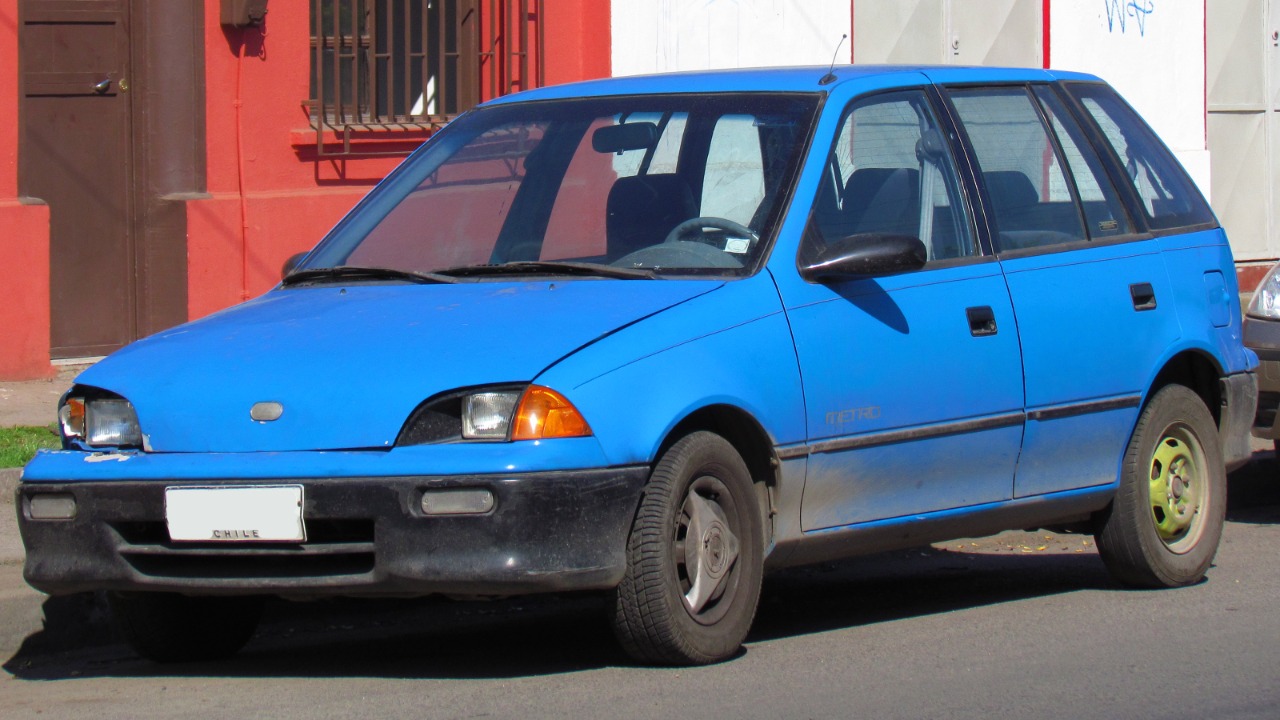
Long before lithium ion batteries and sophisticated power electronics, American showrooms already offered cars that treated gasoline like a precious resource. One of the most famous is the 1990–1994 Geo Metro XFi, a stripped down subcompact that prioritized low weight and modest power over comfort or speed. The Geo Metro was the result of a joint venture between General Motors and Suzuki, and it showed how far careful aerodynamics and a tiny engine could go when the goal was simply to travel as far as possible on a gallon of fuel.
I see that era as proof that efficiency is not only about advanced technology, but also about design discipline. The Geo Metro and its peers relied on small displacement engines, narrow tires, and minimal equipment, which kept curb weight low and reduced the energy needed to move the car. While modern buyers might balk at the lack of safety features or refinement by today’s standards, those early 1990s compacts established a baseline that later hybrids and electrics would surpass only by adding far more sophisticated hardware on top of the same basic physics.
Compact gasoline cars that pushed MPG to the limit
Even as hybrids and electric cars grabbed headlines, a handful of conventional gasoline models quietly delivered standout efficiency. The Honda Civic HF from 2012, for example, was tuned specifically for low fuel consumption and carried a rating of 32 m, while the 2014 Toyota Corolla LE Eco reached 34 m in official testing. Those numbers might not match the best hybrids, but they are impressive for cars that rely solely on internal combustion and still offer the space and comfort of mainstream compact sedans.
Smaller hatchbacks went even further by embracing minimalist design. The Mitsubishi Mirage, introduced as an all new five door subcompact, was marketed as the most fuel-efficient nonhybrid gasoline powered vehicle available at the time, with an official rating that reached 34 mpg city and 42 mpg highway. I see cars like the Honda Civic HF, the Toyota Corolla LE Eco, and the Mitsubishi Mirage as the high water mark for traditional gasoline engineering, squeezing out every last bit of efficiency without the complexity or cost of electric assistance.
Hybrids change the game for everyday drivers
The real shift in America’s efficiency story came when hybrid powertrains moved from niche experiments to mainstream options. Hybrids pair a gasoline engine with one or more electric motors and a battery, allowing the car to recapture energy during braking and use electric power at low speeds, which dramatically cuts fuel use in city driving. Technical work on model year 2011 vehicles found that After the advanced electric drive vehicles, hybrid models made up the majority of the most efficient powertrains in the United States fleet, which underscores how central this technology has become.
Among hybrids, one name towers over the rest. Of all the vehicles sold in the United States by all the major manufacturers, none is more fuel-efficient than the Toyota Prius, which has also become the best selling hybrid on the market. I view the Prius as the car that normalized hybrid technology for American buyers, proving that a vehicle could deliver exceptional fuel economy without sacrificing reliability or basic practicality. Its success pushed other manufacturers to develop their own hybrid systems and helped shift expectations about what a family car could achieve at the pump.
The Hyundai Ioniq Hybrid and the modern MPG record
As hybrid technology matured, engineers kept finding ways to trim losses and extend range, culminating in some of the highest official mpg ratings ever assigned to a car that does not plug in. The Hyundai Ioniq Hybrid, particularly in its base Blue trim level, stands out in that regard. In that configuration, the EPA estimated 58 m in combined driving, a figure that puts it at the very top of the non plug in hybrid segment and makes it one of the most efficient gasoline burning cars ever sold in the United States.
What impresses me about the Hyundai Ioniq Hybrid is how it packages that efficiency in a relatively conventional body style. The Blue trim does not rely on exotic materials or radical design; instead, it uses a carefully calibrated hybrid system, low rolling resistance tires, and aerodynamic tweaks to reach its 58 m rating. That approach shows how far incremental improvements can go when they are applied systematically, and it gives buyers a way to enjoy near Prius level efficiency in a car that feels familiar to drive and own.
Electric cars and the rise of MPGe
Once battery electric vehicles entered the mainstream, the definition of “most efficient” had to expand beyond gasoline. Because electric cars do not burn fuel, regulators convert their energy use into a miles per gallon equivalent, or MPGe, which lets drivers compare them with traditional models. The latest Tesla Model 3 Standard Range, for example, has been cited as the Best mileage overall electric car, with a combined city and highway rating of 142 MPGe. That 142 figure reflects how little electricity the car needs to travel a given distance, and it puts the Model 3 Standard Range in a different league from even the best hybrids.
Electric drivetrains have inherent advantages that help explain those numbers. Modern gasoline engines are more efficient than ever, thanks to technologies like turbocharging and direct fuel injection, but they still waste a large share of energy as heat because of the inherent inefficiencies of internal combustion. Electric motors, by contrast, convert a much higher percentage of their input energy into motion, which is why cars like the Tesla Model 3 Standard Range can post triple digit MPGe ratings. For drivers focused purely on energy use per mile, that makes today’s leading EVs the most efficient cars ever to reach American roads.
Why gasoline cars still matter in the efficiency race
Even as hybrids and EVs dominate the efficiency charts, gasoline only models remain central to the American fleet, and their design still shapes overall fuel consumption. Gasoline Cars rely solely on internal combustion engines, which generally offer lower MPG than hybrid models, and that gap is unlikely to disappear as long as they lack electric assistance. While gasoline engines have improved, they still cannot match the energy recovery and low speed efficiency that hybrids and EVs achieve through regenerative braking and electric drive.
At the same time, engineers continue to refine combustion technology in ways that keep conventional cars competitive for buyers who are not ready to plug in. Discussions of compression ratio and combustion chamber design highlight that, Despite the fact that some of the most efficient vehicles do not really use gasoline in the traditional sense, the same thermodynamic principles apply when engineers chase better fuel economy. I see that ongoing work as a reminder that even as the market shifts toward electrification, improvements to gasoline engines will still play a major role in how much energy the overall fleet consumes.
Policy pressure and the official efficiency leaderboard
The cars that top America’s efficiency charts do not exist in a vacuum; they are shaped by regulations that reward low fuel consumption and penalize waste. Federal standards set minimum efficiency targets for automakers’ fleets, and recent debates have focused on how to treat electric and hybrid vehicles within those rules. Consequently, the latest fuel economy standards consider electric vehicles and miles per gallon when hybrid vehicles are counted, which can give manufacturers extra credit when they exceed the targets in a given year.
Those rules help explain why automakers have invested so heavily in hybrids like the Toyota Prius and the Hyundai Ioniq Hybrid, as well as in high MPGe electric models such as the Tesla Model 3 Standard Range. By raising the bar for what counts as acceptable fleet efficiency, regulators effectively push the market toward the kinds of vehicles that now dominate the top of the official rankings. I expect that as standards evolve, the definition of the “most efficient” car will keep shifting, with new models emerging that blend electric power, advanced combustion, and lightweight design in ways that would have been hard to imagine back in the days of the Geo Metro.
More from MorningOverview