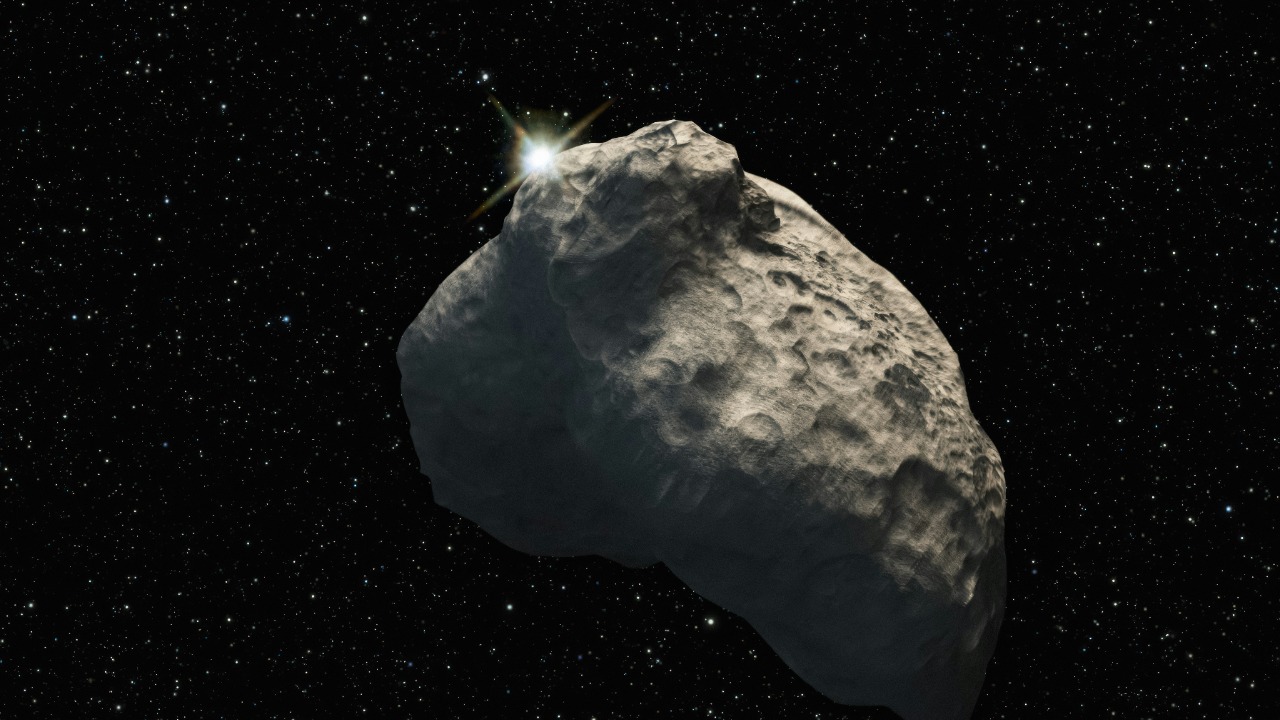

Asteroids are no longer just celestial curiosities on a telescope chart; they are emerging as test beds for a new resource economy that could reshape how humanity powers industry, builds infrastructure and explores deep space. The most promising clues are not in speculative business plans but in ancient space rocks themselves, whose chemistry and structure are starting to reveal a practical playbook for extracting metals, water and carbon in microgravity.
As scientists decode these primitive objects, I see a convergence between laboratory analysis and commercial ambition that turns asteroid mining from a science fiction trope into a near term engineering problem. The blueprint is written in carbonaceous chondrites and other early solar system fragments, and the race is now on to read it fast enough to guide the first wave of missions that hope to turn rubble piles into refueling depots and metal foundries in orbit.
What ancient space rocks are really telling us
The most important shift in the asteroid mining conversation is that it is no longer driven only by entrepreneurs and futurists, but by detailed measurements of real rocks. Researchers studying fragile meteorites and returned samples are finding that some of the oldest objects in the solar system are rich in water bearing minerals, organic compounds and metals, a combination that makes them both scientifically precious and commercially attractive. In work highlighted under the heading Ancient Space Rocks May Hold the Blueprint for Asteroid Mining, scientists connect these ancient bodies to the source of carbonaceous chondrites, the dark, carbon rich meteorites that fall to Earth and hint at the resources locked inside similar asteroids.
Those same investigations, described as work By Spanish National Research Council scientists at CSIC, frame these meteorites as more than relics of planetary formation. They are being treated as reference manuals for future resource use, with researchers cataloging how water, metals and organics are distributed through their interiors and how those materials survived billions of years in space. I read that as a deliberate pivot: instead of asking only what these rocks can tell us about the Early Solar System, teams are now asking how their physical and chemical properties can be harnessed to support long duration human activity beyond Earth.
Bennu, Ryugu and the new sample science economy
If meteorites are the rough draft of this resource manual, the pristine samples from near Earth asteroids Bennu and Ryugu are the edited, high resolution version. At the Workshop on Bennu and Ryugu, organized under Meeting Planning Services, scientists are gathering in Houston, Texas and virtually to compare how water and amino acids are preserved in these Samples from the Early Solar System. That focus on preservation is crucial for mining, because it reveals how delicate volatiles and complex molecules behave inside small bodies that have been bombarded and heated over time.
The same samples are feeding a broader push to open access to data and material for the global community. An Announcement of Opportunity for Ryugu and Bennu Samples lays out Key milestones, including a Call for proposals and a Deadli for accepted proposers to request material for their own experiments. I see that as the start of a sample science economy, where dozens of teams test drilling techniques, thermal processing and chemical extraction methods on tiny grains that stand in for full scale mining targets. The more we learn from Bennu and Ryugu now, the fewer surprises early commercial missions will face when they try to anchor to, cut into and process similar rubble piles in situ.
From feasibility studies to engineering checklists
Turning those scientific insights into a business case requires more than enthusiasm; it demands a sober look at what is technically and economically possible. That is where dedicated feasibility work comes in. A pioneering study led by ICE at CSIC, described in a release that notes how ICE-CSIC leads a pioneering study on the feasibility of asteroid mining, zeroes in on the physical and chemical composition of asteroid material and how it would respond to extraction. By treating asteroids as specific engineering environments rather than generic rocks in space, the study starts to define which targets are worth visiting and what equipment they would require.
In parallel, mission data are being translated into practical design constraints. Graphics from a NASA briefing on Bennu explain how, After seven years in deep space, the OSIRIS-REx spacecraft flew past Earth to deliver samples of the near Earth asteroid, then continued on to explore other small worlds across the solar system. For me, that trajectory is a reminder that any mining architecture will have to account for multi year cruise phases, complex rendezvous maneuvers and sample handling in microgravity, all of which are now documented in mission archives that engineers can mine for lessons as aggressively as they hope to mine the rocks themselves.
Why carbonaceous asteroids look like prime targets
Not all asteroids are created equal from a resource perspective, and the data are starting to sharpen that distinction. Carbon rich, or carbonaceous, bodies stand out because they combine water, metals and organics in a single package. A technical analysis framed under the title Abstract on Chondritic asteroids notes that these objects contain FeNi and valuable metals such as platinum and cobalt, and that their composition can be quantified through measurements of carbonaceous chondrites by ICP MS. That combination of iron nickel, platinum group elements and volatiles is exactly what mining advocates have been hoping to find.
Earlier commercial roadmaps anticipated this focus. A plan that argued asteroid mining may be a reality by 2025 emphasized that the effort would begin with water, which is plentiful in a type of space rock known as carbonaceous chondrites, and that this water could support propellant production and life support before companies moved on to metals for electronics and other high tech goods. Those expectations are captured in a report that notes how This ambitious plan begins with water and then extends to a broader portfolio of resources. As laboratory measurements confirm that carbonaceous bodies really do host this mix, the case for targeting them first becomes less speculative and more like standard resource geology, just transposed into microgravity.
Private companies race to turn theory into hardware
While scientists refine the map, startups are building the picks and shovels. One of the most aggressive players is AstroForge, which has laid out a sequence of missions that move from technology demonstration to actual resource prospecting. Reporting on the company explains that a Space mining startup AstroForge aims to launch a historic asteroid landing mission in 2025, after emerging from stealth mode four months later than its initial reveal. That schedule is ambitious, but it signals that at least one company is willing to stake real hardware on the proposition that small bodies can be reached and studied with relatively low cost spacecraft.
The same company has been promoting its plans in more public facing channels, underscoring how quickly asteroid mining is moving from conference slides to social media feeds. In a post that declares that Space mining is no longer science fiction, AstroForge highlights its preparations to explore asteroid 2022 OB5 in search of valuable materials, tagging the effort with #FutureTech and #Asteroid2022OB5. I see that messaging as more than marketing; it is a signal to investors, regulators and potential partners that the company expects to operate in a world where the scientific groundwork on carbonaceous chondrites and other targets has already de risked the basic premise that there is something worth finding.
The trillion dollar promise and the boom narrative
Behind the technical details sits a simple economic story: if the resources in these rocks can be tapped, the payoff could be enormous. Policy analysts have pointed to databases that try to quantify that upside. One commentary notes that, According to Asterank, a database that estimates the expected value of thousands of asteroids based on scientific publications, a single object can be worth $1.5 trillion, an enormous boon if even a fraction of that value can be realized. Those figures are not cash flow forecasts, but they frame why investors and governments are willing to entertain the idea that asteroid mining could eventually rival terrestrial extractive industries.
The narrative of a coming resource rush is also seeping into mainstream coverage. A video essay on the space economy, titled The Space Mining Boom, argues that resources from the moon to the asteroids could shape how the next great economic expansion unfolds, describing how the race for space resources could spark the greatest economic boom in human history. I read that framing as both aspirational and cautionary. If the boom materializes, it will be because the blueprint hidden in ancient space rocks translated into reliable supply chains, not because of hype alone. If it fails, it will likely be because the engineering and legal hurdles proved harder than early advocates admitted.
How traditional space powers are positioning themselves
States are not waiting on the sidelines while startups and think tanks sketch out this future. Major spacefaring nations are weaving asteroid resources into their broader strategies for exploration and defense. In China, researchers and officials have outlined a combined approach to planetary protection and potential utilization. A report on that effort explains that China has done a series of preparation works for asteroid defense, with the China National Space Administration launching dedicated programs and building observation facilities in locations such as Lijiang in southwest China. While the focus is framed as defense, the same tracking and characterization capabilities are directly relevant to identifying and assessing mining targets.
In the United States, the private sector is increasingly treated as a partner in this shift. A feature on the emerging industry notes how Hope Hodge Seck reports for Studio Gannett on how private companies are being drawn into a new space race, with figures like When Joel Sercel championing the promise of extracting valuable materials from asteroids with potential for mining. I see that as a sign that asteroid resources are no longer a niche topic for planetary scientists, but a live issue in industrial policy and national strategy, where questions about who gets to mine what, and under which legal frameworks, are starting to move from theory into negotiation.
From hype to hard choices in the next decade
For all the excitement, the path from blueprint to operating mine is not guaranteed, and the next decade will be defined by a series of hard choices. Companies like AstroForge will have to prove that small spacecraft can not only reach targets like 2022 OB5 but also characterize them well enough to justify follow on missions that carry heavier extraction hardware. Scientists working with Bennu and Ryugu material will need to translate their findings into specific design rules, such as how to anchor to loosely bound regolith or how to heat carbonaceous material without destroying the very volatiles they hope to capture. The fact that Meeting Planning Services is convening a dedicated Workshop on Bennu and Ryugu Samples from the Early Solar System, and that agencies are issuing open calls for proposals tied to Key milestones and Deadli, tells me that the research community understands the urgency of that translation.
At the same time, policymakers will have to decide how to regulate an industry that could, if the most optimistic projections hold, unlock resources valued in the trillions while operating in a legal environment that was never designed for commercial extraction beyond Earth orbit. The combination of detailed composition studies, such as those cataloged in the Chondritic asteroid Abstract, and sweeping economic narratives about a Space Mining Boom, will shape those debates. In the end, ancient space rocks will not just guide drill bits and processing plants; they will also guide laws, treaties and norms, as humanity decides whether to treat asteroids as shared scientific heritage, private quarries or something in between.
More from MorningOverview