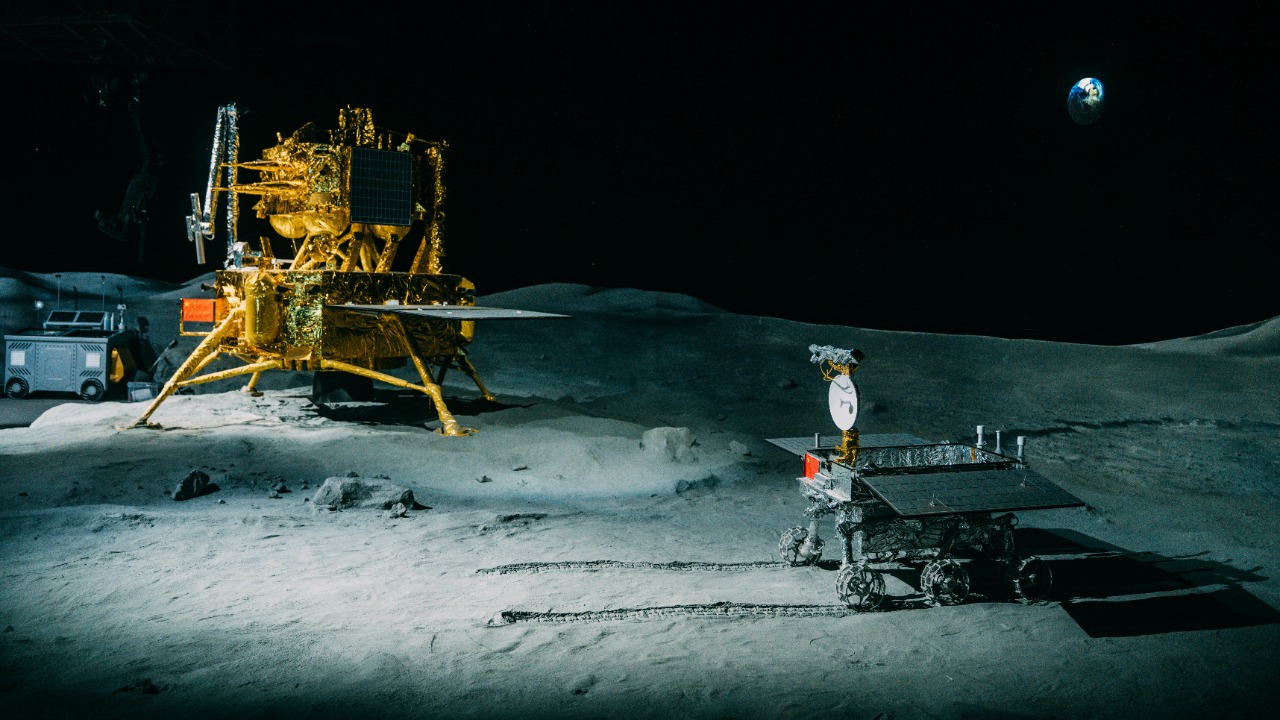

Humanity has left boot prints, flagpoles, and crash sites scattered across the Moon, and a growing group of scientists now argue those traces are significant enough to mark a new chapter in lunar history. Instead of treating the Moon as a pristine time capsule, they say we should recognize a distinct “lunar Anthropocene,” a period defined by human activity reshaping the surface of another world. The debate is no longer about whether our presence is visible there, but whether those marks are now permanent features of the Moon’s geological story.
As missions from national space agencies and private companies accelerate, the stakes of that argument are rising quickly. I see the emerging consensus around a lunar Anthropocene as a warning label, a way of forcing policymakers and engineers to confront the fact that every landing, rover track, and plume of exhaust is altering an environment that has been largely unchanged for billions of years.
How a quiet Moon became a human archive
For most of its existence, the Moon evolved under the slow grind of impacts and solar radiation, with no atmosphere, water cycle, or plate tectonics to erase its scars. That changed abruptly when Homo sapiens, who first appeared in Homo sapiens first appeared in Africa around 300,000 years ago, developed the technology to leave Earth and reach the lunar surface. In geological terms, the gap between those first steps in Africa and the first steps in the Sea of Tranquility is a blink, yet the physical evidence of that leap is now etched into the Moon’s regolith.
From the Apollo landing sites to robotic missions that have crashed, landed, or orbited, the Moon has become a kind of open-air museum of human exploration. I see it as an archive that records not only our technological progress but also our changing attitudes toward space, from Cold War competition to commercial opportunity. Scientists who argue for a lunar Anthropocene are essentially saying that this archive is no longer a side note to lunar geology, it is now one of its defining features.
What scientists mean by a “lunar Anthropocene”
On Earth, the term Anthropocene is used to describe a proposed geological epoch in which human activity dominates climate and ecosystems, but that label is still contested. A committee of experts convened by the International Union of Geological Sciences recently rejected a formal start date, so in official stratigraphic terms the Anthropocene has not yet begun. Yet in parallel, planetary scientists and archaeologists are adapting the concept for the Moon, arguing that human actions there are already distinct enough to justify their own epochal label.
In their view, the lunar Anthropocene is not about greenhouse gases or biodiversity, but about the cumulative physical imprint of exploration on a body that otherwise changes very slowly. Researchers who study these sites point to lander pads, rover tracks, discarded equipment, and impact scars from spent rocket stages as evidence that human activity has crossed a threshold. I read their argument as a call to treat these traces as part of lunar geology, not just as historical curiosities.
From first footprints to a new epoch
The case for a new lunar epoch often starts with a single, iconic moment: the first human landing. When Apollo astronauts descended to the surface, their engines blasted plumes of dust and gas across the landscape, and their boots pressed crisp tracks into the regolith that have barely softened since. Scientists now describe that dust-stirring event as a pivot point, arguing that that pivotal, lunar dust stirring landing marked the beginning of a qualitatively new phase in the Moon’s history.
From that moment onward, every mission has added layers to a growing human-made stratum. Crash sites from failed attempts, controlled impacts of upper stages, and the scattering of tools and instruments have all contributed to a patchwork of disturbances. I see the argument for a lunar Anthropocene as a way to connect these individual episodes into a single narrative, one that treats the Moon as a place where human and natural processes now interact.
How humans are physically reshaping the lunar surface
What makes the lunar Anthropocene more than a metaphor is the scale and permanence of the changes scientists are documenting. Analyses of mission records and surface imagery show that Humans are changing the Moon’s surface so much it’s entered what some researchers describe as a new geological era, with landers and rovers disturbing regolith, ejecta plumes redistributing dust, and impact experiments carving fresh craters. On a world without wind or rain, these disturbances can persist for millions of years, effectively fossilizing our presence.
Even seemingly minor artifacts, from small instruments to the famous golf balls left behind by astronauts, are now counted as part of this transformation. Scientists who track these sites note that the Moon’s new era includes footprints, tire tracks, flags, and discarded hardware, and they warn that future missions could erase or overwrite this record. Reports on how humans affect the lunar surface with footprints, photographs, and golf balls underline how even small acts of exploration can have outsized, long-lasting effects in such a static environment.
Why some researchers say the Moon has “officially” crossed a line
As the evidence of human impact accumulates, some scientists have moved from cautious suggestion to confident declaration. They argue that the combination of physical disturbance, cultural significance, and the prospect of rapid expansion in lunar activity means we have already crossed the threshold into a new epoch. In their framing, Scientists Think We have Officially Entered the Lunar Anthropocene, and they treat the Apollo sites and later missions as the first chapters of a much longer story.
Archaeologists involved in this work emphasize that footprints and artifacts on the Moon are not just engineering leftovers, but part of the overarching narrative of evolution and culture. I find their perspective striking because it reframes the lunar surface as a shared heritage site, one that belongs to all of humanity rather than to any single nation or company. By declaring that we have Officially Entered the lunar Anthropocene, they are trying to lock in that idea before commercial pressures and geopolitical rivalries reshape the terrain beyond recognition.
Comparing lunar change with Earth’s contested Anthropocene
The debate over a lunar Anthropocene is unfolding alongside a more contentious argument about Earth’s own status. On our planet, some researchers have proposed that industrialization, nuclear testing, and fossil fuel combustion have left a clear stratigraphic signal, but a key working group’s recommendation to formalize the Anthropocene was rejected. As a result, But a committee of scientists organized by the International Union of Geological Sciences has effectively ruled that, in official geological time scales, the Anthropocene has not yet begun.
That decision highlights a paradox. On Earth, where human influence on climate and ecosystems is overwhelming, the formal label is still withheld, while on the Moon, where our footprint is physically smaller but geologically stark, scientists are more willing to speak of a new epoch. I see this contrast as a reminder that geological timekeeping is conservative by design, and that terms like Anthropocene and lunar Anthropocene are as much about politics and perception as they are about rock layers and dust.
Why the Moon’s geology makes human traces so enduring
Part of what makes the lunar Anthropocene compelling is the Moon’s unique geological context. Unlike Earth, the Moon has no atmosphere, no liquid water at the surface, and no active plate tectonics, so natural processes that erase or recycle landscapes are extremely limited. Over the same span that Earth has passed through around 15 geological periods, the Moon’s surface has changed far less, which means that even small disturbances can stand out for eons.
Scientists like Waldmann, who study the implications of this contrast, warn that as missions multiply, the cumulative effect could define an entire new geological period for the Moon. Waldmann is concerned that mission planners are not yet fully accounting for how exhaust plumes, landing pads, and resource extraction might spread dust or alter local conditions in ways that are effectively permanent. When I weigh those warnings against the Moon’s slow natural evolution, it becomes clear why some researchers see the current moment as a once-only chance to set norms before the next wave of exploration fans out into the solar system.
Growing concern over future missions and lunar “pollution”
The push to name a lunar Anthropocene is not just academic, it is also a reaction to the surge of planned missions from space agencies and private firms. Scientists who track these developments are increasingly vocal about the risk that uncoordinated landings, mining experiments, and tourism could degrade scientifically valuable sites. Reports highlighting how Scientists are concerned over human impact on the Moon describe a new era in which our activities there could have a significant impact on the planet-sized satellite that shapes Earth’s tides and nights.
These concerns extend beyond visible litter to more subtle forms of contamination, such as exhaust gases that might alter the chemistry of polar ice or dust clouds that could interfere with future observations. I read the warnings from lunar researchers as an attempt to get ahead of these problems, rather than waiting for a crisis. By framing the current phase as the Moon’s new era, they are trying to build public and political support for rules that would limit the most damaging forms of lunar “pollution.”
Calls for protection, heritage status, and “space hygiene”
Recognizing a lunar Anthropocene naturally leads to questions about preservation. If the first landing sites and early robotic missions mark the start of a new epoch, should they be treated like protected heritage zones, off limits to casual visitation or commercial exploitation? Researchers such as Holcomb and colleagues argue that there is currently no equivalent of terrestrial heritage protections for lunar sites, and they recommend a program for space hygiene that would safeguard key locations. Their proposal for the Moon: the Lunar Anthropocene explicitly links this new epoch to the need for careful stewardship.
In practice, space hygiene could mean designating buffer zones around historic sites, coordinating landing locations to avoid dust contamination, and setting standards for how hardware is left or removed. I see these ideas as an attempt to import lessons from conservation on Earth into a very different environment. Holcomb and other advocates are not arguing for a frozen Moon with no new activity, but for a managed approach that balances exploration, science, and preservation in a way that respects the Moon’s emerging status as both a scientific resource and a cultural landmark.
What Earth’s Anthropocene debate can teach lunar policymakers
On Earth, the Anthropocene conversation has already pushed governments and institutions to rethink how they manage resources and environmental risks. International bodies of palaeontologists, geologists, and stratigraphists, in particular the International commissions that oversee geological time scales, have used the concept to highlight the threats human activities pose to the planet. Even without formal ratification, the Anthropocene has become a powerful shorthand for the scale of our impact.
I think lunar policymakers can draw on that experience as they craft rules for exploration and resource use. The label “lunar Anthropocene” can serve a similar function, signaling that human actions on the Moon are no longer negligible and that they require coordinated governance. If the international community can agree that we have entered a new epoch in the Moon’s history, it may be easier to build consensus around guidelines that protect both scientific opportunities and the shared heritage embodied in those first dusty footprints.
Why the timing of this debate matters
The urgency behind the lunar Anthropocene idea is tied to the pace of current and planned missions. Over the past six decades, a steady trickle of landers and orbiters has already shaped the Moon’s environment, and scientists now argue that Six decades of human lunar exploration have brought us to a tipping point. However, when we consider the number of missions on the horizon, from national programs to private ventures, it is clear that the next few decades could transform the lunar surface far more dramatically than the previous half century.
That is why I see the current push to define and name a lunar Anthropocene as more than a semantic exercise. It is an attempt to set the terms of debate before the landscape is irrevocably altered by mining operations, permanent bases, and tourism. If we wait until those projects are fully underway, the opportunity to shape norms and expectations will be much smaller, and the Moon’s new epoch will be defined by default rather than by design.
More from MorningOverview