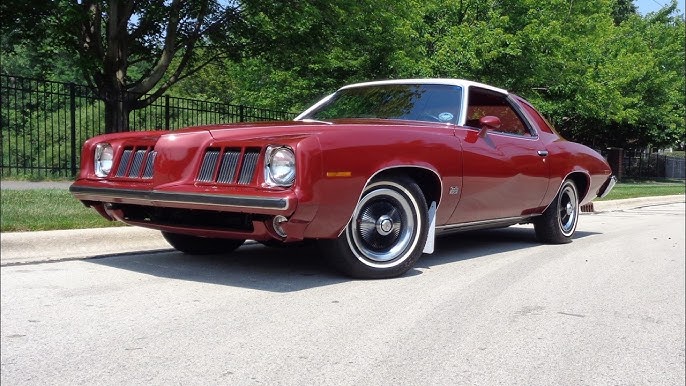

The Pontiac performance story is usually told through GTOs and Trans Ams, yet the brand’s most elusive muscle machine hid in plain sight under a mid-size body and a luxury badge. Buried in the early 1970s, the Pontiac Grand Am Super Duty 455 combined the division’s wildest big-block with a European-flavored chassis, then vanished into obscurity as if it had never existed. I set out to trace how this car slipped through the cracks, and why it now stands as the rarest Pontiac muscle car most enthusiasts never knew they missed.
To understand this forgotten heavyweight, I have to rewind to the end of the classic muscle era, when insurance penalties, emissions rules, and corporate politics were closing in. In that chaos, Pontiac quietly built a handful of mid-size coupes with the same brutal 455 Super Duty hardware that made Firebirds legendary, then watched the project get strangled before it could reach showrooms. The result is a car that exists more as a whispered legend than a production model, yet its story reshapes how I look at Pontiac’s final stand.
The late muscle era that birthed a secret Super Duty
By the early 1970s, Detroit’s horsepower party was already winding down, but Pontiac was still trying to squeeze real performance out of shrinking corporate patience. The division had spent the 1960s building its reputation on big-inch V8s and streetable race hardware, and it was not ready to surrender that identity just because regulators and insurance companies were turning the screws. Inside that pressure cooker, engineers developed the Super Duty version of the 455, a big-block designed to survive serious abuse even as the rest of the industry retreated to softer, low-compression engines.
What makes the Pontiac Grand Am Super Duty so compelling to me is that it represented an attempt to transplant that hardcore 455 into a more sophisticated mid-size package. Rather than limiting the engine to pony cars, Pontiac tried to create a European-inspired touring coupe with real muscle under the hood, a move that would have given the brand a unique niche in the fading performance market. The project never reached full production, but the intent behind it explains why the car now sits at the center of any discussion about the rarest Pontiac muscle machines.
Why the Pontiac Grand Am Super Duty 455 is “as rare as Pontiac muscle cars get”
Among Pontiac faithful, the phrase “Super Duty” still carries a kind of reverence, and attaching it to the Grand Am turns an otherwise overlooked model into a unicorn. The 1973 Pontiac Grand Am Super Duty 455 was conceived as a mid-size coupe that could carry the same heavy-hitting big-block hardware as the brand’s most famous performance cars, yet it was wrapped in a body more often associated with comfort than quarter-mile times. That combination, along with the tiny number of cars actually built, is why the Grand Am Super Duty 455 is now described as “Is As Rare As Pontiac Muscle Cars Get,” a status that has only grown as collectors dig deeper into Pontiac’s back catalog.
What elevates this car beyond ordinary rarity is the way it blends a luxury-leaning platform with the full-bore 455 Super Duty engine. During the muscle car heyday, GM’s divisions usually reserved their wildest engines for coupes like the GTO or Firebird, but the Grand Am Super Duty 455 broke that pattern by pairing a big-block 455 with a more refined chassis and interior. When I look at the surviving documentation on the Pontiac Grand Am Super Duty, it is clear that this was never meant to be a volume seller, which is exactly why it slipped under the radar for so long.
The 455 Super Duty big-block, explained in plain language
To grasp why this car matters, I have to start with the engine itself. The 455 Super Duty was not just a bored-out version of a standard Pontiac V8, it was a heavily reinforced big-block 455 designed to handle serious cylinder pressure and sustained high rpm. Engineers reworked the block, beefed up the internals, and tuned the package for massive torque, creating an engine that could survive both street duty and competition use at a time when most manufacturers were dialing performance back.
In practical terms, that meant the Super Duty 455 delivered the kind of low-end shove that could move a mid-size coupe with ease, even when saddled with early emissions hardware and taller gearing. The engine’s reputation for brutal torque and commensurate fuel consumption is part of its mystique, and it is exactly that character that Pontiac tried to bottle in the Grand Am. When I look at period coverage of the 455 Super Duty, it is obvious that this was never a compromise engine, which makes its pairing with a comfort-oriented body all the more intriguing.
How the Grand Am Super Duty fit into Pontiac’s rarest muscle hierarchy
When I stack the Grand Am Super Duty 455 against other low-production Pontiacs, its scarcity becomes even more striking. Enthusiasts often point to the 1973 Pontiac Firebird Formula 455 as one of the hardest performance Pontiacs to find, and with only 43 Models Produced it certainly deserves that reputation. The Firebird Formula paired the 455 with a lighter F-body shell, and surviving examples are now tracked closely by collectors who specialize in early 1970s muscle.
Even within that rarefied group, the Grand Am Super Duty 455 occupies a different tier. The Firebird Formula 455 and other limited builds, such as the cars highlighted in lists of the rarest Pontiac Firebird Formula variants, were at least recognized as performance models when new. The Grand Am, by contrast, was marketed more as a sporty luxury car, which meant that its Super Duty configuration never got the same spotlight. That mismatch between image and hardware is part of why the Grand Am Super Duty 455 remained almost invisible in the broader muscle car conversation for decades.
The Trans Am SD-455 “holy grail” and what it reveals about rarity
Any discussion of Pontiac’s rarest muscle cars eventually runs into the Trans Am SD-455, a car that has long been treated as the benchmark for collectible Firebirds. Enthusiasts who track production figures point out that there were 943 SD 455s made in 1974 and only 252 SD 455s were made in 1973, numbers that instantly explain why early Super Duty Trans Ams command such intense attention. Those figures also show how Pontiac’s performance output was already shrinking, even as the brand tried to keep its image alive with a handful of high-spec cars.
When I compare those totals to the shadowy history of the Grand Am Super Duty 455, the contrast is stark. The Trans Am SD-455 is widely recognized as a “holy grail” car, especially in 1973 form, and its production numbers are well documented in enthusiast breakdowns of the 943 and 252 SD 455 runs. The Grand Am Super Duty, by contrast, never enjoyed that kind of spotlight, which is why it can legitimately be described as a big-block Pontiac that almost no one outside the deepest circles of the hobby knew existed.
Why collectors call the 1973–1974 Super Duty cars the “holy grail”
From a collector’s perspective, the 1973 and 1974 Super Duty 455 cars represent the last uncompromised expression of Pontiac’s muscle philosophy. These were built at a time when corporate leadership was under overwhelming pressure to cut performance, yet engineers still managed to push the Superduty 455 into production in limited numbers. That defiance is part of why the 197374 Superduty 455 cars are described as the holy grail for Pontiac collectors, a label that reflects both their mechanical significance and their scarcity.
What I find telling is that this “holy grail” status is not limited to a single body style. Whether the engine sat in a Trans Am, a Firebird Formula, or the elusive Grand Am Super Duty 455, the core appeal was the same: a big-block 455 that refused to conform to the era’s retreat from performance. Enthusiast deep dives into the Superduty Pontiac story underline how close these cars came to being canceled altogether, which only adds to the mystique surrounding any surviving Super Duty 455 machine.
How a luxury-leaning Grand Am became a stealth muscle car
On paper, the Grand Am was never supposed to be the star of Pontiac’s performance lineup. It was pitched as a mid-size car with European-inspired ride and handling, a more refined alternative to the rawer GTOs and Firebirds that had defined the brand’s muscle image. Yet by slipping the Super Duty 455 into this chassis, Pontiac effectively created a stealth muscle car, one that could deliver serious straight-line performance without the overt graphics and spoilers that shouted for attention on a Trans Am.
That dual personality is part of what fascinates me about the Grand Am Super Duty 455 today. The car’s styling and interior leaned toward comfort and sophistication, but under the hood sat the same big-block 455 hardware that made other Super Duty cars legends. In an era when insurance companies were targeting obvious performance models, a Grand Am with Super Duty power would have been a clever way to keep real muscle on the street, even if only a tiny number of buyers ever had the chance to order one.
Why so few people knew this 455 Grand Am existed
The obscurity of the Grand Am Super Duty 455 is not just a function of low production, it is also the result of how Pontiac’s story has been told over time. Popular histories tend to focus on headline models like the GTO Judge or the Trans Am SD-455, cars that were heavily promoted and raced in period. The Grand Am, with its more subdued image and limited marketing as a performance car, simply did not generate the same kind of folklore, even if its hardware was every bit as serious.
As a result, the Grand Am Super Duty 455 spent decades as a footnote, known mainly to archivists and the most dedicated Pontiac historians. Only as collectors began to chase deeper into the brand’s catalog, comparing production figures for cars like the Firebird Formula 455 and the various Super Duty 455 applications, did the Grand Am’s true rarity come into focus. That delayed recognition is why it can be described as a 455 big-block no one knew, a car that quietly carried some of Pontiac’s best engineering while the spotlight shone elsewhere.
What the Grand Am Super Duty 455 means for Pontiac’s legacy
Looking back now, I see the Grand Am Super Duty 455 as a symbol of Pontiac’s refusal to give up on performance, even as the classic muscle era collapsed around it. The decision to engineer a Super Duty version of a mid-size luxury-leaning car shows how deeply the division believed in big-inch V8s as part of its identity. It also highlights the tension between engineers who wanted to keep building fast cars and corporate leadership that was increasingly wary of the political and financial costs of doing so.
For modern enthusiasts, the car’s story reshapes the way Pontiac’s final muscle years are understood. Instead of a simple narrative where performance died with the rise of emissions rules, the Grand Am Super Duty 455 proves that serious hardware was still being developed and, in very limited numbers, built. In that sense, the rarest Pontiac muscle car is not just a curiosity, it is a reminder that even in its final years, the brand was still trying to find new ways to keep the 455 flame alive.
More from MorningOverview