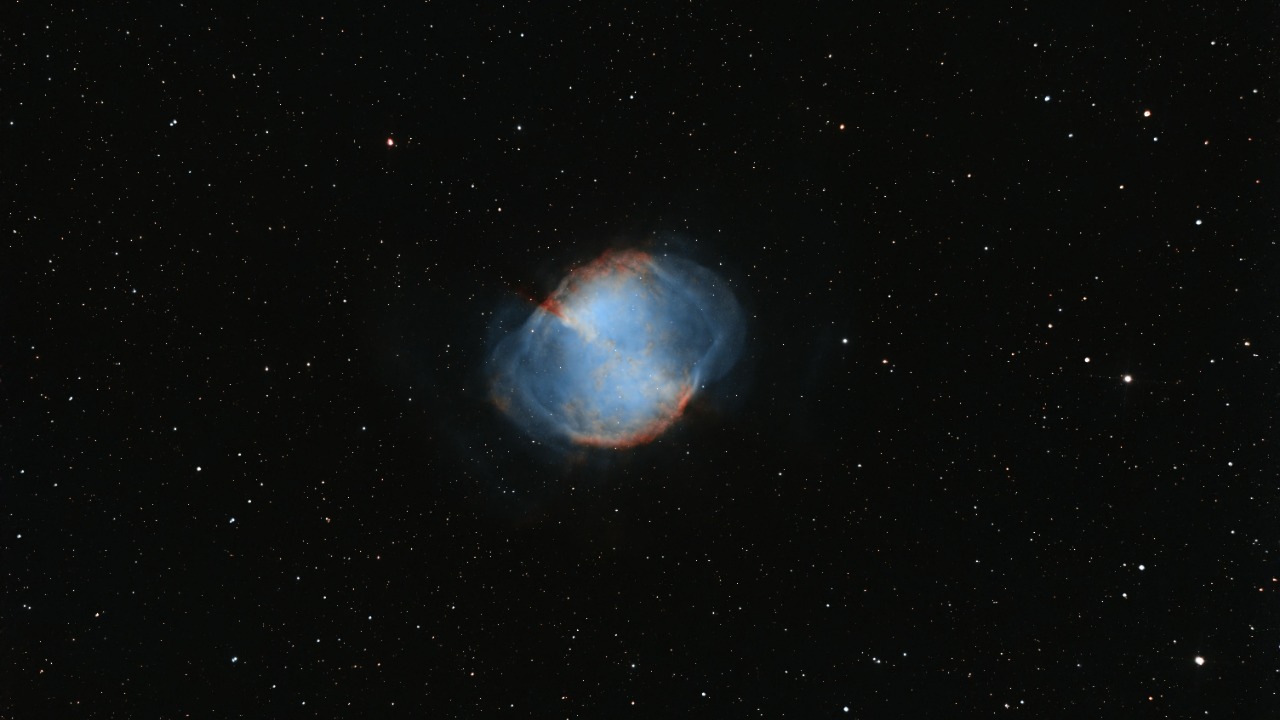

Hubble has turned its sharp gaze on a compact, intensely blue dwarf galaxy about 13 million light years away, revealing a crowded nursery where massive stars are being forged at a furious pace. The new view captures a system so small and bright that it looks almost like a single star, yet it is packed with clusters whose radiation and winds are reshaping the gas around them.
By freezing this brief but dramatic phase of galactic growth, the image offers a rare close-up of how star formation proceeds in an environment that resembles the early universe more than our own Milky Way. I see in this scene not just a pretty picture, but a laboratory for understanding how massive stars leave their fingerprints on a galaxy’s light, structure, and future.
A blue compact dwarf in sharp focus
The galaxy at the heart of the new image is a classic blue compact dwarf, a small system whose light is dominated by hot, young stars rather than the older, redder populations that fill galaxies like the Milky Way. Its compact appearance comes from the way star formation is concentrated into tight knots, so the galaxy glows as a single, glittering blue patch even though it contains countless individual suns. At roughly 13 million light years away, it sits close enough for Hubble to resolve those knots into distinct clusters and filaments, turning what might look like a point of light in a backyard telescope into a richly textured landscape.
Blue compact dwarfs are especially valuable because their low mass and relatively simple structure make it easier to isolate the effects of recent star formation. In this case, the galaxy’s intense blue color signals a population of massive, short-lived stars that are pouring out ultraviolet radiation and carving cavities in the surrounding gas. The new view, released as a Hubble Picture of the Week from ESA, highlights how those massive stars are clustered in brilliant knots, with their influence etched into the galaxy’s spectrum and morphology.
Why dwarf galaxies matter for cosmic history
Although they are small, dwarf galaxies like this one play an outsized role in the story of cosmic evolution. Their shallow gravitational wells and modest gas reservoirs make them highly sensitive to the feedback from massive stars, so a single burst of star formation can dramatically alter their structure. When I look at a blue compact dwarf, I see a scaled-down version of the conditions that likely prevailed in the early universe, when galaxies were smaller, more irregular, and dominated by fresh waves of starbirth. Studying these nearby analogues lets astronomers test theories about how the first generations of stars lit up the cosmos.
Because dwarf galaxies are less chemically enriched than large spirals, their gas more closely resembles the primordial mix of hydrogen and helium that filled space after the Big Bang. Massive stars in such environments produce distinct signatures in the light they emit and in the heavy elements they forge and disperse. By examining how those signatures appear in a compact, vigorously star-forming system only 13 million light years away, researchers can connect local observations to the distant, faint galaxies seen at high redshift. The Hubble view of this blue compact dwarf therefore serves as a bridge between the nearby universe and the formative epochs when galaxies were first assembling.
Massive stars and their violent influence
The most striking aspect of the new image is the dominance of massive stars, which shine so intensely that they overwhelm the light from more ordinary suns. These giants live fast and die young, burning through their fuel in a few million years and flooding their surroundings with ultraviolet photons and powerful stellar winds. In the compact environment of a dwarf galaxy, that energy does not dissipate quietly. It sculpts the gas into bubbles and shells, compressing some regions into new star-forming clumps while blowing others clear of material altogether.
Over time, this feedback from massive stars can regulate or even quench further star formation by heating and expelling gas from the galaxy’s shallow gravitational well. The Hubble image captures this process in action, with bright clusters embedded in wispy structures that trace the paths of outflows and shock fronts. Spectroscopic observations of such systems reveal how the radiation from these stars is etched upon the galaxy’s spectrum, encoding information about their temperatures, compositions, and the ionization state of the gas they bathe. In a blue compact dwarf, where the massive stars dominate the light, those spectral fingerprints become especially clear and powerful as diagnostic tools.
Reading the galaxy’s spectrum like a forensic record
One of the quiet triumphs of this observation is how it turns the galaxy’s spectrum into a kind of forensic record of stellar activity. When I think about a spectrum from a system like this, I picture a barcode of emission and absorption lines, each one tied to a specific element, ionization level, or physical condition. Massive stars pump out high-energy photons that strip electrons from atoms in the surrounding gas, producing strong emission from ionized hydrogen, oxygen, and other elements. The relative strengths and shapes of those lines tell astronomers about the temperature of the stars, the density of the gas, and the overall chemical makeup of the galaxy.
In a blue compact dwarf, where the light is dominated by a recent burst of star formation, the spectral features associated with massive stars stand out with particular clarity. That is why the description of this system emphasizes how the influence of these stars is etched upon the galaxy’s spectrum, turning it into a direct record of their presence and power. By comparing these spectral signatures with models of stellar populations and with observations of other dwarf galaxies, researchers can reconstruct the star formation history of the system and estimate how much mass has been converted into stars during the current burst.
Starburst structure on galactic and cluster scales
Zooming in on the Hubble image, the galaxy’s starburst does not appear as a single monolithic event, but as a patchwork of clusters and associations at different stages of evolution. Some knots are intensely bright and compact, likely hosting very young, massive stars still embedded in their natal clouds. Others are more diffuse, suggesting that stellar winds and radiation have already cleared away much of the surrounding gas. This layered structure hints at a sequence of star-forming episodes that propagate through the galaxy as feedback from one generation triggers or suppresses the next.
On the scale of individual clusters, the density of massive stars can be extreme, with their combined radiation fields overlapping and reinforcing one another. In a small galaxy, those clusters are packed into a relatively tight volume, so their collective influence can reshape the entire system. The Hubble view of this blue compact dwarf illustrates how a galaxy only a fraction of the Milky Way’s size can host a starburst whose impact is global rather than local. Gas flows, shock fronts, and ionization fronts span the visible extent of the galaxy, tying the fate of its interstellar medium to the life cycles of a few thousand massive stars.
A nearby stand-in for distant, early galaxies
One of the reasons I find this observation so compelling is that it offers a nearby stand-in for the faint, compact galaxies that populated the early universe. At high redshift, telescopes like Hubble and the James Webb Space Telescope see small, intensely star-forming systems that are often unresolved or barely resolved, their light dominated by young, hot stars. The blue compact dwarf captured here shares many of those traits, but it sits close enough that Hubble can pick apart its internal structure and measure its spectrum in detail. That combination of proximity and similarity makes it an ideal analogue for testing theories about early galaxy growth.
By studying how massive stars shape the gas, dust, and overall energy budget of this dwarf galaxy, astronomers can refine models of how similar processes might have unfolded when the universe was only a fraction of its current age. For example, the efficiency with which massive stars drive gas out of a shallow potential well affects how quickly a galaxy can build up its stellar mass and how much ionizing radiation escapes into intergalactic space. In the context of cosmic reionization, where the first galaxies are thought to have reionized the hydrogen between them, systems like this provide crucial clues about how much light could leak out of compact, vigorously star-forming galaxies and transform the larger cosmic environment.
Hubble’s enduring role in mapping star formation
Even in an era when newer observatories are pushing deeper into the universe, Hubble remains uniquely powerful for detailed imaging of nearby galaxies. Its sharp vision in optical and ultraviolet wavelengths is perfectly suited to tracing the light from hot, massive stars and the glowing gas they ionize. The blue compact dwarf highlighted in the recent Hubble Picture of the Week is a textbook example of how the telescope can turn a seemingly simple object into a richly structured scene, revealing the interplay between stars and gas on scales of a few light years.
Hubble’s long operational history also means that it can place new observations in the context of decades of prior work on dwarf galaxies and starbursts. By comparing this galaxy to other blue compact dwarfs and to more quiescent systems, astronomers can map out a continuum of star formation activity and feedback strength. The consistency and depth of Hubble’s imaging archive allow researchers to ask not just what this galaxy looks like now, but how its current state fits into broader patterns of galactic evolution. In that sense, each new image is both a fresh discovery and a data point in a much larger effort to understand how galaxies live, grow, and transform.
What this starburst reveals about galactic futures
Looking ahead, the intense star formation in this dwarf galaxy raises questions about its long-term fate. Massive stars will soon end their lives as supernovae, injecting additional energy and heavy elements into the surrounding gas. In a small system, a concentrated wave of supernova explosions can drive powerful outflows that strip gas from the galaxy or push it into extended halos. Whether the galaxy can retain enough material to sustain future generations of stars depends on a delicate balance between its gravitational pull and the cumulative force of stellar feedback.
If the current burst expels a significant fraction of the galaxy’s gas, the system could transition into a more quiescent phase, with only low-level star formation continuing in whatever material remains bound. Alternatively, if some gas is pushed outward but later cools and falls back, the galaxy might experience episodic bursts, cycling between active and quiet periods over hundreds of millions of years. The Hubble snapshot captures just one moment in that longer story, but by analyzing the distribution of gas, the ages of star clusters, and the signatures of outflows in the spectrum, astronomers can infer how this particular episode fits into the galaxy’s broader evolutionary arc.
Why images like this still change how I see the universe
For all the technical detail embedded in the data, there is also a simple, visceral impact to seeing a small galaxy lit up by such concentrated starbirth. It is a reminder that the universe’s most dramatic transformations often unfold in compact, easily overlooked corners, not just in grand spirals or massive clusters. A blue compact dwarf 13 million light years away might seem remote, yet the physics at work there is the same that shaped the Milky Way’s earliest epochs and continues to govern how stars form in our own neighborhood.
When I study an image like this, I am struck by how much information is encoded in a single frame: the ages and masses of stars, the flows of gas, the chemical fingerprints of past generations, and the hints of future change. Hubble’s view of this glittering blue galaxy distills those layers into a scene that is both aesthetically striking and scientifically dense. It shows that even after decades in orbit, the telescope can still surprise, revealing new facets of familiar processes and giving us fresh vantage points on how galaxies, large and small, build their stars and write their histories in light.
More from MorningOverview