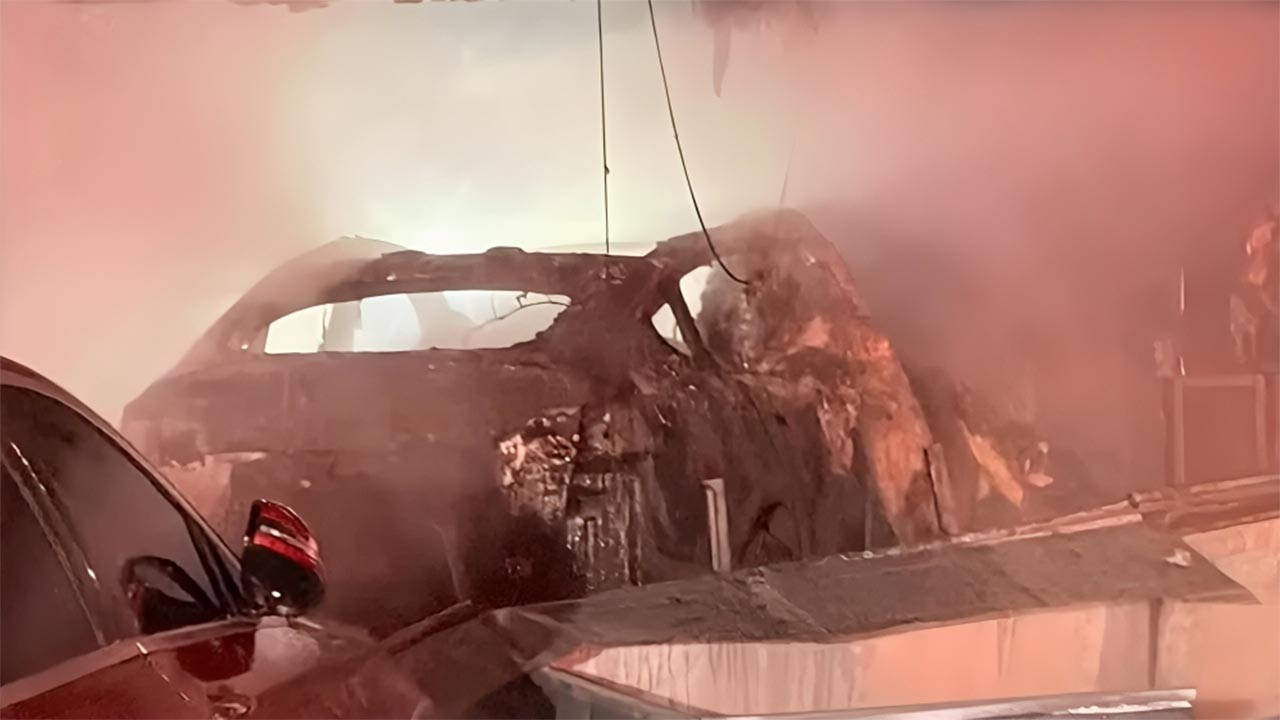

A Florida family’s ordinary night of home charging turned into a life‑or‑death scramble when flames from a Tesla charger ripped through their garage and raced toward the bedrooms upstairs. In seconds, a quiet suburban house became a maze of smoke, blocked stairways, and split‑second decisions that separated survival from catastrophe. The fire destroyed nearly everything they owned, but it also exposed how little most of us understand about the risks that come with parking high‑voltage technology under the same roof where our children sleep.
As electric vehicles move from novelty to normal, the story of a Tesla charger fire that gutted a Florida home and nearly trapped a family of six is more than a freak accident. It is a warning about how quickly lithium ion systems can fail, how fragile our escape routes can be, and how far safety guidance and regulation still have to go to keep pace with the batteries and chargers we now treat as everyday appliances.
The night a Tesla charger turned a garage into a trap
The family in Sanford, Florida, had done what millions of EV owners do every night: plug in the car, close the garage door, and head upstairs. According to reporting on the incident, the blaze started in the area of the Tesla charging station in the garage, then spread so fast that the parents and four children were suddenly cut off from their usual way out. One parent later described trying to reach the stairs and realizing that “the fire was eating the stairs,” a moment when the familiar layout of the house turned into a dead end filled with heat and smoke.
That same account makes clear how close this came to being a mass‑casualty fire. The father, identified as Mina Raky, had to improvise an escape plan in real time while the structure around him failed. He and his partner had to move children away from the staircase, find alternative exits, and keep everyone together as the garage burned below. In the chaos, the family of six lost nearly all of their possessions, but they survived, a result Raky later described as a “miracle” given how quickly the blaze consumed the home and how completely it destroyed their belongings, as detailed in coverage of the family of 6.
Inside the Sanford family’s escape from a burning home
What happened inside the house in those minutes is a study in how modern fires outpace human reaction time. Once the garage was involved, smoke and heat moved upward, cutting off the staircase and forcing the family to consider windows and secondary exits that were never meant to be primary escape routes. The father’s realization that he “couldn’t” use the stairs, and that his daughter would not be able to either, captures the speed at which a familiar home can become unrecognizable when a fire starts in an attached garage.
Investigators later noted that the blaze did not appear to be intentional, a key detail that shifts attention away from arson and toward the systems and equipment inside the garage. The official report, according to coverage of the case, stated that the cause remained under investigation but that there was no sign of deliberate ignition, a conclusion that leaves open questions about the role of the Tesla charging setup and any other electrical components in the space. That same report, which has not yet been fully resolved, underscores how a family can lose everything in minutes even when there is no criminal act involved, as reflected in the finding that the fire “did not appear to be intentional” in the official report.
Why firefighters focused on the Tesla charging station
From the start, local firefighters treated the Tesla charging station as a prime suspect. Crews who responded to the Sanford blaze pointed to the EV equipment in the garage as a likely ignition source, based on where the flames were most intense and how the damage radiated outward. Their early assessment was careful, not definitive, but it reflected a growing familiarity among first responders with the unique hazards of high‑capacity chargers and lithium ion systems installed inside homes.
Coverage of the incident notes that firefighters described the Tesla charging station as “suspected” in the Florida house fire, a choice of words that matters. It signals that trained investigators saw enough evidence to focus on the charger while still leaving room for further electrical or mechanical analysis. The family, for its part, has been clear that the fire began in the garage where the Tesla was plugged in, and that the charging setup was central to the disaster that nearly trapped them, a narrative echoed in reports that a Florida family escapes house fire after a Tesla charger was flagged by crews on scene.
A Florida family that now blames Tesla for burning down their house
As the smoke cleared, the Sanford family’s view of what happened hardened into a direct accusation. They now say their Tesla and its charging system are to blame for burning down their house, a claim rooted in their experience of seeing the garage erupt while the vehicle was plugged in. From their perspective, they did what Tesla and other EV makers encourage owners to do, charging at home overnight, and the result was a total loss of their property and a near miss for their lives.
Reporting on the case describes them as a Florida family that explicitly blames Tesla for the destruction, emphasizing that “everyone survived” but that the house itself was effectively wiped out. The story places the incident in Sanford, Florida, and frames it as part of a broader pattern of consumer frustration when high‑tech products fail in ways that traditional homeowners insurance and product warranties are not yet fully equipped to handle. The family’s stance, that Tesla bears responsibility for burning down their house, is captured in coverage of the Florida Family Blames Tesla for Burning Down Their House in Sanford, Florida.
What investigators and early reports say about the cause
While the family’s anger is clear, the official cause of the fire remains unresolved. Fire investigators have said the blaze started in the garage and that the Tesla charging station is a focus, but they have stopped short of declaring a definitive mechanical failure inside the charger or the vehicle. The language used in reports, that the fire “remains under investigation,” reflects both the technical complexity of EV‑related incidents and the legal stakes of assigning blame to a specific product or installation.
One day after the fire, coverage of the case described how Mina Raky was already wondering if his Tesla was behind the disaster, even as authorities continued to examine the scene. That same reporting noted that the lithium ion battery in the vehicle was a central concern, and that officials were treating the car and its charging system as potential sources while still gathering data. The phrase “the fire remains under investigation” appears repeatedly in accounts of the incident, including a report that highlights how One day after Mina Raky rescued his family, he was already confronting the possibility that the Tesla in his garage had turned his home into a hazard.
How EV charger fires happen, and why they are so hard to fight
To understand why a single charger can destroy an entire house, it helps to look at how EV fires behave. Lithium ion batteries store large amounts of energy in a compact space, and when something goes wrong, that energy can be released as intense heat in a process known as thermal runaway. Once a cell inside a battery pack overheats, it can trigger neighboring cells, creating a chain reaction that is difficult to stop with conventional firefighting tactics, especially in a confined space like a residential garage.
Experts note that EV fires can occur for several reasons, including thermal management failures, exposure to floodwaters, or physical damage to the battery or charging components. In the Sanford case, the fire appears to have started near the charging station, which would be consistent with a fault in the charger, the wiring, or the interface between the car and the home’s electrical system. More broadly, analysis of EV incidents points out that EV fires can occur due to thermal management issues, flood damage, or other stressors that compromise the battery, and that once a blaze involving lithium ion cells is underway, it can take extraordinary amounts of water and time before the reaction is fully stopped.
Why indoor charging multiplies the risk for families
Charging an EV inside an attached garage concentrates several hazards in one place: high‑voltage equipment, flammable building materials, and the primary escape routes for anyone sleeping above. When a charger or battery fails outdoors, the fire can still be severe, but there is more room for heat and smoke to dissipate and more time for occupants to react. Indoors, especially under bedrooms, a fire can cut off stairways and hallways in minutes, as the Sanford family discovered when the flames “were eating the stairs” before they could reach their children.
Safety specialists have been warning that indoor charging, whether for EVs, e‑bikes, or scooters, requires a different level of caution than most people currently apply. Guidance from property and risk experts stresses the importance of following manufacturer instructions, avoiding makeshift wiring, and keeping charging equipment away from combustible materials. One advisory urges landlords and tenants to Share battery safety tips from trusted sources like the National Fire Protection Association so that people understand how to charge and store high‑energy batteries more safely. The Sanford fire shows what happens when that knowledge gap collides with real‑world equipment failures.
What the Sanford blaze reveals about Tesla’s home‑charging footprint
The Sanford incident is not just about one family’s tragedy, it is about the scale of Tesla’s presence in American garages. Tesla has sold hundreds of thousands of vehicles that rely on home charging, and its Wall Connector and Mobile Connector systems are now fixtures in suburban neighborhoods. When a fire like this occurs, it raises questions about how those systems are installed, how they are monitored, and what kind of redundancy or fail‑safes exist to prevent a single fault from turning into a house‑engulfing blaze.
Reporting on the Sanford case describes it as a Tesla charger fire that burned down a Florida home and nearly trapped the family inside, a framing that highlights both the severity of the damage and the narrow margin by which the occupants survived. The story notes that one family in Florida learned the hard way what can happen when a Tesla charging station in the garage becomes the origin point of a fire, and that the blaze moved so quickly that escape routes were compromised almost immediately. That description, of a Tesla Charger Fire Burned Down a Florida Home, Nearly Trapping The Family Inside, underscores how a single piece of equipment can have outsized consequences when it fails inside a residential structure.
The human cost: a family of six that “lost everything”
Behind the technical debates and legal questions is a simple, brutal reality: a family of six walked out of their home with their lives but almost nothing else. The parents and four children lost clothing, furniture, keepsakes, and the everyday objects that make up a life, from school supplies to family photos. Rebuilding will take years, and some losses, like the sense of security that comes from believing your home is a safe place to sleep, may never fully return.
In interviews, Mina Raky has described the outcome as a miracle, not because the fire was minor, but because the damage was so total that survival itself felt improbable. He has spoken about the moment he realized he could not reach the stairs, the fear that his daughter would be trapped, and the relief of finally getting everyone out. Coverage of the aftermath emphasizes that the family “lost everything” in the fire, a phrase that is not hyperbole but a literal description of a house reduced to a shell and a family forced to start over from scratch, as detailed in accounts of the blaze appears to be stopped only after the structure was largely consumed.
What this means for anyone charging an EV at home
For the growing number of households that now rely on EVs, the Sanford fire is a call to treat home charging as serious electrical infrastructure, not just another appliance. That starts with professional installation by licensed electricians, adherence to local codes, and regular inspection of wiring, breakers, and connectors. It also means thinking about where chargers are located, how close they are to sleeping areas, and whether there are working smoke alarms and clear escape routes between the garage and the bedrooms above.
It is also a reminder that even when a fire “did not appear to be intentional,” as investigators noted in the Sanford case, the consequences can be indistinguishable from a deliberate attack if safety systems fail. Families should review their evacuation plans, practice alternate exits in case stairs are blocked, and consider whether indoor charging is the right choice for their layout. The Sanford family’s experience, from the first flicker in the garage to the moment they realized the stairs were gone, shows how little time there is to improvise when high‑energy technology fails inside the walls of a home in Florida, or anywhere else.
More from MorningOverview